每周热搜|Fractal 主网上线,CAT 协议怎么玩?

foresightnewsPublished on 2024-09-12Last updated on 2024-09-13

Abstract

Fractal 遭 mempool 创始人质疑?CAT 协议又该如何参与?

Fractal 遭 mempool 创始人质疑?CAT 协议又该如何参与?


撰文:Alex Liu,Foresight News

制图:Kiet,Foresight News


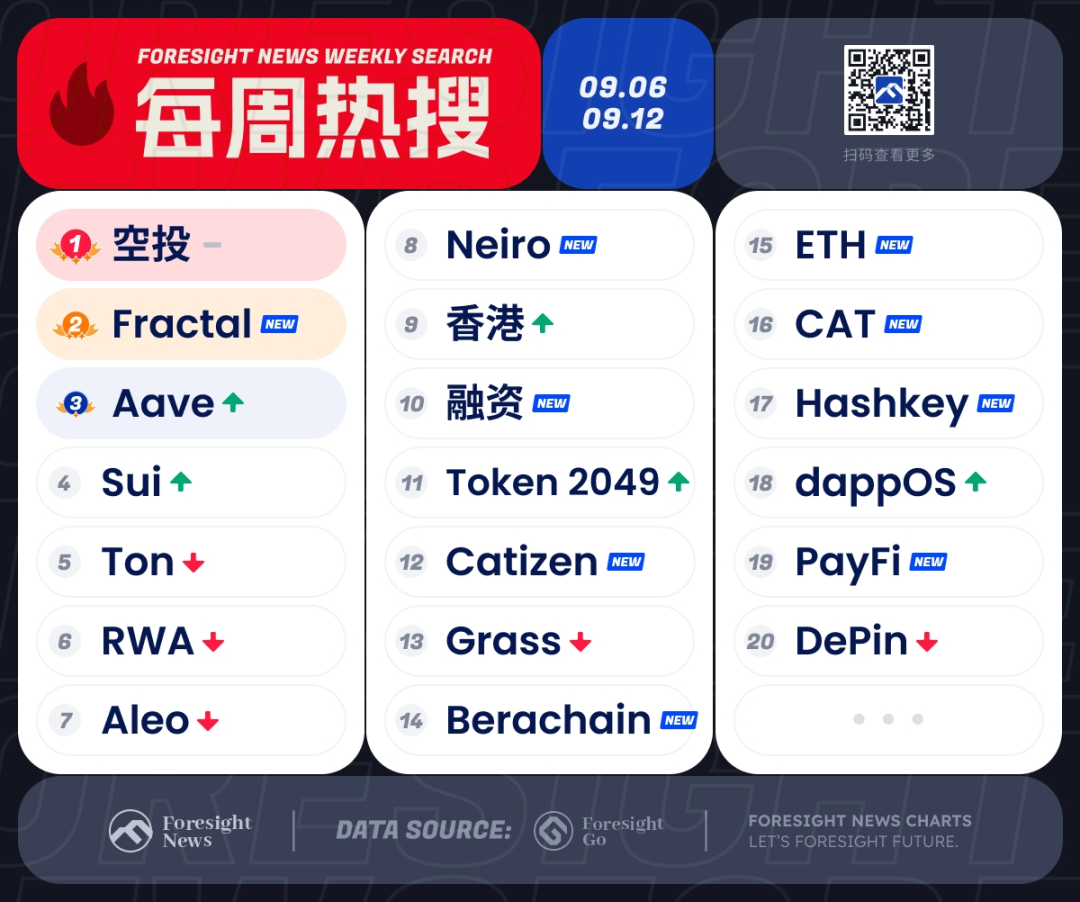
注:「每周热搜」统计自 Foresight News 上周五至本周四(9 月 6 日至 9 月 12 日)的用户搜索结果,同时对相同概念的大小写进行了合并处理。


本周最火热的项目无疑是「Fractal」了。


9 月 8 日,比特币扩容方案 Fractal Bitcoin 公布代币经济模型,代币的 80% 分配给社区,20% 分配给团队和贡献者(有锁定期),代币的总供应量为 2.1 亿枚:供应总量的一半(50%)分配给工作量证明 (PoW) 挖矿;15% 的代币保留给生态系统金库;10% 的代币分配给社区赠款,生态系统金库和社区赠款的分配上限为每年总分配的 10%,持续 10 年;5% 的代币用于预售;15% 的代币分配给核心贡献者,预售和团队代币的解锁时间表从一开始就已经明确定义,根据条款规定,这些代币将于第 7 个月末开始解锁,并线性释放直至第 12 个月末;另外 5% 的代币目前保留给现在和未来的顾问,顾问的分配上限为每年总分配的 20%,分 5 年进行。


紧接着,9 月 9 日,Fractal Bitcoin 上线主网,提供社区激励同时通过 OP_CAT 进行网络治理,并在 9 月 10 日完成 Bootstrap 计划的奖励发放。


然而 Fractal 也遭遇了诸多质疑。mempool 的创始人表示 Fractal Bitcoin 克隆了 Bitcoin Core 的大量代码,然后抄袭了 Namecoin 和 Bcash。其技术白皮书中的大量高深用语实际上没有任何意义。并指出其 50 % 代币被预留。这批评是否合理?欢迎读者进一步研究。


本周另一热点是 「CAT」 20 协议,Fractal Bitcoin 官网界面已显示支持。协议该如何参与?推荐阅读:上车指南:三分钟速览 CAT Protocol (CAT Protocol 能打吗?上车必看,一文速通。)


「Sui」本周由于币价的强势上涨,热搜指数飙升,一起来看看其生态进展。


Sui 背后的开发商 Mysten Labs 于上周开放游戏掌机 SuiPlay0x1 预定。SuiPlay0x1 原生支持 「Sui」 生态游戏以及 Steam 和 Epic 游戏库,运行 Playtron OS(专为掌机设计的操作系统)。该设备每台价格为 599 美元(不含运费和税费),支持使用 SUI、ETH 和 SOL 代币购买,预计将于 2025 年交付。首批一千名预订 SuiPlay0x1 设备的客户将获得一个不可转让的灵魂绑定 NFT,该 NFT 将提供特别的访问权限、奖励和福利。推荐阅读:售价 599u,SuiPlay 游戏掌机值得买吗?


机构方面:灰度在社交媒体上发文表示,其 Sui 信托(Grayscale Sui Trust)已向寻求投资 SUI 的合格投资者开放


生态项目也在趁机行动!Sui 流动性协议 DeepBook 宣布已更新白皮书,新版本中初始社区空投占比 10%,核心贡献者和早期支持者占比 28.43%,剩余 61.57% 将分配至未来补助金、社区计划和社区倡议等社区活动。


交易所方面也在行动:币安宣布将于 9 月 18 日 18 时上线 SUI 币本位永续合约,最高支持 20 倍杠杆。


更多热词速递


  • 据知情人士称,「香港」正考虑让证券及期货事务监察委员会(SFC)参与监管场外(OTC)虚拟资产交易服务。目前 SFC 已就潜在的加密货币 OTC 服务新牌照制度征询业内意见,该制度将由 SFC 与海关共同监管这些公司。有关这两个许可证的讨论仍处于早期阶段,可能会发生变化。此前 2024 年 2 月公布的提案中,OTC 加密货币商店仅由海关监管。
  • 意图执行网络 「dappOS」 联合 「Berachain」将其意图执行网络拓展至 Berachain 生态,旨在向生态应用及用户提供应用意图交互、意图资产及意图交易等核心用例。
  • 「Ton」生态持续保持高热度。Telegram 氪金养成小游戏 「Catizen」 预计将于 9 月 20 日空投并上线交易所。
  • 特朗普宣布其加密货币项目 World Liberty Financial 将于 9 月 16 日正式上线。该项目旨在「拥抱加密货币的未来」,并「抛弃过时的大型银行」。项目将基于去中心化金融平台 「Aave」和以太坊区块链,并围绕「信用账户系统」进行,衍生品协议 Dolomite 联合创始人 Corey Caplan 被任命为项目顾问。
  • 「Solana」生态的「DePin」项目 Grass 在上周上线空投检查门户。本周依旧热度不减。「GRASS」 代币总供应量为 10 亿枚,10% 将用于首次空投。其中 1.5% 将分配给 Closed Alpha、7% 将分配给 Epochs 1 至 7、0.5% 将分配给 Bonus Epoch、1% 分配待定。


「Token 2049」即将召开,推荐阅读:9 月 Web3「跑会」指南。9 月 Web3 活动抢先看,重要峰会不容错过。


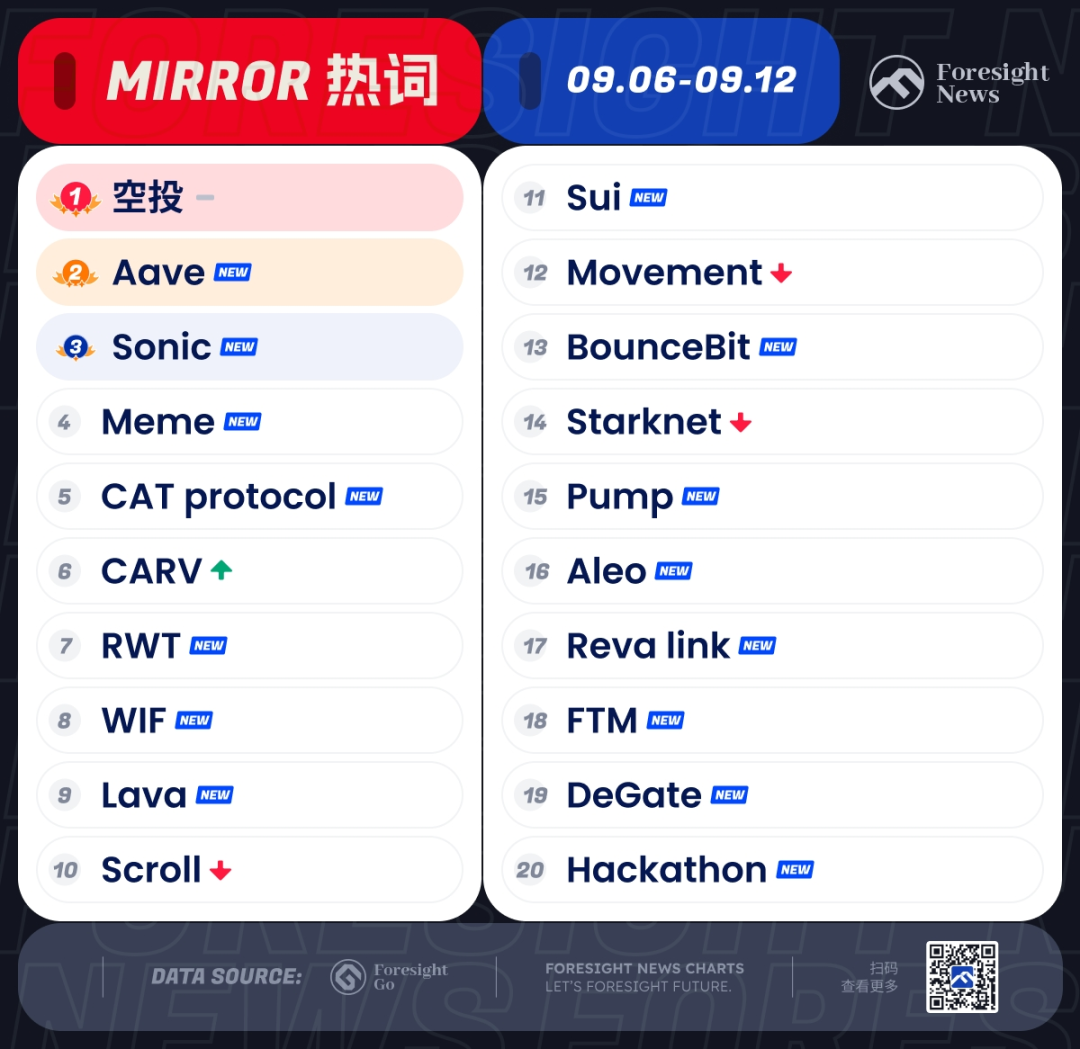
以下为本周 Mirror 热搜榜:


Related Reads

DeFi Has Reached Its Most Dangerous Moment: The Real Vulnerabilities Are Not in the Code

DeFi in Peril: The Real Vulnerability Isn't in the Code April 2026 marked a paradigm shift in DeFi security, with over $625 million lost across 30 incidents—the worst month in crypto history by event count. Crucially, none of the major exploits (Drift Protocol: $285M, KelpDAO: $292M, Wasabi Protocol: $4.5M) resulted from smart contract vulnerabilities. Instead, failures occurred in the operational "plumbing": social engineering to compromise multi-signature councils, a single-point-of-failure 1-of-1 bridge validator, and stolen admin private keys. These events expose a fundamental misalignment: the industry's security model has long focused on code audits, while the actual attack surface has shifted to privileged access points and off-chain infrastructure. The article introduces the term "OpenFi" to describe this reality: permissionless, on-chain, yet operationally dependent on trusted third parties (admins, validators, oracles) at key junctures. The KelpDAO exploit vividly demonstrated asymmetric "contagion risk." A configuration error in a smaller protocol triggered a panic, causing approximately $13.2 billion in outflows from larger, unaffected protocols like Aave within 48 hours, as users fled uncertain collateral. The core dilemma is the double-edged sword of centralization. Operational levers like emergency councils (e.g., Arbitrum freezing stolen funds post-KelpDAO) enable crisis response but also create catastrophic attack surfaces if compromised (e.g., Drift). The path forward demands radical honesty: protocols must clearly disclose their trust assumptions, operational levers, and failure modes. The industry must treat operational security (key management, configurations, incident response) with the same rigor as code security. Survival depends on building systems whose risks can be understood, priced, and insured, moving beyond the outdated "code is law" mantra to a mature model of disclosed and managed trust.

链捕手3h ago

DeFi Has Reached Its Most Dangerous Moment: The Real Vulnerabilities Are Not in the Code

链捕手3h ago

Vitalik's Article Emphasizes Ethereum Must Be 'Amazing', But Foundation Is Not the Center

Vitalik Buterin has published a lengthy response to recent community criticism directed at the Ethereum Foundation (EF). Acknowledging a sense of "unease," he addresses concerns about the EF's strategic direction, its perceived disconnect from ETH's price performance, and calls for its reduced central role. Vitalik rejects the notion that the EF should be the central governing body of Ethereum, framing it instead as one "node with a clear mandate" among many within the ecosystem. He highlights the EF's limited ETH holdings (≈0.16% of supply) compared to other blockchain foundations and states it will no longer sell significant amounts of ETH. Its future focus will be on long-term, critical projects that align with Ethereum's core values of censorship-resistance and decentralization, which might not otherwise happen. A core argument is that Ethereum must be "amazing," but not by merely chasing higher transaction speeds at the cost of decentralization. He proposes focusing on the "CROPS" dimensions: creating a Cryptographically provable, Reliable, Open, Private, and Secure network. This includes pursuing goals like a formally verifiable, bug-free Ethereum client and minimizing protocol-level reliance on intermediaries. The article concludes by noting that while Vitalik clarifies the EF's refocused role, he does not directly address community suggestions for creating a new organization explicitly aligned with ETH's economic interests. This "alignment gap" is presented as a key challenge for Ethereum's future.

链捕手3h ago

Vitalik's Article Emphasizes Ethereum Must Be 'Amazing', But Foundation Is Not the Center

链捕手3h ago

Galxe: How a Quest Platform Evolved into Web3's Growth Infrastructure

Galxe, once perceived as a simple Web3 quest platform, has evolved into a core growth infrastructure within the Web3 ecosystem. It addresses a fundamental Web3 growth dilemma: the lack of a mature, systematic user acquisition and retention system akin to Web2's advertising and analytics platforms. While users complete quests (social tasks, on-chain interactions) for rewards, Galxe's true innovation lies in transforming these fragmented, one-off actions into lasting, verifiable identity credentials. This process of *behavioral assetization* creates a persistent record of a user's activities across projects and chains. For users, their wallet accumulates a valuable history that can unlock future access and rewards, fostering a "profile-building" mentality. For projects, Galxe provides a pre-screened user pool with rich behavioral data, enabling targeted outreach to users based on their specific on-chain history and community engagement. Galxe employs a gamefied growth path, guiding users from low-friction social tasks into deeper, valuable on-chain interactions through a structured progression of quests. This solves the incentive-behavior mismatch common in Web3, filtering users by their willingness to engage. Beyond quests, products like Passport (identity verification) and Starboard (community analytics) position Galxe as a comprehensive growth operating system. The platform's defensible advantage is its self-reinforcing data and network flywheel: more projects attract more users, enriching behavioral data; richer data enables better user targeting, attracting more projects. Ultimately, Galxe is shifting Web3's growth logic from short-term "reward-driven" traffic towards a long-term "identity-driven" relationship model, where a user's accumulated on-chain履历 becomes a core asset.

marsbit3h ago

Galxe: How a Quest Platform Evolved into Web3's Growth Infrastructure

marsbit3h ago

Trading

Spot
Futures

Hot Articles

What is TRUMP CAT

Trump Cat Family, $Trump Cat: An Unraveled Mystery Introduction In the constantly evolving landscape of crypto projects and web3 innovations, a curious phenomenon has emerged—one that appears to straddle the line between cryptocurrency and internet meme culture. This is the enigmatic “Trump Cat Family”, also referred to as “$Trump Cat”. Though it might arouse curiosity among crypto enthusiasts, the reality appears far removed from the standard definition of a crypto project. This article aims to explore the concept of Trump Cat Family, bringing to light the context surrounding it and clarifying its status in the crypto realm. What is Trump Cat Family, $Trump Cat? At first glance, one might think that “Trump Cat Family” refers to a legitimate cryptocurrency or web3 project. However, upon deeper investigation, it becomes evident that the term lacks the trappings of a traditional crypto venture. Instead, “Trump Cat” seems to be predominantly associated with the viral meme culture that surged following controversial statements made by former U.S. President Donald Trump regarding Haitian immigrants. The media coverage sparked a myriad of memes, humorous interpretations, and a wave of social commentary. These memes depict various forms of satire centred on Trump's dialogue, often utilising cats in comedic and sometimes absurd scenarios. Rather than a structured project aimed at addressing technological advancements or financial transactions, the “Trump Cat Family” concept exists predominantly in the realm of internet humour. Who is the Creator of Trump Cat Family, $Trump Cat? In the investigation of who stands behind the “Trump Cat Family,” it becomes apparent that there exists no identifiable creator or founding figure. The phenomenon seems to have originated from collective internet expression, rather than from a singular visionary with a defined project goal. This anonymity further emphasises its status as a meme rather than a structured initiative akin to most known crypto projects. Who are the Investors of Trump Cat Family, $Trump Cat? Given that “Trump Cat Family” does not conform to the characteristics of a reputable crypto project, the question of investment becomes moot. There have been no established foundations or organisations expressing support for a project by this name. Instead, what exists are individual contributors to meme culture—hobbyists, artists, and social media users who collectively populate the internet with their interpretations and humour surrounding the term “Trump Cat.” This organic growth within digital human communication reflects more of a social commentary than a financial investment landscape. How Does Trump Cat Family, $Trump Cat Work? If one seeks to establish how “Trump Cat Family” operates, the answer is vastly different from what might be expected of standard crypto projects. There are no operational mechanisms, technological innovations, or unique features inherent to this phenomenon. Instead, it exists through viral spread online, relying upon social media platforms for proliferation. The “how” lies in the realm of culture and communication—its essence derived from the dynamics of social interaction rather than from established crypto protocols or blockchain functionalities. What makes “Trump Cat” unique, if anything, is the way it dramatizes a political dialogue through humour. People utilise engaging visuals, inside jokes, and inventive storytelling to convey sentiments regarding political figures and societal issues. The power of memes transcends traditional communication, encapsulating complex thoughts in a form that resonates widely, yet remains elusive in terms of quantifiable success or structured goals. Timeline of Trump Cat Family, $Trump Cat September 2024: The discourse surrounding Donald Trump's comments about Haitian immigrants allegedly consuming pets gains traction online, leading to a blossoming of memes and parodic interpretations across various platforms. Continuing Impact: Following this period, the “Trump Cat” phenomenon sees continued life as social media users leverage humour to address, critique, or simply celebrate the absurdity of political conversations and events. It is essential to note that as “Trump Cat Family” lacks the formal structure of a traditional project, the timeline consists primarily of anecdotal observation rather than remarkable milestones commonly found in recognised crypto ventures. Key Points Meme Culture: Rather than a structured crypto initiative, “Trump Cat” aligns more with the evolving landscape of internet memes. Origin of the Term: The genesis of “Trump Cat” relates directly to commentary on President Trump's remarks about Haitian immigrants, sparking widespread humorous representation. Absence of a Project Framework: The term fails to align with any defined project objectives, creators, or investors, marking it as a novel cultural experience rather than a crypto project. Conclusion In summary, the investigation into “Trump Cat Family, $Trump Cat” reveals a phenomenon entrenched in internet meme culture rather than a recognised project within the cryptocurrency or web3 sectors. The virality surrounding the term is birthed from collective user engagement, reflective of modern digital discourse rather than a formalised initiative with structure or strategic foresight. For all the curiosity it may invoke among those seeking the next big crypto project, “Trump Cat Family” serves as a testament to humanity's creativity, humour, and often absurd relationship with politics in the digital age.

255 Total ViewsPublished 2025.01.22Updated 2025.01.22
What is TRUMP CAT

Discussions

Welcome to the HTX Community. Here, you can stay informed about the latest platform developments and gain access to professional market insights. Users' opinions on the price of CAT (CAT) are presented below.

活动图片