灰度8月报告:ETH跑输大盘,比特币今年有望重测历史前高

Odaily星球日报Published on 2024-09-05Last updated on 2024-09-05

Abstract

投资者应密切关注9月6日发布的月度就业报告及劳动力市场数据。

原文来自 Grayscale Research

编译 | Odaily星球日报 Golem(@web3_golem

灰度8月报告:ETH跑输大盘,比特币今年有望重测历史前高

总结:

  • 2024 年 8 月,加密货币估值回落,与此同时,金融市场波动性出现短暂飙升。比特币跑赢整体加密市场,而以太坊跑输整体加密市场。

  • 美联储主席鲍威尔暗示降息即将到来,这可能会支持比特币以及其他与美元竞争的资产(例如实物黄金)。

  • 以太坊的扩容策略可能会让一些投资者对其长期前景产生不确定性,尽管其 L2 上的活动显著增加。

  • 8 月份,稳定币市值上升,一些关键协议也进行了升级,同时围绕数字隐私的讨论日益激烈。

8 月内市场大幅波动,美元疲软和利率下降会对比特币产生利好

2024 年 8 月,全球股市整体变化不大,但月内有大幅波动。在 8 月 2 日发布的就业报告弱于预期之后,许多风险资产价格下跌,股票波动性飙升,芝加哥期权交易所波动率 (VIX) 指数一度超过 65% 。不过,随后的经济数据并未显示出进一步的危险迹象,许多市场板块出现反弹,VIX 指数迅速回落至 20% 以下。

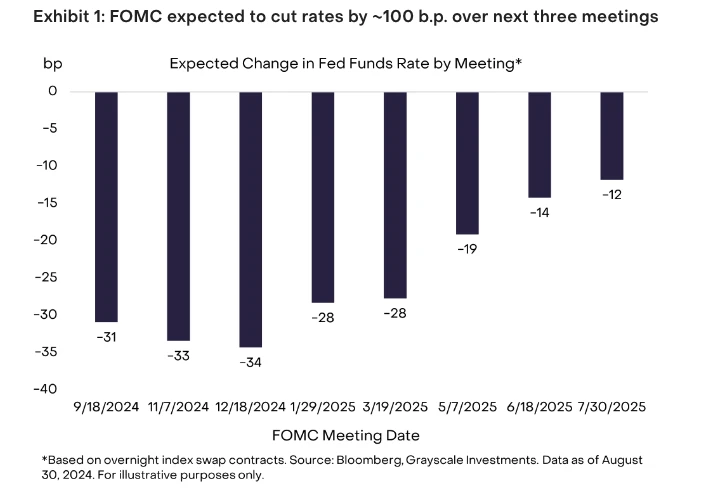
与此同时,劳动力市场状况走软的消息可能影响了美联储决策者的观点。美联储主席鲍威尔在 8 月 23 日杰克逊霍尔年度会议上的讲话中表示,“降息时机已到”,这在一定程度上反映了“就业下行风险加大”的事实。利率期货目前显示,央行将在今年剩余的三次联邦公开市场委员会(FOMC)会议上将政策利率降低 100 个基点。
灰度8月报告:ETH跑输大盘,比特币今年有望重测历史前高

图 1 :预计 FOMC 将在未来三次会议上降息约 100 个基点

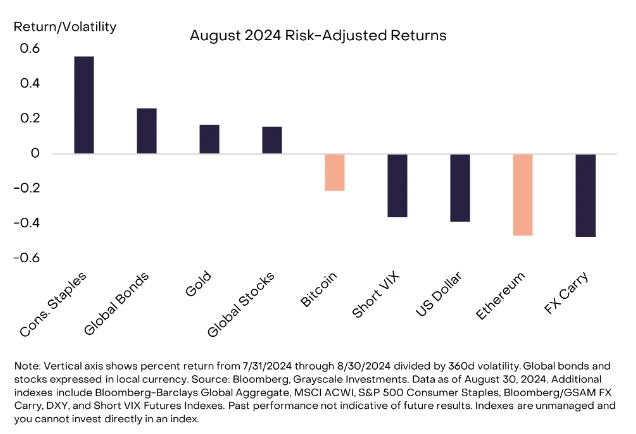
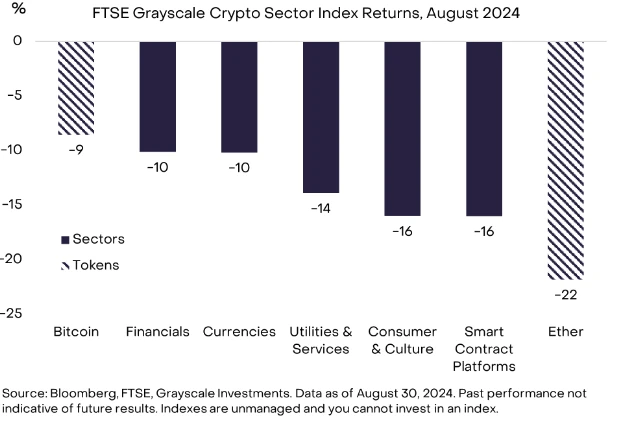
综上所述,短暂的波动和即将降息的信号在市场上留下了一些变化(见图 2)。处于风暴中心的一些策略的回报大幅下降(包括短期波动率策略和外汇套息交易),美元对主要货币走软,同时黄金价格上涨,而高质量债券和消费必需品类股票等防御性资产表现优异。比特币小幅下跌(-8.5% ),而以太坊下跌幅度较大(-21.8% ),是风险调整后表现不佳的资产之一(下文将进一步讨论)。
灰度8月报告:ETH跑输大盘,比特币今年有望重测历史前高

图 2 :以太坊在 8 月回调期间表现不佳

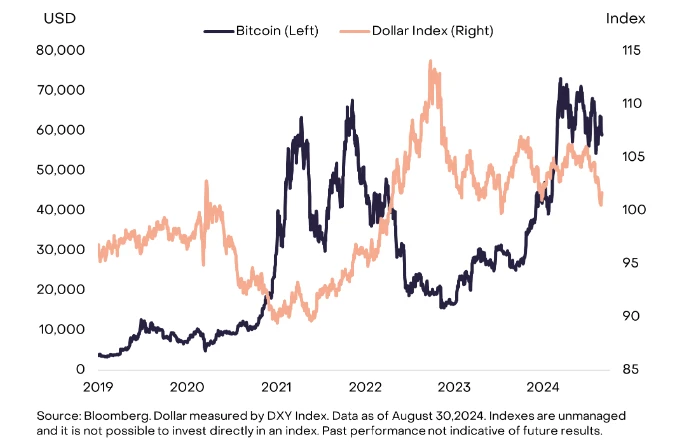
我们认为,如果美元疲软和利率下降持续下去,应该会对比特币产生利好。与实物黄金一样,比特币是一种在国际市场上与美元竞争的替代货币系统。美国利率下降会削弱美元的竞争优势,并可能使与美元竞争的资产受益,包括其他法定货币、实物黄金和比特币。在过去几年中,随着数字资产与主流金融市场的融合程度越来越高,比特币与实际利率水平和美元价值都呈负相关(图 3)。因此,那些担心美元疲软对其投资组合产生影响的人可能会考虑将资金配置到比特币上以实现多元化。
灰度8月报告:ETH跑输大盘,比特币今年有望重测历史前高

图 3 :比特币与美元价值呈负相关

对以太坊的悲观情绪短期无法转变

如上所述,以太坊在 8 月初出现显著下跌,且在月末未能出现显著反弹。我们认为,这在一定程度上反映了 CME 上市期货和永续期货的多头仓位。 2024 年 5 月,在美国证券交易委员会批准发行人提交的美国现货以太坊交易所交易产品 (ETP) 19 b-4 申请前后,交易员大幅增加了永续期货的总持仓和 CME 期货的净持仓,或许是因为判断以太坊在获得监管部门的全面批准后价格会进一步上涨;该批准于 2024 年 7 月获得,美国现货以太坊 ETP 随后不久开始交易。我们认为投机性持仓的过剩导致以太坊价格大幅回落,并限制了此后的价格回升。

更根本的是,以太坊网络正在经历重大转型,这可能会让一些投资者对其未来产生不确定性。如我们在之前的文章中探讨的那样,以太坊计划通过将更多交易转移到L2网络来实现更大的扩展,这些 Layer 2 网络将定期结算到 Layer 1 主网。

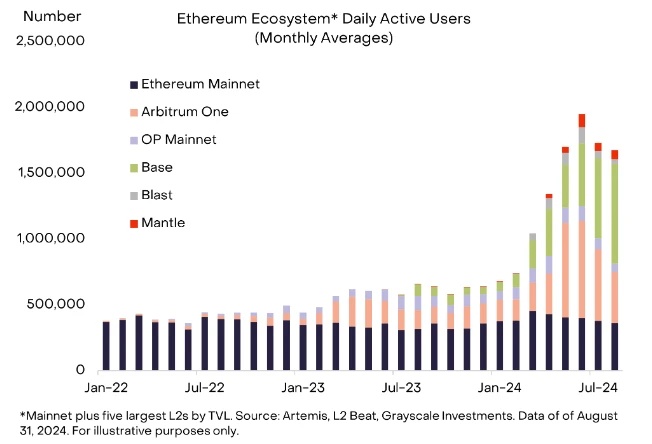
这个策略正在奏效:今年以太坊L2蓬勃发展(图 4),索尼等大公司已宣布在以太坊中建设项目。然而,这也导致第主网的费用收入降低,进一步又对 ETH 的价值产生潜在影响。此外,这种不确定性可能导致 7 月推出的现货以太坊 ETP 的净流入量相对较低。Grayscale Research 认为,以太坊的扩容策略正在发生有效作用,当前市场对以太坊的悲观情绪是没有根据的,但市场共识的转变可能需要一些时间。
灰度8月报告:ETH跑输大盘,比特币今年有望重测历史前高

图 4 :以太坊扩容策略正在发挥作用

货币加密板块和金融加密板块仍有亮点表现

FTSE/Grayscale 加密货币行业指数系列在 8 月份也有所下降,但跌幅小于以太坊(图 5)。尽管市场整体遭遇挫折,但仍有一些值得注意的亮点,尤其是在货币加密板块和金融加密板块。
灰度8月报告:ETH跑输大盘,比特币今年有望重测历史前高

图 5 :比特币的表现优于大多数加密货币领域

货币加密板块的隐私保护资产 ZCash (ZEC) 在 8 月中旬上涨了 29.5% ,然后在当月晚些时候回落。8 月初,ZCash 的创始人加入了 Shielded Labs,开发了一种“Crosslink”混合共识机制。从历史上看,这是一个工作量证明协议,这次升级将添加权益证明作为最终确定性层,旨在增强网络安全性并允许 ZEC 持有者进行质押。这一举措获得了大量支持,包括以太坊创始人 Vitalik Buterin 等人的捐款。 此外,第二次 ZEC 减半事件定于今年 11 月晚些时候举行,进一步激发了投资者的兴趣。

Aave 协议是金融加密板块的另一个亮点。该协议的每周活跃借款人数量创下历史新高,其治理代币 AAVE 上涨了 21% 。与此同时,Aave 社区提出的一项新提案将部署一种“buy and distribute”模式,利用 Aave 的超额收入从市场上购买 AAVE 代币并将其分发给质押者——类似于 Maker 协议使用的智能销毁引擎。该提案预计将于 2024 年底上线,但仍需社区批准。

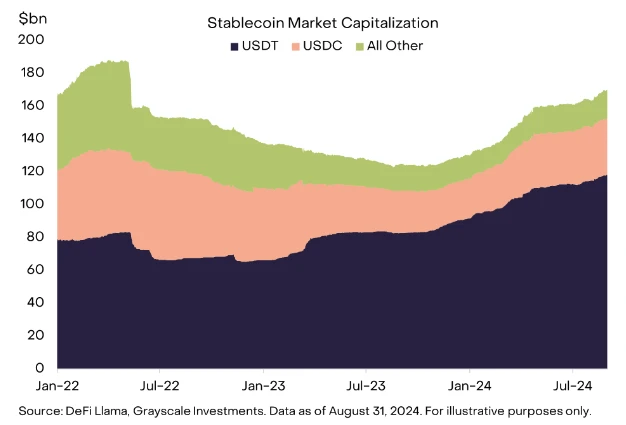
稳定币市值在 8 月份再次上涨,目前正接近之前的历史最高水平(图 6)。重要的是,苹果的软件更新可能会为市场带来更多稳定币支付的采用。 Circle 首席执行官 Jeremy Allaire 表示,由于苹果决定向第三方开发商开放近场通信支付功能,Circle 的 USDC 稳定币即将在 iPhone 上实现“轻触支付”。此功能独立于 Apple Pay,不涉及 Circle 和 Apple 之间的直接关系,但它可以通过 FaceID 确认和区块链结算实现 USDC 交易。此外,拉美电商平台Mercado Libre宣布创建其自己的美元挂钩稳定币,而稳定币发行商 Tether 则表示将创建与阿联酋迪拉姆挂钩的代币

灰度8月报告:ETH跑输大盘,比特币今年有望重测历史前高

图 6 :稳定币市值上升

最后,在 Telegram 创始人 Pavel Durov 在法国被捕后,人们越来越关注区块链技术与数字隐私之间的潜在联系。法国当局表示,这些指控与“未能减少”加密消息应用程序在非法活动上的滥用”有关。TON 在消息传出后下跌了 20% 以上,随后几天略有回升。

展望:抛压结束、基本面改善,比特币有望新高

自第一季度以来,比特币的价格一直保持在相当窄的区间内,因为一方面虽然加密货币市场受益于积极的基本面消息,但另一方面也受到一些抛售压力的影响。Grayscale Research 认为,来自德国政府、Mt Gox 遗产等的抛售压力基本已经过去,基本面的改善影响应该会逐渐显现出来。如果美国劳动力市场保持稳定,美联储降息和围绕加密行业的美国政策变化可能会让比特币价格在今年晚些时候重新尝试突破前高。

们认为,加密估值的主要下行风险是失业率进一步上升和可能的经济衰退。因此,投资者应密切关注即将发布的劳动力市场数据,包括定于 9 月 6 日发布的下一个月度就业报告。然而,即使出现衰退风险,Grayscale Research 仍认为市场对深度经济衰退的容忍度很低,我们认为政策制定者有动机在出现经济问题的初期通过印钞和支出进行应对。货币和财政政策的这种不受约束的做法是一些投资者选择投资比特币的原因之一;因此,经济疲软的时期可能会进一步加强比特币的长期价值投资逻辑。


Related Reads

Is MicroStrategy Selling Bitcoin Not a Bearish Signal? Deconstructing the 5 Financial Logics Behind Corporate Bitcoin Divestment

The article "Is Strategy Selling Bitcoin Not a Bearish Signal? Decoding 5 Financial Logics Behind Corporate Bitcoin Divestment" analyzes why companies might sell their bitcoin holdings, arguing it's not necessarily negative. It begins by noting the market's surprise at Strategy's potential sale, contrasting its previous "never sell" stance. The core argument is that corporate decisions prioritize shareholder value, and selling bitcoin can be a rational strategic choice. The article outlines five key financial reasons for such sales: 1. **Increase Bitcoin Holdings Per Share:** Companies can use proceeds from bitcoin sales to repurchase shares when the stock price is undervalued relative to its bitcoin assets. This reduces the outstanding share count, potentially increasing the bitcoin amount backing each remaining share. 2. **Optimize Capital Structure & Reduce Financing Costs:** Building cash reserves through bitcoin sales can improve credit ratings (as favored by agencies like S&P), leading to lower future borrowing costs. Repaying debt with sale proceeds also reduces financial leverage. 3. **Legitimate Tax Planning:** In the absence of wash-sale rules for bitcoin in the US, companies can sell to realize capital losses, then repurchase, lowering the tax basis of their holdings and creating tax offsets. 4. **Counter Negative Market Narratives:** A controlled, non-disruptive sale could demonstrate market resilience and disprove fears that corporate selling would crash the market, thereby normalizing bitcoin as a corporate treasury asset. 5. **Repurchase Preferred Stock at a Discount:** If a company's preferred stock trades significantly below its face value, using bitcoin sale proceeds to repurchase it can retire expensive liabilities at a profit, saving on future dividend payments. The conclusion emphasizes that bitcoin's monetary properties offer flexibility. Strategic sales can protect corporate and shareholder interests, making asset utilization more important than rigid "hold" mandates.

marsbit8m ago

Is MicroStrategy Selling Bitcoin Not a Bearish Signal? Deconstructing the 5 Financial Logics Behind Corporate Bitcoin Divestment

marsbit8m ago

Why Did Zhipu Surge Nearly 30% in a Single Day?

"Global AI Model Unicorn" Zhipu's stock surged nearly 30% in a single day, reaching a new market cap high. The catalyst was the launch of its GLM-5.1-highspeed API, boasting a generation speed of **400 tokens per second**, setting a new global benchmark. This speed, roughly 3-5 times faster than industry leaders like OpenAI's GPT-4o and Anthropic's Claude, is achieved **without compromising the full-scale model's capabilities**. In the era of AI Agents requiring dozens of self-calls, such latency reduction is critical, transforming speed from a system metric into a determinant of intelligence limits. The breakthrough stems from a three-layer technical overhaul: 1. **TileRT Inference Engine**: Compiles the entire model into a continuous, always-on computation pipeline using "Warp Specialization," minimizing GPU idle time by having different processor groups handle data loading, computation, and communication in parallel. 2. **Heterogeneous Parallelism for MLA**: To efficiently run the GLM-5.1 model using the MLA attention mechanism, TileRT employs a heterogeneous strategy. One GPU handles sparse indexing/routing, while the others perform dense computation, optimizing for MLA's unique workflow. 3. **ZCube Network Architecture**: Replaces the standard Spine-Leaf (ROFT) network topology with a flat, dual-group interconnect. This design creates a single optimal path between any two GPUs, eliminating network congestion at scale and reducing latency. The business impact is significant: a 15% increase in cluster throughput (free extra capacity), a 40.6% reduction in tail latency (improved stability), and a one-third cut in networking hardware costs. Long-term, this innovation challenges the dominance of NVIDIA's integrated hardware-software stack (GPU+NVLink+InfiniBand), potentially benefiting manufacturers of high-density Leaf switches and optical modules while lowering the software barrier for domestic AI chips like Huawei's Ascend. The innovation proves that more can be achieved with the same compute, reshaping the infrastructure beyond just GPUs.

marsbit1h ago

Why Did Zhipu Surge Nearly 30% in a Single Day?

marsbit1h ago

Bidding Farewell to the 'Gray Gambling Game'! Polymarket Charges into the Compliance Track—How Will This Impact the Entire Crypto Industry?

From Gray to Regulated: How Polymarket’s Compliance Journey Reshapes Crypto The evolution of Polymarket, a decentralized prediction market platform, illustrates a critical trend in crypto: innovative, high-value sectors ultimately integrate into regulatory frameworks. Founded in 2020, Polymarket quickly gained traction by leveraging low-cost Layer 2 blockchain technology for event-based trading, notably during the 2024 US presidential election where its markets outperformed traditional polls. However, its "build first, comply later" approach led to a 2022 CFTC enforcement action, resulting in a $1.4 million fine and a ban from the US market. A pivotal shift occurred in 2025 under a new US administration. Polymarket strategically acquired CFTC-licensed derivatives exchange QCX for $112 million, securing a regulated pathway back into the US. This move coincided with a regulatory reversal, as the CFTC withdrew a prior proposal to ban political event contracts. The platform’s successful "regulatory acquisition" strategy, avoiding a lengthy independent licensing process, highlights a viable compliance path for crypto-native projects. Its journey from regulatory target to a CFTC-recognized entity—bolstered by a major data partnership and investment from Intercontinental Exchange (ICE)—signals the maturation of prediction markets from a "crypto novelty" into acknowledged financial infrastructure. The story underscores that genuine utility provides negotiating power with regulators and that embracing compliance does not necessarily mean sacrificing core technological advantages.

marsbit1h ago

Bidding Farewell to the 'Gray Gambling Game'! Polymarket Charges into the Compliance Track—How Will This Impact the Entire Crypto Industry?

marsbit1h ago

Trading

Spot
Futures

Hot Articles

What is $BITCOIN

DIGITAL GOLD ($BITCOIN): A Comprehensive Analysis Introduction to DIGITAL GOLD ($BITCOIN) DIGITAL GOLD ($BITCOIN) is a blockchain-based project operating on the Solana network, which aims to combine the characteristics of traditional precious metals with the innovation of decentralized technologies. While it shares a name with Bitcoin, often referred to as “digital gold” due to its perception as a store of value, DIGITAL GOLD is a separate token designed to create a unique ecosystem within the Web3 landscape. Its goal is to position itself as a viable alternative digital asset, although specifics regarding its applications and functionalities are still developing. What is DIGITAL GOLD ($BITCOIN)? DIGITAL GOLD ($BITCOIN) is a cryptocurrency token explicitly designed for use on the Solana blockchain. In contrast to Bitcoin, which provides a widely recognized value storage role, this token appears to focus on broader applications and characteristics. Notable aspects include: Blockchain Infrastructure: The token is built on the Solana blockchain, known for its capacity to handle high-speed and low-cost transactions. Supply Dynamics: DIGITAL GOLD has a maximum supply capped at 100 quadrillion tokens (100P $BITCOIN), although details regarding its circulating supply are currently undisclosed. Utility: While precise functionalities are not explicitly outlined, there are indications that the token could be utilized for various applications, potentially involving decentralized applications (dApps) or asset tokenization strategies. Who is the Creator of DIGITAL GOLD ($BITCOIN)? At present, the identity of the creators and development team behind DIGITAL GOLD ($BITCOIN) remains unknown. This situation is typical among many innovative projects within the blockchain space, particularly those aligning with decentralized finance and meme coin phenomena. While such anonymity may foster a community-driven culture, it intensifies concerns about governance and accountability. Who are the Investors of DIGITAL GOLD ($BITCOIN)? The available information indicates that DIGITAL GOLD ($BITCOIN) does not have any known institutional backers or prominent venture capital investments. The project seems to operate on a peer-to-peer model focused on community support and adoption rather than traditional funding routes. Its activity and liquidity are primarily situated on decentralized exchanges (DEXs), such as PumpSwap, rather than established centralized trading platforms, further highlighting its grassroots approach. How DIGITAL GOLD ($BITCOIN) Works The operational mechanics of DIGITAL GOLD ($BITCOIN) can be elaborated on based on its blockchain design and network attributes: Consensus Mechanism: By leveraging Solana’s unique proof-of-history (PoH) combined with a proof-of-stake (PoS) model, the project ensures efficient transaction validation contributing to the network's high performance. Tokenomics: While specific deflationary mechanisms have not been extensively detailed, the vast maximum token supply implies that it may cater to microtransactions or niche use cases that are still to be defined. Interoperability: There exists the potential for integration with Solana’s broader ecosystem, including various decentralized finance (DeFi) platforms. However, the details regarding specific integrations remain unspecified. Timeline of Key Events Here is a timeline that highlights significant milestones concerning DIGITAL GOLD ($BITCOIN): 2023: The initial deployment of the token occurs on the Solana blockchain, marked by its contract address. 2024: DIGITAL GOLD gains visibility as it becomes available for trading on decentralized exchanges like PumpSwap, allowing users to trade it against SOL. 2025: The project witnesses sporadic trading activity and potential interest in community-led engagements, although no noteworthy partnerships or technical advancements have been documented as of yet. Critical Analysis Strengths Scalability: The underlying Solana infrastructure supports high transaction volumes, which could enhance the utility of $BITCOIN in various transaction scenarios. Accessibility: The potential low trading price per token could attract retail investors, facilitating wider participation due to fractional ownership opportunities. Risks Lack of Transparency: The absence of publicly known backers, developers, or an audit process may yield skepticism regarding the project's sustainability and trustworthiness. Market Volatility: The trading activity is heavily reliant on speculative behavior, which can result in significant price volatility and uncertainty for investors. Conclusion DIGITAL GOLD ($BITCOIN) emerges as an intriguing yet ambiguous project within the rapidly evolving Solana ecosystem. While it attempts to leverage the “digital gold” narrative, its departure from Bitcoin's established role as a store of value underscores the need for a clearer differentiation of its intended utility and governance structure. Future acceptance and adoption will likely depend on addressing the current opacity and defining its operational and economic strategies more explicitly. Note: This report encompasses synthesised information available as of October 2023, and developments may have transpired beyond the research period.

363 Total ViewsPublished 2025.05.13Updated 2025.05.13

What is $BITCOIN

Discussions

Welcome to the HTX Community. Here, you can stay informed about the latest platform developments and gain access to professional market insights. Users' opinions on the price of BTC (BTC) are presented below.

活动图片