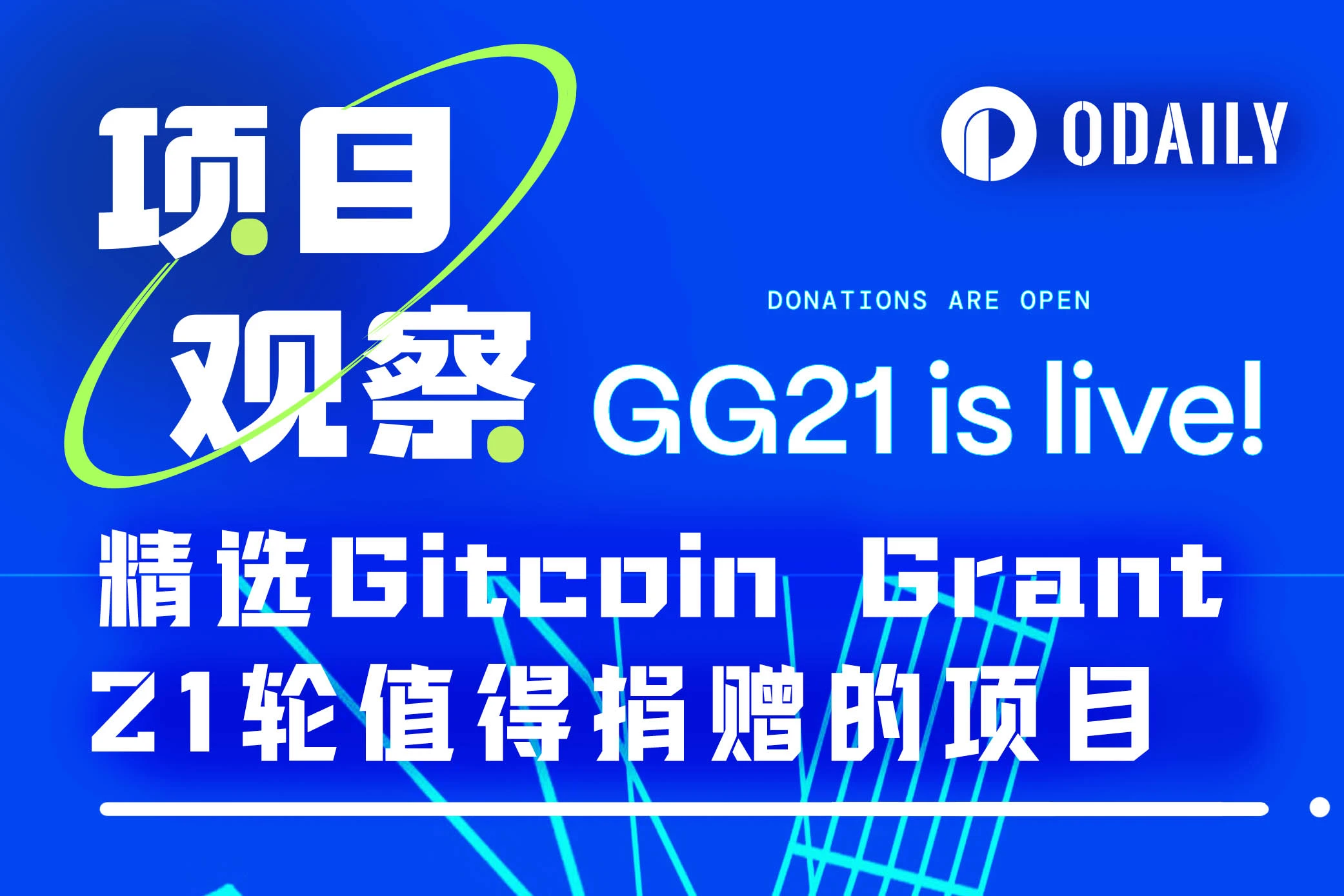
精选Gitcoin Grant 21轮值得捐赠的项目

Odaily星球日报Published on 2024-08-14Last updated on 2024-08-14

Abstract

老玩家与新概念再次集合。

原创|Odaily星球日报(@OdailyChina

作者|CryptoLeo

精选Gitcoin Grant 21轮值得捐赠的项目

Gitcoin 捐赠又开始了,本轮(Gitcoin Grants Round 21)为 Gitcoin 的第 21 轮捐款,Gitcoin Grants Round 21 (GG 21)是专注于生态系统和社区驱动的轮次。主题是协作、新的治理流程和外部伙伴关系。共分为 9 个社区轮次,主要集中在 Arbitrum 链,其中最早的捐赠截止日期为 8 月 21 日 19 : 00 (北京时间)。

关于 Gitcoin Grant 简介和操作就不进行过多文字讲解,大家可以在以往的 Gitcoin Grant 捐赠相关内容中(如 Gitcoin Grants 20 轮极简攻略)找到。本文Odaily星球日报按生态与场景挑选出 GG 21 中值得捐款的 29 个项目。

GG 21 :蓬勃发展的 Arbitrum Summer(Arbitrum 链) 

本版块旨在支持增强 Arbitrum 生态的增长和发展,匹配池金额为 150, 000 ARB,共 65 个项目,以下为推荐的捐赠项目:

NiceNode

NiceNode 是一个开源节点运营平台,用户不需任何技术知识就可在计算机上立即设置一个节点。相比其它节点提供商,NiceNode 主打操作简单、灵活,由 Ethereum Foundation、  Gitcoin Grants、CityDAO、EthStaker 支持。

Revoke.cash

Revoke.cash 是近几轮 Gitcoin 捐赠的常驻项目了,用来保护钱包与应用的代币授权工具,可管理用户钱包代币批准并进行钱包授权清理,定期撤销应用授权可以增加钱包的安全性。

Umbra

Unmbra 是一个隐私转账工具,通过注册一个中转站来接受和提取加密货币,可以进行单笔转账也可以批量转账,对于撸毛人很友好,基本不会增加钱包的关联度(避免钱包被集体女巫),目前支持 ETH 主网、Arbitrum、Optimism、Gnosis Chain、Polygon 和 Base 网络。

DefiLlama

DefiLlama 就不过多赘述了,大家常用的数据监测、查询平台,支持就完事了。

dm 3 protocol

dm 3 协议是 Web3 的消息传递协议,重点关注安全的端对端加密、去中心化、可扩展性和互操作性。dm 3 注册表基于 ENS,即 dm 3 配置文件作为文本记录添加到 ENS 名称中。也在近期获得了L1 公链 LUKSO 的 Wave 1 的资助。 

GiveStation

GiveStation 是一种多链捐赠赚取赠款协议,旨在为每个区块链项目做出贡献的用户提供代币奖励来激励 Web3 生态。项目方可申请项目捐赠,用户通过捐款为项目的创新、协作提供支持,可获得代币奖励。

ethdaily.eth

ETH Daily 是专注于以太坊的新闻聚合器,通过播客和时事通讯提供每日重要内容摘要,由 Elon Musk 旗下的社交应用聚合器 Firefly 提供支持。

Blockscout

Blockscout 是一款开源区块链浏览器,帮助用户在 EVM(以太坊虚拟机)区块链上实现深度搜索、与合约交互、验证合约等。目前支持 600 多个网络的链上交易信息查询,近期也完成了 300 万美元的种子轮融资,由1kx领投。

TurtleShell

TruleShell 是一个Web3安全工具,旨在通过引入链上防火墙来检测协议上的恶意活动并防止黑客攻击,发生异常活动时,TurtleShell 防火墙都会提供一系列保护措施,包括交易阻止、协议暂停、资金冻结或控制资金提取等手段。 

GG 21 :现实世界 Builder(Celo 链)

现实世界 Builder 计划支持团队研究区块链技术的用例,对金融惠普、生态信用、RWA、DePIN 等领域的物理社区和环境产生积极影响。匹配池金额为 75000 美元,共 37 个项目。以下为本轮推荐的捐赠项目: 

Glo Dollar

Glo Dollar 是一种由法定货币支持的稳定币,用于资助公共事业,其中包括扶贫、脱碳计划和 Web3 开源计划。用户无需捐款,仅链上购买 Glo 就可以资助公共事业。买入后流通的 Glo 通过转换为美元或者美国国债来赚取收益(链下投资),收益会再次作为 Glo 回归链上,用户可以用收益部分 Glo 选择支持的项目,捐赠页面会分享所有转账交易信息。 

Pretium

Pretium 是一个专注非洲加密的支付平台,使个人和企业能够在商户点进行支付,促进跨境支付,并使用加密资产结算其他公用事业支付,同时以当地货币为商家解决支付问题,目前在肯尼亚、乌干达、坦桑尼亚、加纳、尼日利亚和南非开展业务。

GG 21 :Asia Round(Optimism 链)

亚洲是加密大规模采用的重要地区,Asia Round 主要为亚洲创新者、建设者和项目提供必要的资金和资源。匹配池资金为 75000 DAI,共 68 个项目。以下为本轮推荐的捐赠项目: 

Zuzalu City

Zuzalu City 是一个Web3社区平台,Zuzalu 是起底于 Vitalik 的“明星”概念,该平台由 Ethereum Community Fund 提供支持。 

CoindPay

CoindPay 是一个多链 DEX,目前支持 26+ EVM、Solana、ICP 链,可支持跨链支付,并于 Coinbase Pay、Solana Pay 等合作,为其提供 KYC 技术,避免女巫攻击和恶意转账等,所有付款都会自动流入 Compound 和 Lido 等智能合约。

Nextme

Nextme 是一个支持 27+ EVM、Solana 链的跨平台的去中心化社交经济网络,主打创作者经济,类似于 Farcaster 集成了 PayPal 的 Venmo。目前该 App BETA 版已入驻 14 万+用户。

DeFiHackLabs 

DeFiHackLabs 是一个区块链安全研究社区,致力于完善链上安全生态和人才培养,主要针对智能合约安全、链上监控、用户资产安全、反洗钱、CTF、应急事件处理和救援行动。

Hey.xyz

Hey.xyz(原 Lenster) 是一个去中心化的、无权限的社交媒体应用,Hey.xyz 由 Lens Protocol 提供支持,Lens Protocol 是由 Aave 公司建立的去中心化的社交图谱。

MiniBridge

MiniBridge 是一个 0 费率的跨链应用,具有支持多链和快速确认等优点,由 Chaineye 团队开发。Chaineye 是 2023 年上海以太坊大会的获奖项目,获得了 Gitcoin、Optimism 和 Arbitrum 的资金支持。 

GG 21 :Public Good in The Metaverse(Arbitrum 链)

本轮次致力于开发基于开放标准的真正去中心化的 Metaverse,并通过可互操作、开放的 dApp 和体验来推动 Metaverse 成为公共产品。本轮次匹配池金额为 350000 ARB,共 5 个项目。推荐项目为: 

Pairwise

Pairwise 是一款开源的投票 Dapp,该平台通过Web2登录方式创建 AA 钱包,将钱包连接到他们现有的 OP 主网地址,该地址使用 ZK 证明保存他们的链上声誉,投票者通过 AA 钱包创建投票,通过 EAS 证明。 

GG 21 :气候解决方案轮(Arbitrum 链)

本轮次旨在资助全球范围内具有实际影响的气候解决方案项目,匹配池金额为 125000 USDGLO(此前提到的 Glo Dollar 稳定币),共 71 个项目,其中很多项目都是在前几轮捐赠中出现过的。推荐项目为:

GainForest

GainForest 是一个保护森林资源的非营利性组织,该项目将现有的 AI 算法用于检测物种和生物多样性上,通过基于去中心化物理基础设施网络(DePIN)的无人机来收集森林数据,并致力于构建世界上最大、最有价值的森林无人机图像数据集,改变我们对地球生物资源的理解并增强保护。此外,该项目会为这些森林数据收集者提供可持续收入。

Litter Token

Litter Token 是一个“边收垃圾边赚”应用,该项目 token LTK 用于支付用户收集垃圾的报酬,用户可以通过收集垃圾并拍照证明,便可在该项目 DC 上领取 LTK,LTK 会发送到用户的钱包,可以将其兑换为 USDC,且每次收集垃圾后该项目都会提供垃圾的开源图片用以证明用户行为。

Solar Foundation

Solar Foundation 也是一个去中心化太阳能解决方案,该项目旨在加速新兴市场中服务不足的社区获得离网太阳能,利用去中心化小型太阳能装置,提供可靠且价格合理的电力,同时降低二氧化碳排放来保护气候。 

GG 21 :OpenCivics 协作研究轮(Arbitrum 链)

OpenCivics 协作研究轮致力于为公共领域贡献关键研究,并与他人合作以直接授权给社区组织者的形式分享这些内容。匹配池金额为 42000 USDC,共 16 个项目。推荐项目为:

P2P Foundation

P2P Foundation 是一个研究P2P技术和基于公共设施的基础设施对社会各个领域的影响的网络,该平台可看作是Web3的维基百科,具有很多权威性和科普性内容与出版物,该平台也借鉴Web2机制产出很多 Web 3 领域的研究内容,包括加密治理和加密经济等主题(PS:孙哥关注了该平台 X 账号)。 

Stephen Reid

Stephen Reid 是一个跨学科技术专家,研究技术元现代主义,该申请主要是为 Stephen Reid 的课程研究提供支持,Reid 会邀请一些领域的专家共同探讨涉及到 AI、Web3、DAO、技术社区等方面的内容。

GG 21 :CollabTech 轮(Arbitrum 链)

本轮主要致力于链上组织、B2B SaaS 的发展和工作的未来,推进身份和声誉、治理和决策、运营、社区和贡献者工具的项目,匹配池金额为 30000 USDC,共 29 个项目。推荐项目为:

ZKT Network

ZKT Network 是一个去区块链合规基础设施,支持跨链的合规交易。通过 ZK 证明和一套开发人员工具,简化了将监管标准集成到区块链应用的过程,确保项目满足合规又不损害隐私或去中心化。

Meet with Wallet

Meet with Wallet 是一个Web3远程会议应用,该应用提供了Web2 的用户体验,同时秉承 web3 的去中心化和隐私性,类似于Web3中的 Calendly,该应用通过钱包连接,无需邮箱电话注册,本人会议只有在会议阶段是公开的,而其它会议前的时间里所有会议议程都是加密,仅本人可以查看。

RnDAO

RnDAO 是一个支持 Web3 协作软件初创企业的研发 DAO 和研究主导的风险投资生态,为早期项目提供研究支持并构建协作技术,例如组织工具、社区工具、DAO 运营和治理工具。

本轮 CollabTech 还有几个项目是由 RnDAO 提供支持的,例如 Meet with Wallet 等。

GG 21 :Web3赠款生态(Arbitrum 链)

本轮主要致力于推进在 Web3 赠款和新闻聚合类的优质项目,匹配池金额为 125000 ARB,共 57 个项目。推荐项目为:

welcomeonchain.eth

welcomeonchain 是一个Web3数据汇集平台,该平台汇集了行业相关科普版块、项目信息、KOL 简介和Web3技能的一些教程类内容。用户只需搜索相关信息即可获得自己想要的内容。目前该平台收集并维护 1500 个项目的信息,且具有社交属性,用户可以在任意版块下进行评论。

CharmVerse

CharmVerse 是面向开发者设计的链上赠款管理平台,项目可以发布提案,通过社区投票进行治理或者筹集资金等。此前 CharmVerse 完成了 380 万美元种子轮融资,Spartan Group、Cultur 3、Red Building Capital、Opensea Ventures、Alliance DAO、Orange DAO、Builder Capital、POAP Ventures 等参投。 

GG 21 :QuantumStake(Scroll) 

QuantumStake

本轮次以申请项目 QuantumStake 命名,匹配池金额为 100000 USDC,QuantumStake 是一个质押平台。据其官网介绍,QuantumStake 平台具先进技术集成、可扩展性、用户友好界面、社区驱动发展、智能合约审计等优势。 

结语

上述项目筛选通过项目背后支持、目前所获捐款金额与人数、社交平台数据和网站设计与完善度来完成的,很多项目并不是仅限某一轮次,而是参与了多个轮次的申请,项目推荐仅供参考,捐款还需 DYOR。

Related Reads

EF's Epic Reorganization: 20% Layoffs, Budget Halved, Is Ethereum Gearing Up for a Leaner Future?

The Ethereum Foundation (EF) has announced a major organizational restructuring, involving a 20% staff reduction (approx. 54 employees) and a division into functional clusters like Protocol, Access, User, Community, and Institutional layers. Co-founder Vitalik Buterin further revealed plans to cut the EF's budget by around 40% over the coming years, aiming to reduce its annual spending rate from about 15% to roughly 5% by 2030, transitioning to an endowment-driven model. This overhaul is seen as a long-overdue correction to the EF's ambiguous role. As Ethereum grew, the foundation faced persistent criticism over ETH sales, perceived lack of execution, and unclear strategy, often becoming a focal point for community frustration amid ETH's price stagnation. The reform aims to redefine the EF's boundaries, narrowing its focus to core protocol research, public goods funding, and ecosystem coordination, while offloading more applied development work to the broader market. Concurrently, ecosystem forces like the newly formed Ethlabs (founded by ex-EF researchers) and other independent groups are stepping in to fill the space, signaling a shift from a centralized model to a more distributed, collaborative ecosystem structure. The move was notably praised by Solana co-founder toly, who viewed a "leaner" EF as potentially more decisive and agile.

Odaily星球日报34m ago

EF's Epic Reorganization: 20% Layoffs, Budget Halved, Is Ethereum Gearing Up for a Leaner Future?

Odaily星球日报34m ago

Dragonfly Partner Haseeb: The Fastest-Growing Companies of the Future May All Get Stuck at 149 Employees

Dragonfly partner Haseeb explores the distorted economics of AI model pricing, drawing parallels to tax policy. He notes that startups and small teams (under 150 users) enjoy heavily subsidized, fixed-price AI subscriptions (like Claude Code), where the marginal cost of an additional token is effectively zero. This creates a powerful incentive for them to maximize token usage ("token-maxxing") and innovate aggressively with AI automation. In contrast, large enterprises (over 150 users) are forced onto "Enterprise" plans, paying per-token API fees with high (~75%) markups. This acts like a steep "tax" on AI-powered labor, disincentivizing marginal automation and experimental use, and encouraging them to retain more human workers. Haseeb argues this pricing creates a "150-person cliff," a regulatory notch similar to labor laws in France that discourage firms from growing past 50 employees. He predicts the fastest-growing future companies may deliberately cap their headcount at 149 to avoid the punitive enterprise pricing. This would foster an "AI-first" management philosophy obsessed with automation and outsourcing to stay lean. While not intentionally designed, this bifurcated pricing could become one of the most influential de facto tax policies, shaping how AI replaces labor—not through mass layoffs at big firms, but through agile, AI-native startups outcompeting them.

marsbit45m ago

Dragonfly Partner Haseeb: The Fastest-Growing Companies of the Future May All Get Stuck at 149 Employees

marsbit45m ago

How xBubble Breaks Through in the VC-Heavily-Backed OPC Economy

xBubble: Addressing the Structural Gap in the VC-Backed OPC Economy The concept of OPC (One Person Company) is evolving from a buzzword to a significant AI-driven market. While AI coding tools like Replit and Lovable have validated demand from non-technical users wanting to build applications, a key gap remains: the leap from creating a demo to running a stable, evolving business. These tools still require users to manage the development process, including technical judgments for integrations, modifications, and deployments—a major hurdle for OPCs. xBubble, by DAPPOS, tackles this by shifting from "Prompt-to-Code" to "SOP-to-Business." Instead of generating code from instructions, its core is a system of pre-organized SOPs (Standard Operating Procedures) that translate business goals—like "sell World Cup merchandise"—into complete, executable workflows. This includes generating cohesive assets, pages, payment systems, and backend logic. The platform is augmented by a network of third-party service providers who handle infrastructure (hosting, domains, payment setup), acting like "on-site service engineers." Users can pay for these services directly with xBubble credits, simplifying onboarding. This ecosystem aims to deliver not just an app, but a complete, modifiable business launch path. xBubble targets a clear OPC segment: small commercial nodes (e.g., creators, merchants) with existing products, customers, or channels, but for whom a full tech team is unjustifiable. Its potential lies in SOPs accumulating expertise from real cases, improving reliability and reducing delivery costs over time. Additionally, its native support for crypto payments caters to global or digital-native OPCs. In summary, as AI democratizes software creation, xBubble's opportunity is to prove that "SOP-to-Business" provides more immediate value for launching a real, operational business than a powerful but unstructured AI coding tool.

链捕手48m ago

How xBubble Breaks Through in the VC-Heavily-Backed OPC Economy

链捕手48m ago

If It's Not a Clear Yes, It's a No: A Nine-Year Retrospective by a VC Who Survived Four Cycles

**"Invest Only When Certain": A Nine-Year Retrospective from a VC Across Four Cycles** IOSG founder Jocy shares hard-earned lessons from nine years and over a hundred investments in Web3. The core challenge isn't identifying successful founders, but understanding why talented founders with solid ideas still fail. Through building a "failed founder database," IOSG identified six recurring failure patterns. **Founder Trait Red Flags:** 1. **Emotionally Unstable:** Founders who react defensively to criticism or publicly lash out under pressure (e.g., 80% drawdowns) often fail. Resilience is key. 2. **Lacking Hunger / Having a Fallback:** Founders with significant safety nets (family wealth, cushy fallback jobs) may lack the "do-or-die" commitment needed to survive crypto's brutal cycles. 3. **Unchecked Ego:** Includes "polished execution machines" who excel in known frameworks but struggle when paradigms shift, and "professor-types" who are technically brilliant but resistant to commercial feedback or coaching. **Project Structure Red Flags:** 4. **Token-First, Not Product-First:** Treating the token solely as a fundraising tool with no real utility or connection to product value is a major warning sign. The project should have value even if the token goes to zero. 5. **No Day-1 Exit Thesis:** Founders must have a clear, staged capital strategy from the start, understanding what each funding round needs to prove to unlock the next. "Exit before entry" is crucial. 6. **No Full-Cycle Experience:** Founders who haven't lived through a complete crypto bull/bear cycle (e.g., 2018, 2022) often underestimate their vulnerability. IOSG limits initial checks for such teams to $250k, sizing for risk. **The Positive Flipside: Desirable Founder Traits** The ideal candidate exhibits: obsessive problem-depth, being a second-time founder with a non-consensus vision, strong communication skills with *controlled* ego, relentless perseverance, and a global perspective with agency and taste (increasingly vital in the AI era). **Three Survival Tips for Founders:** 1. **Cash Flow Over Narrative:** Real revenue is what sustains projects, not vanity metrics. 2. **Tokens Are a Liability:** Avoid issuing a token unless absolutely necessary. The hidden costs (market making, liquidity, compliance) are immense, often a multi-million-dollar burden. 3. **Respect Liquidity:** Sell during peaks to build treasury, buy back to support the protocol during troughs. Be realistic about valuations and your ability to deliver for the next round. The final principle is simple yet paramount: **"If it's a borderline 'yes' or 'no,' don't invest."** In an industry that reinvents itself every few years, the discipline to consistently say "no" is the ultimate secret to longevity.

Foresight News1h ago

If It's Not a Clear Yes, It's a No: A Nine-Year Retrospective by a VC Who Survived Four Cycles

Foresight News1h ago

Trading

Spot
Futures
活动图片