IoTex 2.0 如何推动DePIN革命?

币界网Published on 2024-07-18Last updated on 2024-07-18

币界网报道:

来源:陈剑 来源:X,@jason_chen998

全流通的Depin龙头IoTex发布2.0版本

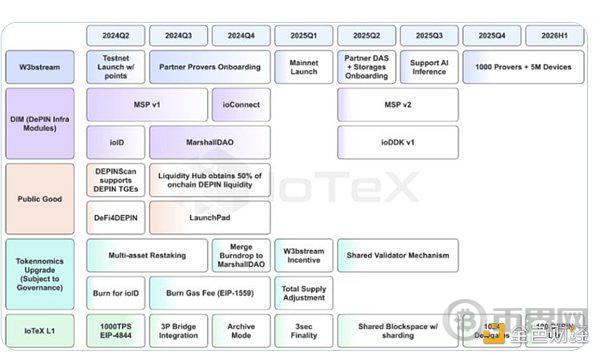
今天,作为全流通的Depin龙头,IoTex正式发布了2.0版本。距离1.0版本的发布已经过去了整整7年,新版本的白皮书内容丰富,体现了团队强烈的做事意愿。如下图Roadmap所示,2.0版本的主要基调是将原本的一个物联网Layer1公链彻底升级为一整套Depin解决方案与开放平台体系,也符合本次2.0的理念“属于所有人的AI和DePIN”。尽管表面上看起来只是像OP一样支持了在IoTex之上搭建Layer2,但具体的改进远不止这些,主要包括四部分:W3bstream、DIM、Public Good、经济模型。
W3bstream:链下计算与认证

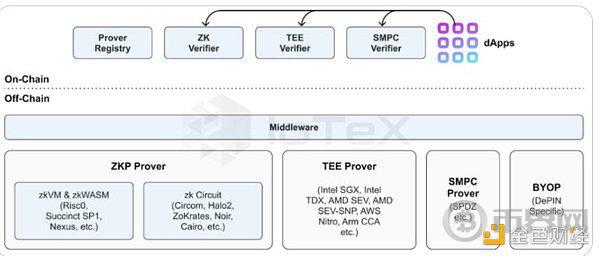
作为Depin公链,最主要的职责是确保链下的众多设备的工作量是真实可信的,并及时上传至链上完成认证与奖励分发。W3bstream号称世界上第一个去中心化的链下计算网络,通过ZK、全同态加密、可信执行环境、多方计算实时生成现实世界活动证明,并将这些证明发布到链上,从而奖励设备的持有者。为了实现计算的快速性,IoTex最新发表的论文将ZKP的性能提升了30%,成为世界上最快的zkSNARK证明器。W3bstream还可以用于链下AI计算并确保计算过程的可信度,构建AI数据集,在这一点上与AO的位置相似。除此以外,还需要确保链上钱包与链下设备的一致性,和硬件设备接入的统一性,这在后续的DIM中也有相应解决方案。
DIM:模块化基础设施

DIM(Depin Infra Modules)通过一系列模块化的方式为Depin项目提供开箱即用的能力,首先包括MSP模块化安全池,打造Depin基础设施的统一可信层,从而让L2更快速地启动。由于Depin同时包括大量链上与链下的内容,需要从头构建自己的去中心化架构以提升可信度。MSP可以理解为Depin领域的Eigenlayer,包括三个角色:DIM的构建者、质押者和验证者。其中,构建者最为重要,即第三方开发者为Depin打造的数据流、处理、存储、自动化等模块。MSP提供了贿选机制,确保质押者可以从中获得足够的激励。

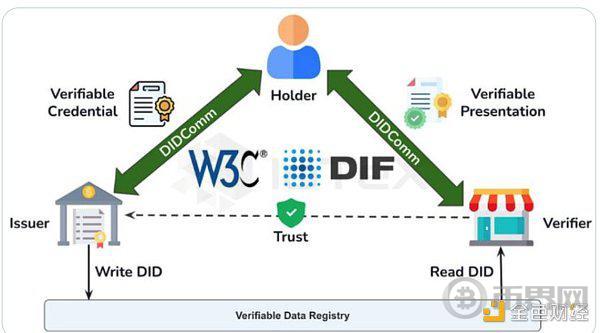
ioID的存在同样是为了解决Depin领域同时出现大量链上地址与链下设备交互时产生的身份不一致问题。ioID使用钱包地址作为链上身份,DID作为链下身份,并将其进行映射关联。链下设备的身份认证是一个难点,因为设备种类繁多。在ioID中,Depin设备可以通过集成IoTex的SDK直接在设备内即时生成DID,即为每个设备创建一个NFT。用户通过MetaMask登录网站,存入最低10个IOTX Token作为设备启动过程中的Gas费,在设备生成好DID后,网站上读取到对应的DID并进行绑定注册,从而实现链上与链下的关联。
ioConnect:通用嵌入式SDK

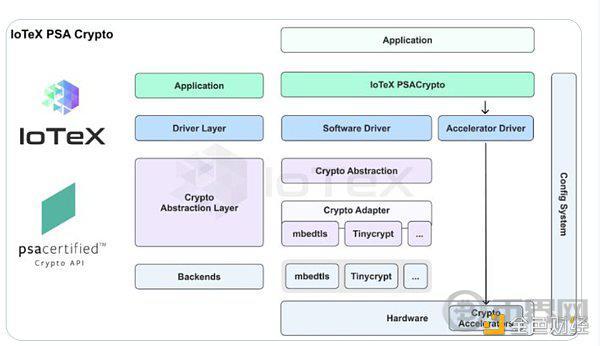
ioConnect是一个通用嵌入式SDK,用于消除Depin硬件设备的复杂性。尽管ioID可以为各种不同类型的硬件生成DID,但硬件设备和芯片种类繁多、标准不统一的问题依然存在。为此,IoTex开发了更通用的标准SDK,易于硬件设备接入联网。
ioDDK:构建L2应用链

在DIM的最后是ioDDK,允许Depin项目基于IoTex之上搭建L2应用链,并继承IoTex的安全性。IoTex上线这些年里,没有发生过一起宕机事故或黑客盗窃事件。

除了DIM提供的模块化组件外,IoTex在Public Good领域也提供了DePinScan,用于让用户、矿工和投资者监控Depin项目的增长情况,从而发现早期项目。DePin Liquidity Hubs是一个专门用于Depin Token的Dex,为早期Depin项目提供流动性。

经济模型:通胀与通缩机制

最后是经济模型的调整。在2.0版本中,IoTex同时具备通胀和通缩机制,形成动态的平衡对冲。在通胀方面,IoTex的质押节点将收到对应的Token作为奖励。同时,IoTex在2.0中引入了类似于以太坊的Gas燃烧通缩机制,使用ioID为设备创建链上身份时也需要销毁一定数量的Token。如果IoTex网络能够在业务层面实现良好的增长,则会形成一个正向飞轮,使用的人越多,Token销毁的数量也越多。

Related Reads

Former Nvidia AI Director Overturns Transformer, Creates 5 Trillion-Context Physical AI That Can Simulate the Entire Universe

Former NVIDIA AI Director Anima Anandkumar and her co-founder Benedikt Jenik have unveiled a groundbreaking "Physical AI" model through their startup, Accelerated Understanding. This model departs entirely from the dominant Transformer architecture, instead utilizing "Neural Operators" to directly understand and simulate physical phenomena in their full 4D spacetime (3D space + time). It achieves a staggering inference-time context window of over 5 trillion tokens—reportedly 5 million times larger than current top LLMs—enabling it to generate complete 4D trajectories of complex physical systems in a single, one-shot inference without subsampling or chunking. The model, pre-trained with 1 trillion parameters and scaled to 35 trillion in experiments, functions as a universal physics simulator capable of handling diverse domains from weather to materials science. It establishes a "simulate → improve → simulate" loop for reality validation. The founders notably turned down a lavish offer from Jeff Bezos's Project Prometheus, which included 35% equity, a $2M salary, and over $20B in committed funding. Industry speculation points to NVIDIA CEO Jensen Huang, who previously championed Anandkumar's work, as a potential key supporter behind the scenes. This development signals a paradigm shift from language/image-centric AI to physics-first intelligence.

marsbit18m ago

Former Nvidia AI Director Overturns Transformer, Creates 5 Trillion-Context Physical AI That Can Simulate the Entire Universe

marsbit18m ago

NVIDIA Earnings Report Quick Read: Quarterly Revenue on the Verge of Breaking the $100 Billion Mark, Can Still Grow 70% Next Year

NVIDIA Q2 FY2027 Earnings Report: Record Revenue Nears $100 Billion, Projects 70% Growth for Next Year NVIDIA reported exceptional Q2 FY2027 results, with revenue reaching $96.22 billion (up 106% YoY) and non-GAAP net income of $53.95 billion (up 118% YoY). Q3 revenue guidance of $108 billion signals the company's imminent entry into a "quarterly $100 billion revenue" era. The most striking projection came from the CFO, who forecasted approximately 70% revenue growth for FY2028, significantly above Wall Street's 45% expectation, and notably stated this outlook excludes any data center revenue from China. The data center segment remained the core driver, generating $89 billion (up 117% YoY), representing over 90% of total revenue. Growth continues to be primarily fueled by capital expenditures from hyperscale cloud providers like Amazon, Microsoft, Google, and Meta. A key product milestone was the confirmation that the Vera Rubin platform has entered full-scale production and begun shipments. Management stated that every 1 GW of Vera Rubin compute deployed represents a roughly $40 billion revenue opportunity, with the platform expected to contribute about 20% of data center revenue in Q3. CEO Jensen Huang noted its ramp-up is the fastest in company history, providing confidence for the strong future outlook. Management emphasized that AI demand is not slowing but accelerating and broadening into new areas like inference, enterprise AI, and robotics. The primary constraint on growth is now supply, not demand. Huang indicated that without supply limitations, the FY2028 outlook would be "much higher." Bottlenecks include components like HBM, advanced packaging, and data center power. In response, NVIDIA is expanding its role, collaborating with financial firms to mobilize over $500 billion in third-party capital for AI infrastructure and securing key resources like land and power. Crossing the $100 billion quarterly revenue mark represents a new scale for NVIDIA, while the 70% growth projection for next year suggests it may just be the starting point for the next phase.

Odaily星球日报21m ago

NVIDIA Earnings Report Quick Read: Quarterly Revenue on the Verge of Breaking the $100 Billion Mark, Can Still Grow 70% Next Year

Odaily星球日报21m ago

Trading

Spot
活动图片