​Ai赛道大火,代币盘点,还有哪些机会?Starknet上线,长期来看对比Arb具备哪些优势?

金色财经Published on 2024-07-15Last updated on 2024-07-15

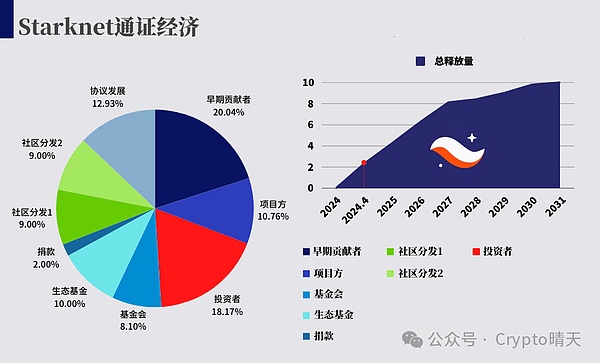
我们将代币分配分成三个部分:项目方可把持的、投资者以及社区

毫无疑问初期能被判定为项目方所把持(蓝色系)的是极其多的,占据了一半以上。

但长期来看,这也能够意味着对链上及一些协议端的发展会有更好的扶持因为我看到融了这么多轮的一个项目,投资者的部分甚至还没20%,这令我感到很惊讶,果然是极擅长PUA的项目,不知道具体他们是怎么分这20% 。

最后是社区的部分:虽然 strk 老鼠仓严重,但是这种挺容易拉盘的。甚至包括机构在内的既得利益团体可能都在以这种方式进一步收成本。
640?wx_fmt=png&from=appmsg

但聊回根本,总体的释放曲线,在这一轮周期里面,非常陡峭,截至2027年,释放的代币在80%以上,我觉得可以格局一下这一轮周期,搏STRK对协议、生态(包括L3)的进一步扶持!

至于初步的上线价格,在这轮周期看,上线什么价都不重要,再不济你怕追高就打小仓,后面再补。

因为还有较为关键的一点:STRK在最新版本已可作为链上GAS使用,结合一下其潜在的对生态支持,品!(最后插一个冷知识:空投/返利不是就一波,甚至第一波的7%都没用完原定分配的份额)。

那么L3视角下,ARB和STRK哪个更具优势?

先说结论:Starknet可能会更具优势可能不少人忽略了一点,Starknet前不久和Celestia宣布了合作,将基于其模块化DA发展L3,这也是我觉得在竞争格局上,Starknet瞄准了ARB开炮的原因。

单论链上,Starknet几乎可以说无法在短期内威胁到发展已久的ARB,但在L3的竞争中,ARB并没有领先多少

当前的模块化DA成了一种明显的趋势,甚至可以说是版本答案,而对Layer3的范式探索,也还处于较早期的阶段,当下的ARB L3方案即使是从先发的角度,我们也无法拍板就说ARB的最优。

未来Starknet通过zk-Rollup+Layer3的叙事嵌套,再结合Celestia的模块化,我认为会相比ARB的原生方案更值得期待。

AI赛道大火,代币盘点,还有哪些机会?

这几天AI赛道太火了,WLD直接快突破7U,当初一起不到2.5U布局的兄弟,早已翻倍!其实AI和DEPIN都是想象力非常大的赛道,甚至比币圈其他赛道的想象力都大。币圈的想象力是千亿,而AI和DEPIN是万亿。晴天来盘点一下,现在AI板块的代币:

640?wx_fmt=png&from=appmsg

?. $AGIX: 针对 ?? 的去中心化平台,只在构建基于区块链的基础设施,以实现从图像识别到自然语言处理的各种 ?? 算法的实时灵活交互。

?. $ARKM: ?????? 是一个区块链分析平台,利用人工智能(??)对区块链和链上数据进行去匿名化。

?. $TAO: 提出了一种新的 ?? 市场模型,这个市场模型通过???计算机网络,使用数字去中心化账簿记录排名,并以去中心化方式为参与者提供激励。

?. $RNDR: ?????? ??????? 是一个 ??? 计算网络,允许用户使用他们的 ???? 代币来换取额外的计算能力,用于云端渲染场景。

?. $FET: 基于人工智能和机器学习的区块链平台。

?. $NFP: 一个 ?? 驱动的 ??? 平台,专为新一代 ???? 创作者而设计,它是一个集 ?? 创作、社交和商业化于一体的平台。

?. $WLD: ????????? 是由 ?????? 创始人 ??? ?????? 创立的??????项目。是建设一个全球最大的,公平的数字身份和货币体系。

?. $ALT: ??? ???????? 是首个致力于数据注释和 ?? 模型训练的 ???? 数据基础设施。

?. $AI: ????????? ?? 是一款基于 ?? 的虚拟伴侣游戏,利用 ???? 和 ??? 来创建丰富的基于故事的游戏玩法以及与角色有机发展的互动。

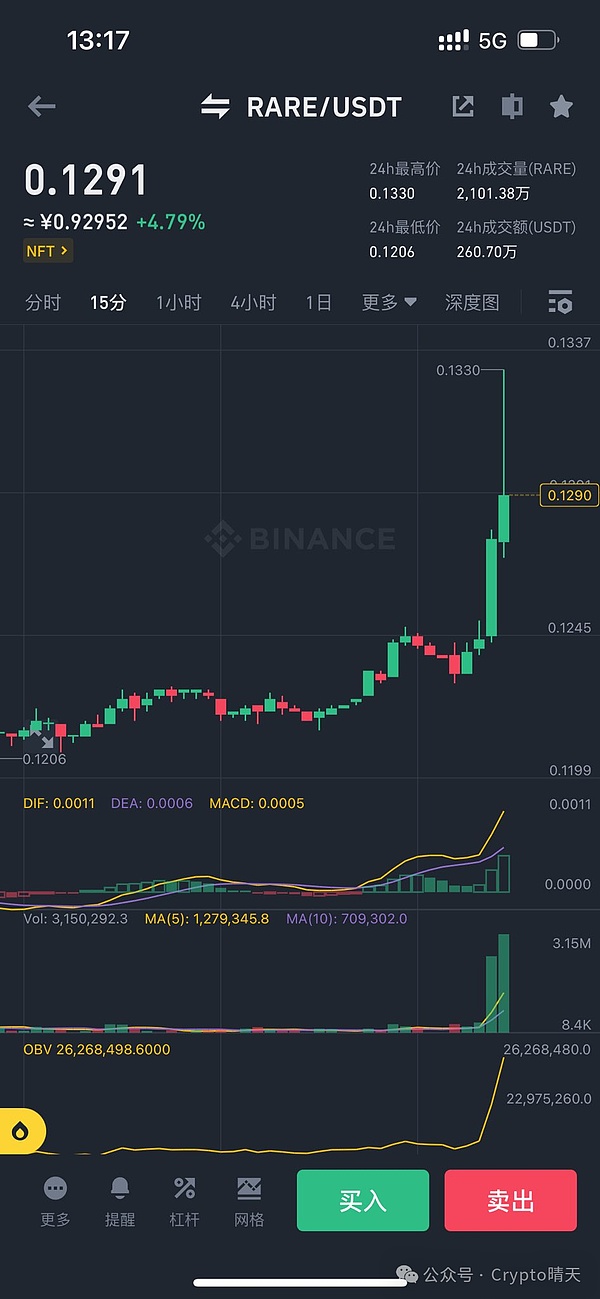
晴天这里说一个币种:$Rare,现价0.1290,近期ai币大火,且看看rare炒作逻辑,技术角度,rare目前0.1290,有机会可以去0.2左右,这里到0.2都是真空。
640?wx_fmt=png&from=appmsg

目前eth的nft交易量已经超过sol,nft市场正在复苏。打开dune,blur的dau和交易量在上升,和他一起上升的仅有superrare,look和x2y2都不行,blur的市值10个亿,rare的市值1个亿都不到,和looks还有x2y2一个水平。

rare从本来的无用变成有用,rareprotocol的质押功能出现,你可以毒株你喜欢的艺术品,从上面分取收益。而且rare并不是同质化的nft拍卖平台,是艺术品平台,上面卖的东西很赛博朋克,期待乘着AI的风,成为王炸!

我是晴天,一个老韭菜,祝你暴富,点个关注吧,瑞思拜!

Related Reads

Where Is the AI Infrastructure Industry Chain Stuck?

The AI infrastructure (AI Infra) industry chain is facing unprecedented systemic bottlenecks, despite the rapid emergence of applications like DeepSeek and Seedance 2.0. The surge in global computing demand has exposed critical constraints across multiple layers of the supply chain—from core manufacturing equipment and data center cabling to specialty materials and cleanroom facilities. Key challenges include four major "walls": - **Memory Wall**: High-bandwidth memory (HBM) and DRAM face structural shortages as AI inference demand outpaces training, with new capacity not expected until 2027. - **Bandwidth Wall**: Data transfer speeds lag behind computing power, causing multi-level bottlenecks in-chip, between chips, and across data centers. - **Compute Wall**: Advanced chip manufacturing, reliant on EUV lithography and monopolized by ASML, remains the fundamental constraint, with supply chain fragility affecting production. - **Power Wall**: While energy demand from data centers is rising, power supply is a solvable near-term challenge through diversified energy infrastructure. Expansion is further hindered by shortages in testing equipment, IC substrates (critical for GPUs and seeing price hikes over 30%), specialty materials like low-CTE glass fiber, and high-end cleanroom facilities. Connection technologies are evolving, with copper cables resurging for short-range links due to cost and latency advantages, while optical solutions dominate long-range scenarios. Innovations like hollow-core fiber and advanced PCB technologies (e.g., glass substrates, mSAP) are emerging to meet bandwidth needs. In summary, AI Infra bottlenecks are multidimensional, spanning compute, memory, bandwidth, power, and supply chain logistics. Advanced chip manufacturing remains the core constraint, while substrate, material, and equipment shortages present immediate challenges. The industry is moving toward hybrid copper-optical solutions and accelerated domestic supply chain development.

marsbit22m ago

Where Is the AI Infrastructure Industry Chain Stuck?

marsbit22m ago

Autonomy or Compatibility: The Choice Facing China's AI Ecosystem Behind the Delay of DeepSeek V4

DeepSeek V4's repeated delay in early 2026 has sparked global discussions on "de-CUDA-ization" in AI. The highly anticipated trillion-parameter open-source model is undergoing deep adaptation to Huawei’s Ascend chips using the CANN framework, representing China’s first systematic attempt to run a core AI model outside the CUDA ecosystem. This shift, however, comes with significant engineering challenges. While the model uses a MoE architecture to reduce computational load, it places extreme demands on memory bandwidth, chip interconnects, and system scheduling—areas where NVIDIA’s mature CUDA ecosystem currently excels. Migrating to Ascend introduces complexities in hardware topology, communication latency, and software optimization due to CANN’s relative immaturity compared to CUDA. The move highlights a broader strategic dilemma: short-term compatibility with CUDA offers practical benefits and faster adoption, as seen in CANN’s efforts to emulate CUDA interfaces. Yet, long-term over-reliance on compatibility risks inheriting CUDA’s limitations and stifling native innovation. If global AI shifts away from transformer-based architectures, strict compatibility could lead to technological obsolescence. Despite these challenges, DeepSeek V4’s eventual release could demonstrate the viability of a full domestic AI stack and accelerate CANN’s ecosystem growth. However, true technological independence will require building an original software-hardware paradigm beyond compatibility—a critical task for China’s AI ambitions in the next 3-5 years.

marsbit40m ago

Autonomy or Compatibility: The Choice Facing China's AI Ecosystem Behind the Delay of DeepSeek V4

marsbit40m ago

How Blockchain Fills the Identity, Payment, and Trust Gaps for AI Agents?

AI Agents are rapidly evolving into autonomous economic participants, but they face critical gaps in identity, payment, and trust infrastructure. They currently lack standardized ways to prove who they are, what they are authorized to do, and how they should be compensated across different environments. Blockchain technology is emerging as a solution to these challenges by providing a neutral coordination layer. Public ledgers offer auditable credentials, wallets enable portable identities, and stablecoins serve as a programmable settlement layer. A key bottleneck is the absence of a universal identity standard for non-human entities—akin to "Know Your Agent" (KYA)—which would allow Agents to operate with verifiable, cryptographically signed credentials. Without this, Agents remain fragmented and face barriers to interoperability. Additionally, as AI systems take on governance roles, there is a risk that centralized control over models could undermine decentralized governance in practice. Cryptographic guarantees on training data, prompts, and behavior logs are essential to ensure Agents act in users' interests. Stablecoins and crypto-native payment rails are becoming the default for Agent-to-Agent commerce, enabling seamless, low-cost transactions for AI-native services. These systems support permissionless, programmable payments without traditional merchant onboarding. Finally, as AI scales, human oversight becomes impractical. Trust must be built into system architecture through verifiable provenance, on-chain attestations, and decentralized identity systems. The future of Agent economies depends on cryptographically enforced accountability, allowing users to delegate tasks with clearly defined constraints and transparent operation logs.

marsbit1h ago

How Blockchain Fills the Identity, Payment, and Trust Gaps for AI Agents?

marsbit1h ago

Trading

Spot
Futures

Hot Articles

How to Buy ARB

Welcome to HTX.com! We've made purchasing Arbitrum (ARB) simple and convenient. Follow our step-by-step guide to embark on your crypto journey.Step 1: Create Your HTX AccountUse your email or phone number to sign up for a free account on HTX. Experience a hassle-free registration journey and unlock all features.Get My AccountStep 2: Go to Buy Crypto and Choose Your Payment MethodCredit/Debit Card: Use your Visa or Mastercard to buy Arbitrum (ARB) instantly.Balance: Use funds from your HTX account balance to trade seamlessly.Third Parties: We've added popular payment methods such as Google Pay and Apple Pay to enhance convenience.P2P: Trade directly with other users on HTX.Over-the-Counter (OTC): We offer tailor-made services and competitive exchange rates for traders.Step 3: Store Your Arbitrum (ARB)After purchasing your Arbitrum (ARB), store it in your HTX account. Alternatively, you can send it elsewhere via blockchain transfer or use it to trade other cryptocurrencies.Step 4: Trade Arbitrum (ARB)Easily trade Arbitrum (ARB) on HTX's spot market. Simply access your account, select your trading pair, execute your trades, and monitor in real-time. We offer a user-friendly experience for both beginners and seasoned traders.

4.9k Total ViewsPublished 2024.03.29Updated 2025.03.21

How to Buy ARB

Discussions

Welcome to the HTX Community. Here, you can stay informed about the latest platform developments and gain access to professional market insights. Users' opinions on the price of ARB (ARB) are presented below.

活动图片