2026 Cryptocurrency Exchange Listing Decision Questionnaire Survey Report

marsbitPublished on 2026-01-21Last updated on 2026-01-21

Abstract

The 2026 Cryptocurrency Exchange Listing Decision Survey Report, conducted by RootData, gathered 313 valid responses from professionals including Listing BD personnel, researchers, and listing committee members. Key findings reveal that over 69% of respondents are directly involved in or responsible for listing decisions, with many handling over 50 projects annually, leading to significant information overload. Major pain points in the decision-making process include fragmented and outdated data, with approximately 50% of respondents citing these issues. High "hidden costs of trust" and data inaccuracy often prolong the review process. Over 30% of respondents noted that data delays significantly impact decisions, potentially causing missed opportunities or errors. Transparency of project information—such as details about institutional investors, valuation, team, and product roadmap—is critical. More than half of the respondents rely on third-party data platforms like RootData (used by 88.9% of participants) for verification. Projects listed on authoritative platforms with detailed information can improve listing efficiency by at least 30%. Conversely, low transparency often triggers extended defensive reviews, with 16.7% of respondents likely rejecting such projects outright. The report concludes that data transparency is vital in listing approvals, significantly affecting both the efficiency and outcome of a project’s capitalization efforts.

Source: RootData

Recently, RootData initiated a survey questionnaire focusing on cryptocurrency exchange listing decisions, collecting a total of 313 valid responses. Participants included Listing BD personnel, researchers, and listing committee members, among others. The survey results are now compiled into this research report for reference.

Respondent Profile: Covering Frontline Practitioners and Decision-Makers in Listing
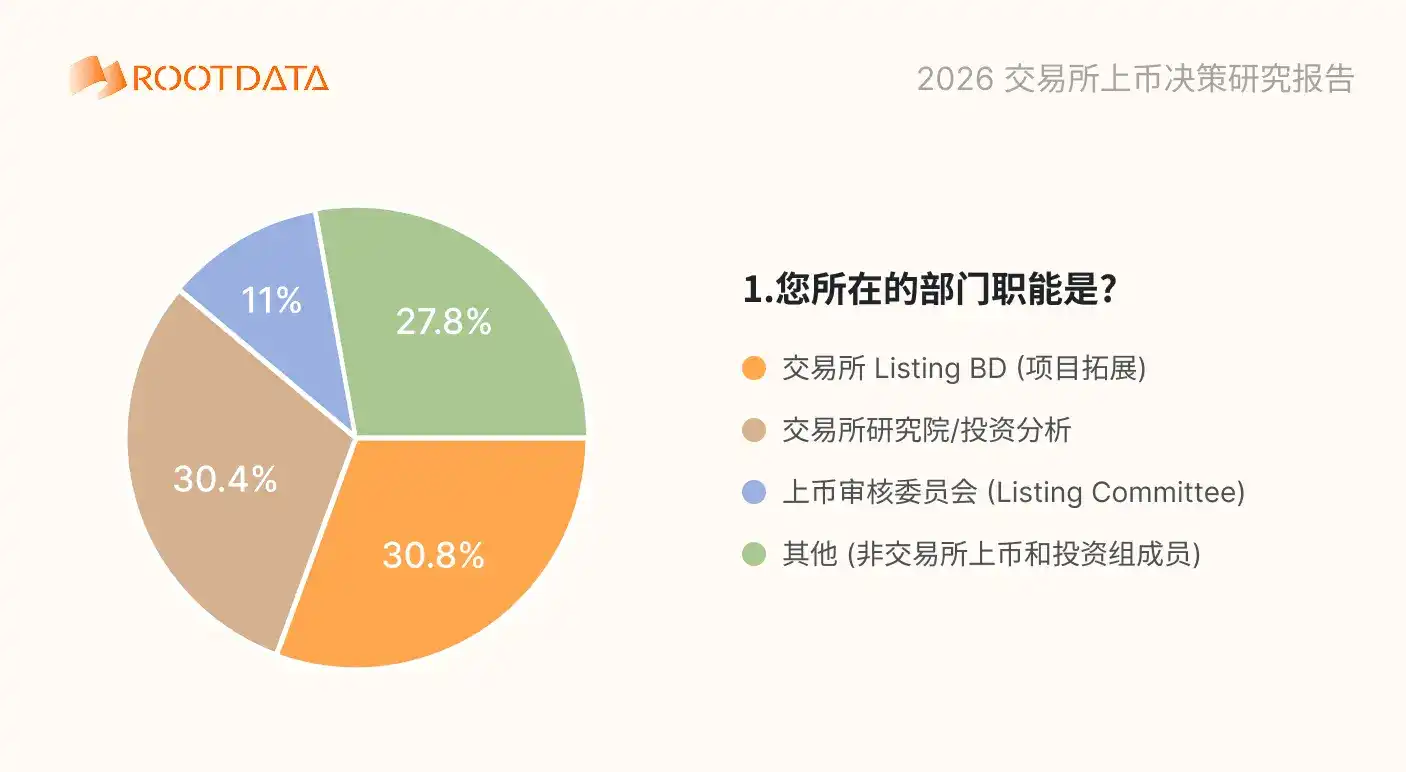
Over 69% of respondents are involved in or directly decision-makers for Listing work. Survey participants were primarily from exchange Listing BD and research institute/investment analysis roles. They are the "value discovery" and "access control" departments of exchanges, and decision-makers face immense information processing pressure.

Decision-Making Pain Points: Fragmented Data and Delayed Updates
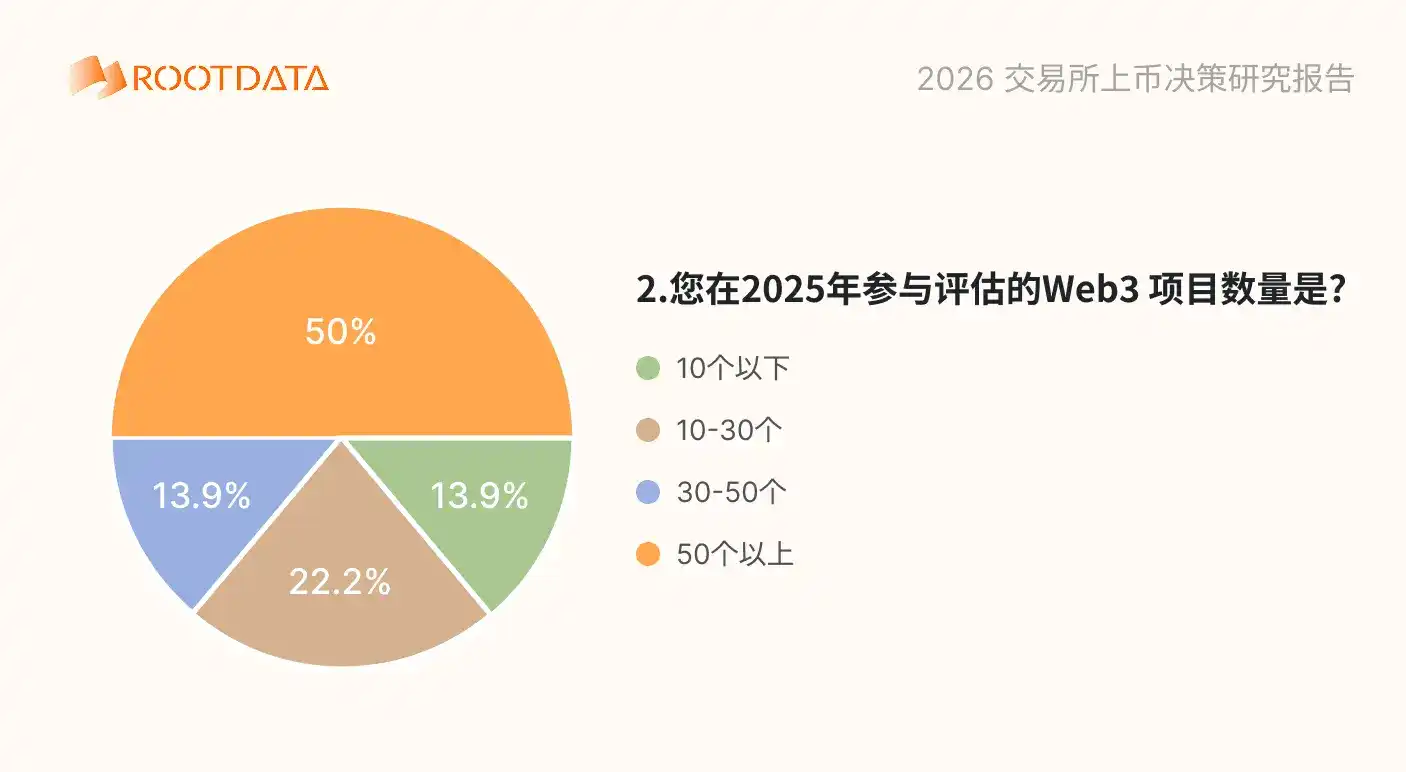
Approximately 50% of respondents evaluate over 50 projects annually. Decision-makers are in a state of severe "information overload." Among the vast number of projects, those that can provide structured and transparent data significantly reduce the cognitive cost for decision-makers. This also indicates that "transparency" has become one of the important metrics for projects to stand out within the extremely short evaluation window.

Distribution of Core Work Responsibilities
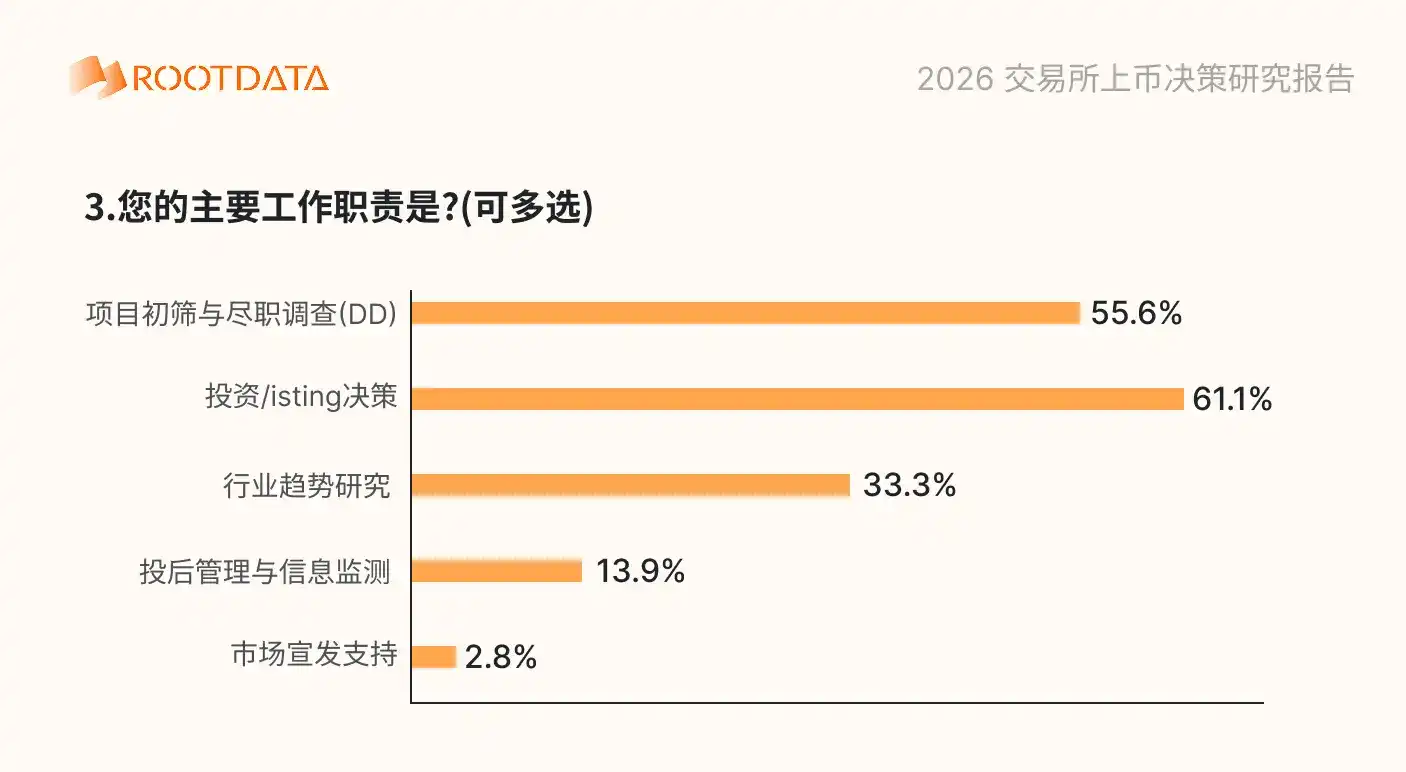
Due diligence and decision-making are highly overlapping functions. This means that data platforms are no longer just auxiliary tools but are integrated into the decision-making chain.

The "Stumbling Block" to Decision-Making Efficiency

"Trust cost" is the most expensive hidden cost for exchanges. Uncertainty in data can cause the decision-making process to repeatedly backtrack. As the compliance trend further intensifies, the accuracy and effectiveness of asset information disclosure will become important factors affecting the exchange listing cycle.

The "Hidden Penalty" of Data Delay
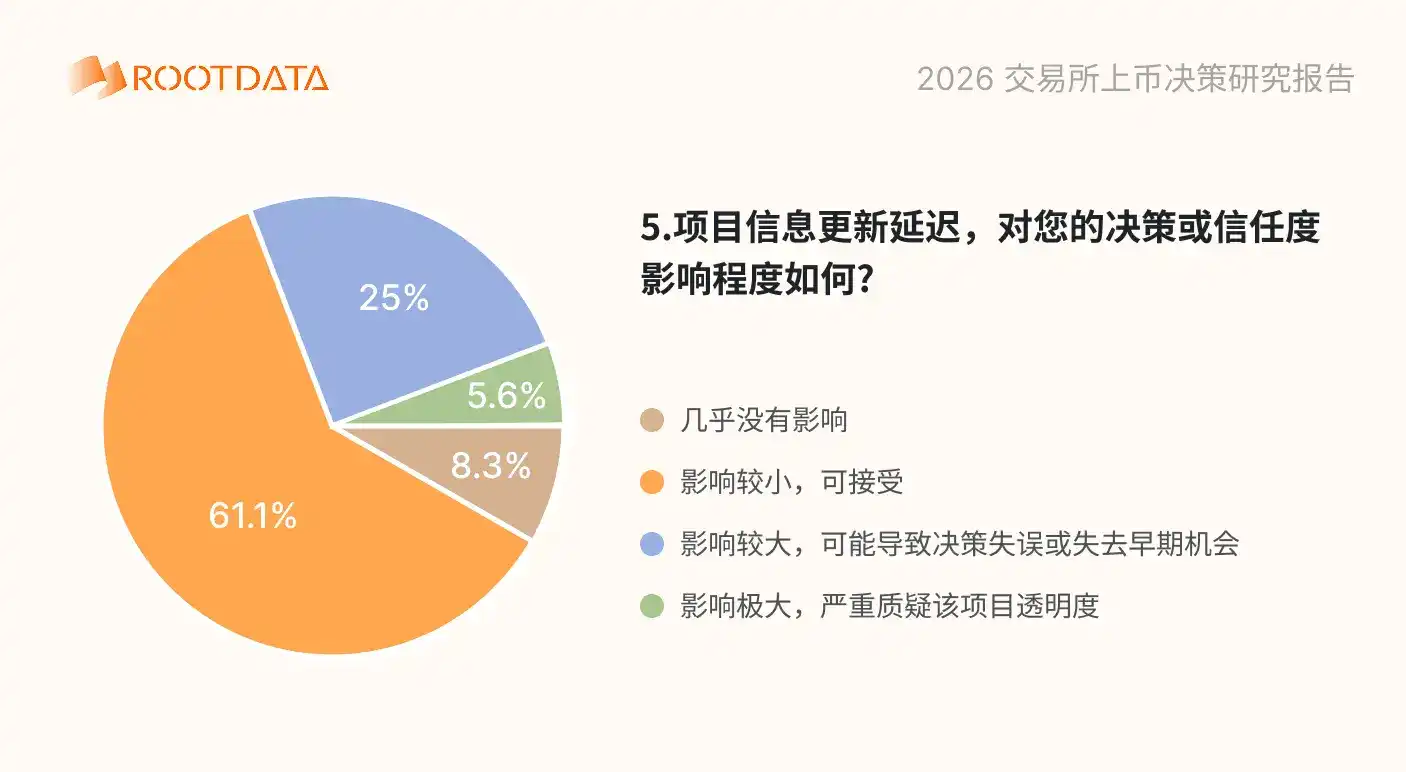
Over 30% of respondents believe delays have a significant or极大 impact, potentially leading to decision-making errors, missed opportunities, or even质疑 project transparency. Even though 60% of respondents表面 "can accept it," delayed information updates from projects may result in a hidden penalty during the Listing evaluation.

Handling of Outdated Information
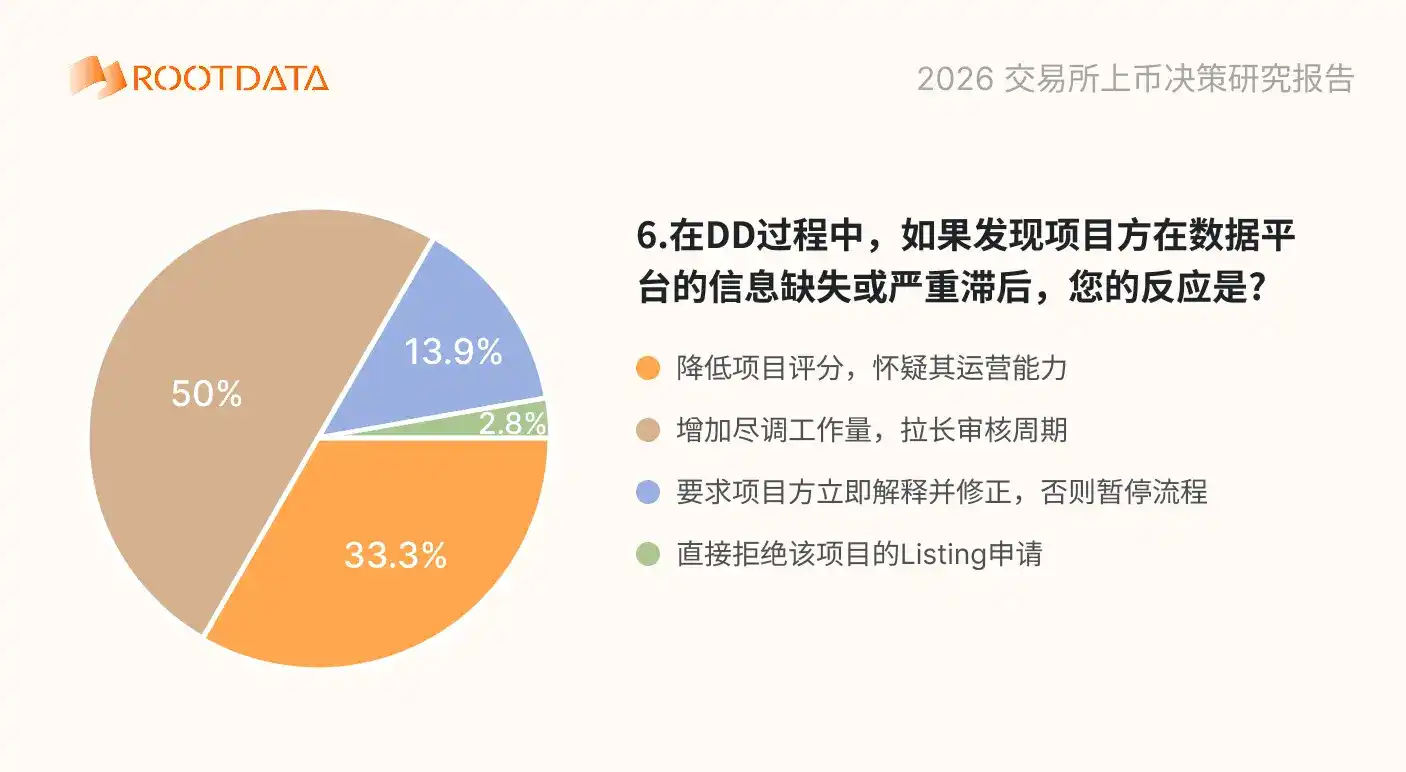
50% of respondents indicated that if project data is not transparent, it will trigger the exchange's "defensive due diligence," prolonging the review time. 16.7% of respondents explicitly stated they would stop the review process or even directly reject the project's Listing application.

The "Required Course" for Listing Review
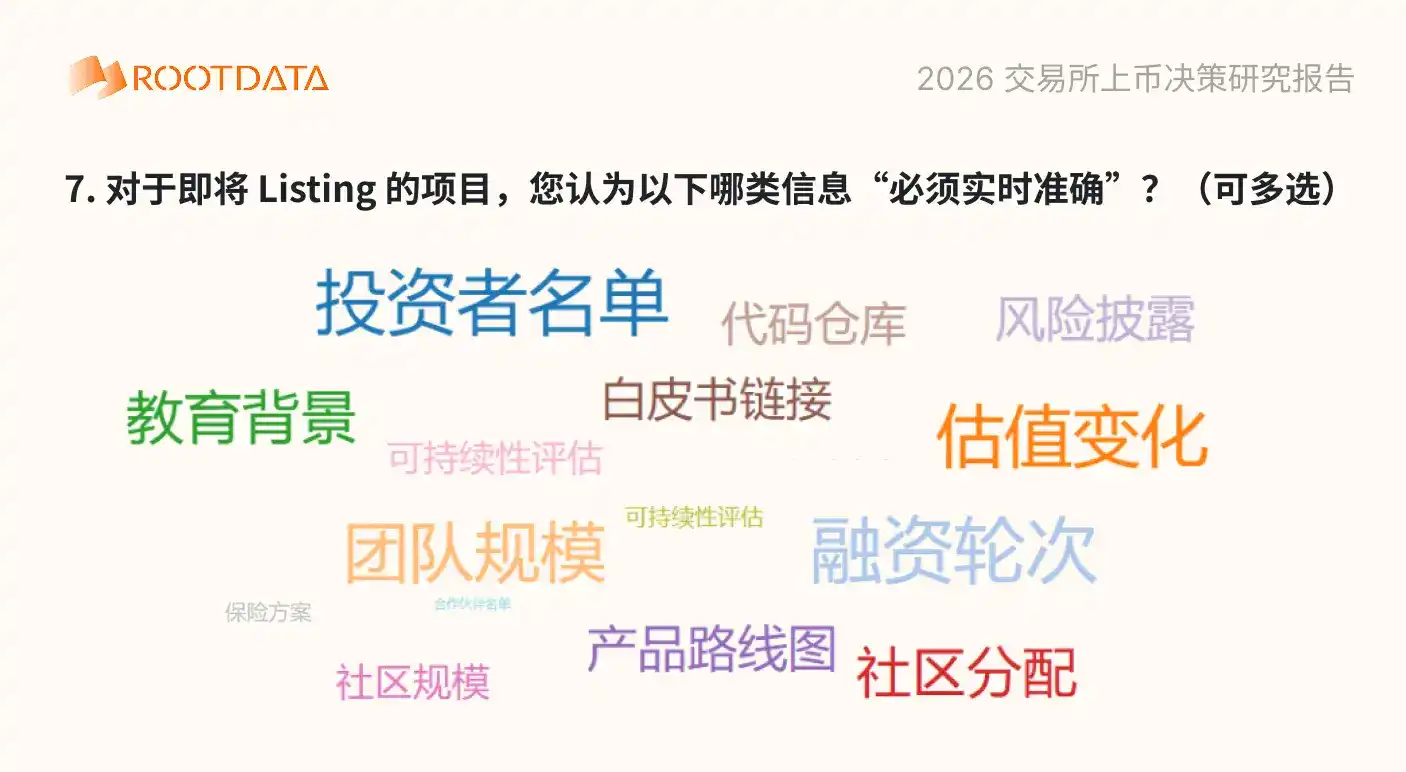
The historical track record of institutional investors, valuation, team, product roadmap, and other asset-related "essential dimensions" constitute the credit cornerstone of Web3 projects. In reality, this information is also very easy to falsify. Therefore, over half of the respondents indicated a strong need for third-party data platforms to help them cross-verify information.

Preferred Commonly Used Data Platforms
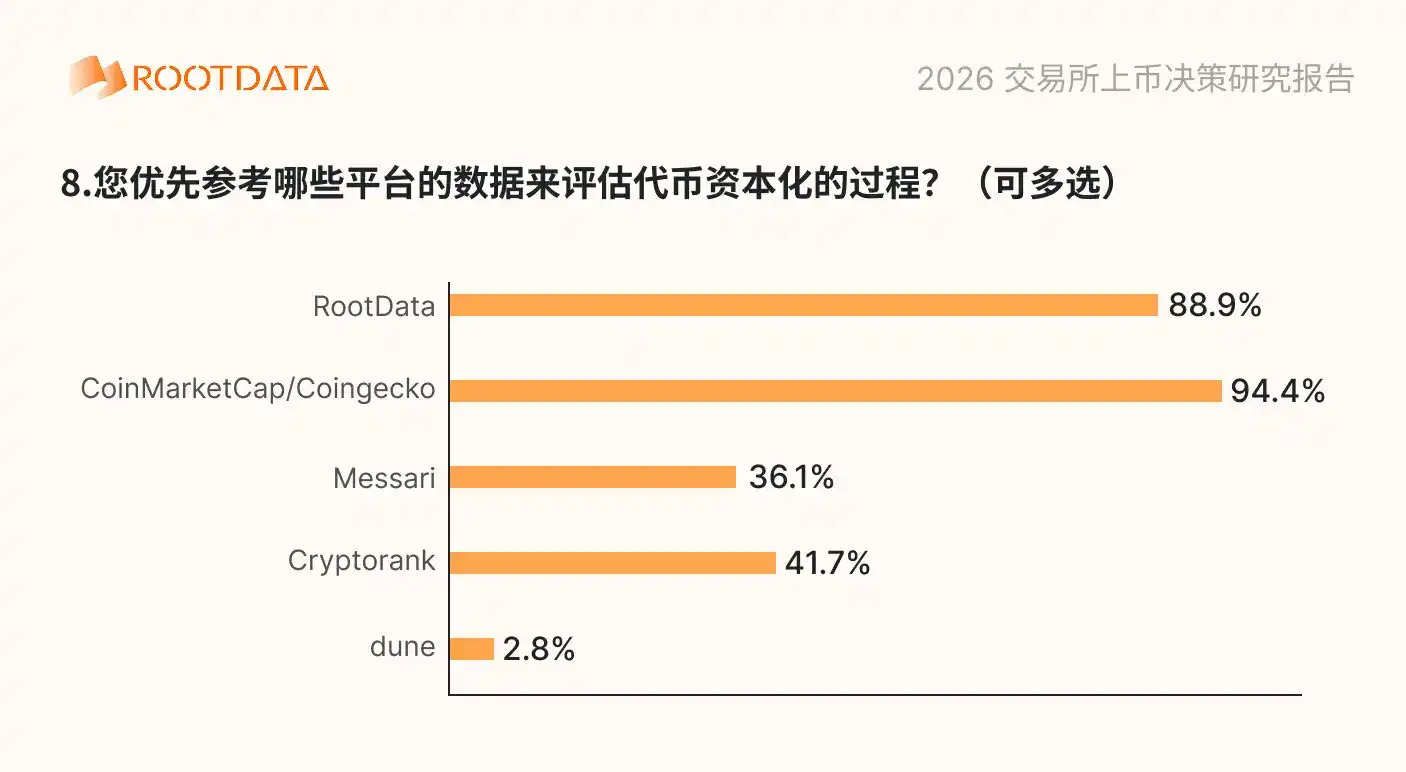
88.9% of respondents stated they choose to reference RootData's data, making it a "desktop essential" tool for exchange Listing teams. This is particularly evident for projects with lower token capitalization (primarily those with their first TGE or not yet listed on major global crypto exchanges). This high penetration rate signifies that the data structure and quality control established by RootData for Web3 projects are becoming an industry standard. For projects with very high token capitalization, 94.4% of respondents会选择 Coingecko or Coinmarketcap platforms for data cross-verification.

Efficiency Boost from Detailed Project Information
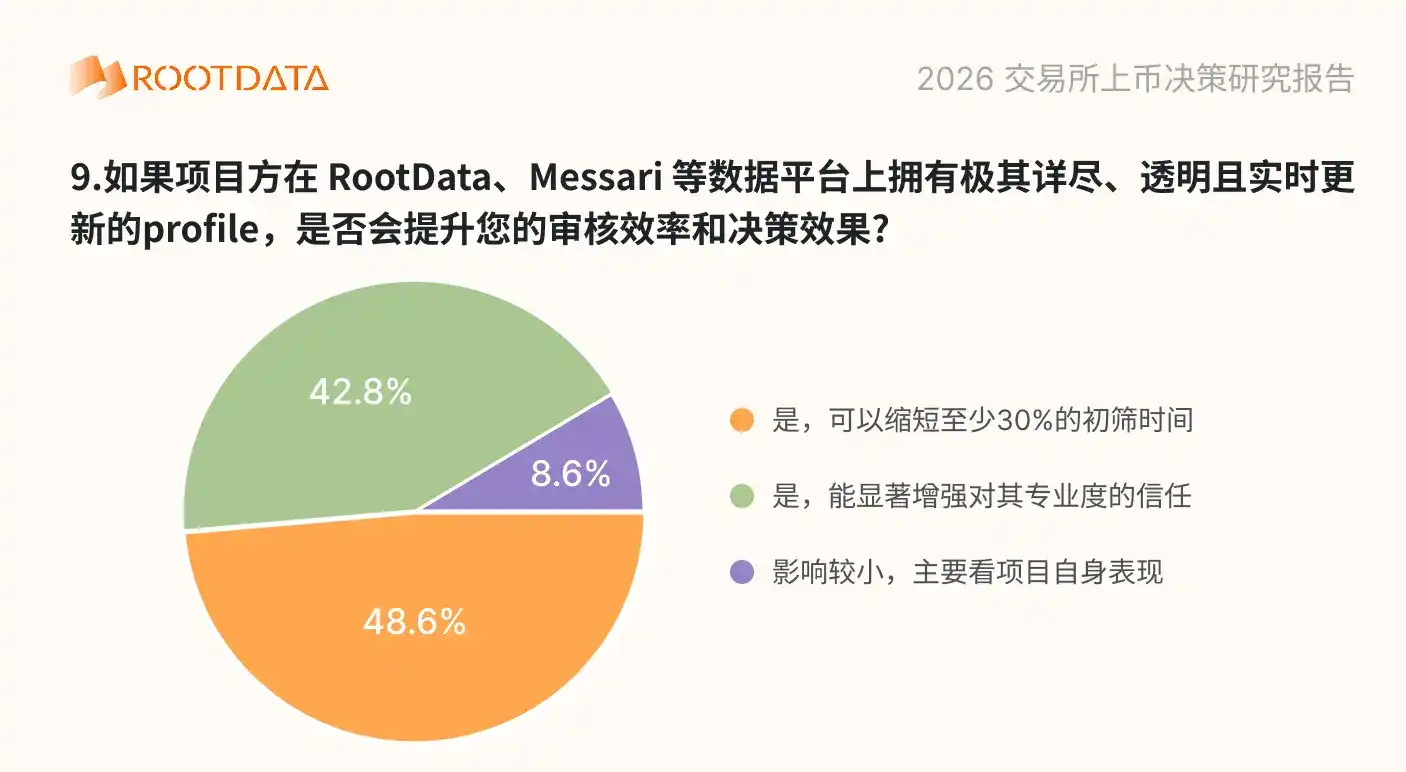
91.4% of respondents explicitly stated that a project being listed on authoritative third-party data platforms like RootData and Crunchbase with detailed information will significantly improve Listing efficiency and好感度,至少可以带来 30% 的审核效率的提升 (at least bringing a 30% improvement in review efficiency).

The Role of Data Platforms in Web3 Development

Only 2.7% of respondents believe projects do not need to focus on data transparency. Listing, being one of the most mysterious links in the industry, has over 80.6% of users agreeing that data platforms are very important for their Listing decisions. This further indicates that whether a project values data information disclosure will directly affect the effectiveness and efficiency of its capitalization.

Summary

The survey results reflect that over half of the professionals in exchange listing departments regard project information transparency as a crucial part of the listing review process, especially information regarding institutional investors, valuation, team, and product roadmap. Sufficient information transparency on third-party data platforms can effectively speed up the review progress (by over 30%), while the review cycle for projects with low transparency will be prolonged.

In the current state of industry development, a large number of projects are陷入 "launching the token only for it to break issue price immediately"窘境, and users have lost trust in the vast majority of crypto projects. The reasons include both the projects' own lack of highlights and reliable business models, as well as many projects being in an information-opaque "black box" state. The disclosure status of a project's core information has become one of the core factors affecting its capitalization progress and effectiveness.

Related Questions

QWhat percentage of survey respondents are directly involved in or make decisions about exchange listings?

AOver 69% of respondents are directly involved in or make decisions regarding exchange listings.

QWhat is considered the most expensive hidden cost for exchanges during the listing process, according to the report?

A"Trust cost" is considered the most expensive hidden cost for exchanges, as data uncertainty leads to repeated backtracking in the decision-making process.

QWhich data platform is used by the vast majority (88.9%) of listing teams for reference, especially for projects with low token capitalization?

A88.9% of respondents use RootData as a reference, making it a 'desktop essential' tool for exchange listing teams, particularly for projects with low token capitalization.

QHow does having detailed information on authoritative third-party data platforms like RootData impact the listing efficiency?

A91.4% of respondents stated that having detailed information on platforms like RootData significantly improves listing efficiency and favorability, increasing audit efficiency by at least 30%.

QWhat are the 'mandatory dimensions' or core information that form the credit foundation for a Web3 project during listing reviews?

AThe 'mandatory dimensions' include institutional investors, valuation, team, product roadmap, and the asset's historical evolution, which form the credit foundation for a Web3 project.

Related Reads

Fu Peng's First Public Speech in 2026: What Exactly Are Crypto Assets? Why Did I Join the Crypto Asset Industry?

Fu Peng, a renowned macroeconomist and now Chief Economist at New火 Group, delivered his first public speech of 2026 at the Hong Kong Web3 Festival. He explained his perspective on crypto assets and why he joined the industry, framing it within the context of macroeconomic trends and financial evolution. Fu emphasized that crypto assets are transitioning from an early, belief-driven phase to a mature, institutionally integrated asset class. He drew parallels to the 1970s-80s, when technological advances (like computing) revolutionized traditional finance, leading to the rise of FICC (Fixed Income, Currencies, and Commodities). Similarly, current advancements in AI, data, and blockchain are reshaping finance, with crypto assets becoming part of a new "FICC + C" (C for Crypto) framework. He noted that institutional capital, including traditional hedge funds, avoided early crypto due to its speculative nature but are now engaging as regulatory clarity emerges (e.g., stablecoin laws, CFTC classifying crypto as a commodity). Fu predicted that 2025-2026 marks a turning point where crypto becomes a standardized, financially viable asset for diversified portfolios, akin to commodities or derivatives in traditional finance. Fu defined Bitcoin not as "digital gold" in a simplistic sense but as a value-preserving, financially tradable asset. He highlighted that crypto's future lies in regulated, institutional adoption, moving away from retail-dominated trading. His entry into crypto signals this maturation, where traditional finance integrates crypto into mainstream asset management.

marsbit1h ago

Fu Peng's First Public Speech in 2026: What Exactly Are Crypto Assets? Why Did I Join the Crypto Asset Industry?

marsbit1h ago

Justin Sun Sues Trump Family: What $75 Million Bought Was Only a Blacklist

Justin Sun, founder of Tron, has filed a lawsuit in federal court against World Liberty Financial (WLF), alleging he was made the "primary target of a fraudulent scheme" after investing $75 million. Sun claims the investment secured him an advisor title and WLFI tokens, which were later frozen by WLF, causing "hundreds of millions in losses." The dispute began in late 2024 when Sun's investment helped revive WLF's struggling token sale, which ultimately raised $550 million. Shortly after, the SEC dropped its lawsuit against Sun following Donald Trump's inauguration. However, relations soured when Sun refused WLF's demands for additional funding. In August 2025, WLF added a "blacklist" function to its smart contract, allowing it to unilaterally freeze tokens. Sun's holdings, worth approximately $107 million, were frozen, and he was threatened with token destruction. The lawsuit highlights WLF's structure, which directs 75% of token sale profits to the Trump family, who had earned $1 billion by December 2025. WLF's CEO is Zach Witkoff, son of U.S. Middle East envoy Steve Witkoff. The project faces scrutiny for opaque operations, including a controversial loan arrangement on the Dolomite platform, co-founded by a WLF advisor. Despite Sun's history with the SEC, the case underscores centralization risks within DeFi, as WLF controls governance and holds powers to freeze assets arbitrarily. Sun's tokens remain frozen as legal proceedings begin.

marsbit1h ago

Justin Sun Sues Trump Family: What $75 Million Bought Was Only a Blacklist

marsbit1h ago

$500 to Buy OpenAI Stock: Silicon Valley's Most Respectable Liquidity Invitation

Silicon Valley's largest venture capital platform, AngelList, has launched a new fund called USVC, allowing U.S. retail investors to buy into high-profile AI companies like OpenAI, Anthropic, and xAI with a minimum investment of $500—no accredited investor status required. Promoted by AngelList co-founder Naval Ravikant, the fund is framed as an opportunity for ordinary people to access high-growth private tech investments traditionally reserved for VCs. However, critics argue it functions more like an exit vehicle for early insiders. USVC acquires shares not through primary rounds but largely via secondary transactions—purchasing stakes from early investors, VC funds, and employees looking to cash out at peak valuations. With companies like xAI heavily weighted in the portfolio, the fund effectively channels retail money into providing liquidity for insiders who entered at much lower valuations. The fund’s structure raises concerns: shares are illiquid, with no secondary market, and buybacks are limited and discretionary. The actual annual fee reaches 3.61%, far above the advertised 1% management fee. This model parallels the "low float, high fully diluted valuation" strategy seen in crypto, where early investors profit by selling to latecomers at inflated prices. The timing—alongside similar moves by platforms like Robinhood—suggests that Silicon Valley’s sudden interest in retail inclusion may be less about democratizing access and more about securing exits for insiders.

marsbit1h ago

$500 to Buy OpenAI Stock: Silicon Valley's Most Respectable Liquidity Invitation

marsbit1h ago

Trading

Spot
Futures
活动图片