Pantera Capital:黑天鹅的缺席,就是本轮牛市最大的利好

Odaily星球日报Published on 2024-02-27Last updated on 2024-02-27

Abstract

在接下来的18到24个月,市场很可能会迎来一波强劲牛市。

本文来源:Pantera Capital

译者:Odaily 星球日报 Azuma
Pantera Capital:黑天鹅的缺席,就是本轮牛市最大的利好

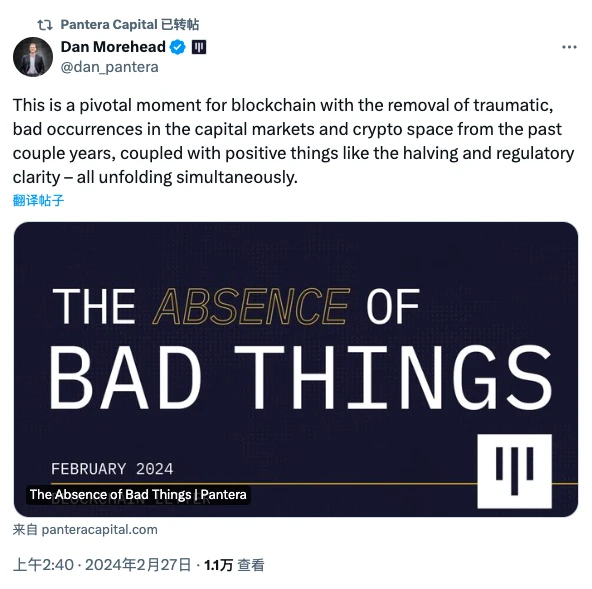
编者按:昨夜至今晨,加密市场再次迎来行情突变,BTC 一度突破 57000 美元,单日大涨 10% 。值此关键时刻,许多投资者都在努力寻找各类利多信号,试图为 BTC 的突然上涨寻找答案,但 Odaily星球日报却发现 Pantera Capital 在近期发布的一篇报告《The Absence of Bad Things》中提供了一种很别致的思路 —— 当前市场最大的特点在于找不到任何利空事件,这本身就是最大的利好。

以下为 Pantera Capital 报告总述部分内容,由 Odaily 星球日报编译。
Pantera Capital:黑天鹅的缺席,就是本轮牛市最大的利好

去年六月,我在彭博投资大会(Bloomberg Invest Conference)与美国证券交易委员会(SEC)前主席 Jay Clayton 一起就银行危机、宏观市场以及区块链进行了讨论。

在讨论结束之际,主持人问了我一个问题:“我们应该留意哪些潜在的黑天鹅事件?”

我当时的回答是:“在黑天鹅发生之前,每个人都会选择忽视,一旦发生了,大家又会想着讨论‘下一个(黑天鹅)会是什么’。在我看来,目前最好的消息就是我们在过去一年间已见证了所有潜在黑天鹅的落地,不会再有什么更疯狂的事情发生了……如果你非要让我说些什么,我只能说监管态度是没人预料到的,这可能导致好几种不同的结果。”

关于当前的市场状况,一个非常重要的主题就是坏消息的缺席。

在 2022 年和 2023 年的大部分时间里,各种罕见到疯狂的坏消息不停地在出现。

全球宏观市场经历了史无前例的波动。专门从事历史投资回报相关研究的圣塔克拉拉大学名誉教授 Edward McQuarrie 曾表示, 2022 年是美国债券投资者经历过的最差年份 —— “即使你回溯 250 年,也找不到比 2022 年更糟糕的一年。”

2022 年也是“经典 60/40 股债组合”自大萧条以来表现最糟糕的一年。

私募市场所遭受的影响更大,这直接影响了我们的风投业务。与上一年相比,IPO 募资总额减少了 95% ,交易量则减少了 85% 。

加密货币市场同样无法幸免,FTX 的暴雷以及六家借贷机构荒谬的杠杆操作导致加密货币总市值缩水了逾 70% 。

在我看来,这些本都应该是一代人才会遇见一次的疯狂事件。在接下来的 10 年或 15 年里,不会再有人给加密货币对冲基金借款,尤其是那些没有抵押物、业务不透明的机构,但凭借我超过 25 年的周期性观察经验,再往下一代肯定会有人再次这么做。

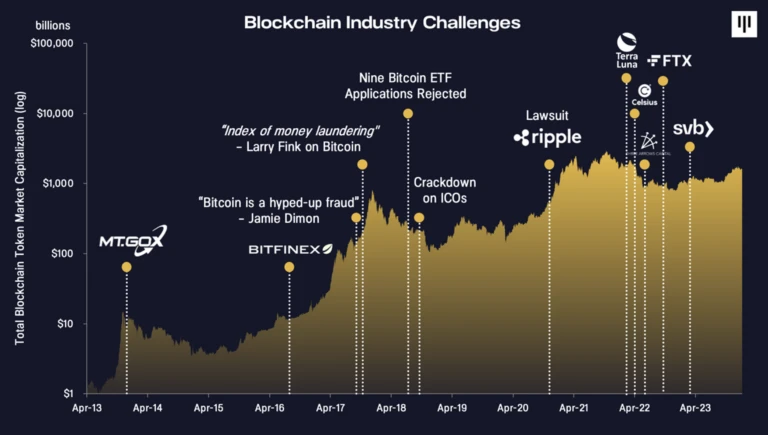
下面是区块链历史上灾难性事件的直观视觉展现。
Pantera Capital:黑天鹅的缺席,就是本轮牛市最大的利好

这些黑天鹅并没有杀死加密货币,而它们的缺席,反过来则成为新一轮周期的巨大利好。

还有另一项巨大的利好,加密货币行业之前面临的一些监管障碍已经消除,特别是对于那些希望基于该新兴资产类别进行构建的金融机构而言。

过去一年间,Ripple、Grayscale 的胜诉以及 ETF 的获批都预示着区块链领域的监管环境可能正在趋于明朗。

自一月份比特币现货 ETF 获批上线之后,机构端的采用速度看起来似乎已在加速。

鉴于比特币还将在 2024 年 4 月底迎来减半,我们相信这些利好的相互作用将推动 BTC 走向下一轮牛市。

此外,区块链行业可能正在经历从“拨号上网”向“宽带”时代的跃迁。我们可以通过以太坊 Layer 2 和其他高性能 Layer 1 的增长上见证这一跃迁,这将是我们三月投资者沟通的主要内容,且将成为我们下一次主题研讨会的焦点。

Pantera Capital 聚焦于加密货币行业的时间可能比任何公司都长 —— 超过十年,见证了多次牛熊轮回。我们已经经历了三个完整的周期,见证了多次暴涨与暴跌。我们认为,市场现在正处在第四个大周期的开端。

2022 年的股市崩盘对机构投资者造成了巨大的冲击,许多机构已撤出私募市场。现在,随着股市重回历史高点,它们将会再次杀回私募市场,因此我认为,在接下来的 18 到 24 个月,加密货币市场很可能会迎来一波强劲的牛市。

当前正是一个转折性时刻,过去几年金融市场和区块链领域的创伤已经成为过去,同时减半和监管趋缓等积极因素也都在同时发生,这一切都预示了未来的发展方向。

Related Reads

Beyond the Model Lies the Harness: Deepseek Enters the Arena, Why Has the Main Battlefield of China's AI Competition Shifted?

In mid-to-late May 2026, Deepseek internally established a new Harness team focused on code agent products, internally benchmarked against Anthropic's Claude Code. This move, marked by the formula "Model + Harness = Agent" in their job postings, signals a major shift in China's AI competition: the main battlefield is transitioning from developing large models to building toolchains and achieving workplace integration. Deepseek's direct involvement in Harness development aims to secure control over interface design and training data feedback loops, moving beyond open-sourcing powerful models. Harness, the runtime infrastructure for AI agents, handles everything beyond model reasoning—task orchestration, tool calling, context management, safety checks, and error recovery. It is crucial because agent products are not just outputs of model capability but also training grounds for it. Real-world task failures recorded by Harness can feed back into model training, creating a flywheel effect. Engineering Harness is more critical than optimizing prompts, as poor context management or error handling can drastically reduce agent success rates in multi-step, real-world scenarios. This shift is not isolated. Other major Chinese tech companies are also pursuing differentiated toolchain strategies. Tencent leverages its enterprise ecosystem (WeChat Work, Tencent Cloud) to build connectors for organizational-level AI collaboration and complex task delivery. Alibaba focuses on lowering automation barriers on the web with a front-end, browser-based GUI Agent framework, PageAgent. This diversification shows the industry recognizes that success lies not in a perfect general agent, but in vertically focused solutions built with robust engineering. The trend is validated by overseas success, such as Poland's Viktor, an AI coworker on Slack achieving $20M ARR by autonomously executing complex, multi-step tasks. This proves a shift in enterprise willingness to pay—from "AI-assisted generation" to "AI-autonomous execution." As Harness matures to provide safety guards and reliability, AI transitions from a human-supervised intern to an independent outsourcer. The competition now faces key engineering challenges: preventing "token explosion" through intelligent context compression, and building "thick frameworks" with features like sandbox isolation and checkpoint recovery for enterprise-grade stability. Geopolitical restrictions on tools like Claude Code further create a significant market vacuum for domestic solutions like Deepseek's Harness. For enterprises and developers, the focus must shift from comparing model benchmarks to evaluating a vendor's engineering capabilities, error recovery mechanisms, context management, and ecosystem compatibility when choosing AI products and platforms.

marsbit56m ago

Beyond the Model Lies the Harness: Deepseek Enters the Arena, Why Has the Main Battlefield of China's AI Competition Shifted?

marsbit56m ago

Soaring Export Data for Memory Chips, Market Is Redefining the Valuation Anchor for Memory Stocks

Korean storage export data for the first 20 days of June shows substantial year-on-year increases in both value and price-per-kilogram for categories like DRAM, NAND, and SSDs. This signals a potential shift beyond simple demand recovery, indicating rising prices and a product mix shift towards higher-value items, possibly influenced by AI infrastructure needs. A key point is that the surge in price-per-kilogram is not simply a uniform chip price hike. It reflects a combination of actual price increases and, more importantly, an export structure increasingly dominated by high-value-density products like HBM (High-Bandwidth Memory) and advanced DRAM, which are critical for AI servers. This suggests AI-driven demand may be spilling over from just HBM into broader memory markets. SK Hynix stands to benefit directly due to its leading HBM position. For Samsung and Micron, the implication is potential for greater margin elasticity if the tightness in high-end memory spreads to enterprise SSD and NAND prices. However, the storage sector remains cyclical. Risks include supply expansion, inventory changes, and potential slowdowns in broader AI capital expenditure. Ultimately, while the strong export data supports upward revisions for storage company earnings and fuels discussion of an "AI infrastructure bottleneck premium," a definitive valuation shift from a cyclical to a structural story depends on upcoming quarterly reports. Investors need confirmation from SK Hynix, Samsung, and Micron that improvements in average selling prices, product mix, and, crucially,毛利率 are sustained over multiple quarters.

marsbit2h ago

Soaring Export Data for Memory Chips, Market Is Redefining the Valuation Anchor for Memory Stocks

marsbit2h ago

Trading

Spot
Futures
活动图片