18 Years Later, Cashtag on X Is Finally "Usable"

marsbitPublished on 2026-04-15Last updated on 2026-04-15

Abstract

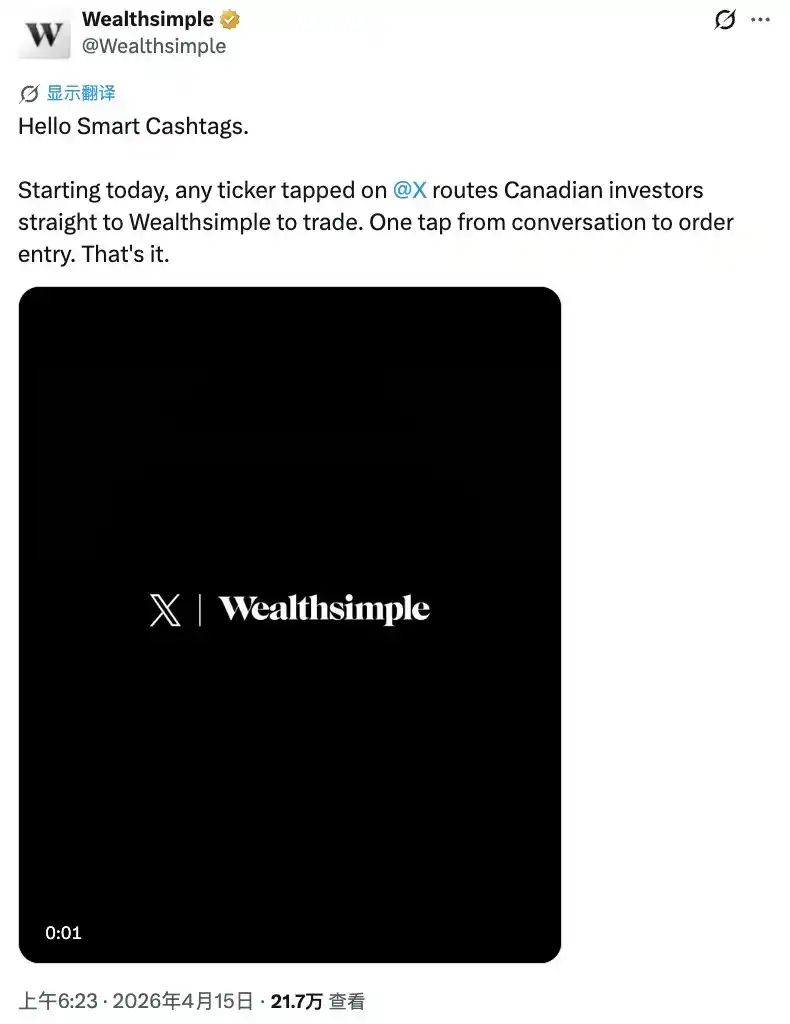
On April 14, X launched the Cashtag feature for iPhone users in the U.S. and Canada, allowing users to click on symbols like $AAPL to view real-time stock charts, historical price trends, and related discussions. In Canada, users can also jump directly to Wealthsimple to execute trades. The feature supports cryptocurrencies like $BTC and $ETH, and even tokens via Solana contract addresses. X positions itself as a "data and discovery layer," not a broker, avoiding direct regulatory scrutiny while streamlining the path from discussion to transaction. The term "Cashtag" was originally coined by Howard Lindzon on StockTwits in 2008, but was adopted by Twitter (now X) in 2012 without attribution. Wealthsimple, chosen as the initial Canadian partner, is the country’s largest online broker with experience in both traditional securities and crypto, despite past controversies like a data breach and a class-action settlement over fee disclosures. The rollout is part of X’s broader financial strategy, building on partnerships with Visa, the announcement of X Money, and a clear regulatory stance. This move integrates social discussion, data, trading, and payment layers, advancing Elon Musk’s vision of an "everything app." Cashtag’s journey from concept to functional tool took 18 years.

On April 14, the X platform launched the Cashtag feature on the iPhone in the United States and Canada. The usage is very simple: type $AAPL in a tweet, and this string of characters becomes a blue clickable link. Click on it, and you will see Apple's real-time stock price chart, price trends over a period of time, and all discussions on X with $AAPL. If you are in Canada, you will also see a button that directly jumps to Wealthsimple to complete the transaction.
What Can Cashtag Do?

It's not just stocks. X's Cashtag also supports cryptocurrencies. You can search for $BTC, $ETH, or directly input the contract address of a token on the Solana chain to find its on-chain data. In other words, this system aims to cover everything from mainstream blue-chip stocks to long-tail meme coins.

X's product lead, Nikita Bier, specifically emphasized at the feature launch: X will not act as a broker and will not directly execute trades. X's positioning is the "data and discovery layer"; it is responsible for presenting information, aggregating discussions, and guiding users. The actual order placement is handed over to third-party brokers to complete.
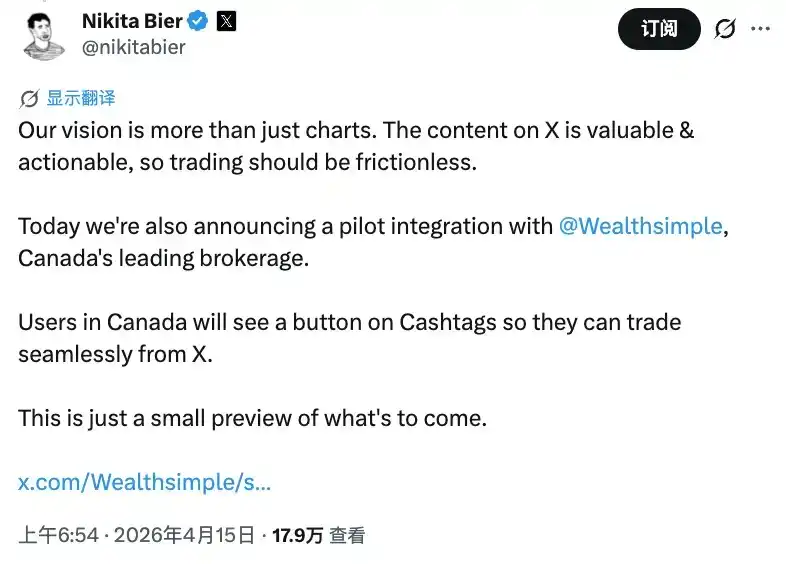
This positioning is crucial. If X were to directly act as a broker, it would need to face the SEC's broker license review, FINRA's compliance requirements, and a series of complex regulatory procedures. By defining itself as a "data layer," X only provides information display, while trade execution happens elsewhere, making the regulatory boundaries much blurrier.

But in terms of user experience, the entire path from seeing a tweet to completing a transaction has been compressed to just a few clicks. This is the first time on the X platform that there is no friction between discussion and action.

Its Origin Is Somewhat Ironic

The term "Cashtag" was not invented by X.

In 2008, a financial analyst and angel investor named Howard Lindzon created StockTwits, a social platform specifically for investors. He introduced symbols like $AAPL on it, using the $ prefix to turn stock tickers into clickable hashtags, allowing retail investors to discuss specific assets and track market sentiment. He named this design: cashtag.
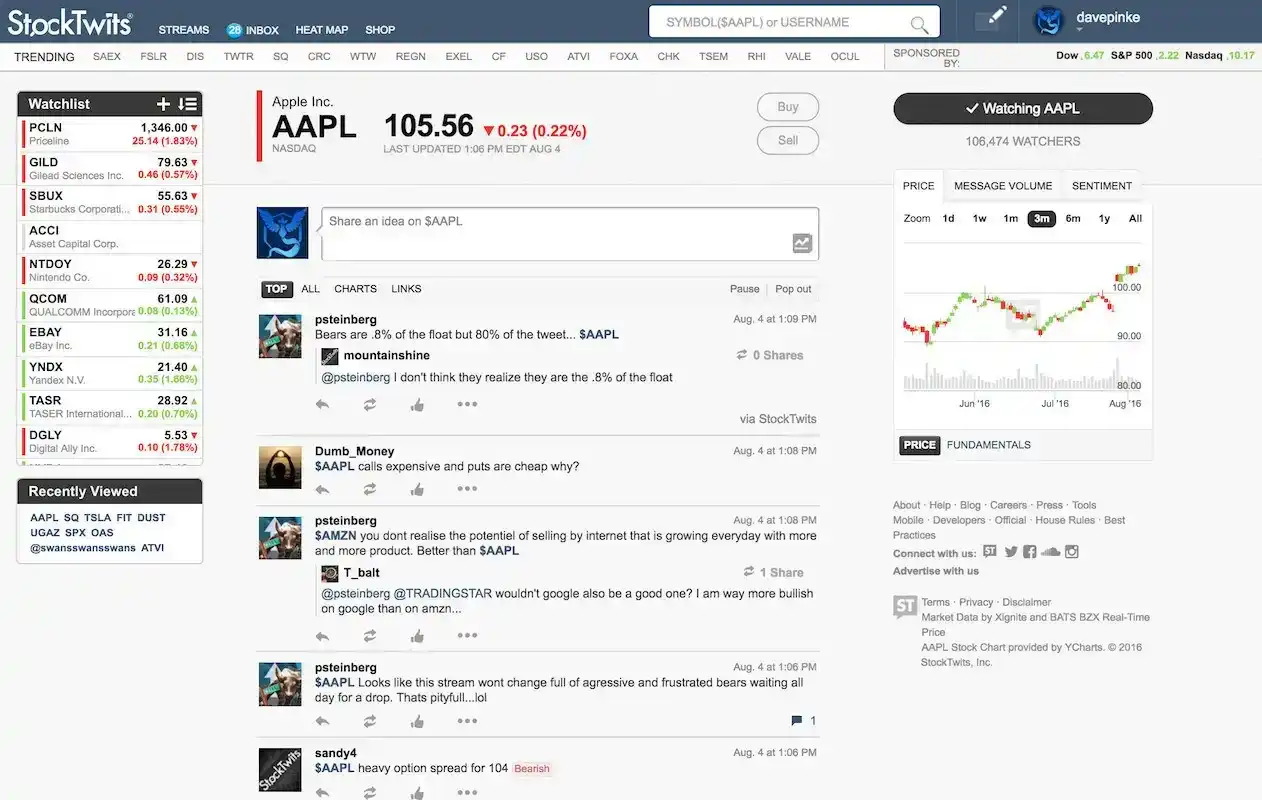
This idea circulated in small circles for four years.

In July 2012, Twitter announced official support for cashtag; $AAPL on Twitter became a blue clickable link. Lindzon publicly expressed "disappointment," saying Twitter had "hijacked" his idea. But he was powerless; cashtag had no copyright, the $ symbol belongs to everyone, and Twitter owed him no explanation.

Over the next dozen years, the two reached a strange balance: StockTwits lived off cashtag, but its traffic was far less than Twitter's. Twitter had the cashtag feature, but on Twitter, it was more like a hashtag than a real financial tool. Clicking on it only led to a topic page—no data, no prices, nothing actionable.

On April 14, 2026, Lindzon posted a tweet on his X homepage advertising the 2026 Cashtag Awards that StockTwits was about to host at the New York Stock Exchange.
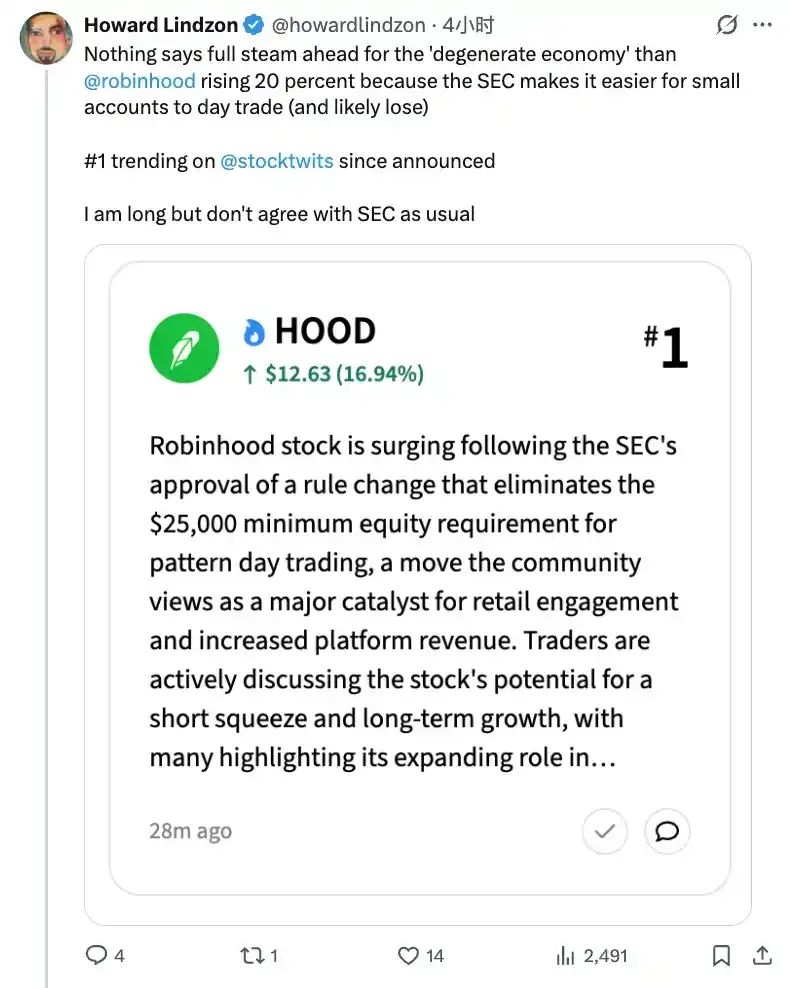
On the same day, the X platform made cashtag truly usable for the first time. Cashtag was invented, appropriated, shelved for over a decade, and then weaponized right under the nose of its inventor, who was still advertising on the opponent's platform.

Why Wealthsimple?

The Cashtag feature was first launched in the US and Canada, but only Canadian users can click on a Cashtag to directly jump to a broker to place an order. The reason is simple: Wealthsimple is a Canadian company, so it's available in Canada. The trading partner for the US market has not yet been announced. But the interesting question is: Why Wealthsimple, and not other Canadian financial institutions?

Wealthsimple is Canada's largest online broker—this is its most direct identity. Founded in 2014, it now manages over CAD 50 billion in assets and has extremely high penetration among young investor demographic in Canada. It holds both traditional securities licenses and digital asset trading permits (Wealthsimple Digital Assets), allowing it to handle both stocks and cryptocurrencies—a condition that X's Cashtag needs to support. This is not something just any institution in Canada can meet.

At the same time, Wealthsimple is also a partner with "a history."

In March 2026, just one month before the partnership with X was announced, the Quebec Superior Court approved a class-action lawsuit settlement against Wealthsimple's crypto business. The cause was its promotion of "zero-commission" trading without clearly explaining to users that it profits from the bid-ask spread. The final settlement was CAD 750,000, averaging about CAD 3.34 per investor. Wealthsimple did not admit any wrongdoing, but the information disclosure issue was already publicly disputed.

Earlier, in 2025, Wealthsimple experienced a data breach. A software package from a trusted third-party supplier was attacked, leading to unauthorized access to some customers' Social Insurance Numbers and account information. Wealthsimple controlled the situation within hours, completing full notification and emergency response. From a crisis management perspective, it did not collapse.

To summarize Wealthsimple's status in one sentence: It has stumbled, but it has gotten back up. It knows where the regulatory boundaries are and has real crisis management experience. For X's new feature, which aims to connect social discussion with trading entry, such a partner, compared to one that hasn't been tested, actually presents more predictable risks.

The real suspense lies in the US market. Robinhood is testing its own social trading feature (Robinhood Social); Coinbase has deeper crypto compliance experience but also more friction with the SEC. Whom X chooses in the US will be the real test of whether this model can succeed.

X's Financial Ambitions, A Timeline Explained in One Chart

The launch of the Cashtag feature marks the assembly of a layered architecture. Looking back at X's actions over the past 16 months, each step falls into a precise position:

January 2025: Partnered with Visa, obtaining the infrastructure for fiat peer-to-peer transfers;

January 2026: Nikita Bier previewed Smart Cashtags, the outline of the financial data layer began to emerge;

February: Proactively clarified "X is not a broker," completing the regulatory separation;

March: X Money officially announced public beta plans, the payment layer surfaced;

April 14: Cashtags launched, simultaneously announcing the Wealthsimple partnership—the data layer and trading layer connected for the first time.
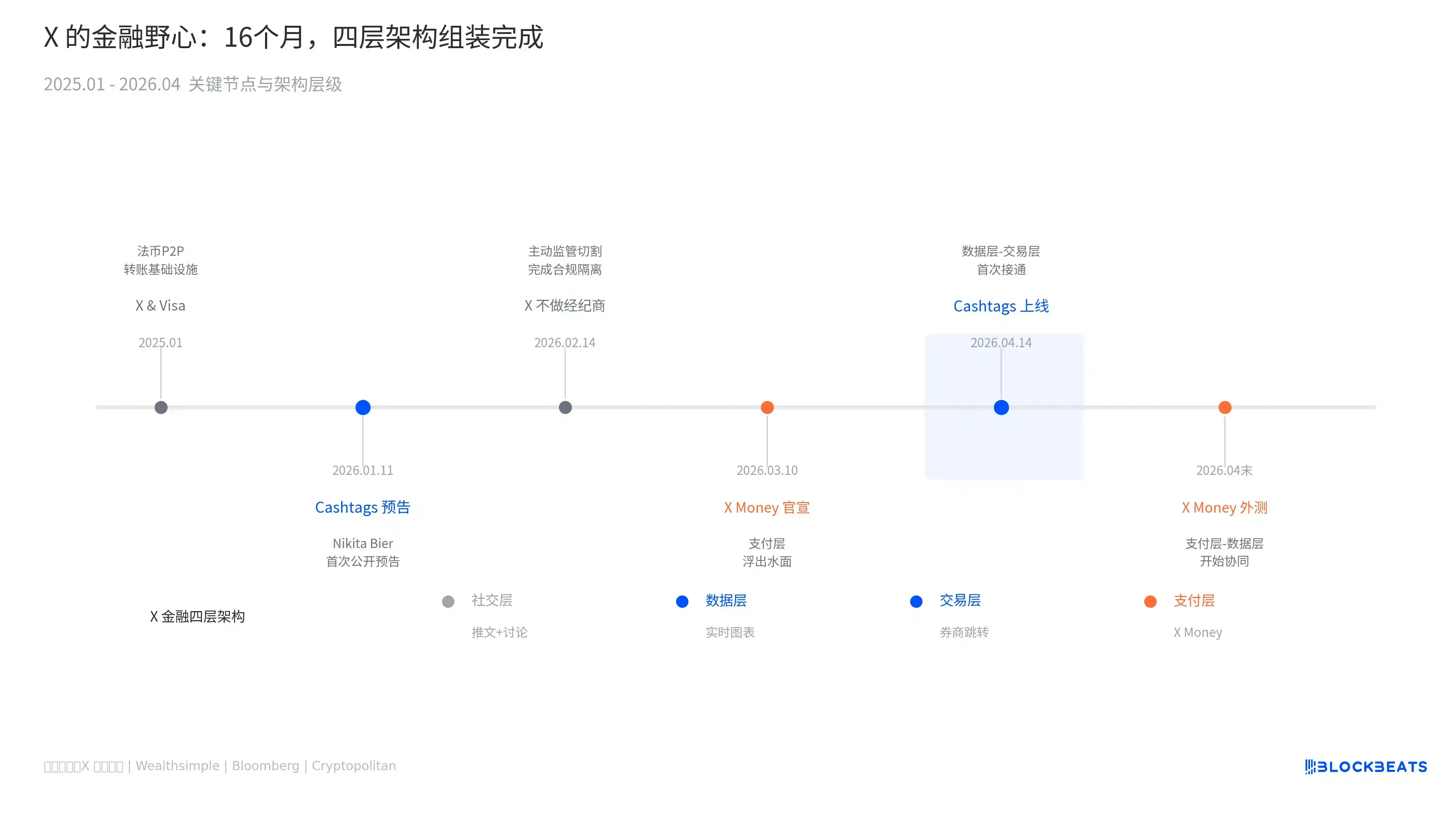
Stack the four layers together: Social layer (tweets + discussions), Data layer (real-time charts), Trading layer (broker jump), Payment layer (X Money P2P transfers + 6% APY yield account). Each layer individually has mature competitors, but combined, no platform has done this before.

This is the most concrete landing of the "everything app" that Elon Musk has been talking about. Starting from attention, it first captures all discussions about money, then step by step transforms these discussions into real capital flows. From Howard Lindzon typing the first $AAPL on StockTwits in 2008 to the X platform today allowing hundreds of millions of users to click this symbol and directly buy stocks, cashtag took 18 years to fulfill its destiny.


Related Questions

QWhat is the Cashtag feature recently launched on X, and how does it work?

AThe Cashtag feature on X allows users to type a dollar sign followed by a stock ticker (e.g., $AAPL) in a post, turning it into a clickable blue link. Clicking the link displays real-time stock price charts, historical price trends, and all related discussions on X. In Canada, it also includes a button to jump directly to Wealthsimple to execute trades.

QWhy did X position itself as a 'data and discovery layer' instead of a broker for the Cashtag feature?

AX positioned itself as a 'data and discovery layer' to avoid the complex compliance requirements and regulatory scrutiny from entities like the SEC and FINRA that come with being a broker. By only providing information and redirecting users to third-party brokers for transactions, X maintains a模糊 regulatory boundary.

QWho originally invented the concept of 'cashtag', and how was it adopted by Twitter (now X)?

AThe concept of 'cashtag' was invented by Howard Lindzon, a financial analyst and angel investor, who created StockTwits in 2008. He used the $ symbol followed by stock tickers to create clickable topic tags for discussions. Twitter (now X) adopted this idea in 2012 without compensation or acknowledgment, as the term 'cashtag' and the $ symbol are not copyrighted.

QWhy did X choose Wealthsimple as its initial trading partner for Cashtag in Canada?

AX chose Wealthsimple because it is Canada's largest online broker, managing over CAD 50 billion in assets, with high penetration among young investors. It holds licenses for both traditional securities and digital asset trading, aligning with X's support for stocks and cryptocurrencies. Additionally, Wealthsimple has experience handling regulatory issues and data breaches, making it a tested partner.

QWhat are the four layers of X's financial ecosystem as outlined in the article, and how do they integrate?

AThe four layers are: 1) Social layer (posts and discussions), 2) Data layer (real-time charts and information), 3) Trading layer (broker redirects for transactions), and 4) Payment layer (X Money P2P transfers and 6% APY yield accounts). Together, they form a comprehensive system that captures financial discussions and converts them into actionable financial activities, unique to X's 'super app' vision.

Related Reads

When Doing Cryptocurrency Payment, the First Thing is Licenses, What is the Second?

When launching a crypto payment business, obtaining the necessary licenses is the crucial first step. However, the second, and arguably more critical, step is designing a comprehensive operational framework that forms a coherent business loop. This loop must be clearly understood and executable by all stakeholders: banks, payment partners, exchanges, on-chain analytics providers, regulators, and your internal team. Many projects mistakenly believe a single license permits all operations. Licenses merely grant entry; they don't define how the specific business functions. The real challenge lies in detailing every aspect of the workflow. This involves clarifying the customer base, the flow of fiat and crypto assets, the settlement process, and establishing clear lines of responsibility for risks like AML compliance, sanctions screening, chargebacks, and regulatory inquiries. A robust framework must answer seven core questions: Who are the clients and merchants? Who collects fiat and crypto? Who handles conversion and custody? And who is ultimately accountable for compliance and risk management? Projects often fail not from a lack of licensing, but during due diligence when they cannot convincingly explain these operational details. Therefore, beyond securing licenses, the priority must be constructing a closed-loop system. This system ensures the business model is transparent, risks are managed, responsibilities are delineated, contracts are aligned, and the entire process is comprehensible to partners and regulators. The true competitive edge in crypto payments lies not in acquiring a license quickly, but in integrating licensing, banking, compliance, and operations into a sustainable and executable whole.

marsbit1m ago

When Doing Cryptocurrency Payment, the First Thing is Licenses, What is the Second?

marsbit1m ago

Arthur Hayes Analysis: AI Bubble Nears Burst, Crypto Market Faces Short-Term Pressure

Arthur Hayes argues that the current AI market is a bubble poised to burst, which will exert downward pressure on the crypto market in the near term. The core trigger is rising oil prices due to the US-Iran conflict and a blockade of the Strait of Hormuz. Higher energy costs directly increase the operational expenses of AI data centers, squeezing profit margins for companies like Google, Anthropic, and OpenAI. Hayes predicts that persistent inflation from high oil prices will force Trump, in a bid to win the November election, to turn public sentiment against the AI industry. He may propose regulations and taxes on data centers and AI companies to appeal to voters concerned about costs and job displacement. Such political rhetoric could shatter market confidence. Furthermore, the market is unlikely to healthily absorb the massive concurrent IPOs of SpaceX, Anthropic, and OpenAI, which together seek valuations in the trillions. The combination of soaring energy costs, overwhelming equity supply, and negative political pressure will puncture the AI bubble. Hayes notes that nearly all new USD liquidity since 2022 has flowed into AI, leaving crypto like Bitcoin behind. When the AI bubble bursts, liquidity will contract sharply, pulling down all risk assets, including cryptocurrencies. In response, Hayes's fund, Maelstrom, has sold all AI-related stocks and non-core cryptocurrencies. It maintains core positions in Bitcoin and Ethereum while increasing exposure to energy sector equities, betting on rising oil and gas prices. He expects Bitcoin to bottom after the AI-led market decline, before rallying again with future monetary easing.

Foresight News15m ago

Arthur Hayes Analysis: AI Bubble Nears Burst, Crypto Market Faces Short-Term Pressure

Foresight News15m ago

To C, To B, and the Next Big Thing Called To A

After To C and To B, the Next Wave is To A: Serving AI Agents In a recent quarterly earnings call, Meituan's Wang Xing introduced a new concept: To A (To Agent), signifying that future business services will increasingly target AI Agents as primary clients, not just consumers or merchants. This shift implies that internet giants must now consider how to make their services more appealing for AI Agents to recommend, fundamentally altering traditional distribution logic. This "To A era" is prompting an unusual trend of alliances among major tech companies. Unlike previous competitive battles, firms like Meituan, Tencent, JD.com, Huawei, OPPO, and OpenAI are rapidly forming partnerships. The reason is strategic: as AI Agents become the primary user interface, handling tasks from a single command (e.g., "Book a Japanese restaurant for tomorrow"), the risk for platforms is being bypassed entirely. Companies are positioning themselves within this new value chain. Three primary strategies are emerging: 1. **Super-Entry Points + Service Providers:** Platforms like Tencent's Yuanbao, WeChat, and ChatGPT aim to be the first-stop Agent, integrating various services (food delivery, shopping, travel) from partners like Meituan and JD.com. 2. **Apps as Callable Services:** Companies like Meituan, JD.com, and Uber are ensuring their core services remain accessible and callable by external Agents, shifting from front-end apps to back-end capabilities. 3. **System-Level Agent Entry Points:** Smartphone makers (Huawei, Honor, OPPO) are leveraging their OS-level AI assistants to control the initial user command, redistributing it to relevant service apps. While alliances offer mutual benefit—entry points gain service capabilities, and service providers gain traffic—inherent conflicts of interest exist. A dominant Agent platform could eventually attempt to connect directly with suppliers (restaurants, hotels), bypassing current aggregators like Meituan or Ctrip. Other unresolved challenges include the potential for Agent recommendations to become a new form of paid ranking and unclear accountability for faulty recommendations. The current rush to form alliances is a defensive move by service providers to secure their position before the landscape solidifies. In this To A-driven restructuring, the greatest risk is not losing the race but failing to hear the starting gun.

marsbit23m ago

To C, To B, and the Next Big Thing Called To A

marsbit23m ago

The More Lifelike the Robot, the More Terrifying? Unveiling the 'Uncanny Valley Effect' in the Era of Humanoid Robots

As humanoid robots become increasingly lifelike, they confront a significant psychological barrier known as the "Uncanny Valley Effect," a concept proposed by Japanese roboticist Masahiro Mori in 1970. This phenomenon describes a dip in human comfort and acceptance when robots appear almost, but not perfectly, human. Minor imperfections in facial expressions, eye movements, or skin texture trigger a subconscious sense of unease, as the brain detects something trying, yet failing, to mimic a person. Examples range from the controversial human-like robot Sophia to animated characters in films like *The Polar Express*. The effect poses a key design challenge for robotics companies. Some, like Boston Dynamics, avoid it entirely by creating highly capable but visibly mechanical robots. Others, like Hanson Robotics, push for greater human likeness despite the risk. For consumer robots, especially in homes, most manufacturers opt for stylized or clearly mechanical designs to ensure broader acceptance. While the Uncanny Valley remains a powerful force, its impact may diminish over time through technological advancements that achieve near-perfect realism or through generational familiarity as people grow accustomed to interacting with humanoid machines. Ultimately, navigating this psychological frontier requires as much understanding of human perception as of robotics technology itself.

marsbit24m ago

The More Lifelike the Robot, the More Terrifying? Unveiling the 'Uncanny Valley Effect' in the Era of Humanoid Robots

marsbit24m ago

Trading

Spot
Futures
活动图片




