IRS 'Raided' by Crypto Investors as Industry Puts Up Fight Against U.S. Tax Proposal

CoinDeskPolicyPublished on 2023-11-12Last updated on 2023-11-13

Abstract

The proposal to establish a U.S. tax regime for digital assets has drawn a stunning 120,000 comments and will be the focus of an IRS hearing today.

  • The Internal Revenue Service's audio-only hearing today will draw views from the crypto industry on what threats the digital assets advocates see embedded in the proposed new tax approach being contemplated for cryptocurrencies.
  • The concerns include user privacy, the scope of crypto entities that would have to report transaction information, the inclusion of stablecoins and whether the proposal implies anything about whether digital assets should be counted as securities.

The U.S. Internal Revenue Service (IRS) is gathering the final words now from a crypto sector that is arguing the agency's proposal for a digital-assets taxation regime is an existential threat to investor privacy and to decentralized crypto projects.

10

After a comment deadline and a public hearing on Monday, the U.S. Department of the Treasury's tax arm will have a mountain of more than 120,000 comments to sift through – aided in some instances by the wordsmithing of artificial intelligence tied to such campaigns as the LeCpunK Army's "Treasury Raid."

Monday's hearing – confined to audio – will gather prominent crypto advocates to lay out their arguments on this proposal that maps out how crypto brokers and investors would report transactions to the IRS.

A D V E R T I S E M E N T

The new taxation system – which won't become final until IRS officials weigh the input, rewrite a final version and approve it – has drawn industry ire that's partially focused on how the proposal would define a "broker" that needs to comply.

"The digital asset middleman category stretches the statutory language beyond its breaking point in direct contravention of the relevant legislative history," the DeFi Education Fund argued in a comment letter. The current language of the proposal "inexorably leads to the conclusion that the proposed regulations could treat every participant in the blockchain technology stack as a broker."

DeFi

By intentionally roping in some decentralized finance (DeFi) platforms, decentralized autonomous organizations (DAOs), wallet providers and certain payment processors, the IRS may be trying to require tax information from organizations that would have difficulty providing it.

A comment from Americans for Tax Reform says the government's scope for brokers is pursuing "a broad definition that includes entities incapable of reporting the applicable transactional information." The group argued that "the IRS wants to rope DeFi into the reporting regime to ensure that other entities do not convert to DeFi entities and circumvent reporting requirements."

Another frequent industry concern was for investor privacy when it comes to government reporting of transactions, which crypto brokerage Coinbase (COIN) argued "would impose an unprecedented, unchecked and unlimited tracking on the daily lives of Americans," according to a comment letter from Lawrence Zlatkin, the company's vice president for tax. He contended that the regulations as written would allow "government surveillance of the choices Americans make about their most private health care decisions, or even when they purchase a cup of coffee."

A D V E R T I S E M E N T

Bright side

Despite the objections, there is a general bright side for a crypto taxation approach in the U.S. Establishing rules and forms for how investors report their gains would eliminate one of the central impediments toward wider interest in cryptocurrencies: uncertainty over how to figure out what one owes in taxes. The proposal would establish a bespoke tax form, akin to the 1099s stock market investors are used to dealing with.

Were an IRS rule to pass before any of the crypto proposals from the U.S. Securities and Exchange Commission (SEC), it would clear the first major hurdle in U.S. crypto regulation: establishing an official status for digital assets in U.S. finance, even as Congress continues to stumble in its debate over future crypto markets laws.

Federal agencies are compelled to review all comments in the process of giving birth to a new rule, and the incredible volume for this proposal could demand more time than usual to complete that task. Tens of thousands of individuals provided objections.

Other complaints with the proposal focused on its inclusion of stablecoins as reportable assets and its relationship with defining securities.

To avoid this rule reinforcing the argument that digital assets are securities, Nicolas Morgan, president of the Investor Choice Advocates Network, asked the Treasury Department to make it clear that this rule wouldn't apply to securities law.

Edited by Stephen Alpher.

Related Reads

Is Bitcoin Price Lagging? Record Global M2 Money Supply Could Be a Springboard for BTC's Rise

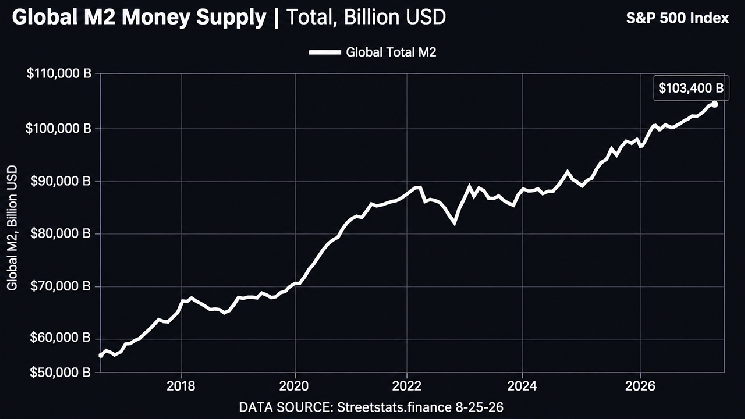
Bitcoin Price Lagging? Record Global Money Supply M2 Could Springboard BTC Growth The global money supply (M2) is expanding rapidly, similar to global debt. The US M2, representing all money circulating in its economy, has reached a record $23.16 trillion. Combined with figures from major economies like the Eurozone, China, and Japan, the global M2 is approximately $103 trillion. Some estimates, however, place it closer to $195 trillion. This surge in liquidity is significant because excess capital often seeks higher returns in assets like precious metals, stocks, and cryptocurrencies. Bitcoin's recent price surge above $81,000 has brought the global M2 metric back into focus. Following a sharp rise in early August after a US Treasury bond buyback announcement, BTC still trades about 37% below its October 2025 all-time high exceeding $126,000. This gap presents a potential "catch-up" trade thesis. Bitcoin's fixed supply of 21 million contrasts with governments' ability to print fiat currency, making scarce assets like BTC attractive if monetary expansion continues. Historically, Bitcoin's bull cycles in 2017-2018 and 2020-2021 coincided with M2 expansion and increased liquidity. Over the past year, the correlation seemed broken as M2 grew while Bitcoin's price fell sharply from its peak. Observers believe fresh dollars may have remained locked in cash-favorable investments. Some, like Ash Crypto, now suggest a long-awaited alignment between Bitcoin and M2 may be starting, especially as a weakening US Dollar Index this month has seen assets like gold and Bitcoin surge. A softer dollar pressures cash havens and prompts holders to act. While record M2 doesn't guarantee higher Bitcoin prices, a sustained influx of liquidity, a weak dollar, and capital flowing into alternative assets could trigger a catch-up rally sooner than expected. However, changes in these conditions could lead to the opposite outcome.

cryptonews.ru22m ago

Is Bitcoin Price Lagging? Record Global M2 Money Supply Could Be a Springboard for BTC's Rise

cryptonews.ru22m ago

Blockchain Capital Partner: Tokenization Will Reshape the Underlying Structure of Capital Markets

"Blockchain Capital partner Aleks Larsen argues that tokenization will fundamentally restructure capital markets by solving a costly 'packaging' problem in finance. Currently, assets like mortgages, private equity, and stocks exist in fragmented, incompatible systems, creating huge friction and slowing capital flow. Tokenization introduces a standardized, machine-readable interface for assets—akin to shipping containers for finance. Just as containerization standardized global trade, enabling massive efficiency gains and economic growth, tokens standardize financial rights. This allows platforms, lenders, and custodians to interact with assets directly on a shared network without rebuilding infrastructure for each one. Stablecoins demonstrate this potential, processing volumes rivaling Visa with far lower cost and faster settlement. Beyond payments, tokenization is expanding to assets like U.S. Treasuries, commodities, and private credit, now totaling nearly $400 billion on-chain. This shift changes financial service access: instead of depending on relationships with institutions, services become accessible based on the asset's tokenized properties themselves. DeFi protocols like Aave exemplify this, where assets meeting criteria can be used as collateral programmatically. Ultimately, tokenization will reorganize capital markets around open networks of specialized services, lowering barriers to entry and reducing costs. This could unlock global capital for currently underserved assets—small receivables, regional infrastructure, emerging market credit—integrating them into a seamless, programmable financial system. Combined with AI, tokenization promises to make capital allocation more efficient, transparent, and globally accessible, reshaping how economic value is created and distributed."

marsbit26m ago

Blockchain Capital Partner: Tokenization Will Reshape the Underlying Structure of Capital Markets

marsbit26m ago

Trading

Spot
活动图片