Coin price today 11/7: Bitcoin prepares for CPI week, MINA leads altcoins as US stocks prosper

Tap Chi BitcoinPublished on 2023-07-11Last updated on 2023-07-11

Abstract

Bitcoin (BTC) price is rising in the lower timeframe, but there is no viable price action in the higher timeframe.
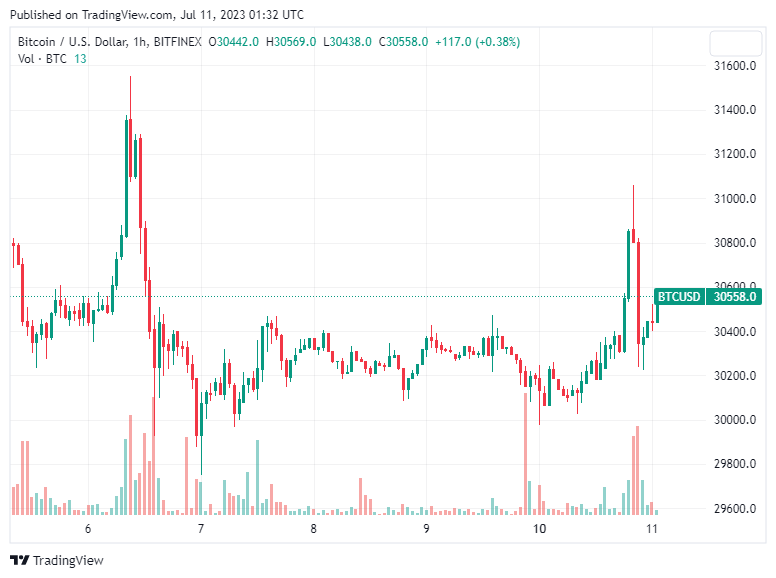
Bitcoin (BTC) price is rising in the lower timeframe, but there is no viable price action in the higher timeframe.

Source: TradingView

The Dow Jones Industrial Average rallied on Monday (July 10), as Wall Street attempted to recover from last week's decline. The reversal comes as investors brace for a flurry of inflation data this weekend and the start of second-quarter earnings season.

Closing Monday's session, the Dow Jones Industrial Average rose 0.62%) to 33,944 points. The S&P 500 Index advanced 0m24% to 4,409 points. Meanwhile, the Nasdaq Composite inched up 0.18% to 13,685 points. The main indexes all ended a series of 3 consecutive losing sessions.

The US CPI Consumer Price Index report will be released on July 12, followed by the PPI producer price index report – a measure of wholesale price pressure – on July 13.

Last week, the S&P 500 lost 1.16%, while the Nasdaq Composite and Dow Jones fell 0.92% and 1.96%, respectively. Although jobs data rose less than expected in June, wages rose slightly higher than expected, raising concerns about the possibility of more rate hikes from the US Federal Reserve (Fed). .

Fundstrat's Tom Lee sees inflation reporting possibly lower than forecast, which could lead to another steep climb.

Gold prices were mostly flat on Monday, as investors awaited US inflation data that could influence the Federal Reserve's (Fed) policy stance. At the end of the session, the spot gold contract was almost flat at 1,925 USD/oz. Gold futures fell 0.1% to $1,931 an ounce.

On the same day, oil prices fell on the possibility of more US rate hikes, however, the move to cut crude oil supply from top oil exporters Saudi Arabia and Russia capped the decline. of oil prices. At the end of the session, the Brent oil contract fell 1% to $ 77.69 a barrel, after touching the highest level in more than 2 months at the beginning of the session.

On the 1-hour chart, BTC/USDT is showing actionable price movement, unlike the one-day timeframe where the market is stagnant. The crypto king remains bullish after flipping the 50, 100, and 200-day exponential moving Medium (EMAs) at $30,522, $30,296 and $30,344 to support.

However, experts predict there will be a lingering drag until the CPI causes some volatility. Based on popular opinion, the report could be at 3.1%, an outcome that could trigger a rally for the top cryptocurrency.

If that happens, Bitcoin price is likely to break out of the range and move above $30,500 to record new highs.

The Fibonacci Retracement indicator shows that Bitcoin price is likely to head towards the 50% Fib level at $30,727. This outlook is supported by the Relative Strength Index (RSI) and AO, moving up to show bullish momentum.
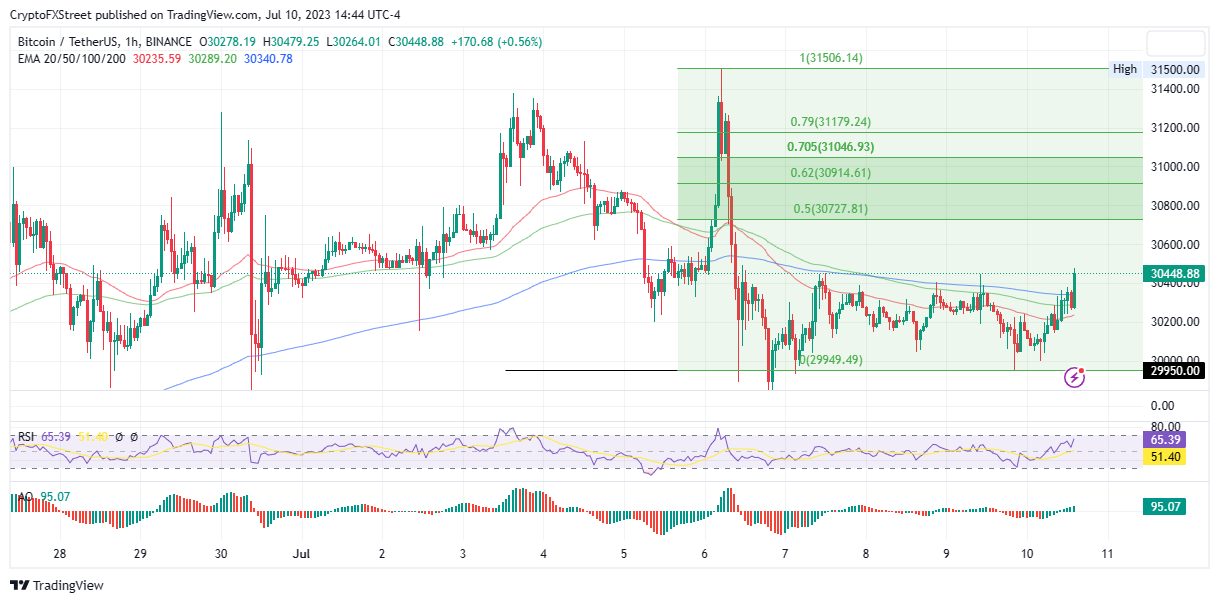
BTC chart. Source: TradingView

However, the influence of macroeconomics like CPI has dried up over time, meaning BTC could either continue its dull price action or succumb to investor greed and head south.

As for ETH, due to the lack of proper catalysts in individual ecosystems, the largest altcoin price is moving in tandem with BTC, gradually increasing its position as the broader market prepares for CPI.
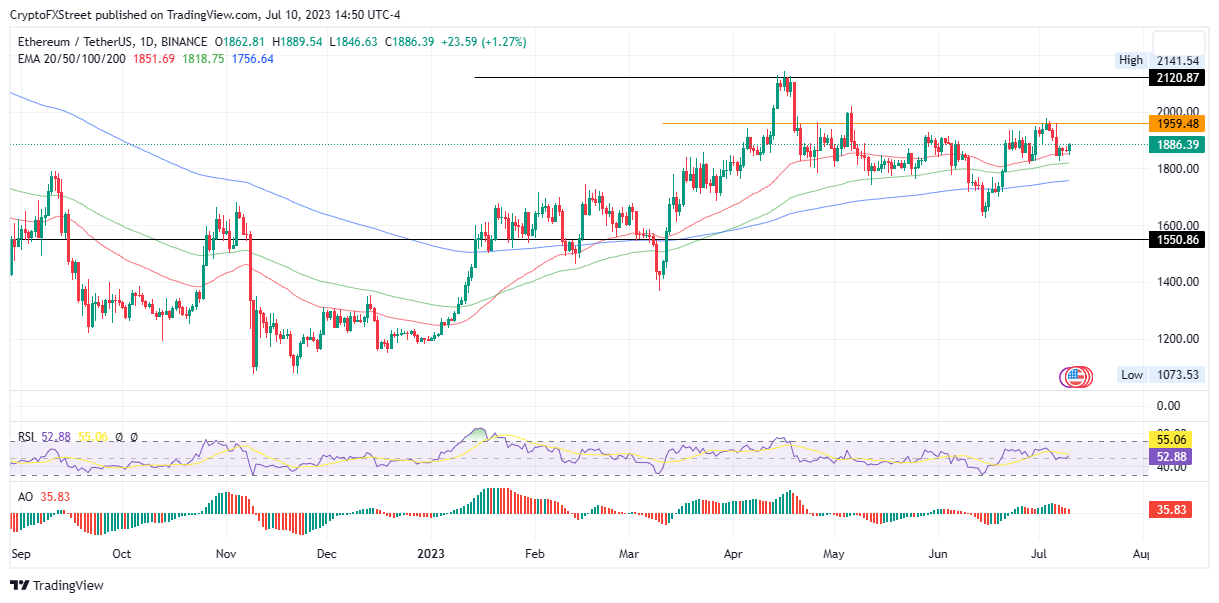
ETH chart. Source: TradingView

On the other side of altcoins, about half of the top 100 are in the green, with MINA leading the way with a gain of more than 15% in a 24-hour period. Following closely behind are MATIC approaching 9%, KAVA +7%, FTM +6.3%, BNB +5.3% and other bullish altcoins recording 0.5 – 4% returns.
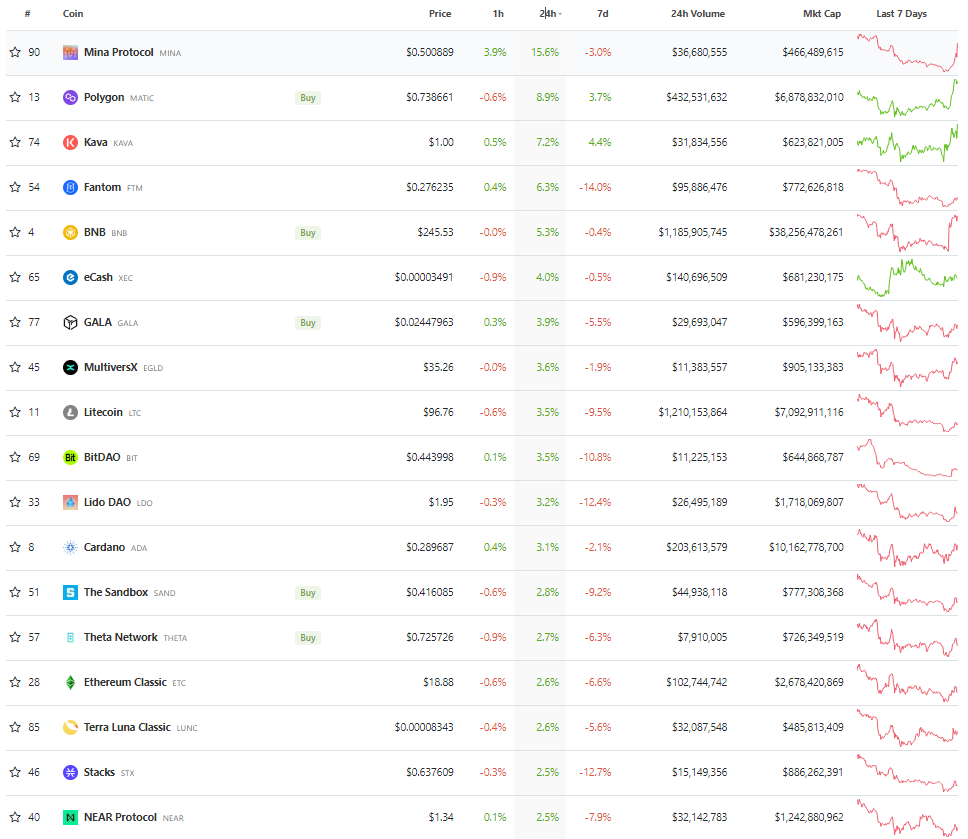
Source: Coinecko


Related Reads

When Real Estate Ownership Goes Digital: What Happens to Your Rights, Risks, and Liquidity?

"Tokenizing Real Estate: Rights, Risks, and the Path to Liquidity" While tokenizing real-world assets (RWA) gains traction, real estate presents unique complexities. Beyond technical token issuance, critical challenges remain: enforcing legal rights, managing the underlying physical asset, and creating genuine secondary market liquidity. This article explores these issues through OneAsset, a Dubai-based commercial real estate (CRE) tokenization platform. OneAsset moves away from simply offering asset fragmentation. Instead, it focuses on institutional-grade infrastructure, prioritizing asset quality, legal enforceability, and operational fundamentals. Each property is held in an independent, single-asset vault, backed by a legally separate Special Purpose Vehicle (SPV) for bankruptcy remoteness. Investors acquire tokens representing the economic rights to a specific property, with precise legal claims defined by the underlying SPV structure. OneAsset emphasizes that tokenization cannot transform a poor-quality asset. Its initial focus is on institutional investors and quality Dubai-based CRE, selected for stable tenant cash flows and a clear regulatory environment. The platform integrates compliance by design, aiming to embed investor qualification and transfer rules directly into the token architecture. A core insight is that asset fragmentation does not automatically create liquidity. True liquidity depends on the asset's inherent quality—its location, cash flow, and valuation—as well as sufficient buyer demand. The goal is not just tradability, but making real estate rights more easily priced, verified, and reallocated. Looking ahead, the article discusses the potential for "AiFi" (AI-powered finance). For AI agents to autonomously allocate capital, investment assets like real estate tokens must become truly "machine-readable." This requires a high degree of standardization in legal rights, valuations, cash flows, and compliance data—a direction OneAsset is pursuing through its structured data reporting. In conclusion, real estate tokenization is shifting from a technology narrative to a focus on asset fundamentals. Blockchain can enhance efficiency and programmability, but it cannot replace sound underwriting, property management, or legal execution. The real work begins after the asset is on-chain.

marsbit26m ago

When Real Estate Ownership Goes Digital: What Happens to Your Rights, Risks, and Liquidity?

marsbit26m ago

After Affecting Two Generations, Meta Ordered to Pay $18 Billion in Damages

After more than two decades, a legal parallel has emerged. In 1998, major U.S. tobacco companies settled for $206 billion, leading to strict advertising bans and warning labels that significantly reduced smoking rates. On August 26, 2026, Meta reached a landmark settlement with U.S. attorneys general, agreeing to pay up to approximately $18 billion and implement mandatory changes to Facebook and Instagram. This historic settlement, one of the largest against a tech company, stems from allegations that Meta deliberately designed addictive features like infinite scroll and push notifications, harming youth mental health and violating child privacy laws. Facing a potential $1.4 trillion lawsuit and a series of unfavorable jury verdicts, Meta chose to settle on the eighth day of trial to avoid a catastrophic ruling. The core of the agreement is not just the financial penalty, which Meta will pay over 10 years, but a series of strict, 10-year product mandates for young users. These include a hard two-hour daily time limit (combined across apps), a default "nighttime block" from midnight to 6 AM, restricted notifications during school hours, hidden "like" counts, an optional non-algorithmic feed, and stronger age verification. An independent auditor will monitor compliance. Crucially, roughly 30% ($5.3 billion) of Meta's payment is contingent on YouTube and TikTok adopting similar measures and paying around $5 billion each. This move aims to create an industry-wide standard and prevent Meta from being competitively disadvantaged. The settlement is being likened to Big Tobacco's "tobacco moment." By legally framing addictive algorithm design as a "public nuisance," it sets a powerful precedent. Nearly 3,000 similar cases are pending against other social media giants, signaling a fundamental shift in regulatory pressure. The era where platforms could deny the addictive impact of their designs on children is effectively over.

marsbit32m ago

After Affecting Two Generations, Meta Ordered to Pay $18 Billion in Damages

marsbit32m ago

Trading

Spot
活动图片