Coin price today June 16: Bitcoin turns around $25,500, altcoins and US stocks rally as investors believe the Fed is about to stop raising interest rates

Tap Chi BitcoinPublished on 2023-06-16Last updated on 2023-06-16

Abstract

Ethereum has plunged below $1,700 during the past day. Here's the on-chain indicator that may have signaled this dip in advance. Ethereum Age Consumed Metric Saw A Spike Before The...

Bitcoin slightly rose to around $25,500 as investors believe the Fed is about to end its interest rate hike.
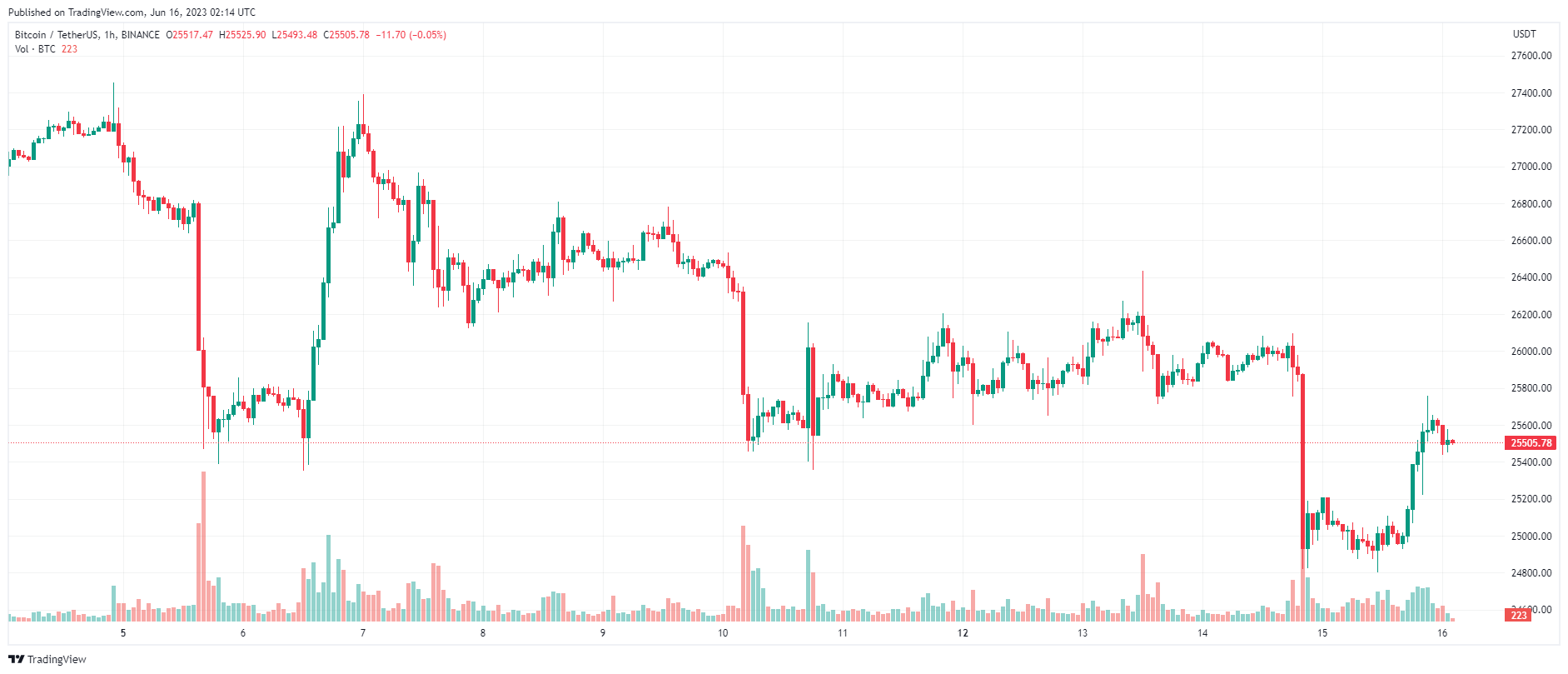
BTC Price Chart – 1 hour | Source: TradingView

Dow Jones recovered more than 400 points and S&P 500 hit a new 13-month high as investors bet that the US Federal Reserve (Fed) is about to stop raising interest rates.

At the end of the session, the Dow Jones index rose 428.73 points (equivalent to 1.26%) to 34,408.06 points; The S&P 500 climbed 1.22% and closed at 4,425.84 points; and Nasdaq Composite rose 1.15% to close at 13,782.82 points. Bond yields fell, while technology stocks continued to lead the market, in line with Wall Street trends in 2023.

Thursday's rally took the S&P 500 and Nasdaq to session highs since April 2022.

The S&P 500 is also recording its longest streak of gains since November 2021 and is about to record its biggest weekly gain since March. Compared to last October's Dip , the index is now up 23%. YTD, the S&P 500 is up 15%, while the Nasdaq technology index is also jumping more than 31% in 2023.

Regarding technology stocks, Microsoft and Oracle gained about 3.2% and 3.5% respectively, while Alibaba climbed nearly 3.2%.

On Wednesday, Fed Chairman Jerome Powell said at a news conference after the policy meeting that the Federal Open Market Committee (FOMC) would use the remaining six weeks before its next meeting to “ consider tightening monetary policy”. He added that the central bank has yet to make a decision on its July policy move.

Thursday's market rally suggests investors are still betting on potential uncertainty ahead of the FOMC's July meeting.

However, Chairman Powell confirmed that the Fed could continue to raise interest rates this year, and said that the agency will continue to assess the situation based on monthly economic data. It is known that US stocks rose and fell in Wednesday's trading session after this comment.

Economic data released on Thursday gave investors and policymakers a clearer view of the state of the labor market and consumer spending. The number of applications for unemployment benefits last week was 262,000, higher than the estimate of 245,000. Besides, retail sales increased by 0.3%.

Oil prices surged more than 3% to a weekly high on Thursday on the back of a weaker dollar and strong refining data in China, the world's top importer.

Ending Thursday's session, Brent crude oil futures rose $2.47/barrel, or 3.4%, to $75.67/bbl, while U.S. WTI crude oil futures contracts increased by 2.35 USD/barrel, or 3.4%, to 70.62 USD/barrel.

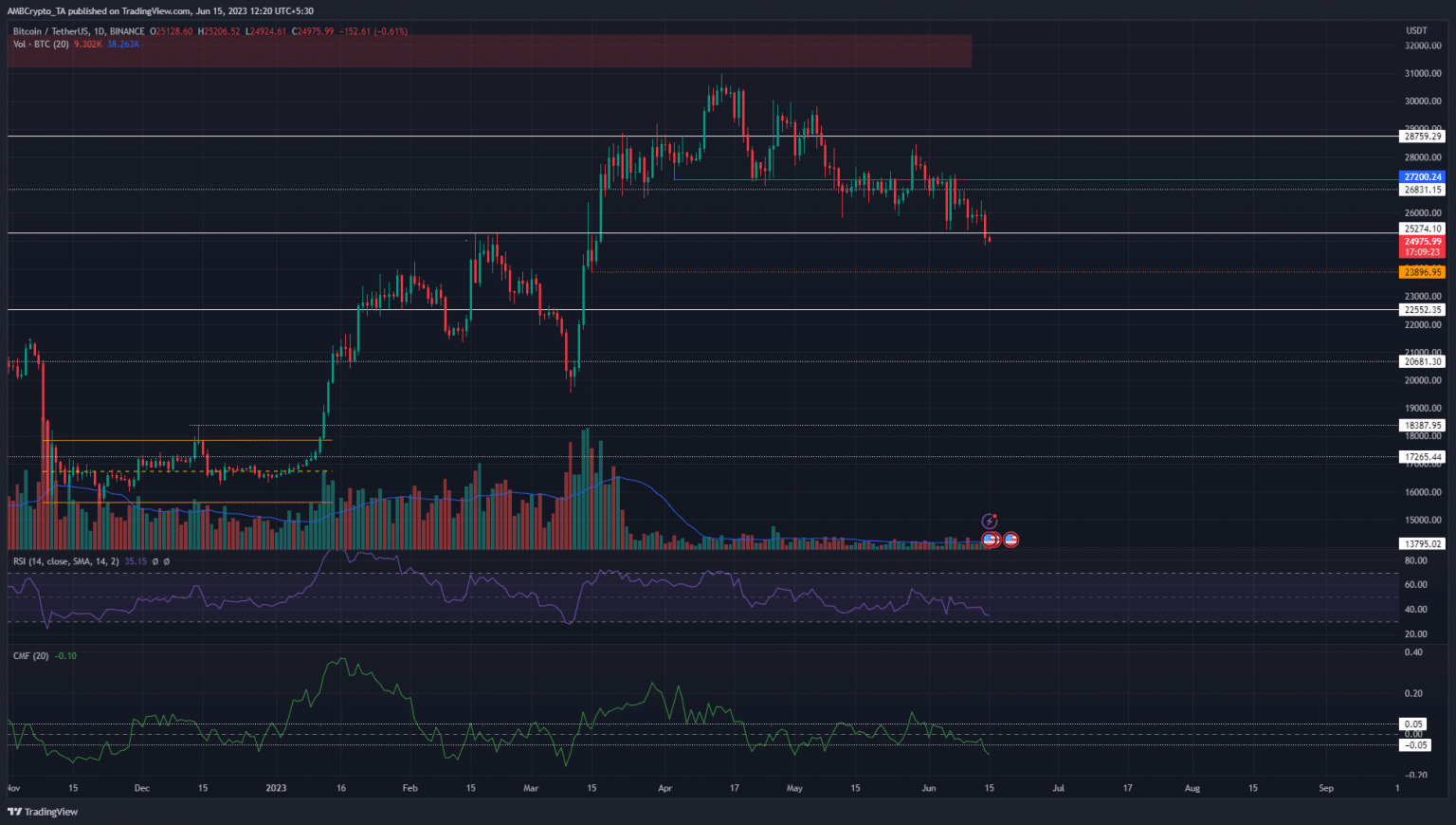
Bitcoin [BTC] has a strong bearish outlook on the higher timeframe price chart. In the short-term, however, BTC has regained key support at $25,200 and is currently trading around the $25,500 area.

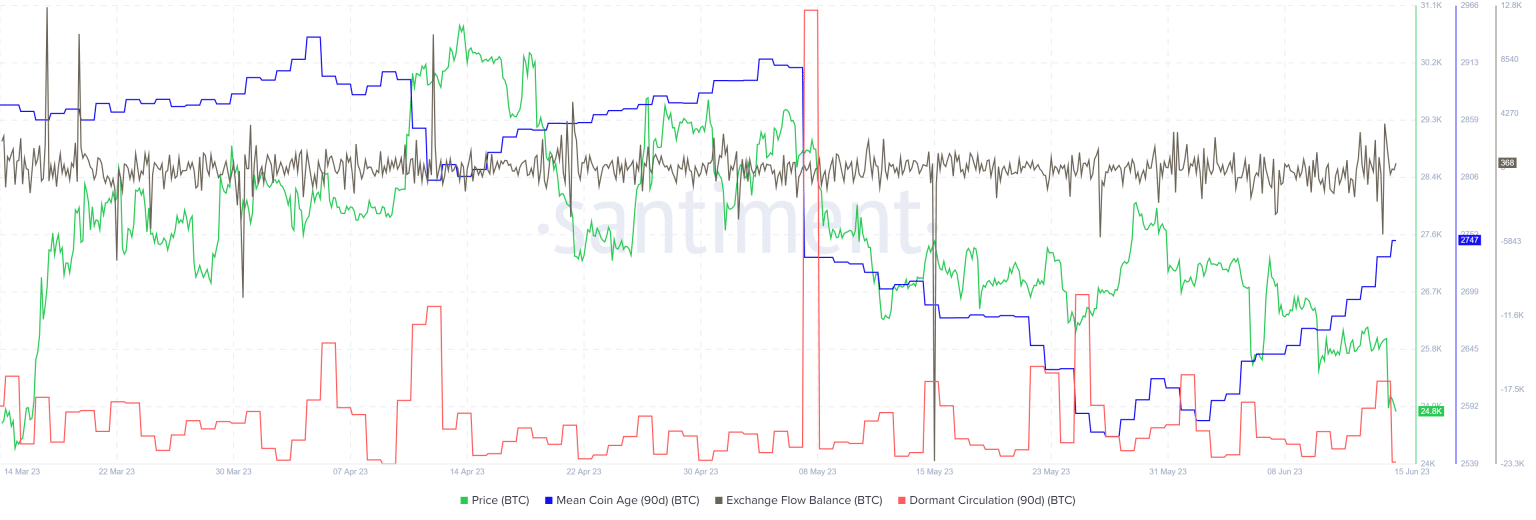
Investors have conducted massive withdrawals to their wallets, causing the supply on exchanges to decrease rapidly. This trend follows the uncertainty surrounding the SEC's lawsuit against Binance and Coinbase.
Source: TradingView

In the larger time frame, Bitcoin's bias is bearish as the market has made a series of lower highs and lower Dip after sliding below the higher Dip at $27,200 on April 24, breaking out previous bull market structure.

The majority of the RSI has been below the neutral 50 level since mid-April, showing bearish momentum. CMF dipping below -0.05 for the first time in a month shows significant Capital outflow from the Bitcoin market.

On the downside, the $23,900 – $24,000 area could offer some support. Meanwhile, $22,000 and $19,500 are the next levels to watch out for.
Source: Santiment

BTC net outflow figures on exchanges show a continuous inflow over the past 4 days. This indicates an increase in selling pressure. The Inactive Circulating Supply Index spiked on June 14. Overall, Bitcoin's price action and metrics have highlighted a bearish bias.

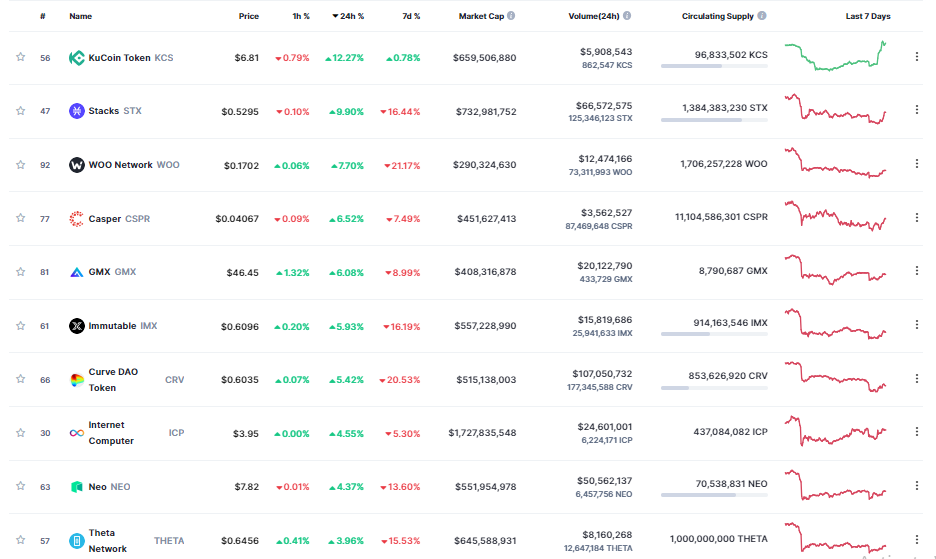
The altcoin market showed signs of a slight recovery in the short term, as BTC turned to rally after a sharp decline.

KuCoin Token (KCS) is the best performing project in the top 100, having bounced up more than 12% in the last 24 hours, erasing the week's losses completely.

Other projects such as Stacks (STX), WOO Network (WOO), Casper (CSPR), GMX (GMX), ImmutableX (IMX), Curve DAO Token (CRV), Internet Computer (ICP), Peg (Peg), Theta Network (THETA)… recovered from 3-9%.
Source: Coinmarketcap

Ethereum (ETH) has also successfully reclaimed the $1,650 level after breaking through this mark on June 14. Currently the largest smart contract Token in the market is trading around $1,660 with a slight gain of 0.5% on the day.
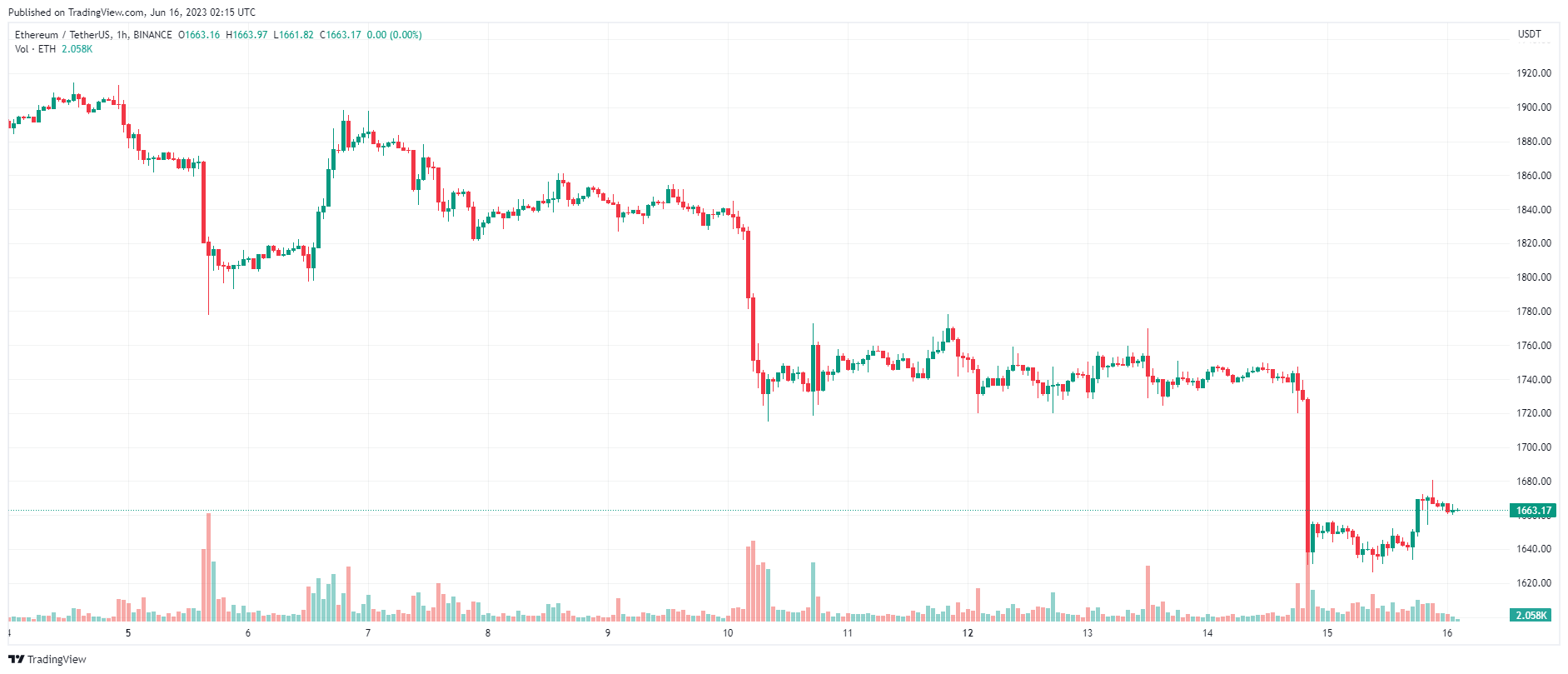
ETH price chart – 1 hour | Source: TradingView

The column “ Coin Price today” will be updated at 9:00 daily with general market news, readers are welcome to follow.

Ethereum has plunged below $1,700 during the past day. Here’s the on-chain indicator that may have signaled this dip in advance.
Ethereum Age Consumed Metric Saw A Spike Before The Price Decline
According to data from the on-chain analytics firm Santiment, institutional investors look to have been expecting the move to take place. The indicator of interest here is the “ETH age consumed,” which first finds the total number of coins moving on the Ethereum blockchain. Then it multiplies this value by the days these coins had been dormant before their movement.
So, in this way, the metric keeps track of how many coins are being sold/moved each day and uses their age as a weighting factor. This means that many old coins are moved to the network whenever this indicator’s value is high.
Naturally, low values of the metric, on the other hand, would imply that there aren’t many coins moving on the chain right now or some coins with a low average age are being transferred.
Related Reading: XRP And Ethereum Seeing Increased Social Media Talk As Bitcoin Loses Interest
Now, here is a chart that shows the trend in the Ethereum age consumed over the past month:
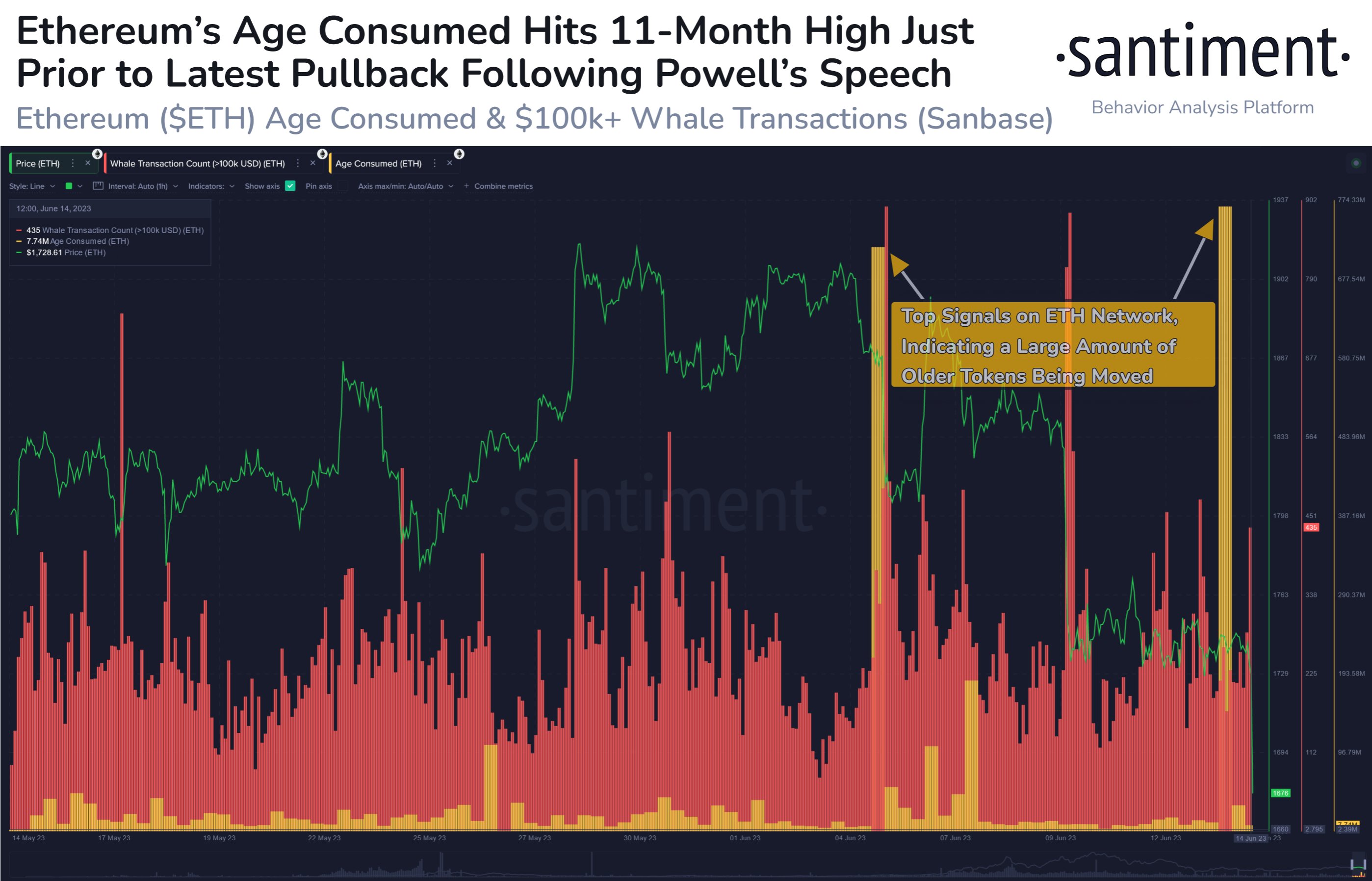
Ethereum Age Consumed


Looks like the value of the metric has been quite high in recent days | Source: Santiment on Twitter
As displayed in the above graph, the Ethereum age consumed metric had recently registered a very large spike. This would suggest the potential movement of many dormant coins on the chain during this surge.
Generally, when such large spikes in the indicator are observed, it’s a sign of selling from the long-term holders (LTHs). The LTH cohort includes all the investors holding onto their coins since more than 155 days ago.
These holders are the experienced hands in the market who don’t easily sell even when the market is distressed. Because of this reason, their movements can be something to watch out for, as when they do finally sell, it’s usually not a positive sign for the price.

The chart shows that the LTHs had also shown a large move earlier in the month. Shortly after these investors became active, the cryptocurrency price plunged.
This time, the spike in the Ethereum age consumed also seems to have preceded a price decline, as the cryptocurrency’s value has now dropped below the $1,700 level.
This latest price plunge has come after the news that the US Federal Reserve isn’t raising interest rates this time, but more hikes would be coming later in the year to fight inflation.
Santiment suggests that the spike in the age consumed metric before the price decline could imply that the institutions already expected the move, hence why they shifted their coins early.
ETH Price
At the time of writing, Ethereum is trading around $1,600, down 11% in the last week.

Ethereum Price Chart


ETH has taken a plunge recently | Source: ETHUSD on TradingView
Featured image from iStock.com, charts from TradingView.com, Santiment.net


Related Reads

Behind the Trillion-Dollar Capital Gamble: Time is Becoming the Counterparty to AI

Amidst unprecedented capital investment in AI, a trillion-dollar "gamble" is unfolding where time itself is becoming the opposing force. Recent events illustrate the volatility and profound uncertainty underlying this rush. In July 2026, hedge fund Situational Awareness, founded by Leopold Aschenbrenner and heavily leveraged on AI hardware stocks like Sandisk, lost $35 billion in a month as a market selloff triggered massive declines, highlighting the irrational human foundations of even AI-augmented markets. Simultaneously, the regulatory landscape is shifting dramatically. Social media addiction lawsuits in the US have exploded, with major platforms like Meta, Snap, TikTok, and Google now facing billions in liabilities. This signals a critical change: the "algorithm is neutral" defense is crumbling for AI, introducing massive legal and governance uncertainties that threaten AI's business models. Financially, the sector is fueled by unsustainable capital intensity. Google reported its first-ever negative free cash flow (-$5.9B) in Q2 2026, while its AI capex is projected to hit $200B. Industry-wide, debt issuance for AI infrastructure could reach $1.5 trillion. Companies like OpenAI and Anthropic project profitability only by 2030, betting on future revenues in the hundreds of billions. This mirrors a national dilemma: the U.S. faces a looming debt crisis, with interest costs projected to exceed $1 trillion annually, creating pressure to secure technological supremacy through AI. The core paradox is that this historic capital infusion aims to buy time for AI to mature and dominate. However, if the anticipated technological leap or market scale fails to materialize within the narrow window before profitability deadlines or a debt crisis, the simultaneous collapse of both corporate and national financial bets could be catastrophic. The race is not just for technological advantage, but against the clock.

marsbit2m ago

Behind the Trillion-Dollar Capital Gamble: Time is Becoming the Counterparty to AI

marsbit2m ago

Monero Price Forecast for 2026-2032: Is it Worth Buying XMR Now?

**Article Summary: Monero (XMR) Price Forecast for 2026-2032 and Investment Outlook** This article analyzes the potential future price trajectory of privacy-focused cryptocurrency Monero (XMR). Based on technical analysis and market sentiment, it presents a bullish long-term forecast. **Key Price Predictions:** * By the end of 2026, XMR is projected to reach **$825.20**. * A maximum price of **$1,016.93** is forecast for late 2029. * The price could surge to **$1,753.23** by 2032. **Current Market Analysis (as of August 2026):** * The current price is approximately $430.66, having faced resistance at $450. * Market sentiment is labeled as "Bullish," though short-term volatility persists with support found around $430. * Technical indicators like moving averages suggest a mixed but generally positive outlook. **Investment Thesis:** Monero is presented as a compelling investment due to its core focus on transaction privacy and security, which drives demand. Its decentralized development model and growing utility are cited as foundations for long-term growth. However, the article cautions investors about significant risks, including regulatory scrutiny, market volatility, and the cryptocurrency's association with illicit activities, which could hinder mainstream adoption. **Conclusion:** While the forecast is optimistic, the article strongly advises investors to conduct thorough personal research and consult experts before investing in the volatile cryptocurrency market. The potential for XMR to reach $1,000 or surpass its all-time high is deemed possible under favorable conditions but remains highly dependent on regulatory developments and broader market dynamics.

cryptonews.ru36m ago

Monero Price Forecast for 2026-2032: Is it Worth Buying XMR Now?

cryptonews.ru36m ago

Livio, CEO of New Huo Group: RWA Will Become the Bridge Connecting Carbon-Based Humans and Silicon-Based AI, Crypto's Next 100 Million Users to Come from AI Agents

At the "Deep Integration of AI and Crypto" roundtable during the Bitcoin Asia conference, Livio Weng, CEO of Bitfire at New Huo Group, stated that the core narrative for AI and Crypto convergence in the coming years will likely focus on the "agential economy." As infrastructure for AI identity recognition, authorized wallets, and payment protocols matures, AI will progressively gain the ability to autonomously use, manage, and transact assets, deeply integrating with existing crypto sectors like trading, prediction markets, asset management, and payments. Livio believes Real World Assets (RWA) will serve as a crucial bridge connecting carbon-based humans and silicon-based AI. On one hand, RWA can tokenize traditional assets, enabling AI to use and trade assets from human society. On the other hand, "AI assets" such as computing power, data, and AI-generated services can also be made accessible to humans through RWA formats for purchase, analysis, and trading. This process will drive deeper integration between humans and AI. "The next 100 to 200 million new crypto users may not be humans, but AI Agents," Livio suggested, noting that future critical infrastructure and applications might be autonomously generated by AI rather than primarily coded by humans. As AI evolves from an information assistant to a wealth management assistant and further into an autonomous task executor, AI Agents are poised to become significant participants in the Crypto ecosystem. Livio also highlighted that deep AI-Crypto integration requires robust underlying infrastructure, including settlement layers for autonomous machine transactions, identity and authorization layers for AI independent identity and recognition, and incentive/disincentive layers to address fraud and misconduct. Protocols like X402 and EIP-8004 are exploring related applications, but challenges in security, governance, and ethics remain. In practice, New Huo is actively embracing RWA to seize opportunities from AI-Crypto convergence. The group recently launched comprehensive RWA operator services and released Hong Kong's first compliant crypto asset quantitative strategy. By incorporating RWA assets, this strategy aims to offer cross-asset allocation and risk hedging opportunities, helping investors navigate volatility across different asset classes and market cycles. Livio concluded that RWA is not only a vehicle for traditional assets to enter the on-chain world but also potential key infrastructure for AI to participate in the real economy, utilize real-world assets, and provide services to humans. As the machine economy develops, the intersection between AI and Crypto will expand, offering substantial room for innovation and growth.

marsbit42m ago

Livio, CEO of New Huo Group: RWA Will Become the Bridge Connecting Carbon-Based Humans and Silicon-Based AI, Crypto's Next 100 Million Users to Come from AI Agents

marsbit42m ago

Successes of Cheburnet: the share of free mobile internet in Central Russia decreased to 30.5%

Russia's "Sovereign Internet" project continues to advance, significantly impacting mobile internet access. In July 2026, only 30.5% of mobile data sessions in Central Russia were unrestricted, with the majority routed through a state-approved "whitelist." This represents a 31% increase in whitelist usage since January. The implementation is geographically uneven: Moscow and St. Petersburg see higher rates of free access (~49% and ~44% respectively), while border regions like Belgorod have seen unrestricted access plummet to around 12%. International forces are also contributing to digital isolation. Major certificate authority GlobalSign began revoking TLS certificates for Russian domains in June to comply with international sanctions, affecting thousands of domains, including those of major corporations like Rosneft. While its market share is small, the move aligns with the trend of separating the Russian internet segment. Domestically, authorities are preparing alternatives to maintain critical services. The government has tasked officials with ensuring the operation of key platforms like healthcare portals and payment systems during internet restrictions. The Ministry of Digital Development promotes a transition to certificates from a Russian National Certification Authority, which are natively supported by domestic browsers but may require manual installation for other devices. An AI analysis raises concerns, comparing the plan to Kazakhstan's failed 2019 attempt to mandate a state root certificate, which was blocked by major browsers as a security threat. This poses a future risk: users may eventually face a choice between foreign browsers potentially incompatible with Russian certificates or domestic software that fully trusts state-issued ones.

cryptonews.ru1h ago

Successes of Cheburnet: the share of free mobile internet in Central Russia decreased to 30.5%

cryptonews.ru1h ago

Trading

Spot
活动图片