The Analysts Who Accurately Predicted the Silver Crash: Bitcoin Has Peaked in the Short Term, May Experience an 'Ultimate Washout' Dropping to $40,000 Between September and October

marsbitPublished on 2026-08-27Last updated on 2026-08-27

Abstract

CMT analyst AG Thorson analyzes recent market movements driven by the US Treasury's bond buyback announcement. The move pushed the US Dollar below its 200-day moving average, fueling a strong rally in precious metals (gold, silver, platinum), which are seen as having confirmed major mid-year lows. Miner stocks (GDX) have surged over 40% from their bottom and are expected to lead the sector, potentially hitting new all-time highs before the metals themselves. Bitcoin also saw a sharp spike due to the Treasury news and a pro-crypto White House event, triggering a record $3 billion in short liquidations. However, Thorson maintains a cautious outlook for BTC. While admitting his confidence is wavering due to Bitcoin's reclaim of the 200-day MA, he still anticipates a potential final "washout" decline in September, possibly testing the $40,000 area (near the Bitcoin Equilibrium Price of $39,880) by October. He argues such a move is needed to shake out remaining bullish sentiment. If this drop does not materialize by September, his timing for a cycle bottom may be off by roughly three months. In summary, the analyst is bullish on precious metals and miners post their mid-year lows but remains watchful for one last significant dip in Bitcoin before a potential sustained upward move.

Author: AG Thorson

Compiled by: Deep Tide TechFlow

Deep Tide's Intro: Certified Market Technician (CMT) AG Thorson's analysis indicates that with the U.S. Treasury's announcement of a bond repurchase plan on Wednesday to suppress long-end yields, the U.S. dollar has fallen below its 200-day moving average, leading to a comprehensive surge in precious metals; gold, silver, and platinum have all confirmed their mid-year lows, with uptrends resuming. Mining stocks (GDX) have soared over 40% from their bottom and are expected to hit new all-time highs before gold this year. While Bitcoin soared on the repurchase news and bullish White House crypto activity, triggering a record $30 billion in short liquidations, the analyst still holds a forecast of a "final dip in September and a bottom near $40,000 in October," although his confidence is wavering.

Key Takeaways

  • The U.S. Treasury's bond repurchase news pushed the dollar below its 200-day MA, boosting precious metals across the board.
  • Gold, silver, and platinum have all rebounded from their mid-year lows. Mining stocks have surged over 40% and are expected to continue leading the gains.
  • Bitcoin regained its position above the 200-day MA, weakening the argument for a "final drop to $40,000 before October."

On Wednesday, the U.S. Treasury announced a bond repurchase plan aimed at suppressing long-end bond yields. The dollar promptly fell below its 200-day moving average, and precious metals surged, with mining stocks leading the rally.

Bitcoin also experienced a sharp rally, triggering significant short covering. Short-term cycles suggest a potential top around next week. The author still anticipates a final round of selling before October—but his confidence in this scenario is diminishing.

The Gold Cycle Indicator reading has risen to 119—the price has moved out of the cycle low.
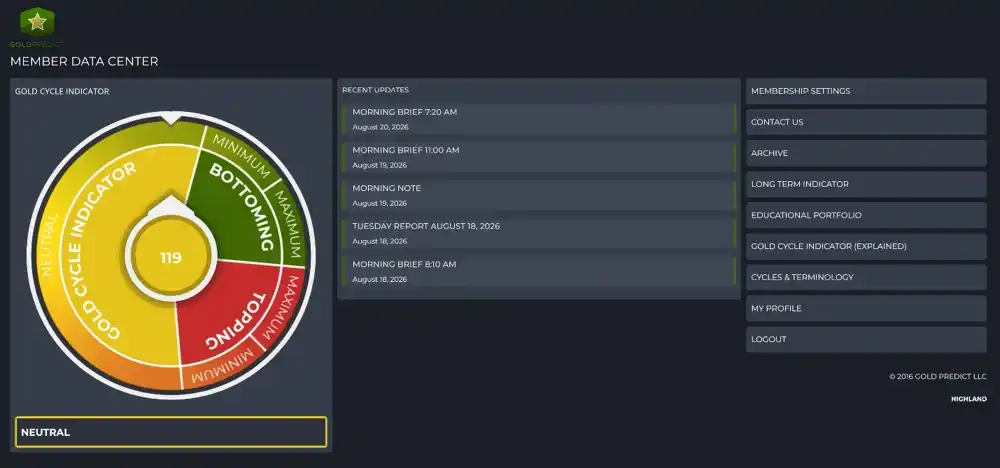
Chart: Gold Cycle Indicator rises to 119, price moves out of cycle low. Source: GoldPredict.com

U.S. Dollar Falls Below 200-Day MA

U.S. Dollar Index: Influenced by Wednesday's bond repurchase news, the dollar broke below its 200-day MA, supporting the judgment that a major top was formed in June. Occasional rebounds are expected, but the overall downtrend should resume, with prices potentially falling below 90 next year.
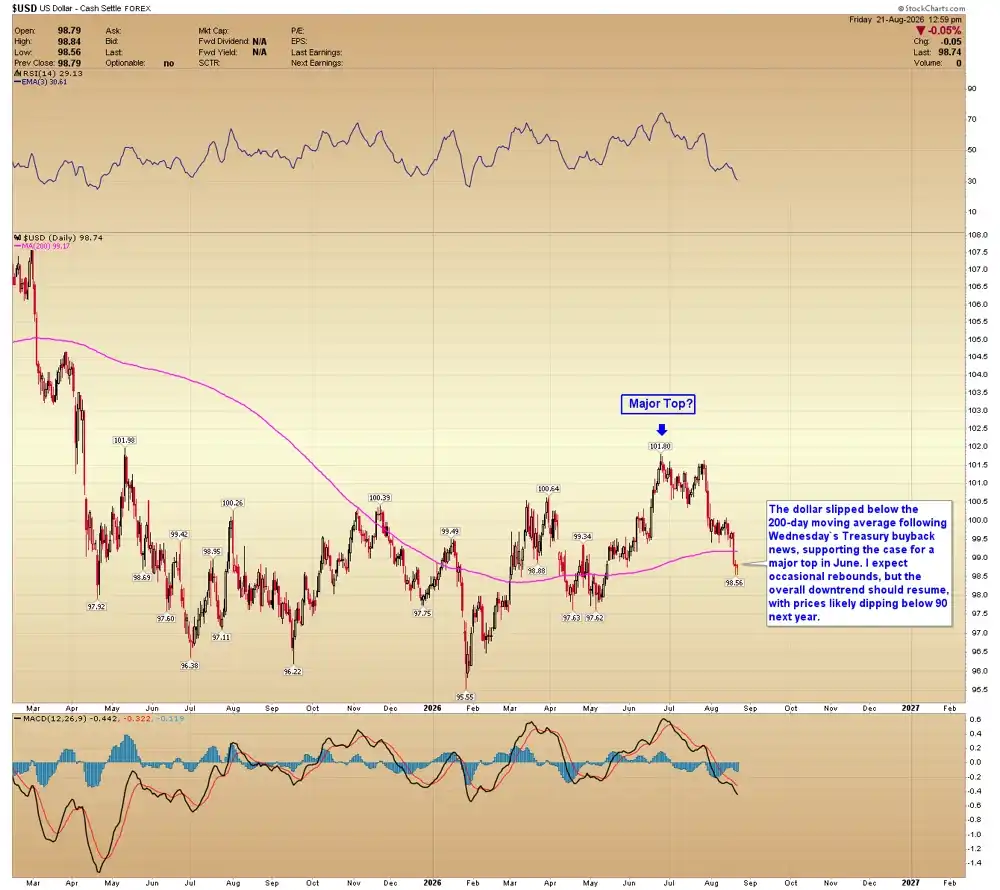
Chart: U.S. Dollar Index falls below 200-day MA, likely peaked in June. Source: StockCharts.com

Crude Oil Testing Upper Boundary

WTI Crude Oil: Oil prices are testing the upper boundary. A consecutive close above $88 would support a breakout. Such a move could push inflation higher, putting upward pressure on long-term Treasury yields.
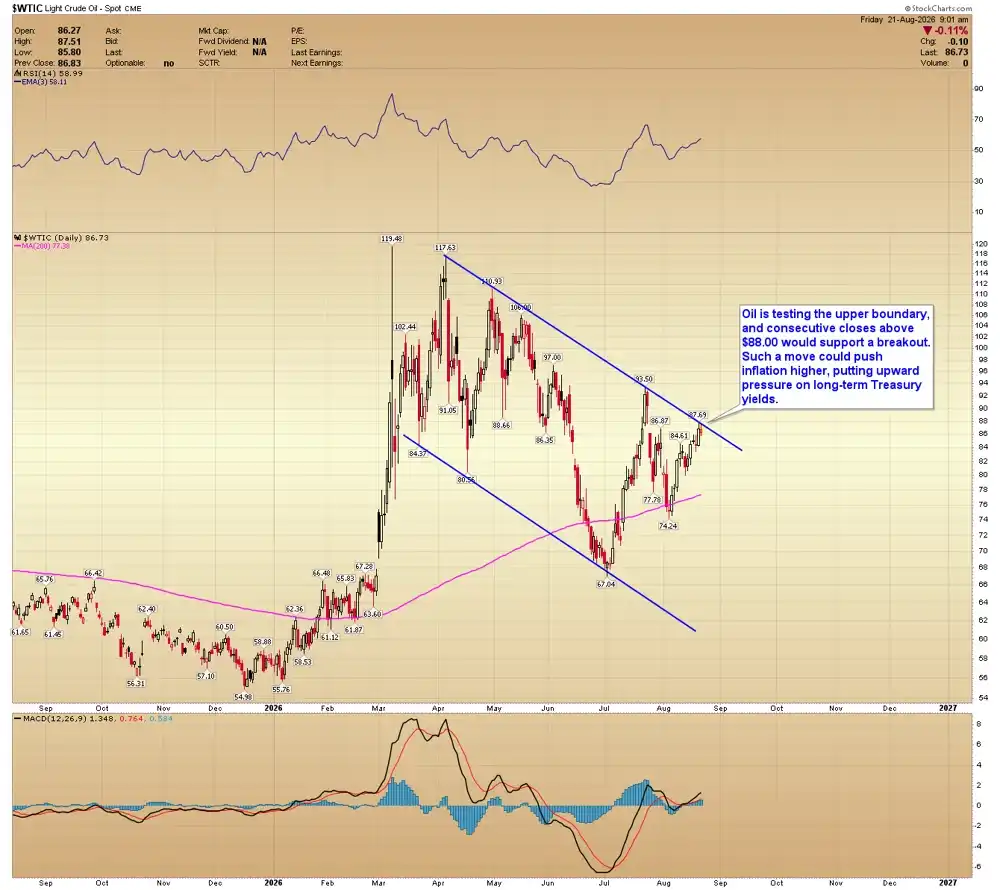
Chart: WTI Crude Oil testing upper boundary, $88 is a key level for a potential breakout. Source: StockCharts.com

Gold Formed a Significant Low Mid-Year

Gold: As previously forecasted, gold formed a significant low mid-year, and the uptrend has now resumed. Although it may take some time for the price to sustainably reclaim $5000, we expect gold to ultimately exceed $7000 next year before reaching the next major top.
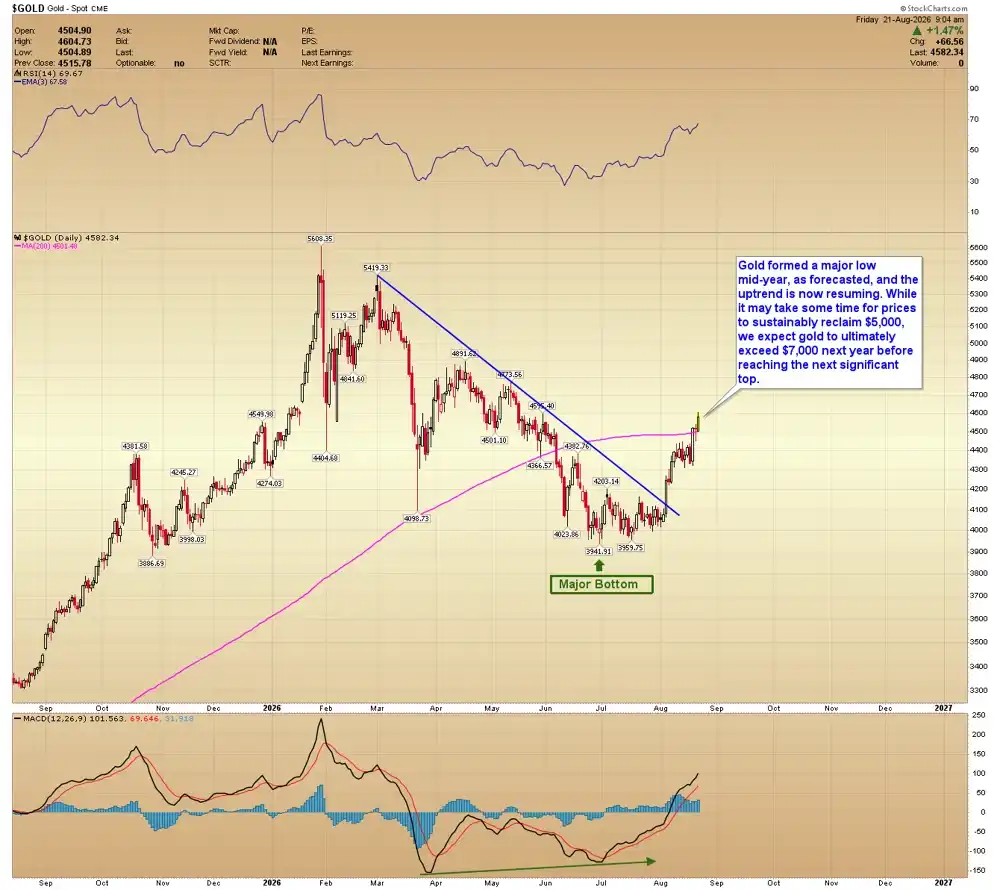
Chart: Gold rebounds from mid-year low, overall uptrend resumes. Source: StockCharts.com

Silver Also Formed a Significant Bottom Mid-Year

Silver: Silver also formed a significant bottom mid-year as predicted, and the uptrend has now resumed. We expect prices to consolidate sideways between $90 and $100 before silver makes a new all-time high next year (most likely in the second half).
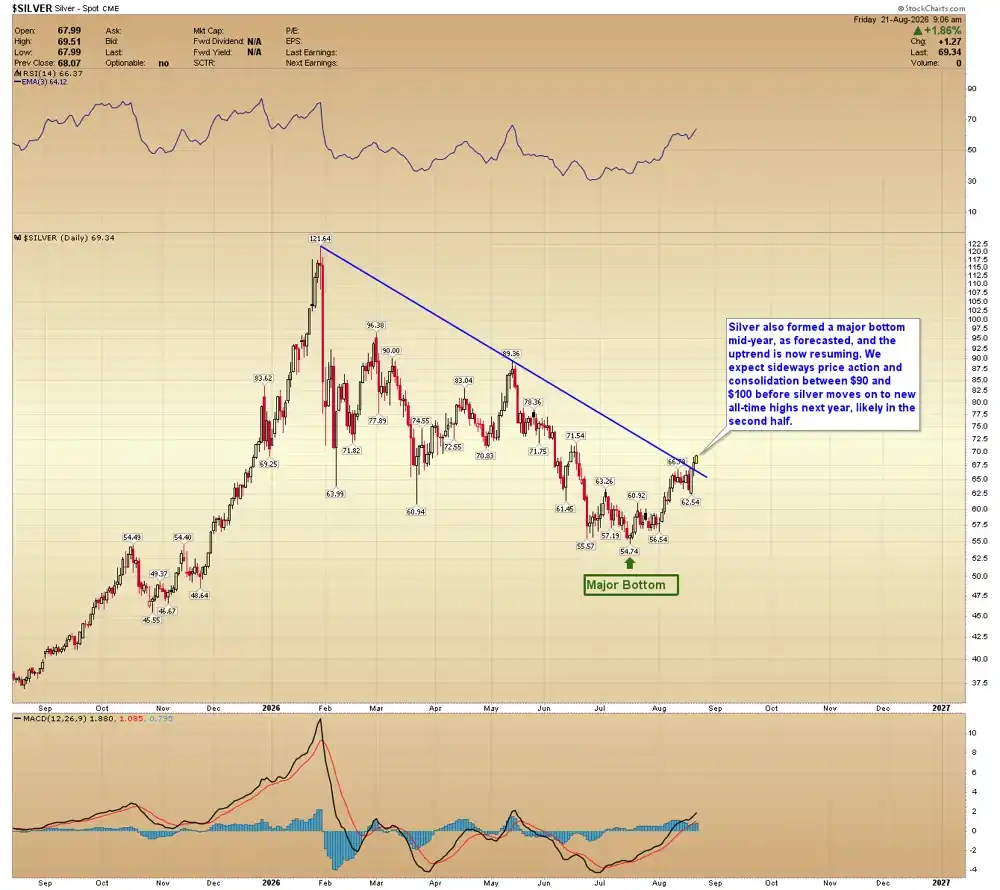
Chart: Silver turns up from mid-year low, breaks above descending resistance line. Source: StockCharts.com

Platinum Breaks Above Cyclical Downtrend Line

Platinum: Platinum has broken above its cyclical downtrend line, confirming the formation of a significant bottom. We expect resistance in the $2200-$2400 zone before prices make a new all-time high next year.
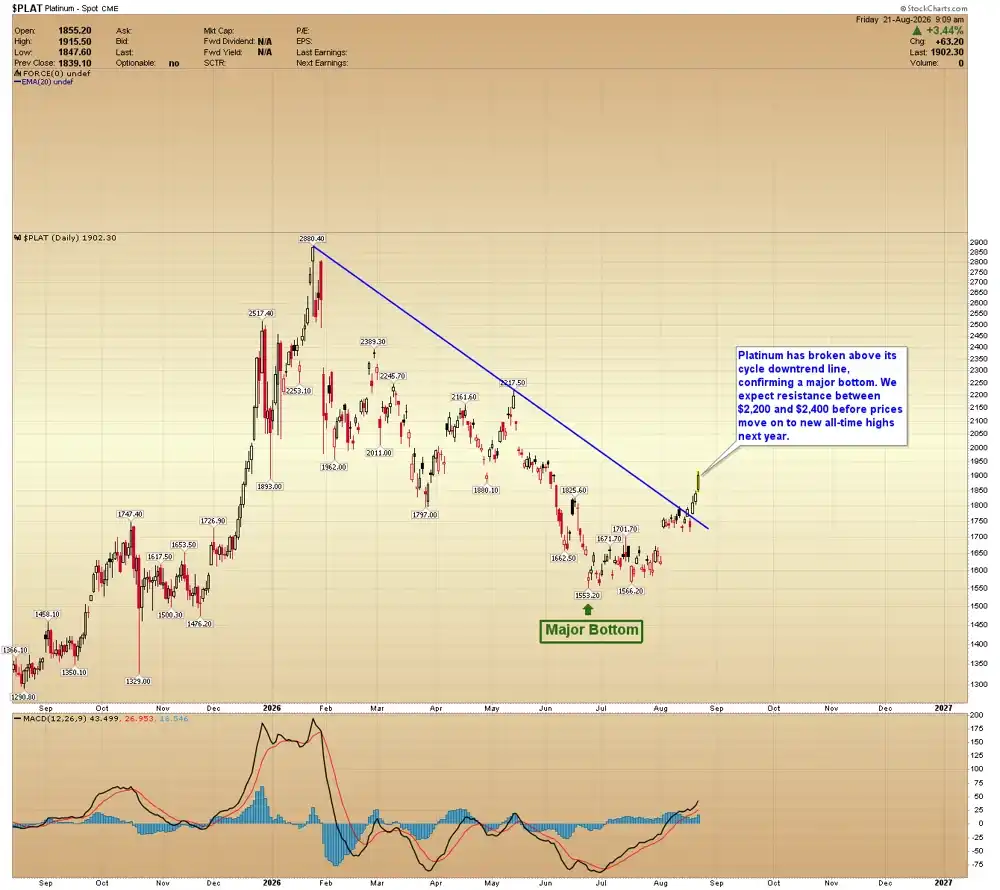
Chart: Platinum breaks above cyclical downtrend line, confirming a significant bottom. Source: StockCharts.com

Mining Stocks Taking Over Leadership from Gold

GDX: As predicted, mining stocks formed a low mid-year and have since surged over 40% from the bottom. This confirms our outlook for continued outperformance and supports the judgment that "mining stocks are taking over the leadership role from gold." We expect mining stocks to make new all-time highs well before gold, likely before year-end.
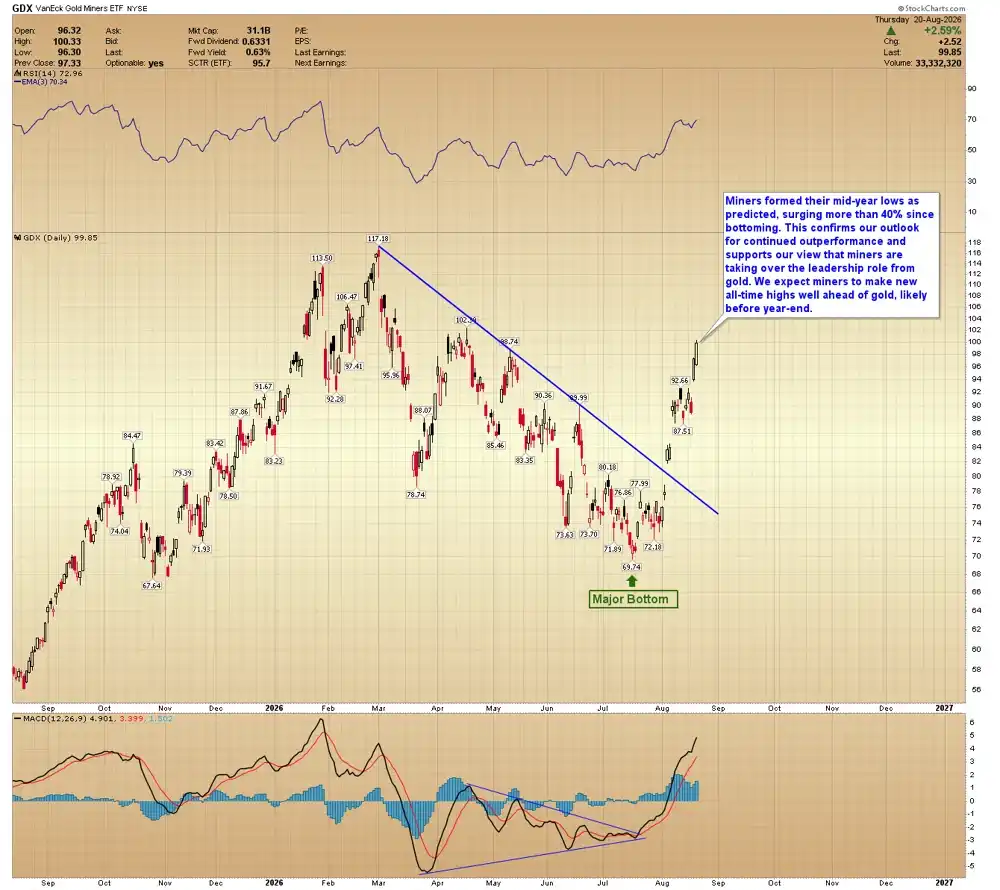
Chart: GDX soars from mid-year low, gold miners taking leadership. Source: StockCharts.com

Junior Miners Find Support at 200-Day MA

GDXJ: Junior miners held support at the 200-day moving average, and a meaningful pullback now appears unlikely.
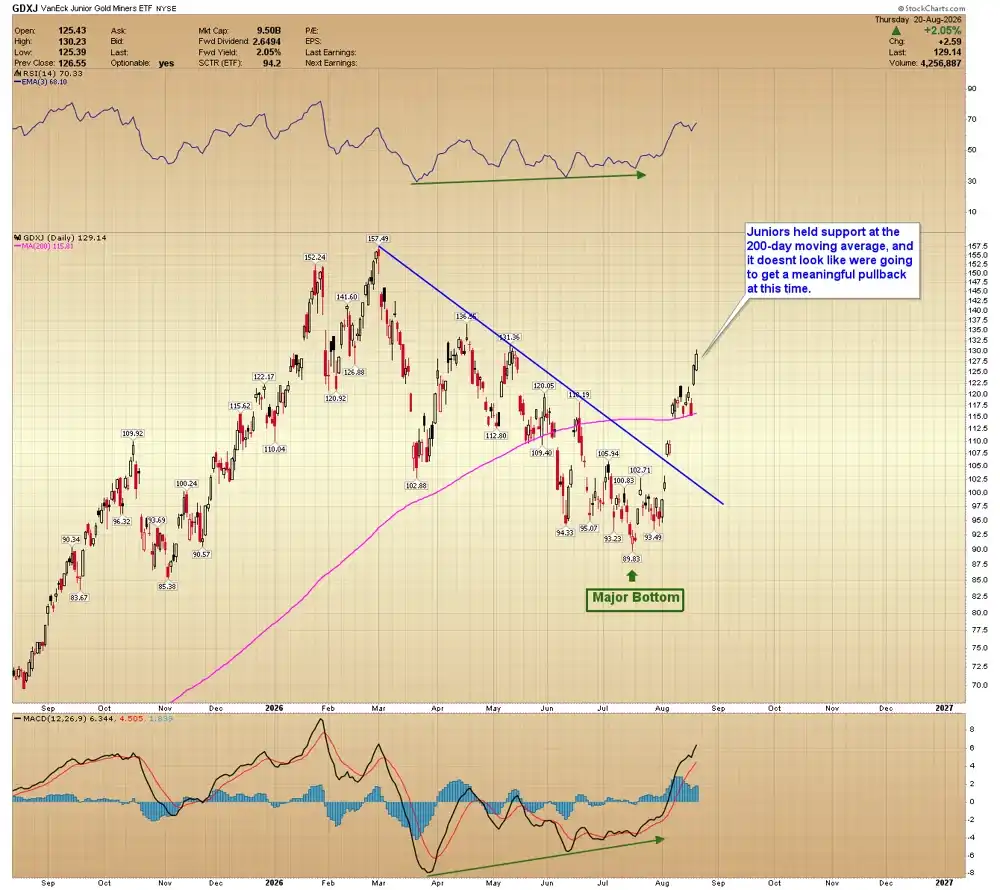
Chart: GDXJ holds 200-day MA, extends rebound from major low. Source: StockCharts.com

Silver Junior Miners Rally Immediately After Testing Trendline

SILJ: Silver junior miners immediately turned higher after testing the trendline. July may have marked a significant bottom. The author continues to believe they will make new highs well ahead of silver itself.
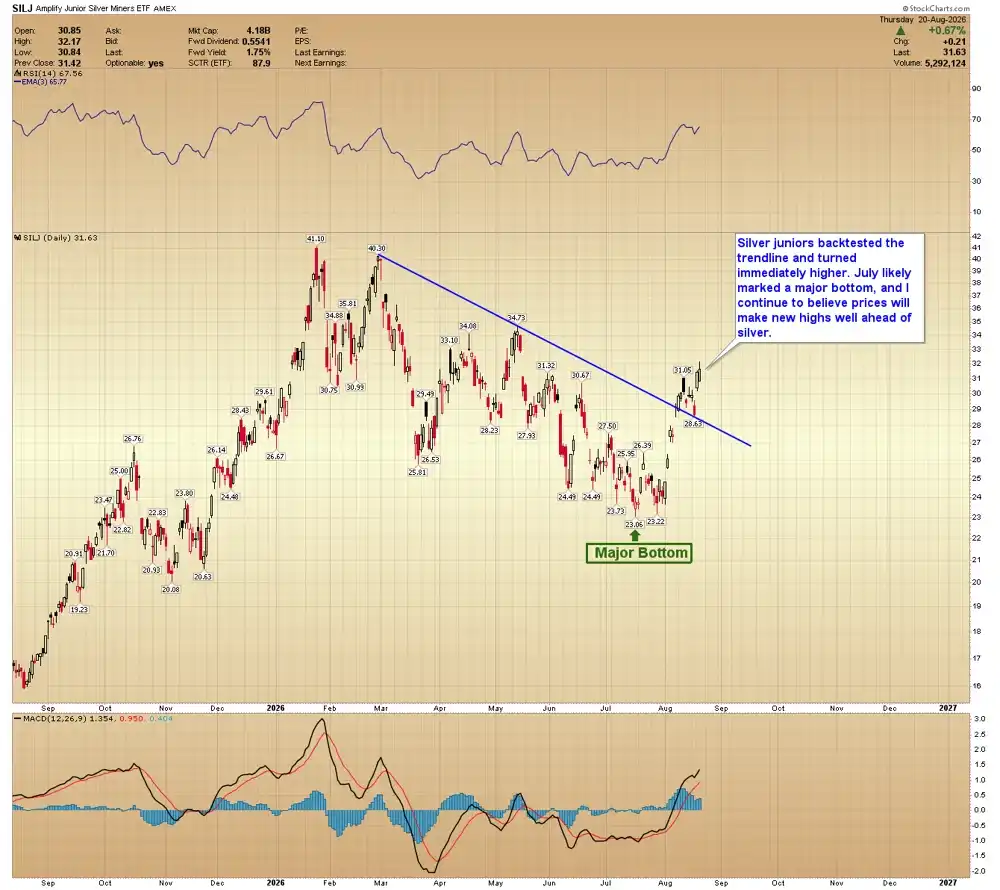
Chart: SILJ turns up after testing trendline, significant bottom formed in July. Source: StockCharts.com

Bitcoin Initially Soared on Bond Repurchase News

Bitcoin: Bitcoin initially soared on the bond repurchase news, then accelerated during a bullish White House crypto event. The result was heavy short covering, with a record $30 billion in liquidations.

In the short term, cycle indicators support the possibility of a top around August 25-26. However, with the price back above the 200-day MA, the author admits one judgment—perhaps both—could be wrong: either the price won't drop to $40,000, or the bottom won't occur in October.

The author still believes a final liquidation round could begin in September. From a sentiment perspective, Bitcoin needs to fall below $50,000 to completely wipe out remaining bulls. If prices don't decline significantly in September, then he is wrong, and a bottom could form approximately 3 months earlier than expected.
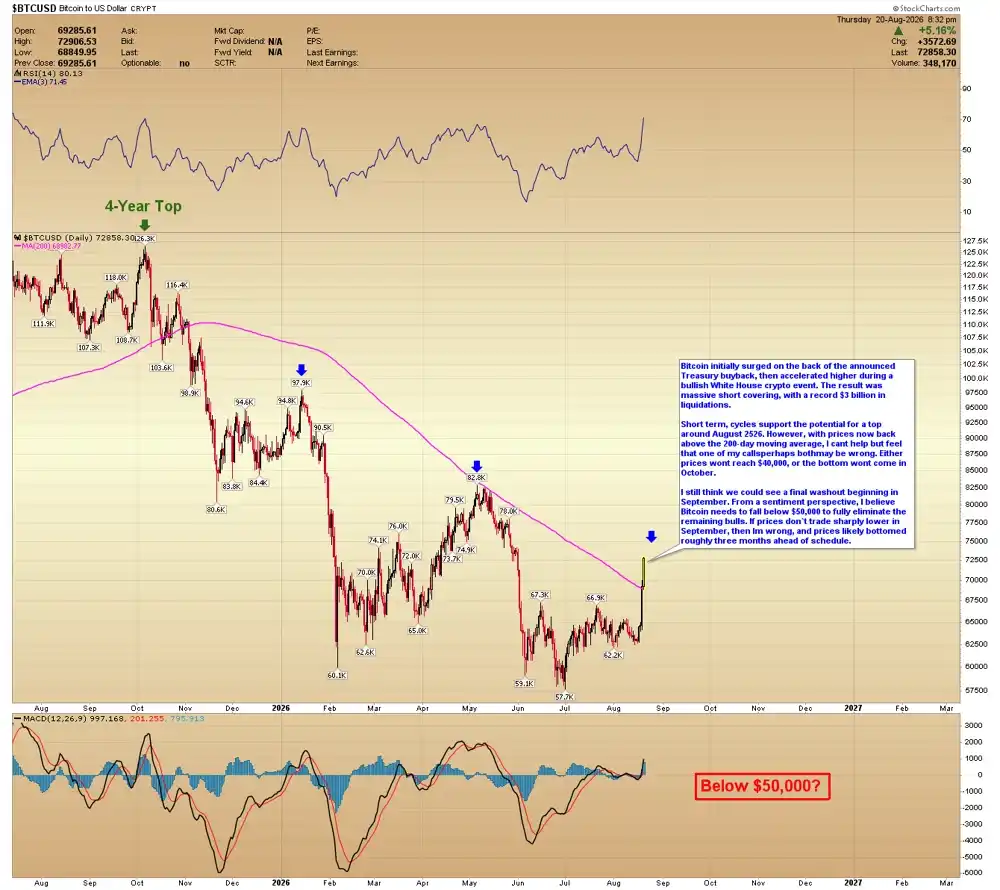
Chart: Bitcoin rallies back above 200-day MA, short covering accelerates. Source: StockCharts.com

Bitcoin's Equilibrium Price

Bitcoin bottoms every four years like clockwork, and in each cycle, the price has at least tested or fallen below the equilibrium price—currently $39,880. This is why the author has been anticipating a test of $40,000 for the past six months.

He still believes there is a high probability of another decline before October. Therefore, this could be the last rally before the final drop—but time will tell.
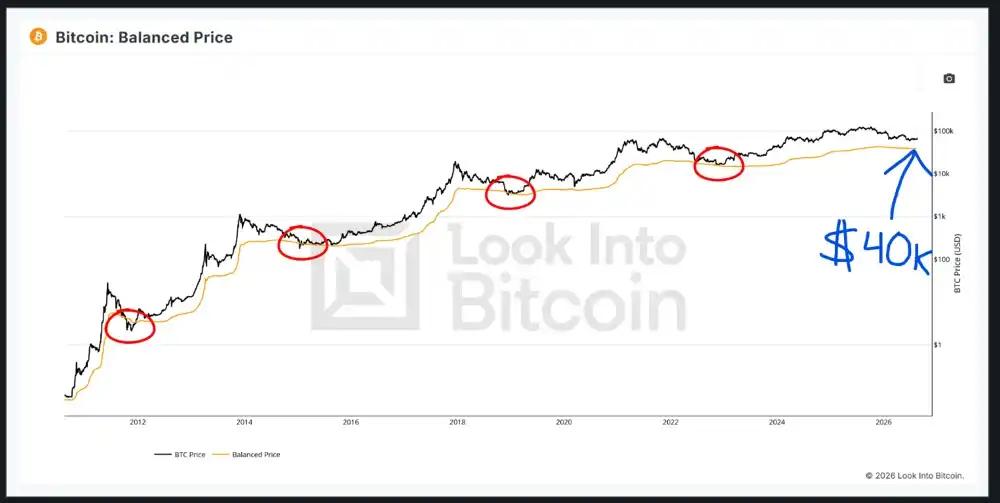
Chart: Bitcoin's equilibrium price remains near $40,000, having previously marked four-year cycle lows. Source: Look Into Bitcoin

Conclusion

Watch for price volatility around Warsh's speech at Jackson Hole next week.

A pullback in metals and miners wouldn't be surprising, but overall, prices appear to have marked significant bottoms in June and July as predicted.

Gold will need time to sustainably reclaim $5000, and silver to climb back above $100, but we expect both to make new all-time highs next year, with miners likely leading the charge.

AG Thorson is a Certified Market Technician (CMT) and a technical analysis specialist.

Related Questions

QWhat key factor does analyst AG Thorson point to as having caused the dollar to break below its 200-day moving average and subsequently boosted precious metals and Bitcoin?

AThe analyst points to the US Treasury's announcement of a Treasury buyback plan on Wednesday, aimed at suppressing long-end bond yields, as the key factor. This caused the dollar to break below its 200-day moving average, which in turn provided a boost to precious metals and initially triggered a surge in Bitcoin.

QWhat is AG Thorson's updated outlook for gold and silver, and what key levels does he mention for their future performance?

AAG Thorson believes gold and silver have formed major mid-year lows and have restarted their uptrends. For gold, he expects it will take time to sustainably reclaim $5,000, but he ultimately forecasts it will exceed $7,000 next year. For silver, he anticipates consolidation between $90-$100 before it likely makes a new all-time high in the second half of next year.

QRegarding Bitcoin, what specific price level and timeframe does Thorson still consider for a potential 'final washout', and why is his confidence in this scenario wavering?

AThorson still considers the possibility of a 'final washout' dip towards the $40,000 level (around the Bitcoin Equilibrium Price of $39,880) before October. However, his confidence is wavering because Bitcoin's price has rebounded back above its 200-day moving average, which weakens the argument for an imminent steep decline to that target.

QWhich asset class does the analyst predict will lead the market and potentially reach new all-time highs first, and what is the evidence supporting this view?

AThe analyst predicts that mining stocks (specifically referencing the GDX and GDXJ ETFs) will lead the market. He expects them to reach new all-time highs well before gold, possibly even before the end of the year. The evidence is that the GDX has already rallied over 40% from its mid-year low, indicating strong outperformance and a transfer of leadership from gold to the miners.

QWhat is the significance of the Bitcoin Equilibrium Price mentioned in the article, and how does it relate to Thorson's long-term analysis?

AThe Bitcoin Equilibrium Price (currently around $39,880) is a model that has historically marked the four-year cycle lows for Bitcoin. Thorson has been anticipating a test of the $40,000 level for the past six months based on this pattern, as price has at least tested or fallen below this equilibrium level in every prior cycle. This forms the basis for his 'final washout' prediction.

Related Reads

The Battle for Control of the Tracks Enters the Second Half: Banks vs. Crypto, Who Will Have the Last Laugh?

The competition for control over the tokenization infrastructure, or the "rails," is intensifying, moving beyond initial asset listing to dominance over settlement, custody, and regulatory layers. Recent developments signal a shift in power towards traditional finance. Key evidence includes: the formation of the BankChain Alliance by 39 U.S. state banking associations to launch a banking-owned blockchain network; moves by market infrastructure giants like DTCC, ICE, and Citadel Securities to establish their own institutional-grade on-chain systems; the struggle of crypto-native custodians like ZeroHash (re-applying for a bank charter) and Copper (facing a severe valuation drop), highlighting that regulatory "license moats" are now more critical than technical advantages; and the launch of stablecoin USD1 by licensed trust bank BitGo on the permissioned Canton network, showing convergence of stablecoin issuance towards regulated entities. The analysis concludes this is not a simple "banks vs. crypto" battle but a redefinition of the foundational infrastructure. A clear division of labor is emerging: open public chains for DeFi and innovation, while bank-led consortium chains and licensed entities capture institutional settlement, tokenized deposits, and regulated custody. The defining question is no longer *if* an asset is tokenized, but *on which rails* it runs and *who controls* those rails, with regulation and牌照 providing the ultimate backstop.

marsbit7m ago

The Battle for Control of the Tracks Enters the Second Half: Banks vs. Crypto, Who Will Have the Last Laugh?

marsbit7m ago

SEC Submits Proposal to White House for Revising Crypto Asset Custody Rules

The U.S. Securities and Exchange Commission (SEC) has submitted a proposal to the White House for revising rules governing the custody of crypto-assets by investment advisers and funds. Dated August 25, 2026, the proposal—known as Amendments to the Custody Rules (RIN 3235-AN46)—has entered review by the Office of Information and Regulatory Affairs (OIRA). The SEC aims to clarify the regulatory framework for crypto-asset custody and modernize certain requirements it deems outdated in light of market and technological evolution. The proposal, classified as economically significant and deregulatory under Executive Order 14192, seeks to alleviate industry burdens by removing redundant rules rather than imposing new ones. This initiative emerges amid Congressional delays in passing the comprehensive Digital Asset Market Clarity Act (CLARITY). SEC Chair Paul Atkins previously indicated the agency would proceed with its own rules if CLARITY stalled. The SEC plans to publish a Notice of Proposed Rulemaking (NPRM) in October 2026, followed by a standard public comment period. The move marks a shift from the post-2008 Madoff scandal era, which spurred stricter custody rules, toward a more flexible approach for crypto markets. However, unresolved technical questions, such as the regulatory treatment of private key custody, remain. The proposal balances industry adaptability against potential risks, as reduced oversight could delay the detection of custody issues.

cryptonews.ru19m ago

SEC Submits Proposal to White House for Revising Crypto Asset Custody Rules

cryptonews.ru19m ago

Trading

Spot
活动图片