Bitcoin Dominance Hits Two-Year Peak as Altcoins Sink –What Next for BTC Price?

beincryptoPublished on 2023-06-13Last updated on 2023-06-13

Abstract

Last week, Bitcoin Dominance (BTC.D) reached 49.2% for the first time since April 2021. As concerned investors continue from embattled altcoins, crypto exchanges have experienced an uptick in demand for Bitcoin. As the BTC price gains momentum, will it clear the $27,000 resistance?

Last week, Bitcoin Dominance (BTC.D) reached 49.2% for the first time since April 2021. As concerned investors continue from embattled altcoins, crypto exchanges have experienced an uptick in demand for Bitcoin. As the BTC price gains momentum, will it clear the $27,000 resistance?

The global altcoin market capitalization is now down 13% since the US Securities and Exchange Commission launched its lawsuit against Binance on June 5th.

Amid heightened volatility and uncertainty in the altcoin markets, crypto investors have reallocated capital to seek refuge in Bitcoin’s (BTC) censorship resistance qualities. Will this push BTC’s price above the critical $27,500 resistance?

Bitcoin Dominance Has Hit a Two-Year Peak

Since June 5, Bitcoin Dominance (BTC.D) has gained two percentage points to graze 49.30% for the first time in two years. BTC.D tracks the percentage of the total global cryptocurrency market valuation that is made up of Bitcoin’s market capitalization.

The chart below illustrates how BTC.D increased sharply from 47.21% on June 5 to 49.25% on June 12.
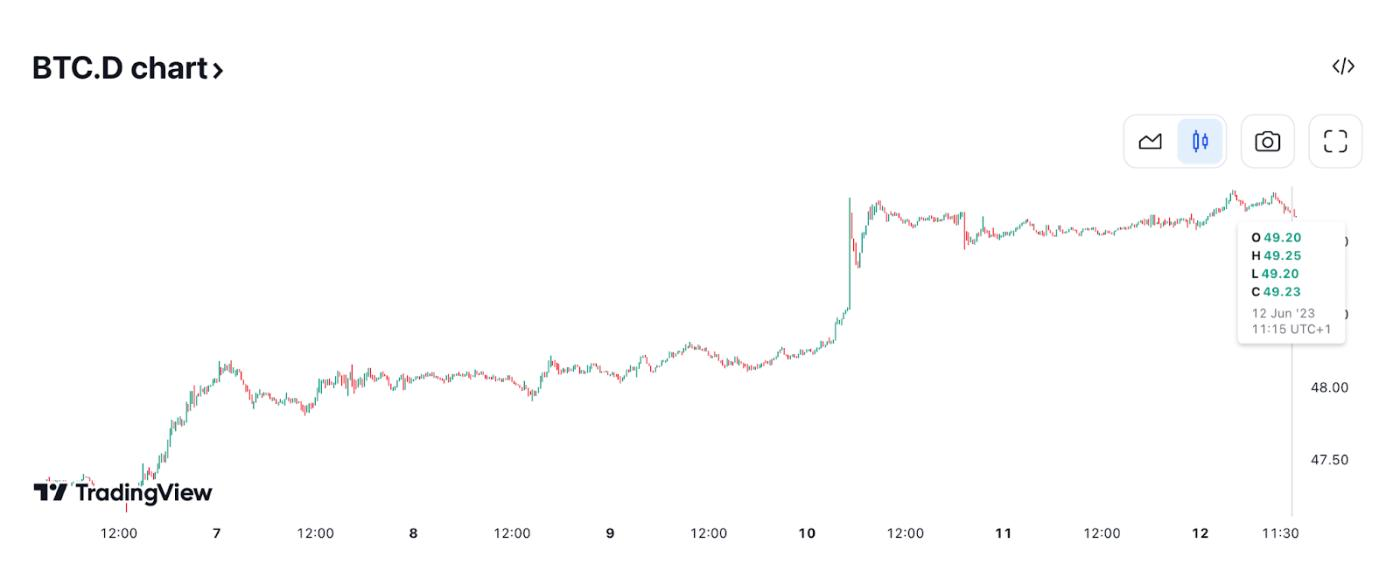
Bitcoin (BTC) Crypto Market Dominance, June 2023Bitcoin (BTC) Crypto Market Dominance, June 2023, Source: Trading View

A sharp rise in BTC Dominance indicates a shift in market sentiment and capital away from altcoins. BTC has gained the market as investors become less interested in altcoins.

Considering the 13% contraction of the altcoin markets within this period, it validates the hypothesis that crypto investors are increasingly selling off their altcoin holdings to purchase BTC.

Historically, BTC price has often witnessed a surge whenever a sudden spike in BTC.D occurs. This pattern will likely reoccur if altcoin prices continue to tank this week.

Hence BTC holders can expect more price upswing in the coming weeks.

Crypto Traders are Queuing Up More Buy Orders

In further confirmation of the bullish outlook, the order books of exchanges suggest that crypto traders are piling more orders to buy up more BTC. The Exchange On-Chain Market Depth chart shows an aggregate of the total buy/sell orders placed by Bitcoin traders across different crypto exchanges.

Currently, BTC traders have placed orders to purchase another 24,000 coins. Meanwhile, sellers have only put up 21,000 BTC for sale.
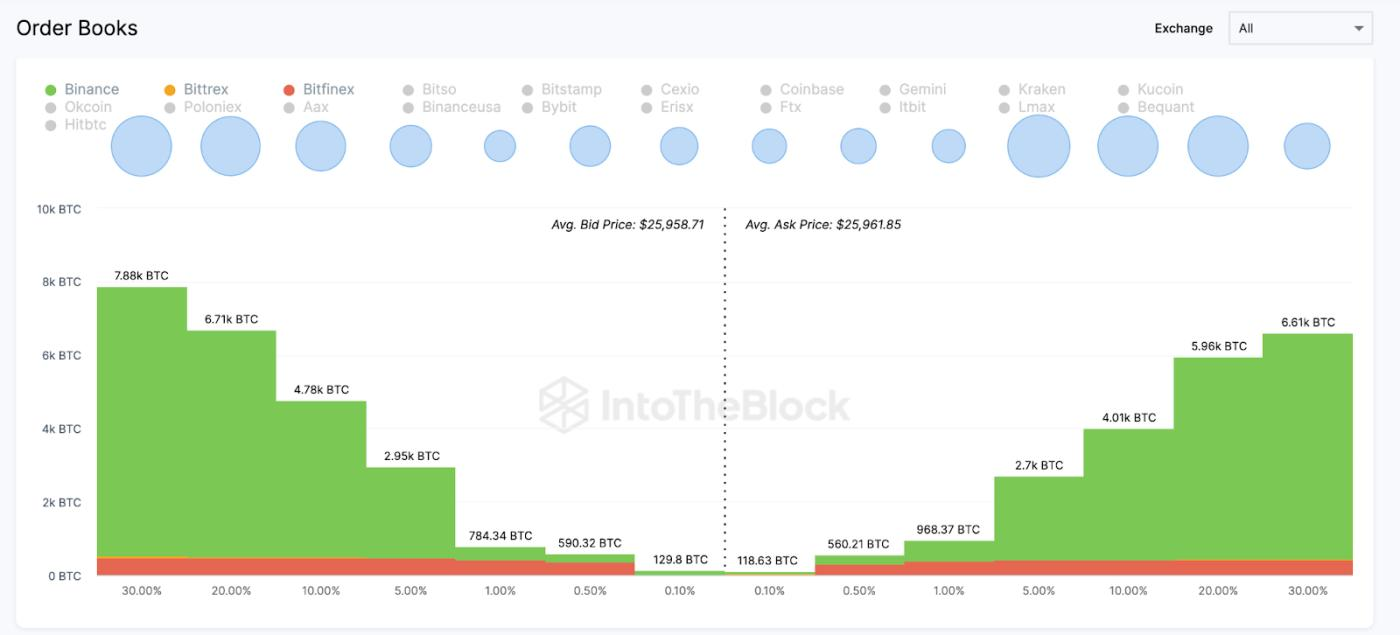
Bitcoin (BTC) Price Dominance, June 2023 - Aggregate Exchange Order BooksBitcoin (BTC) Price Dominance, June 2023 – Aggregate Exchange Order Books. Source: IntoTheBlock

When demand exceeds the supply available on exchanges, it puts upward pressure on price, and buyers begin to compete to get their orders filled.

Currently, there is a supply shortage of 3,000 BTC shortage across exchanges. This means BTC price will likely rebound once buyers begin to compete by increasing their bids to fill their orders quickly.

In conclusion, Bitcoin’s supply shortage and the growing uncertainty in the altcoin markets are two critical factors that could increase BTC price dominance in the coming weeks.

BTC Price Prediction: The $27,000 Resistance is Critical

Considering the growing concerns among altcoin investors, BTC prices will continue to dominate the charts and climb toward $29,000 in the coming weeks.

However, IntoTheBlock’s In/Out of The Money Around Price (IOMAP) data suggests BTC will face initial resistance around the $27,000 mark.

At that zone, two million investors that bought 866,000 BTC at the average price of $27,055 could trigger a pullback.

But if BTC manages to scale that resistance zone, it could make its way toward $29,000 again for the first time since April.
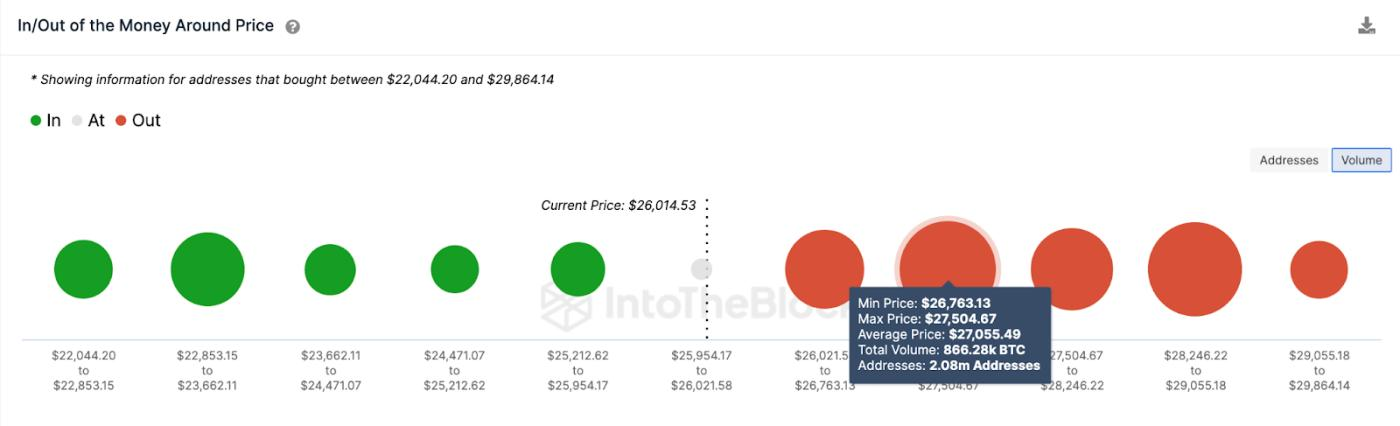
Bitcoin (BTC) Price Prediction, June 2023Bitcoin (BTC) Price Prediction, June 2023 – IOMAP. Source: IntoTheBlock

​​On the other hand, the bears could invalidate the bullish BTC price recovery if it unexpectedly drops below the critical $25,200 support zone.

But, the 350,000 investors that purchased 206,000 BTC at the minimum price of $25,212 will likely prevent the drop. Although unlikely, BTC could retrace further toward $23,500 if that support level cannot hold.

It is important to note that United States Fed will announce the next Interest Rate decision on June 14. Strategic whale investors may hold off on making large trades until then.

Related Reads

Gold Price Achieves Strongest Rally in 46 Years, Tokenized Gold Trading Volume Already Exceeds Full-Year 2025

Gold is experiencing its strongest rally since 1979, with prices reaching a record high near $5,600 per ounce in January. This surge is driven primarily by central banks, not retail investors. In 2025, central banks net purchased 863 tonnes of gold, with a similar increase expected in 2026. Traditional gold investment methods—physical bullion and ETFs—present trade-offs like storage issues, limited access, or management fees. Tokenized gold emerges as a third option: digital tokens representing ownership of physical bars stored in professional vaults. These tokens are globally transferable in seconds, divisible, and redeemable for physical metal. The potential impact mirrors that of dollar stablecoins. Stablecoins digitized the dollar, enabling cheap, instant, global transfers and driving adoption from $27 billion in 2020 to over $3 trillion today. Similarly, tokenized gold solves gold's "form problem"—its lack of divisibility, portability, and accessibility. Adoption is accelerating. In Q1 2026, tokenized gold trading volume hit $90.7 billion, surpassing the $84.6 billion for all of 2025. Its market cap exceeded $6 billion, growing 5.5 times faster than physical gold holdings in the quarter. While concerns about counterparty risk exist, tokenized gold represents a direct claim on allocated bars, with major issuers providing regular attestation reports. Just as stablecoins placed dollars on a digital, global rail, tokenized gold now offers a more practical form for this ancient asset, potentially expanding access to billions.

marsbit11m ago

Gold Price Achieves Strongest Rally in 46 Years, Tokenized Gold Trading Volume Already Exceeds Full-Year 2025

marsbit11m ago

Japanese Rates Return to 1996 Levels, Can Bitcoin Withstand the September Rate Hike?

Japanese borrowing costs have hit their highest levels since 1996, with yields on 30-year bonds reaching 4.185%. This marks a significant shift for a country long reliant on negative rates. Concurrently, Bitcoin surged 22% past $80,000, seemingly decoupled from the bond market turmoil. Historically, the massive yen carry trade has fueled global risk assets, predicated on near-zero Japanese rates. This assumption is now challenged. A potential rate hike by the Bank of Japan in September could strengthen the yen, forcing carry trade unwinds and potentially triggering a global deleveraging event, as seen in August 2024 when Bitcoin fell sharply. Conversely, if the yen weakens further, Bitcoin could attract Japanese investors as a hedge against currency depreciation and the country's massive debt burden. Institutional adoption in Japan is growing, with regulatory changes paving the way for potential crypto ETFs by 2027. The key variable is the BoJ's September policy signal. If it hints at a rapid tightening cycle to combat inflation and support the yen, risk assets like Bitcoin may face selling pressure from carry trade liquidation. However, if debt sustainability concerns limit its hawkishness, leading to a weaker yen, Bitcoin could benefit. Currently, the market is betting on a slow-motion debt crisis, not a sudden collapse. While Bitcoin shows resilience, its fate remains tied to the direction of the yen and the scale of any carry trade unwind.

marsbit14m ago

Japanese Rates Return to 1996 Levels, Can Bitcoin Withstand the September Rate Hike?

marsbit14m ago

How Can Bitcoin Resist Quantum Computers? A Comparison of Three Lattice-Based Signature Schemes

"Bitcoin's Quantum Defense: A Comparison of Three Lattice-Based Signature Schemes" by the Blockstream Research Team explores how Bitcoin can transition to quantum-resistant digital signatures, as current schemes like Schnorr and ECDSA are vulnerable to quantum computers. The report evaluates three lattice-based signature candidates—Dilithium, Falcon, and Hawk—against criteria like on-chain cost (key/signature size), implementation complexity, deployment risks, and support for Bitcoin's key derivation standard (BIP-32). The analysis recommends a minimum Security Level 3 for Bitcoin due to its long-term security needs. Dilithium (ML-DSA) is praised for its simplicity and integer-only operations, making it easier to implement securely, but it has the largest signature size (~5.3 KB for Level 3). Falcon (FN-DSA) offers the most compact signatures (e.g., ~3.1 KB for Level 5) and the fastest verification, though its signing requires complex floating-point sampling—a solvable engineering challenge. Hawk, despite its small size, was withdrawn from NIST standardization after a security vulnerability was discovered, highlighting the importance of conservative security margins. Currently, neither Dilithium nor Falcon has a fully viable, production-ready BIP-32 key derivation method. The report concludes that if a lattice-based scheme had to be chosen now, Falcon-1024 would be the preferred option for its balance of size, speed, and mature security assumptions. However, the short-term recommendation remains hash-based signatures (like SPHINCS+) for their lower risk, with a potential future hybrid or full transition to Falcon once its standard (FN-DSA) is finalized and well-supported.

marsbit16m ago

How Can Bitcoin Resist Quantum Computers? A Comparison of Three Lattice-Based Signature Schemes

marsbit16m ago

Trading

Spot
活动图片