[dragon tiger list] BTC60% selling pressure comes from the main force, NEAR gains catch up with TVL

Huobi ResearchPublished on 2022-04-08Last updated on 2022-04-08

Abstract

On April 7, BTC's latest trading data showed that the selling pressure from the exchange increased significantly, especially the selling pressure brought by the main force in the top 10.

1. Market trend: high profit margins, major changes

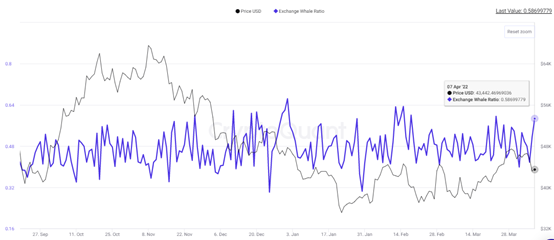
On April 7, BTC's latest trading data showed that the selling pressure from the exchange increased significantly, especially the selling pressure brought by the main force in the top 10. In terms of the proportion of main selling pressure, the value reached 0.587. In other words, nearly 60% of the selling pressure is driven by the trading of large funds, indicating that the short-term currency holding risk is also growing.

In terms of the proportion of relative selling pressure, the proportion of selling pressure on April 7 was lower than the previous high of 0.66 on January 22 and 0.63 on February 15, which means that the BTC price correction may be within the controllable range. At present, we can pay attention to trading opportunities of more than $43000.

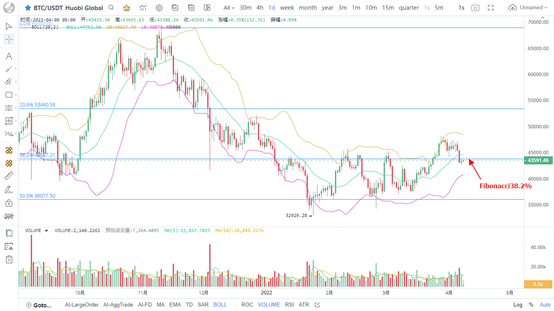
In terms of the K-line, the BTC price retreated, fell below the middle rail of the brin line, and fell below the support of US $43847 corresponding to 38.2% of Fibonacci. The Bulls did not pay attention to the expansion of the decline.
2. Interpretation of investor sentiment:

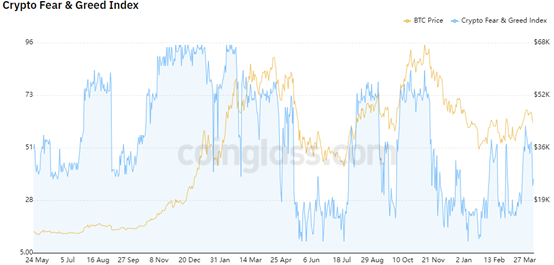
The recent performance of the panic index is weak, and the overall value has not been higher than 60 since 2022, indicating that investors' trading enthusiasm is not high. Compared with the performance of the panic index in the second half of 2021, the current panic index is more panic, so it can not be radical in the trading direction.

In the calculation of the panic index, the trading volume, volatility and bitcoin market value have 25%, 25% and 10% weights respectively. The current trading volume has not changed much, and the long-term contraction trend has not changed, limiting the rebound of the panic index. In addition, the short-term BTC decline expanded, the volatility rose, and the panic index fell to around 37. Panic is spreading rapidly.
3. Dragon and tiger list:

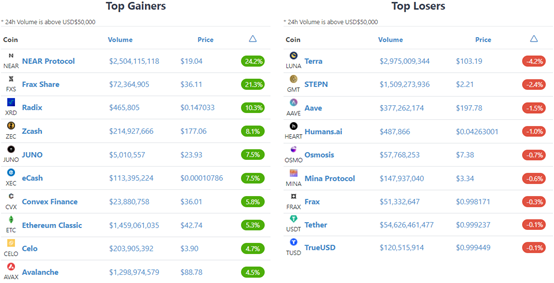
As most mainstream currencies rebounded and rebounded, there were few adjustment currencies in the sector, and most of the top decline was the concept of stable currency. Luna, usdt and UTSD were among the top callbacks. Near, as the second tier concept currency of Ethereum, has a short-term 24-hour increase of 24.2%. FXS, the stable currency of the algorithm, showed strong performance, while CELO and avax, other related currencies, performed well.
NEAR

Near rose 24.2% in 24 hours, ranking the first. The cumulative financing of US $450 million during the year, the expectation of online coinbase and the upcoming algorithm stability currency USN have all become factors for the soaring price.

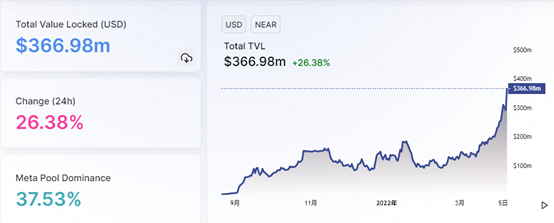
In terms of trading volume, the 24-hour trading volume of near increased to US $1.81 billion, the highest value since September 9, 2021, indicating that the growth potential is expected to open.

Financing: near protocol raised US $350 million, with tiger global leading investment, FTX ventures, dragonfly capital and other investment participants

On April 6, near protocol announced that it had completed a financing of US $350 million, led by Tiger global and participated by Republic capital, FTX ventures, hashed and dragonfly capital. The new financing will be used to accelerate the decentralization of near ecosystem.

In January 2022, near protocol completed $150 million financing, led by three arrows capital, including mechanism capital, dragonfly capital, a16z, jump, Alameda, Zee prime, folius, amber group, 6th manventures, circle ventures and metaweb VC (near ecological Fund), hedge fund giant Alan Howard, Santiago Santos, a former partner of parafi capital, and stani kulechov, founder of AAVE, participated in the investment.

In terms of expected events, near will be listed on the coinbase exchange in the coming months, which will help to improve its popularity among retail investors in an unprecedented way. This also paves the way for the integration of near NFT into the upcoming NFT market of coinbase. Finally, on April 20, near will announce that it will cooperate with other capital sufficient stable currencies to launch their own native algorithm stable currency USN. They will offer an annual interest rate of about 20%, which is very attractive. It will also promote the rotation of defi capital to the near ecosystem and absorb the total TVL from other Tier-1 agreements.

According to the latest TVL growth data, the lock up volume of near increased to US $367 million, an increase of 07% from February 14.
FXS

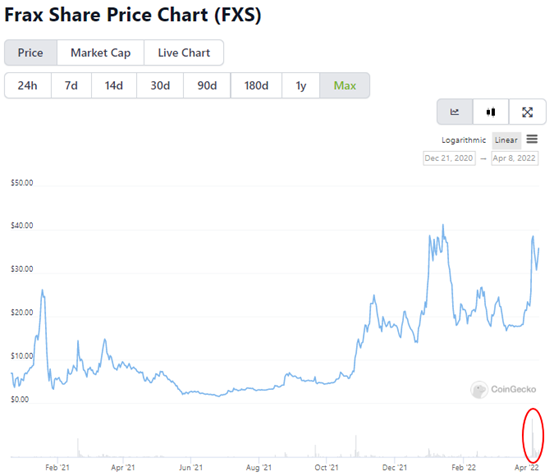
After three trading days of adjustment, the price of FXS rebounded rapidly in the short term, with an increase of around $35 and expanded to 21.3% within 24 hours. In terms of market value, FXS has a market value of US $2.07 billion. The short-term price increase is basically consistent with the growth space of TVL since December 2021. As the daily trading volume reached US $440 million on April 3, there is still great potential for growth.
Decline list

After the short-term increase of Luna, the stable currency of the algorithm, narrows, the price runs around $100. As the leader of algorithmic stability currency, its market value has reached US $36.2 billion. As Luna's volume and price performance is stable, the price correction space may not increase significantly, and the low absorption opportunity can be paid due attention.


Related Reads

UBS: The Crowdedness of A-Share Tech Stocks Is Far From Reaching Historical Peaks

UBS: A-share tech stocks still far from peak crowding levels A-shares' technology sector has seen a strong rebound, with trading activity hitting record highs, raising concerns about market crowding. However, UBS Securities argues that a key indicator of institutional positioning suggests the current crowding level remains well below historical peaks. While the large-cap tech sector's share of total A-share trading volume and market capitalization have reached historical highs, the overweight ratio of domestic mutual funds in this sector stood at 9.9% in Q1 2026. This is down from 11.6% in Q3 2025 and significantly lower than the historical peak of 14.1% in Q4 2015. It also pales in comparison to the historical peak overweight of 18.7% for the consumer sector. UBS notes that typical cycles from a low to a peak in fund overweighting last about three years, and the current outperformance of the tech/growth style has lasted less than two years since the policy pivot in September 2024. UBS expects A-share earnings recovery to accelerate, providing fundamental support. It forecasts 2026 A-share profit growth to rise to 11% from 3.9% in 2025. Non-financial A-share profits grew 11.8% YoY in Q1 2026, with gross and net profit margins at their highest since 2023. Persistent fund inflows, the expansion of thematic ETFs, and a recovery in private fund issuance are supporting market liquidity. In tactical allocation, UBS favors growth and cyclical styles under its "slow bull" base case, with overweight ratings on six sectors: Electronics (benefiting from semiconductor inventory recovery and AI innovation), Communications (driven by AI computing demand), Machinery (aided by domestic capex recovery), Non-ferrous Metals (due to rising copper/aluminum prices), Chemicals (supported by anti-involution policies), and Electrical Equipment (driven by policy support and AI data center power demand).

marsbit1h ago

UBS: The Crowdedness of A-Share Tech Stocks Is Far From Reaching Historical Peaks

marsbit1h ago

Trading

Spot
Futures

Hot Articles

What is $BITCOIN

DIGITAL GOLD ($BITCOIN): A Comprehensive Analysis Introduction to DIGITAL GOLD ($BITCOIN) DIGITAL GOLD ($BITCOIN) is a blockchain-based project operating on the Solana network, which aims to combine the characteristics of traditional precious metals with the innovation of decentralized technologies. While it shares a name with Bitcoin, often referred to as “digital gold” due to its perception as a store of value, DIGITAL GOLD is a separate token designed to create a unique ecosystem within the Web3 landscape. Its goal is to position itself as a viable alternative digital asset, although specifics regarding its applications and functionalities are still developing. What is DIGITAL GOLD ($BITCOIN)? DIGITAL GOLD ($BITCOIN) is a cryptocurrency token explicitly designed for use on the Solana blockchain. In contrast to Bitcoin, which provides a widely recognized value storage role, this token appears to focus on broader applications and characteristics. Notable aspects include: Blockchain Infrastructure: The token is built on the Solana blockchain, known for its capacity to handle high-speed and low-cost transactions. Supply Dynamics: DIGITAL GOLD has a maximum supply capped at 100 quadrillion tokens (100P $BITCOIN), although details regarding its circulating supply are currently undisclosed. Utility: While precise functionalities are not explicitly outlined, there are indications that the token could be utilized for various applications, potentially involving decentralized applications (dApps) or asset tokenization strategies. Who is the Creator of DIGITAL GOLD ($BITCOIN)? At present, the identity of the creators and development team behind DIGITAL GOLD ($BITCOIN) remains unknown. This situation is typical among many innovative projects within the blockchain space, particularly those aligning with decentralized finance and meme coin phenomena. While such anonymity may foster a community-driven culture, it intensifies concerns about governance and accountability. Who are the Investors of DIGITAL GOLD ($BITCOIN)? The available information indicates that DIGITAL GOLD ($BITCOIN) does not have any known institutional backers or prominent venture capital investments. The project seems to operate on a peer-to-peer model focused on community support and adoption rather than traditional funding routes. Its activity and liquidity are primarily situated on decentralized exchanges (DEXs), such as PumpSwap, rather than established centralized trading platforms, further highlighting its grassroots approach. How DIGITAL GOLD ($BITCOIN) Works The operational mechanics of DIGITAL GOLD ($BITCOIN) can be elaborated on based on its blockchain design and network attributes: Consensus Mechanism: By leveraging Solana’s unique proof-of-history (PoH) combined with a proof-of-stake (PoS) model, the project ensures efficient transaction validation contributing to the network's high performance. Tokenomics: While specific deflationary mechanisms have not been extensively detailed, the vast maximum token supply implies that it may cater to microtransactions or niche use cases that are still to be defined. Interoperability: There exists the potential for integration with Solana’s broader ecosystem, including various decentralized finance (DeFi) platforms. However, the details regarding specific integrations remain unspecified. Timeline of Key Events Here is a timeline that highlights significant milestones concerning DIGITAL GOLD ($BITCOIN): 2023: The initial deployment of the token occurs on the Solana blockchain, marked by its contract address. 2024: DIGITAL GOLD gains visibility as it becomes available for trading on decentralized exchanges like PumpSwap, allowing users to trade it against SOL. 2025: The project witnesses sporadic trading activity and potential interest in community-led engagements, although no noteworthy partnerships or technical advancements have been documented as of yet. Critical Analysis Strengths Scalability: The underlying Solana infrastructure supports high transaction volumes, which could enhance the utility of $BITCOIN in various transaction scenarios. Accessibility: The potential low trading price per token could attract retail investors, facilitating wider participation due to fractional ownership opportunities. Risks Lack of Transparency: The absence of publicly known backers, developers, or an audit process may yield skepticism regarding the project's sustainability and trustworthiness. Market Volatility: The trading activity is heavily reliant on speculative behavior, which can result in significant price volatility and uncertainty for investors. Conclusion DIGITAL GOLD ($BITCOIN) emerges as an intriguing yet ambiguous project within the rapidly evolving Solana ecosystem. While it attempts to leverage the “digital gold” narrative, its departure from Bitcoin's established role as a store of value underscores the need for a clearer differentiation of its intended utility and governance structure. Future acceptance and adoption will likely depend on addressing the current opacity and defining its operational and economic strategies more explicitly. Note: This report encompasses synthesised information available as of October 2023, and developments may have transpired beyond the research period.

363 Total ViewsPublished 2025.05.13Updated 2025.05.13

What is $BITCOIN

Discussions

Welcome to the HTX Community. Here, you can stay informed about the latest platform developments and gain access to professional market insights. Users' opinions on the price of BTC (BTC) are presented below.

活动图片