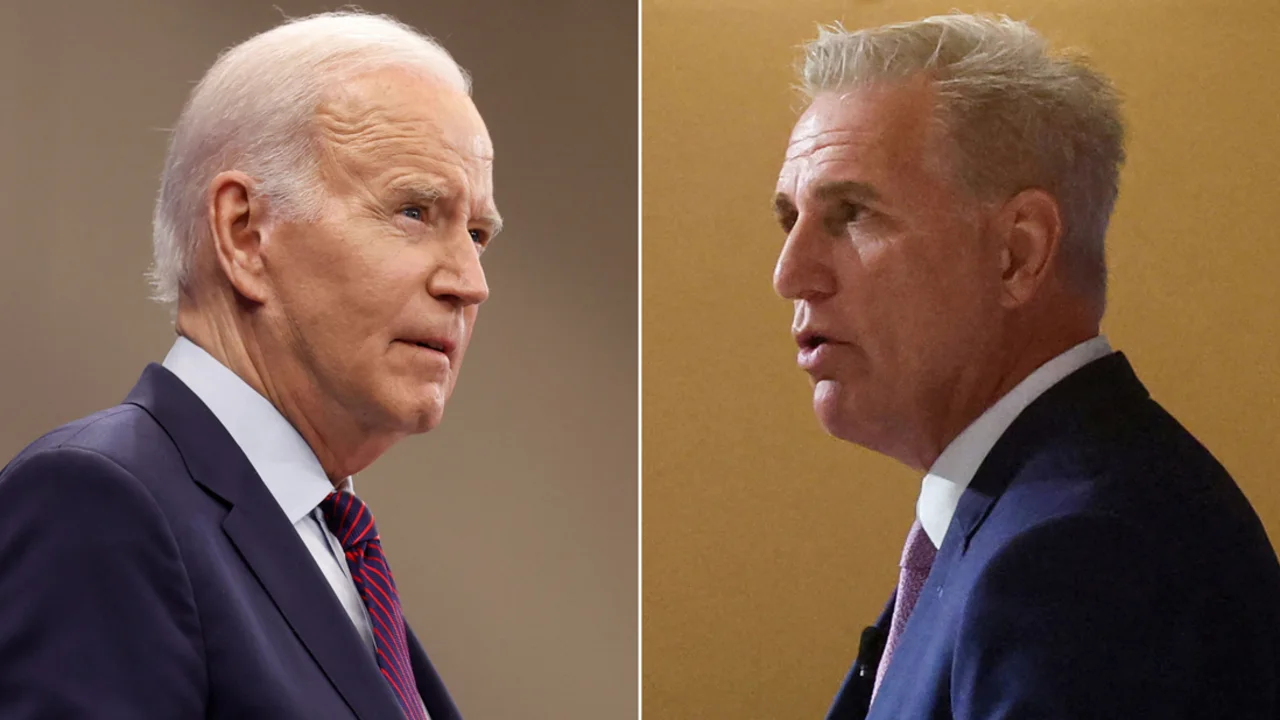
Biden, McCarthy Hold ‘Productive’ Meeting but No Debt-Ceiling Deal Yet

WSJPublished on 2023-05-23Last updated on 2023-05-23

Abstract

Spending levels for next year have become contentious part of negotiations

WASHINGTON—House Speaker Kevin McCarthy and President Biden failed to reach a deal to raise the debt ceiling following a high-stakes meeting at the White House but planned to press ahead with talks, as the U.S. nears a deadline to prevent a first-ever default.

Heading into the meeting, the president said that he was optimistic they could make progress. After the sit-down concluded, Biden termed it a productive meeting and “we reiterated once again that default is off the table and the only way to move forward is in good faith toward a bipartisan agreement.”

McCarthy told reporters that the tone of the roughly 90-minute meeting was “better than any other time we’ve had discussions.” He too said the meeting was productive and offered both leaders an opportunity to dig into the details of their positions.

McCarthy told reporters that the meeting was “productive,” adding, “I think the tone tonight was better than any other time we’ve had discussions.” He said the meeting offered both leaders an opportunity to dig into the details of their positions.

“I believe we can get it done,” he said, adding that negotiators would continue their discussions and he expects to talk to Biden every day.

Central to the talks is setting a top line spending level for the next year and deciding how long to lift the debt ceiling until having to raise it again. The two sides are aiming to reach a deal by June 1, when the Treasury Department estimates the U.S. could run out of money to pay all of its bills, leading to default. Treasury Secretary Janet Yellen repeated that estimate Monday.

Ahead of the meeting, Biden and McCarthy’s negotiating teams huddled on Capitol Hill. The two sides remained at odds on the central issue of spending, but are nearing agreement on secondary matters such as clawing back unused coronavirus-response funding, according to people familiar with the matter.

McCarthy said a deal must be reached this week to have time for the legislation to pass Congress. He added that he would consider canceling a planned House recess next week if there was no deal. “We’re going to stay and do our jobs,” McCarthy said.

Once a deal is reached, it will likely take at least several days for the agreement to wind its way through Congress. McCarthy said he planned to give House lawmakers 72 hours to read the bill, a rule that was put in place at the beginning of this Congress. House lawmakers will likely want to introduce amendments to any agreement as well.

Monday’s meeting comes after several stops and starts in the negotiations and increased tension among White House officials and House Republicans.

Rep. Byron Donalds (R., Fla.) said that in a closed-door briefing with some Republicans, Mr. McCarthy indicated that the talks were dragging on and lawmakers may need to cancel part of a 10-day recess planned to start this weekend.

“We were talking a lot about how to manage the clock and what that was going to look like,” Donalds said.

On Sunday, Biden said House Republicans have taken extreme positions and he called the GOP’s current proposal unacceptable. White House officials have accused Republicans of being unreasonable in the negotiations and pushing partisan proposals that have little chance of winning approval by both chambers of Congress. Meanwhile, Republicans have criticized Biden for waiting until May to engage in the negotiations, and they say the White House isn’t doing enough to cut spending.

Republicans have called for spending cuts as a condition for any debt-ceiling increase and they passed a bill in April to do so, saying that was their starting point on negotiations. They also want to cap spending in future years. Democrats for months declined to negotiate, saying the debt ceiling should be raised with no strings attached, but began engaging seriously in talks earlier this month as the deadline approached.

Biden has said he would like to work to narrow the deficit with some tax increases to wealthy Americans, but McCarthy said tax increases are off the table.

GOP lawmakers also want to attach changes to permitting rules that would speed the process of building energy projects and to tighten work requirements for some government benefit programs, proposals that the White House has signaled some openness to.

McCarthy has said spending in the coming fiscal year must be lower than it was last year. The White House has proposed keeping nondefense and defense discretionary spending flat from fiscal 2023 to fiscal 2024, and a 1% increase in fiscal 2025, according to people familiar with the matter.

Democrats want the debt ceiling increased until after the 2024 election, while Republicans’ original bill pushed the next debt-ceiling deadline to March 2024.

If Congress doesn’t act to raise the debt limit soon and the government is unable to borrow to help pay all of its bills, it might have to suspend certain pension payments, withhold or cut the pay of soldiers and federal workers, or delay interest payments, which would constitute a default.

Given the uncertainty of negotiations, lawmakers are examining emergency solutions that could avoid a default. Nearly all House Democrats have signed a discharge petition, a long-shot parliamentary maneuver that requires 218 signatures to force a vote on debt-ceiling legislation.

Republicans control the House, 222-213, so for their petition to succeed, Democrats would need at least five GOP lawmakers to sign on. Because of timing rules around the maneuver, the petition would also not be ready to implement until after the June 1 deadline.

Progressives in the Senate and House are pushing Biden to use the 14th Amendment of the Constitution to unilaterally act without Congress, a never-before-used process that Republicans have derided, which would almost certainly be challenged in court.

The 14th Amendment states that federal debt authorized by law “shall not be questioned.” Biden has said he was considering invoking the amendment as a way to keep paying the nation’s bills but that it remained a long shot.

Lawmakers could also pursue a short-term increase of the debt ceiling to give negotiators more time to reach a deal. But McCarthy and others in Washington have expressed resistance to that approach.


Related Reads

Breaking: Google Earth Urgently Pulls Back Nano Banana 2 Image Generation Feature!

Google Earth's newly launched "Create image" feature, powered by the Nano Banana 2 AI image generation model, was abruptly withdrawn shortly after its release due to being "played" by users. The feature allowed users to generate and overlay AI-created visuals directly onto real-world satellite and 3D maps in Google Earth. The tool enabled creative applications like historical recreations (e.g., visualizing ancient Pompeii), generating informational graphics for landmarks, and envisioning architectural projects or futuristic cityscapes on real terrain. It operated under "geospatial grounding," meaning the AI respected the underlying geography, topography, and perspective of the chosen map view. The model also integrated with Gemini to retrieve relevant factual information. However, upon release, users quickly tested its limits. A prominent example involved reimagining Philadelphia's historic Independence Hall as a post-apocalyptic ruin overrun by "happy" zombies, evil clowns, and giant alien mechs. This highlighted both the feature's playful potential and its risks regarding the generation of inappropriate or misleading content on realistic maps, leading to its swift temporary removal. Google stated it would re-release the feature after implementing "enhanced guardrails." Analysts note this move strategically leverages Google's vast proprietary geospatial data, positioning its AI not just for artistic generation but for spatially accurate world visualization—a unique advantage in the competitive AI image generation landscape.

marsbit43m ago

Breaking: Google Earth Urgently Pulls Back Nano Banana 2 Image Generation Feature!

marsbit43m ago

Altman Admits: Overestimated AI Snatching Jobs! Huang Renxun: The Unemployment Narrative Is Completely Backwards

Sam Altman has revised his earlier predictions about AI rapidly replacing jobs, admitting he overestimated the speed at which AI would eliminate entry-level white-collar roles. Speaking on the "Invest Like the Best" podcast, he stated that people do not truly want an AI CEO, as accountability and human connection remain critical. He found that individuals prefer interacting with people who can be held responsible for decisions. Similarly, NVIDIA's Jensen Huang argued that the narrative of AI destroying jobs is misguided. He distinguishes between tasks and jobs, noting that while AI can automate specific tasks, entire jobs—encompassing communication, judgment, coordination, and accountability—are not eliminated. He cited examples like radiologists and software engineers, where demand for these roles has increased as AI handles repetitive tasks, allowing for business expansion and the creation of more positions. Data from a University of Maryland and LinkUp study supports this, showing that U.S. job postings for new graduates have actually risen, countering the fear of vanishing entry-level roles. However, a significant shift is occurring: the traditional entry-level tasks that help newcomers gain experience are being automated, making initial career access more challenging. The key insight is that as AI takes over standardized tasks, the enduring value of human work shifts toward areas of responsibility, trust-building, and final decision-making—aspects that AI cannot replicate. The real "moat" for professionals lies in these irreplaceable human elements.

marsbit49m ago

Altman Admits: Overestimated AI Snatching Jobs! Huang Renxun: The Unemployment Narrative Is Completely Backwards

marsbit49m ago

Weekly Editor's Picks (0725-0731)

Weekly Editor's Picks (0725-0731) provides a curated selection of deep analysis, filtering out market noise. Key themes from this week include: **Macro & Policy:** The Federal Reserve's upcoming meeting is marked by high uncertainty, balancing cooling inflation data against persistent price pressures. Meanwhile, the U.S. crypto regulatory Clarity Act faces critical political hurdles, with its 2026 passage probability seen as low. **Investing & Crypto:** Analysis suggests long-term crypto success depends on conviction through volatile cycles, focusing on assets like Bitcoin and core smart contract platforms. A trend noted is the increasing similarity between global equity markets (especially tech) and crypto, driven by narrative and leverage. Several major crypto protocols show strong revenue growth, but this isn't always translating to token price appreciation due to sell pressure and structural factors. **AI & Semiconductors:** Nvidia's rising credit default swap rates signal market concern over AI infrastructure financing risks. The storage sector experienced volatility as markets began pricing in potential 2027 oversupply. Despite a record profitable quarter, SK Hynix's results were deemed "below expectations," reflecting heightened investor demands for future growth visibility. **Markets & DeFi:** TradeXYZ demonstrated remarkable accuracy in pre-market pricing for a major A股 listing. The token ONDO saw gains, linked to its growing role in the on-chain tokenized stock ecosystem. **Ethereum:** Post-Pectra upgrade, a major structural shift is underway as Lido begins migrating millions of ETH to new validator architectures designed for capital efficiency. **Also Highlighted:** Butian's bullish stock market move; OpenAI's Altman promising major advances; Samsung and SK Hynix securing large AI chip deals; Apple reaching a $5T market cap; and ongoing discussions around exchange security following Poolin's bankruptcy case.

marsbit1h ago

Weekly Editor's Picks (0725-0731)

marsbit1h ago

Low Investment Isn't Apple's Immunity Pass

While Meta and Google face investor scrutiny over ballooning AI capital expenditures, Apple's minimal AI investment has paradoxically become a strength. Its market cap recently reclaimed the global top spot, surpassing $5 trillion. The irony is deep: Apple's own AI efforts have lagged, with "Apple Intelligence" delayed and core talent lost, forcing reliance on partners like Google Gemini and Alibaba's Qianwen. Its Q3 FY2026 (Q2 CY) earnings initially seemed stellar. Revenue hit $109.4B (up 16% YoY), with iPhone and Mac sales, growing 22% and 29% respectively, driving most of the growth. However, the stock fell over 8% post-earnings. The primary concern was a weaker Q4 revenue growth forecast of 9-11%, below expectations, due to looming supply chain constraints. Apple is feeling the indirect cost of the AI boom. Soaring memory and chip prices, fueled by massive data center investments from Microsoft, Amazon, and others, are forcing Apple to raise Mac and iPad prices significantly. The upcoming iPhone launch is also expected to see substantial price hikes. Despite avoiding heavy AI infrastructure spending—its capital expenditures are actually down 28%—Apple cannot escape the industry-wide supply and cost pressures. While Apple's operating cash flow remains robust, its substantial R&D spending (up 32% YoY) has yet to yield major AI breakthroughs. As Tim Cook prepares to step down as CEO, Apple faces a challenging transition: balancing its premium hardware success against the strategic and cost pressures of the AI era it has so far cautiously navigated.

marsbit2h ago

Low Investment Isn't Apple's Immunity Pass

marsbit2h ago

Trading

Spot
活动图片



