莱特币减半会将推高LTC吗?

the block cryptoPublished on 2023-05-17Last updated on 2023-05-17

Abstract

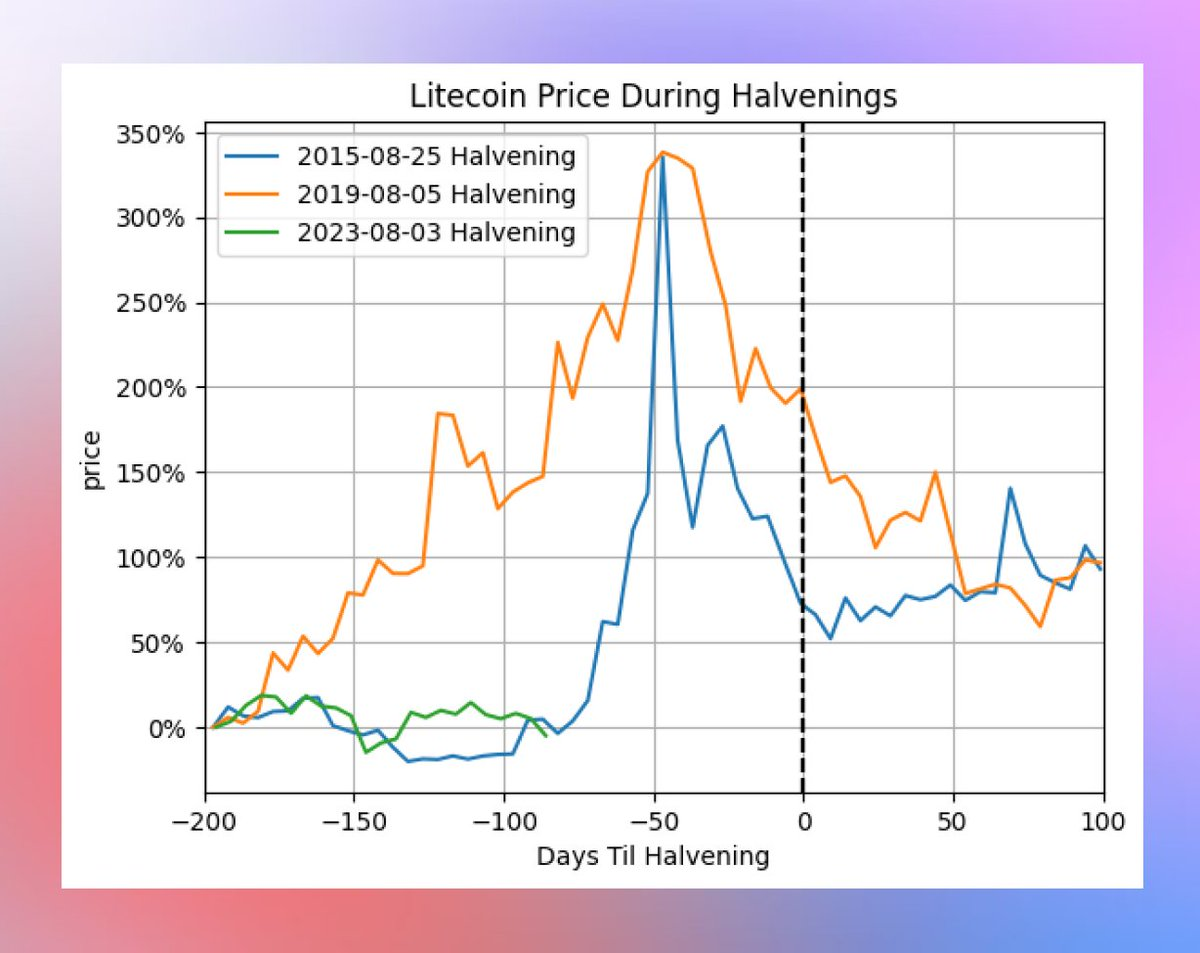
莱特币减半无疑是一个相关事件。虽然过去的表现并不能保证未来的结果,但历史数据表明,莱特币减半对资产价格产生了积极影响。

莱特币 [LTC] 是比特币数字白银,去年凭借MimbleWimble和突然的价格上涨卷土重来。现在,由于即将到来的减半事件,该资产再次引起轰动。莱特币减半是一个经常发生的事件,每四年发生一次。这类似于遵循类似时间表的比特币减半。 2023 年 8 月,莱特币有望迎来第三次减半。这将导致区块奖励从每区块 12.5 LTC减半至 6.25 LTC 。

值得注意的是,莱特币第一次减半发生在 2015 年 8 月,当时区块奖励从每个区块 50 LTC减少到 25 LTC 。第二次减半发生在 2019 年 8 月,当时区块奖励从每个区块 25 LTC减少到 12.5 LTC 。随着社区为第三次减半做准备,也预计竞争币的价格可能会飙升。

LTC能否在减半前飙升?

截至发稿时, LTC的交易价格为 79.25 美元,每日下跌 2.65%。该资产目前比其 412.96 美元的历史高点低 80.81%。减半事件有望重振加密货币的价格。

从历史上看,莱特币减半与其价格的看涨趋势有关。在减半之前的几个月里,投资者倾向于购买更多的莱特币,因为他们预计供应会减少,从而推高需求和价格。即使在减半事件发生之前,这也可能进一步导致潜在的上涨。

减半后,价格通常会出现短期回调,随后会出现逐渐上涨的趋势。这一次,莱特币社区对LTC价格上涨的可能性越来越乐观。 Litecoin 的创始人 Charlie Lee 最近分享了他对未来几个月LTC未来的想法和预测。他说,

“我可以看到 10%(0.025 LTC/ BTC)的上行目标。在下一个牛市中,5% (0.0125) 应该不会太难实现。老实说,我认为它的下行幅度不会远低于 1% (0.0025)。下一次减半将在约 92 天内。这将会非常好玩。”

其他一些人指出资产在减半后甚至可以达到 1000 美元。

#LITECOIN应该超过 1000 美元💥🚀

按照今天 2.85 万美元的比特币价格,今天的公允价值约为 729 美元至 1837 美元。

#Litecoin减半越来越近了。

新的LTC-20 标准现已推出,类似于#Bitcoin的 BRC-20。

区块链活动将使莱特币更加稀有。 pic.twitter.com/iUQJWuLNto

- Boom.LSP (@stellar_boom) 2023 年 5 月 3 日

莱特币减半无疑是一个相关事件。虽然过去的表现并不能保证未来的结果,但历史数据表明,莱特币减半对资产价格产生了积极影响。
Related Reads

Cyclical Stock or Growth Stock? Coinbase's Q2 Earnings Report Reveals 'Valuation Disagreement'

Coinbase's Q2 2026 financial results revealed a mixed performance, reigniting debate over whether the company should be valued as a cyclical stock tied to crypto markets or a growth stock with future potential. Total revenue missed expectations at $1.22 billion, down 19% year-over-year. Transaction revenue fell to $599 million, with retail crypto spot trading revenue dropping 30% to $452 million, back to 2023 levels. The company reported a net loss of $359 million, marking its third consecutive quarterly loss. Despite CEO Brian Armstrong's positive commentary on metrics like a 10.3% overall crypto trading market share and 106% growth in prediction markets, the market reacted negatively, with shares dropping over 5% after-hours. A key issue is the decline in core retail trading. While Coinbase touted record market share, this figure includes derivatives and new products. Its traditional crypto spot trading share is likely shrinking. New ventures like prediction markets, while growing, contributed less than $30 million, insufficient to offset the core revenue decline. The valuation debate hinges on perspective. As a cyclical stock, Coinbase remains deeply tied to the crypto bear market, with user attrition and competitive pressures justifying a lower valuation. The company's strategy appears focused on surviving until the next bull cycle. Viewed as a growth stock, however, Coinbase shows promising diversification. Subscription and service revenue reached $555 million, nearly matching transaction revenue. Stablecoin revenue, its second-largest source at $292 million, remains strong through its partnership with Circle. Critically, Coinbase is positioning itself as a leader in the emerging on-chain "agent economy." Over 90% of agent-based stablecoin transactions occur on its Base network, which it believes could handle trillions in future agent transactions. The recent acquisition of Deribit also aims to boost its international derivatives offering. In summary, Coinbase's present struggles are clear, but its future hinges on whether its investments in revenue diversification, stablecoins, and the agent economy can ultimately transform its business model and justify a growth premium.

Odaily星球日报10m ago

Cyclical Stock or Growth Stock? Coinbase's Q2 Earnings Report Reveals 'Valuation Disagreement'

Odaily星球日报10m ago

Global Market Share Survey: Japanese Firms Lead in Semiconductor Materials

Global Market Share Survey: Japanese Firms Lead in Semiconductor Materials According to the 2025 "Major Goods and Services Market Share Survey" by Nikkei, Japanese companies maintain strong positions in semiconductor-related materials. In silicon wafers, Shin-Etsu Chemical ranks first with a 26.3% share, followed by SUMCO at 17.8%. Together, they hold 44.1% of the market, widening their lead over competitors from Taiwan, Germany, and South Korea. In photoresists, Tokyo Ohka Kogyo, JSR, and Shin-Etsu Chemical occupy the top three spots, with a combined share of 60.5%. Despite their strength in materials, Japanese firms have a weaker presence in core semiconductor segments like DRAM and NAND flash memory, where South Korean and U.S. companies dominate. For instance, SK Hynix and Samsung lead in DRAM, while China’s CXMT doubled its share to 6% in 2025. The semiconductor market is projected to grow rapidly, with WSTS forecasting a 90% increase to $1.5112 trillion by 2026. Major players like Samsung, SK Hynix, and Micron are making massive investments to expand capacity. To maintain their edge in materials, Japanese companies must similarly commit to large-scale, risk-taking investments. In contrast, Japan’s automotive sector shows stagnation. Toyota remains the global leader but with only a slight share increase to 12.3%, while Japanese brands are absent from the top five in the EV market. In shipbuilding, Imabari Shipbuilding rose to third place globally with a 7.2% share, benefiting from large container ship deliveries. However, Chinese and South Korean firms dominate the sector, holding the top two positions. Japan aims to revitalize its shipbuilding industry through government and corporate efforts, targeting a near doubling of output by 2035. Addressing labor shortages and adopting advanced technologies like physical AI will be critical for competitiveness.

marsbit35m ago

Global Market Share Survey: Japanese Firms Lead in Semiconductor Materials

marsbit35m ago

Trading

Spot
活动图片