Bitcoin Taproot Utilization Spikes As Tokens Like PEPE Explode

BitcoinistPublished on 2023-05-09Last updated on 2023-05-09

Abstract

On-chain data shows that Bitcoin taproot utilization has sharply surged recently as BRC-20 tokens like Pepe Coin have exploded in...

On-chain data shows that Bitcoin taproot utilization has sharply surged recently as BRC-20 tokens like Pepe Coin have exploded in popularity.
Bitcoin Taproot Utilization Has Crossed The 43% Mark Recently
As pointed out by Rafael Schultze-Kraft, the co-founder of the on-chain analytics firm Glassnode, Taproot is currently being used in more BTC transactions than ever before. “Taproot” refers to a Bitcoin upgrade that went live in November 2021 and introduced some changes to make transfers more efficient and faster.
The upgrade initially saw little usage, but in the last few months, it has been coming in use a lot more. There are two different metrics available that aim to track the progress of Taproot being accepted: the “adoption” and the “utilization.”
The adoption measures the total percentage of the BTC transactions that contain at least one Taproot input. This indicator, however, isn’t considered the most reliable as it doesn’t contain the entire information about the actual adoption of the upgrade.
This is because even if five out of five inputs to a transfer use Taproot, this transaction’s weightage in the adoption will still be the same as a transfer that has only one out of five inputs that use Taproot.
Glassnode has made the utilization metric to solve this issue, and this new indicator tells us how in-use the upgrade is by measuring the actual amount of spent outputs that involve Taproot.
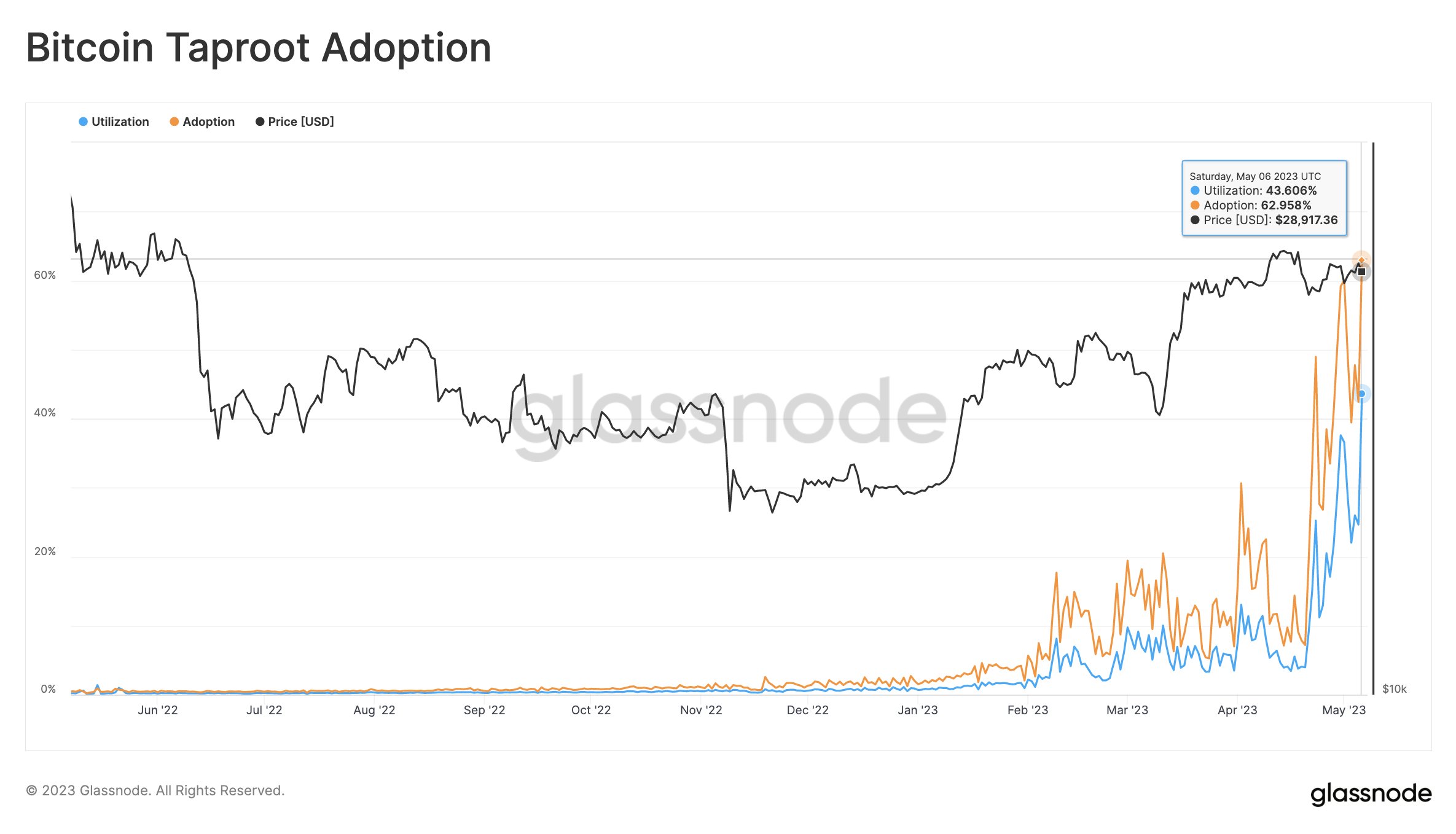
Now, here is a chart that shows the trend in both the adoption and utilization of this Bitcoin upgrade over the last year:
Image


Looks like both these metrics have shot up recently | Source: Rafael Schultze-Kraft on Twitter
As shown in the above graph, these Bitcoin indicators had been at relatively low levels until February of this year, when their values suddenly started to blow up. The reason behind this spike in Taproot utility was because of the emergence of Ordinals.
The Ordinals protocol uses Taproot and has found a variety of applications on the blockchain. Thanks to this protocol, a method of inscribing data like images, text, videos, and other forms has been devised on the network in the form of Inscriptions.
The Inscriptions have quickly become popular on the blockchain, thus leading to a surge in the usage of Taproot. Recently, however, the adoption of the upgrade has gone up another level, and it’s all because of another application of the Ordinals: the BRC-20 tokens.
These tokens make use of the protocol to inscribe text on the chain that represents a fungible token. These coins work similarly to the ERC-20 tokens on the Ethereum network, although they have a lot more limitations.
A large amount of BRC-20 tokens have been minted recently, a lot of which are meme coins. One of the most prominent examples of these is Pepe Coin (PEPE), which has been the topic around the market thanks to its explosive price growth.
As a result of such BRC-20 meme coins becoming very popular recently, the Bitcoin Taproot adoption and utilization have both sharply surged to 63% and 43%, respectively.
BTC Price
At the time of writing, Bitcoin is trading around $27,900, down 2% in the last week.

Bitcoin Price Chart


BTC has gone down in the last 24 hours | Source: BTCUSD on TradingView
Featured image from iStock.com, charts from TradingView.com, Glassnode.com
Related Reads

Why Ethereum Staking Will Change in 2026

The article discusses the evolving role of Ethereum (ETH) staking, shifting from a niche crypto enthusiast topic to a mainstream portfolio management tool for financial advisors and institutional investors. It explains how staking works in Ethereum's Proof-of-Stake network, detailing validator requirements and methods like solo staking, pools, exchanges, and liquid staking protocols, each with its own risk-reward profile (e.g., liquidity, control, technical requirements). A key point is staking's growing importance for corporate treasuries, where staking rewards represent a significant income stream, unlike non-yielding Bitcoin holdings. Looking ahead, the article highlights the anticipated 'Glamsterdam' upgrade in late 2026 as a pivotal development expected to enhance scalability, decentralization, and post-quantum resistance, further solidifying Ethereum's institutional appeal. It also emphasizes that while staking offers passive income and network participation, risks include technical failures, slashing penalties, platform/custodial risks, and regulatory uncertainty. For advisors, the conclusion stresses the need to evaluate staking providers beyond just promised yields, focusing on reliability, fees, withdrawal terms, security, and the specifics of reward structures (protocol vs. MEV-based). The regulatory landscape and infrastructure maturity around digital asset custody are noted as critical adjacent topics to monitor.

cryptonews.ru11m ago

Why Ethereum Staking Will Change in 2026

cryptonews.ru11m ago

Scott Bessent's Risky Bond Buyback Operation Could Fuel Bitcoin Price Surge

Bitcoin returned to the $80,000 level on Thursday, breaking past a key $79,000 resistance point, on news of an upcoming $92 billion U.S. Treasury bill auction scheduled for August 31st. The price recovery saw Bitcoin reach a daily high of $80,808, though it faced brief selling pressure. The cryptocurrency was trading around $80,400 by late morning EST, marking a roughly 3% daily increase and pushing its market cap back to $1.61 trillion. This surge positions Bitcoin for a monthly gain of over 20%, a sharp reversal from July's flat performance. The volatility led to $105 million in leveraged Bitcoin positions being liquidated in 24 hours, with short positions accounting for the majority of losses. Analysts note the large-scale Treasury auction could drain short-term market liquidity, potentially pushing yields higher and pressuring risk assets like stocks and crypto. Furthermore, a recent article in The Economist warns that U.S. Treasury Secretary Scott Bessent's policies risk undermining confidence in the American financial system. The report criticizes measures to artificially cap long-term bond yields and a shift towards issuing more short-term T-bills, which shortens the overall debt duration and increases vulnerability to future rate hikes. This approach, along with distorting market pricing mechanisms, could jeopardize long-term investor trust in U.S. sovereign debt. Prominent figures like Ray Dalio suggest such policies are reducing the inflation-adjusted yield of traditional fixed-income assets, potentially driving capital seeking a store of value towards alternatives like gold and Bitcoin, whose prices have risen since the Treasury's announcements.

cryptonews.ru12m ago

Scott Bessent's Risky Bond Buyback Operation Could Fuel Bitcoin Price Surge

cryptonews.ru12m ago

Trading

Spot
活动图片