Here’s Why The Fair Price Of Bitcoin Currently Is $42,000: Renowned Analyst

newsbtcPublished on 2023-04-04Last updated on 2023-04-04

Abstract

The founder of Capriole Investments, Charles Edwards, has shared in his latest tweet an assessment that Bitcoin is still significantly undervalued at its current price. The creator of the Hash...

The founder of Capriole Investments, Charles Edwards, has shared in his latest tweet an assessment that Bitcoin is still significantly undervalued at its current price. The creator of the Hash Ribbons indicator and one of the leading publishers of on-chain models, stated that Bitcoin is currently trading at a 33% discount to its fair value.


“The symmetry of the Bitcoin cycle and its fundamental data is something truly unique to Bitcoin. I suspect this is a trait only found in tamperproof assets, only Bitcoin,” Edwards wrote. The analyst provides a more detailed rationale in his Capriole Investments newsletter, which has been obtained by NewsBTC.


BTC’s fair value, according to the analyst, is derived from Bitcoin’s energy value, which is calculated based solely on the energy expended to secure the network. “A clean, simple equation that values Bitcoin purely on watts of energy used to mine,” Edwards says.

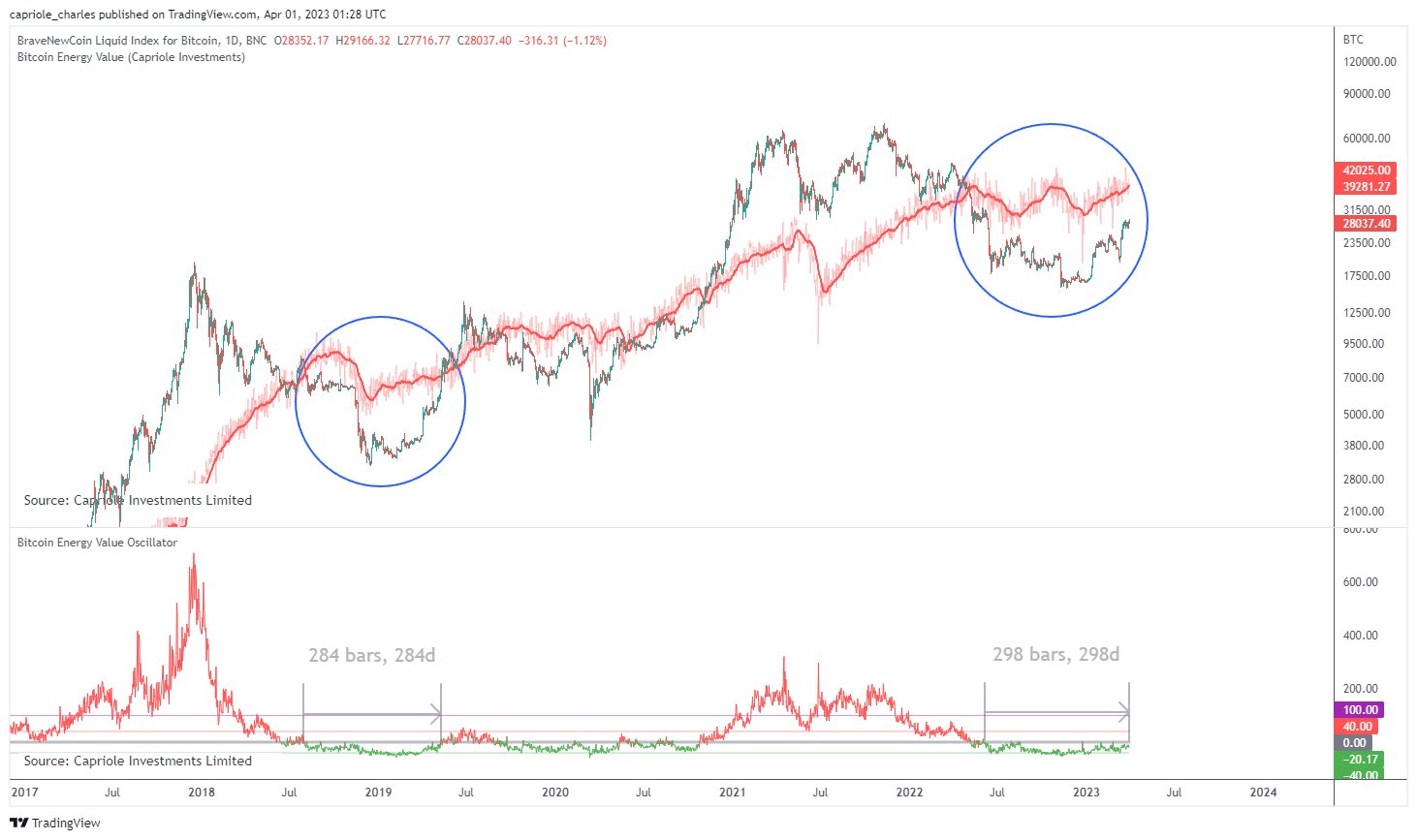
Currently, the Bitcoin Energy Value is $42,000, which means BTC is undervalued by 33%. Interestingly, both the price and hashrate have risen sharply since the beginning of the year.


Therefore, although Bitcoin has increased by 70% since December, the relative value difference between the price and energy value has only decreased slightly. According to Edwards, BTC is therefore currently undervalued at around $28,000 to the same extent that it was undervalued in December 2022, when the price was trading below $17,000.

Edwards further stated that the current undervaluation phase is similar to the bear market of 2018 where Bitcoin traded below its Energy Value for 285 days. Currently, BTC is already 298 days below its fair price.

The fair value of Bitcoin has increased in tandem with price. Bitcoin is worth $42K today based on Energy Value, and has seen a comparable length period of undervaluation to the 2018 lows.
Bitcoin Energy Value

Bitcoin Energy Value | Source: Capriole Investments

”“

Bitcoin Price Surges Due To Organic Demand


In the newsletter, Edwards also discusses that Bitcoin’s significant price increase since the lows of the FTX scam in November 2022 has been driven by organic spot buying. Unlike previous rallies driven by speculators in the derivatives market, there is currently a much healthier price appreciation.

The ratio of derivatives to spot volume has never been lower since the widespread adoption of BTC perpetual swaps in 2018, according to Edwards, who draws two bullish conclusions from this. First, the price increase is caused by organic demand; second, “we’re incredibly early in this bull cycle.”


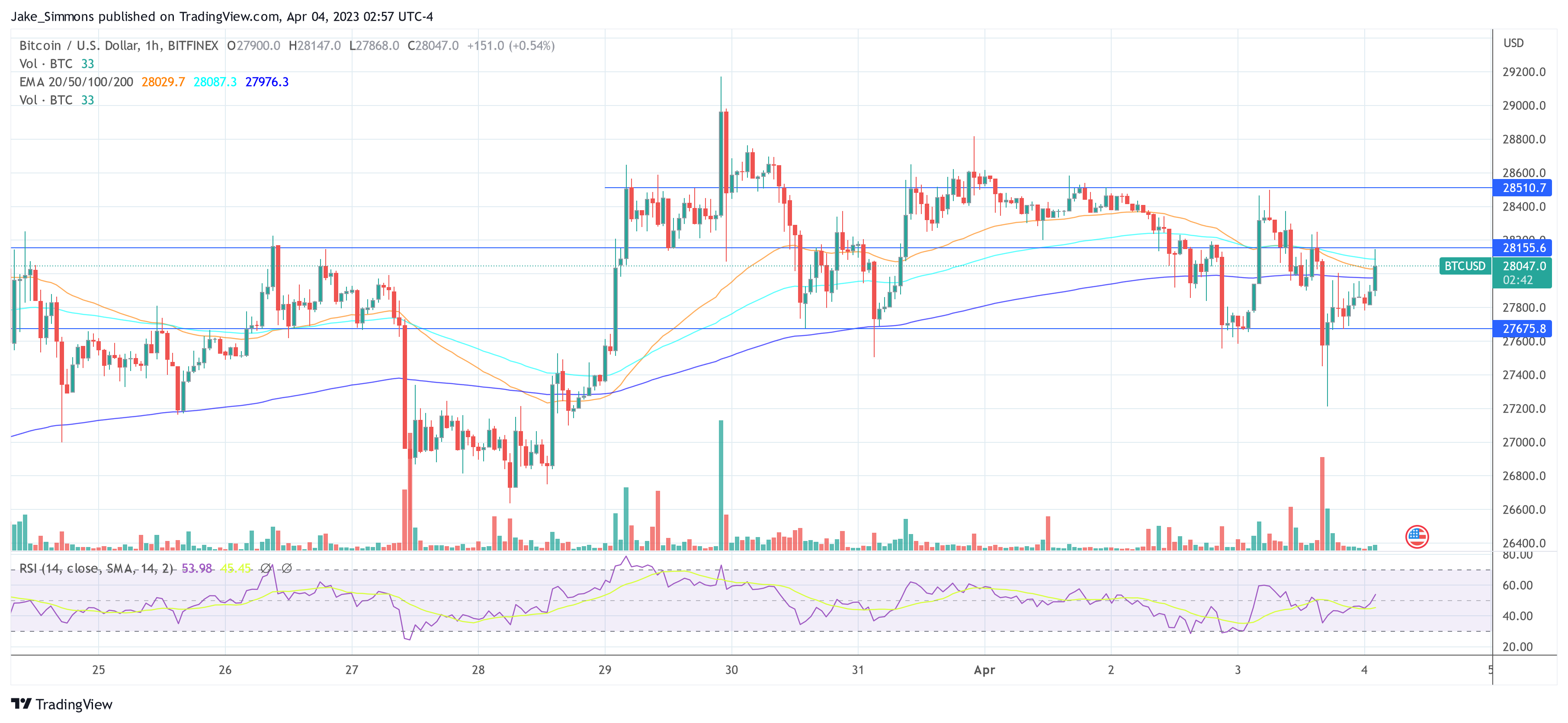
At press time, the BTC price was at $28,047. Yesterday, the price briefly plunged by more than $1,000 on the rumor that Binance CEO Changpeng Zhao received an Interpol Red Notice, reaching a low of $27,207. The rumor has since been debunked as fake news by the CEO of the world’s largest crypto exchange.
Bitcoin price

BTC price, 1-hour chart | Source: BTCUSD on TradingView.com


Trending Cryptos

Related Reads

Comprehensive Analysis of the AI Inference Market: How Can Crypto Projects Break Through?

"AI Inference Market: A Strategic Overview and Crypto's Path to Disruption" The AI inference market, where trained models generate responses to user prompts, is now the primary economic driver, surpassing model training in value. This market is fragmented: hyperscalers (AWS, Google, Microsoft) dominate enterprise reliability; specialized providers (Together, Fireworks) optimize performance; and routing platforms like OpenRouter act as critical bottlenecks, dynamically allocating requests based on cost, latency, and privacy. Crypto AI networks are not competing directly on reliability but are carving out distinct niches: permissionless access, lower-cost supply, privacy, verifiable computation, and agent-native payments. Key projects include Chutes (decentralized inference platform), Akash & io.net (GPU marketplaces), Targon (confidential computing), Darkbloom & Venice (private, consumer-focused inference), and NuNet (orchestration for distributed workloads). The core differentiator is that traditional providers sell trust and enterprise workflows, while crypto networks offer new incentive loops, censorship resistance, and programmable access to resources like compute. For crypto projects to succeed, key metrics are paid token volume (not just usage), sustainable GPU provider revenue, integration into routers like OpenRouter, robust verification against fraud, and genuine privacy guarantees. Ultimately, market control will belong to entities that route, verify, and settle demand—not just those supplying raw compute. The inference market is evolving to resemble a financial system, with tokens as units of account, and crypto's unique value propositions position it to capture emerging segments in this expanding landscape.

Foresight News13m ago

Comprehensive Analysis of the AI Inference Market: How Can Crypto Projects Break Through?

Foresight News13m ago

The War Without a Unified Name: The Domestic Tech Giants' World Model Landscape

The article outlines the diverse and fragmented landscape of "World Models" in China's tech industry, where major players are pursuing similar goals under different names like world foundational models, physical AI, or integrated within autonomous driving and embodied intelligence systems. The core aim is to enable AI to create an internal, dynamic environment for simulation, reasoning, and learning, reducing reliance on infinite real-world data. This "data engine" allows for unlimited generation, experimentation, and iteration. The report categorizes the approaches of different companies: * **Internet Giants:** Alibaba is developing models for linguistic, virtual, and physical worlds (Qwen-AgentWorld, HappyOyster, Qwen-RobotWorld). Tencent's HY-World focuses on 3D, game, and social scenarios. ByteDance leverages its vast video data for a potential "digital twin" model. Huawei integrates its model into industrial applications like smart cars and robotics without separately branding it. Baidu embeds world model capabilities within its Apollo autonomous driving and Ernie systems. * **Automakers:** Companies like NIO, Li Auto, XPeng, and Geely are using world models as virtual "driving schools" and "testing grounds." They generate complex scenarios (e.g., rain, snow) to train and validate autonomous driving systems in simulation, aiming for more capable and safer AI drivers. * **Autonomous Driving Suppliers:** Firms such as Momenta, Horizon Robotics, Haomo.ai, and DeepRoute.ai are building the underlying "world engines." They focus on large-scale video generation for simulation, reinforcement learning, and enhancing end-to-end autonomous driving models, often integrating these capabilities into commercial products. While startups bring focus and innovation, they face challenges like limited data, compute resources, and deployment channels. Large companies possess these advantages and are rapidly transitioning world models from research projects into core business infrastructure powering products in vehicles, games, and industry. The conclusion is that world models represent an evolution and convergence of existing AI fields into crucial industrial infrastructure, moving the competition from simply building a model to effectively deploying it to understand and interact with the physical world.

marsbit30m ago

The War Without a Unified Name: The Domestic Tech Giants' World Model Landscape

marsbit30m ago

Trading

Spot
Futures

Hot Articles

What is $BITCOIN

DIGITAL GOLD ($BITCOIN): A Comprehensive Analysis Introduction to DIGITAL GOLD ($BITCOIN) DIGITAL GOLD ($BITCOIN) is a blockchain-based project operating on the Solana network, which aims to combine the characteristics of traditional precious metals with the innovation of decentralized technologies. While it shares a name with Bitcoin, often referred to as “digital gold” due to its perception as a store of value, DIGITAL GOLD is a separate token designed to create a unique ecosystem within the Web3 landscape. Its goal is to position itself as a viable alternative digital asset, although specifics regarding its applications and functionalities are still developing. What is DIGITAL GOLD ($BITCOIN)? DIGITAL GOLD ($BITCOIN) is a cryptocurrency token explicitly designed for use on the Solana blockchain. In contrast to Bitcoin, which provides a widely recognized value storage role, this token appears to focus on broader applications and characteristics. Notable aspects include: Blockchain Infrastructure: The token is built on the Solana blockchain, known for its capacity to handle high-speed and low-cost transactions. Supply Dynamics: DIGITAL GOLD has a maximum supply capped at 100 quadrillion tokens (100P $BITCOIN), although details regarding its circulating supply are currently undisclosed. Utility: While precise functionalities are not explicitly outlined, there are indications that the token could be utilized for various applications, potentially involving decentralized applications (dApps) or asset tokenization strategies. Who is the Creator of DIGITAL GOLD ($BITCOIN)? At present, the identity of the creators and development team behind DIGITAL GOLD ($BITCOIN) remains unknown. This situation is typical among many innovative projects within the blockchain space, particularly those aligning with decentralized finance and meme coin phenomena. While such anonymity may foster a community-driven culture, it intensifies concerns about governance and accountability. Who are the Investors of DIGITAL GOLD ($BITCOIN)? The available information indicates that DIGITAL GOLD ($BITCOIN) does not have any known institutional backers or prominent venture capital investments. The project seems to operate on a peer-to-peer model focused on community support and adoption rather than traditional funding routes. Its activity and liquidity are primarily situated on decentralized exchanges (DEXs), such as PumpSwap, rather than established centralized trading platforms, further highlighting its grassroots approach. How DIGITAL GOLD ($BITCOIN) Works The operational mechanics of DIGITAL GOLD ($BITCOIN) can be elaborated on based on its blockchain design and network attributes: Consensus Mechanism: By leveraging Solana’s unique proof-of-history (PoH) combined with a proof-of-stake (PoS) model, the project ensures efficient transaction validation contributing to the network's high performance. Tokenomics: While specific deflationary mechanisms have not been extensively detailed, the vast maximum token supply implies that it may cater to microtransactions or niche use cases that are still to be defined. Interoperability: There exists the potential for integration with Solana’s broader ecosystem, including various decentralized finance (DeFi) platforms. However, the details regarding specific integrations remain unspecified. Timeline of Key Events Here is a timeline that highlights significant milestones concerning DIGITAL GOLD ($BITCOIN): 2023: The initial deployment of the token occurs on the Solana blockchain, marked by its contract address. 2024: DIGITAL GOLD gains visibility as it becomes available for trading on decentralized exchanges like PumpSwap, allowing users to trade it against SOL. 2025: The project witnesses sporadic trading activity and potential interest in community-led engagements, although no noteworthy partnerships or technical advancements have been documented as of yet. Critical Analysis Strengths Scalability: The underlying Solana infrastructure supports high transaction volumes, which could enhance the utility of $BITCOIN in various transaction scenarios. Accessibility: The potential low trading price per token could attract retail investors, facilitating wider participation due to fractional ownership opportunities. Risks Lack of Transparency: The absence of publicly known backers, developers, or an audit process may yield skepticism regarding the project's sustainability and trustworthiness. Market Volatility: The trading activity is heavily reliant on speculative behavior, which can result in significant price volatility and uncertainty for investors. Conclusion DIGITAL GOLD ($BITCOIN) emerges as an intriguing yet ambiguous project within the rapidly evolving Solana ecosystem. While it attempts to leverage the “digital gold” narrative, its departure from Bitcoin's established role as a store of value underscores the need for a clearer differentiation of its intended utility and governance structure. Future acceptance and adoption will likely depend on addressing the current opacity and defining its operational and economic strategies more explicitly. Note: This report encompasses synthesised information available as of October 2023, and developments may have transpired beyond the research period.

449 Total ViewsPublished 2025.05.13Updated 2025.05.13

What is $BITCOIN

Discussions

Welcome to the HTX Community. Here, you can stay informed about the latest platform developments and gain access to professional market insights. Users' opinions on the price of BTC (BTC) are presented below.

活动图片