$11.3 Billion Flows Into Bitcoin ETFs In One Month While Retail Sells At A Loss – Details

bitcoinistPublished on 2026-03-27Last updated on 2026-03-27

Abstract

Bitcoin is consolidating around $70,000, but significant capital flows are occurring beneath the surface. Over 30 days, Bitcoin ETFs saw net inflows of $11.3 billion, absorbing 62,986 BTC as institutional buying accelerated to 2.6 times its monthly pace. This sustained demand has pushed ETF cumulative holdings to a record 1,326,874 BTC. Meanwhile, retail investors are selling at a loss, with short-term holders sending approximately 15,500 BTC daily to exchanges at a loss, accounting for the majority of their activity. This reflects sustained stress rather than a final capitulation event. The market structure shows institutions are buying faster than retail is selling, but the key signal to watch is whether loss-side selling compresses while the market holds or rises.

Bitcoin is consolidating around $70,000. The price has gone sideways. The capital flows beneath it have not.

Analyst Axel Adler has published data that reframes the current consolidation entirely: over the 30 days ending March 25, Bitcoin ETF funds absorbed 62,986 BTC in net inflows — $11.3 billion in institutional capital entering the market while the price moved from $64,100 to $71,307. That is not a market drifting. That is a market being quietly bought.

The acceleration signal sharpens the picture further. The 7-day flow average currently stands at 3,288 BTC per day against a 30-day average of 1,256 BTC — meaning institutional buying is running at 2.6 times its own monthly pace. ETF cumulative holdings have reached 1,326,874 BTC, a record that reflects the sustained, compounding nature of this demand rather than a single episodic event.
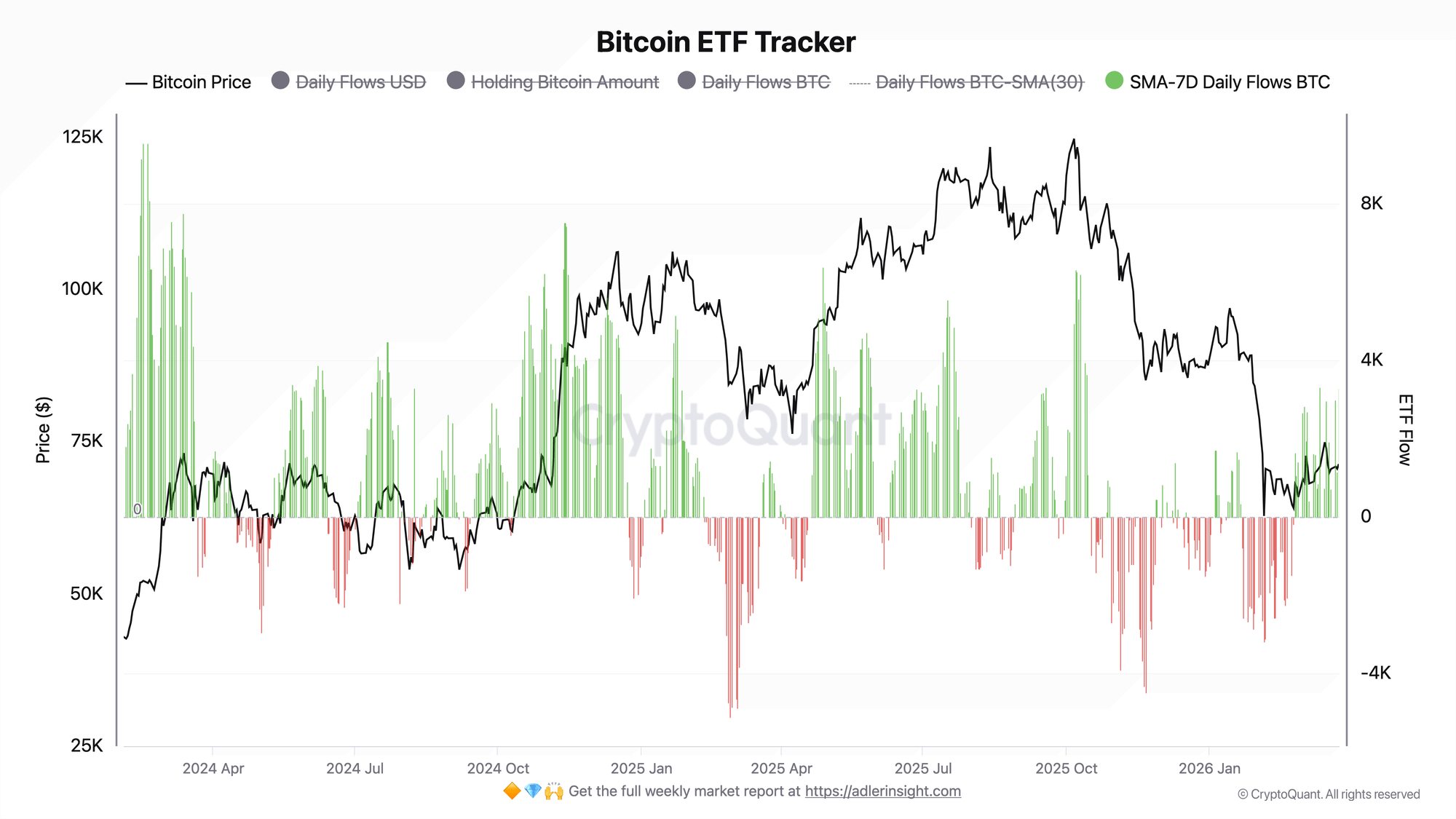
Bitcoin ETF Tracker | Source: CryptoQuant

The counterweight is real and should not be minimized. Short-term holders are consistently realizing losses on exchanges — retail participants selling into weakness, adding distribution pressure that institutional inflows are currently absorbing and overcoming.

That is the structure of this market in one sentence: institutions are buying faster than retail is selling. At $70,000, the question is how long that equation holds.

Retail Is Selling Bitcoin at a Loss

Adler’s second dataset examines the other side of the market structure equation — and it is considerably less comfortable than the ETF picture. The Short-Term Holder P&L to Exchanges metric tracks how many BTC retail participants are sending to exchanges at a loss versus a profit over any 24-hour period. Right now, that reading stands at -15,500 BTC per day flowing to exchanges at a loss, against a total STH exchange inflow of 35,200 BTC per 24 hours.
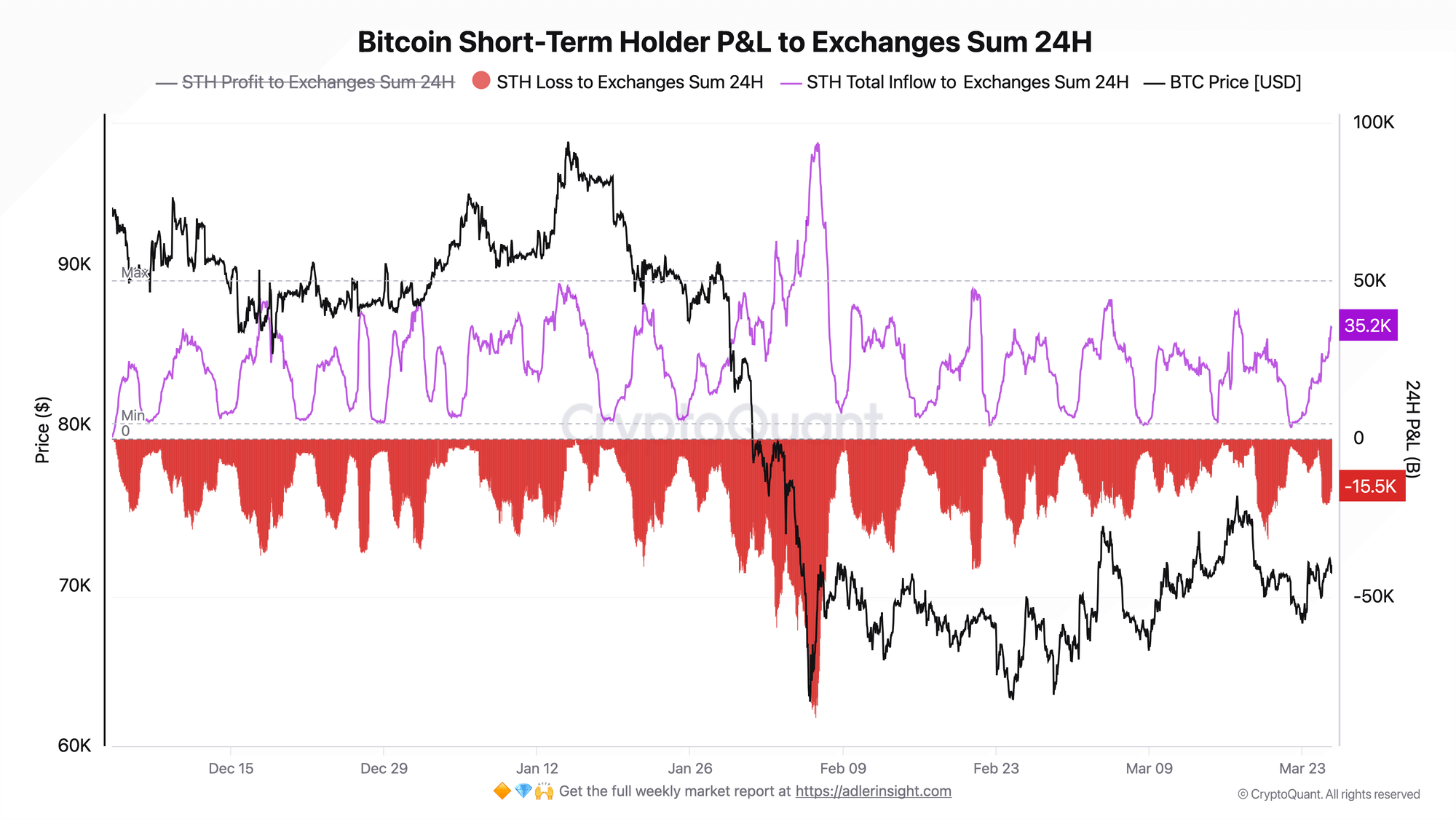
Bitcoin Short-Term Holder P&L to Exchange Sum 24H | Source: CryptoQuant

The arithmetic is unambiguous: the majority of retail activity hitting exchanges is loss-realizing. This is not a temporary anomaly. Adler identifies it as a regime shift — a structural change in behavior that began at the local price peak and has not recovered above the neutral zone since. Short-term holders are not selling opportunistically. They are selling because they are underwater, and they have been for weeks.

What the data does not show is equally important. The -15,500 BTC daily loss flow is consistent with sustained stress, but it lacks the vertical spike that historically marks final capitulation — the exhaustion event where the last forced sellers leave the market simultaneously. That spike has not arrived.

The retail segment remains weak. The institutional segment remains active. The signal that resolves the tension between them is straightforward: loss-side sends compressing while price holds or rises. Until that compression appears, the stress regime remains intact.


Related Questions

QWhat is the total net inflow into Bitcoin ETFs over the 30 days ending March 25, and how much Bitcoin did this represent?

AThe total net inflow into Bitcoin ETFs over the 30 days ending March 25 was $11.3 billion, which represented 62,986 BTC.

QHow does the current 7-day average of institutional buying compare to the 30-day average, and what does this indicate?

AThe 7-day flow average is 3,288 BTC per day, which is 2.6 times the 30-day average of 1,256 BTC. This indicates that institutional buying is accelerating significantly.

QWhat is the behavior of short-term holders (retail participants) according to the data presented by Axel Adler?

AShort-term holders are consistently realizing losses, sending approximately 15,500 BTC to exchanges at a loss per day. This represents the majority of their total 35,200 BTC daily exchange inflows, indicating they are selling due to being underwater on their investments.

QWhat key signal is missing from the current retail selling activity that historically marks a final market capitulation?

AThe data lacks the vertical spike in loss-realizing flows that historically marks a final capitulation event, where the last forced sellers exit the market simultaneously. This spike has not yet occurred.

QWhat is the current structure of the Bitcoin market as described in the article in one sentence?

AThe structure of the market is that institutions are buying Bitcoin faster than retail investors are selling it.

Related Reads

Trading

Spot
Futures

Hot Articles

How to Buy ONE

Welcome to HTX.com! We've made purchasing Harmony (ONE) simple and convenient. Follow our step-by-step guide to embark on your crypto journey.Step 1: Create Your HTX AccountUse your email or phone number to sign up for a free account on HTX. Experience a hassle-free registration journey and unlock all features.Get My AccountStep 2: Go to Buy Crypto and Choose Your Payment MethodCredit/Debit Card: Use your Visa or Mastercard to buy Harmony (ONE) instantly.Balance: Use funds from your HTX account balance to trade seamlessly.Third Parties: We've added popular payment methods such as Google Pay and Apple Pay to enhance convenience.P2P: Trade directly with other users on HTX.Over-the-Counter (OTC): We offer tailor-made services and competitive exchange rates for traders.Step 3: Store Your Harmony (ONE)After purchasing your Harmony (ONE), store it in your HTX account. Alternatively, you can send it elsewhere via blockchain transfer or use it to trade other cryptocurrencies.Step 4: Trade Harmony (ONE)Easily trade Harmony (ONE) on HTX's spot market. Simply access your account, select your trading pair, execute your trades, and monitor in real-time. We offer a user-friendly experience for both beginners and seasoned traders.

3.3k Total ViewsPublished 2024.03.29Updated 2025.06.04

How to Buy ONE

Discussions

Welcome to the HTX Community. Here, you can stay informed about the latest platform developments and gain access to professional market insights. Users' opinions on the price of ONE (ONE) are presented below.

活动图片