$1 Billion in Iranian Cryptocurrency Seized by the U.S., Could It Be Added to the U.S. Strategic Bitcoin Reserve?

marsbitPublished on 2026-06-02Last updated on 2026-06-02

Abstract

US Treasury Secretary Scott Bessent announced the seizure of approximately $1 billion in Iranian cryptocurrency assets. The critical unanswered questions are the specific assets seized (e.g., Bitcoin vs. stablecoins like USDT) and their precise legal status (frozen vs. formally forfeited). According to a 2025 executive order, only Bitcoin that has undergone complete judicial forfeiture can be placed into a permanent, non-saleable Strategic Bitcoin Reserve. Other forfeited digital assets go to a separate US Digital Asset Reserve. Currently, only $344 million in USDT frozen by Tether is publicly confirmed. The remaining $656 million in assets lack public details. The assets' final disposition hinges on three factors: 1) Asset type, 2) Completion of the forfeiture process, and 3) Whether funds are used for victim restitution, law enforcement costs, or other exemptions before treasury transfer. Without confirmed forfeiture of Bitcoin, the seizure may primarily demonstrate stable币 regulatory compliance rather than augmenting the US Bitcoin reserve.

Written by: Gino Matos

Compiled by: Saoirse, Foresight News

Key Takeaways

  • Treasury Secretary Scott Bessent stated that the U.S. seized approximately $1 billion in Iranian crypto assets but did not disclose the relevant wallet addresses or token composition.
  • Asset category is crucial: Bitcoins legally forfeited can be transferred to the Trump Strategic Bitcoin Reserve; other tokens will be handled separately.
  • It remains unclear whether the assets are frozen, seized, or officially forfeited. Their legal status directly determines if the funds can be added to the reserve.

Treasury Secretary Scott Bessent stated at the Reagan National Economic Forum that the United States has seized approximately $1 billion in Iranian crypto assets. This seizure of Iranian assets serves as the first practical test following the implementation of the Trump administration's crypto reserve policy. Bessent added that the U.S. "directly took control of the wallets involved." According to a CBS report, he characterized these funds as money stolen from the Iranian people. However, Bessent did not disclose the asset types or corresponding wallet information—key details that precisely determine whether the funds can flow into the Strategic Bitcoin Reserve established by Trump.

According to an executive order signed by Trump in 2025, U.S. government-owned digital assets are divided into two separate accounts: The Strategic Bitcoin Reserve, specifically designated to hold bitcoins forfeited through civil or criminal judicial proceedings or collected as civil monetary penalties. The order explicitly states that government bitcoins deposited into this account are permanently prohibited from being sold. The other account is the U.S. Digital Asset Reserve, which holds non-bitcoin digital assets that have undergone final forfeiture proceedings. This classification framework makes the current seizure of Iranian crypto assets a practical test case: Only bitcoins that complete the final forfeiture process can be added to the Strategic Bitcoin Reserve; all other remaining tokens will be placed into the U.S. Digital Asset Reserve.

If the seized Iranian assets include bitcoin and the legal forfeiture is successfully completed, they can be incorporated into the reserve. If they consist of stablecoins or other types of tokens, they will likely be transferred to the Digital Asset Reserve. Another possibility is that the assets are merely in a frozen state, in which case the U.S. has not yet obtained legal ownership.

Clarifying the Actual Legal Meaning of "Seizure"

As early as April, the U.S. Treasury Department imposed sanctions on multiple Iran-linked wallets. Tether simultaneously disclosed that it cooperated with U.S. regulators to freeze a total of $344 million USDT across two addresses. Blockchain risk management firm TRM Labs confirmed that these wallets were linked to the Central Bank of Iran, the IRGC Quds Force, and Lebanon's Hezbollah. For the remaining approximately $656 million in assets, there is no publicly available breakdown by wallet or token type.

"Physical seizure" does not equal "legal ownership." OFAC sanctions rules clearly state that blocked assets are only subject to account freezing; the U.S. does not automatically gain ownership rights. Taking stablecoins like USDT as an example, issuers cooperating with regulators to lock addresses constitutes a sanction freeze, not a judicial forfeiture in the criminal law sense. Seizure at the enforcement level only represents the government's temporary control of the assets; ownership still awaits the outcome of forfeiture litigation.

Final forfeiture is a mandatory threshold for assets to enter the reserve: After assets complete the forfeiture process, deductions are made for victim compensation, specialized enforcement expenses, allocations to local law enforcement agencies, legally exempted returns, etc. Only the remaining assets are eligible for transfer into the reserve or the reserve account. Bessent's public statements leave the legal status of these assets entirely uncertain.

At the current Bitcoin price of approximately $73,000, if the entire $1 billion consisted of Bitcoin, it would be equivalent to about 13,632 BTC. According to 2025 statistics, the U.S. government has accumulated about 200,000 compliant bitcoins through past judicial proceedings. If this amount of BTC is fully deposited, the increment would represent 6.8% of the existing reserve volume. In current public records, only the $344 million USDT freeze is documented; details regarding the remaining $656 million in assets—their token types and legal forfeiture progress—are not publicly disclosed. No assets have completed the statutory forfeiture process.

The Industry Basis for the $1 Billion Seizure Figure

Considering the scale of Iran's crypto industry, the $1 billion seizure figure is reasonable, but the asset composition remains opaque.

Chainalysis estimates: In 2025, Iran's annual crypto transfer volume reached $7.78 billion. In Q4 2025, funds flows related to the Iranian Revolutionary Guard accounted for half of the country's total crypto transaction volume. TRM Labs estimates Iran's total annual crypto activity to be nearly $10 billion. Iran's leading exchange, Nobitex, has 11 million users, handling 70% of the country's crypto transactions. Investigations show that this platform has long processed transfers worth hundreds of millions of dollars for sanctioned entities like the Central Bank of Iran and the Revolutionary Guard.

Combining the above industry data, multiple rounds of U.S. enforcement actions plus issuer freezes totaling $1 billion in locked assets is plausible from an industry logic perspective, but the specific asset breakdown cannot be verified. The publicly announced $344 million USDT constitutes only 33% of the total, leaving 65.6% of the funds unaccounted for.
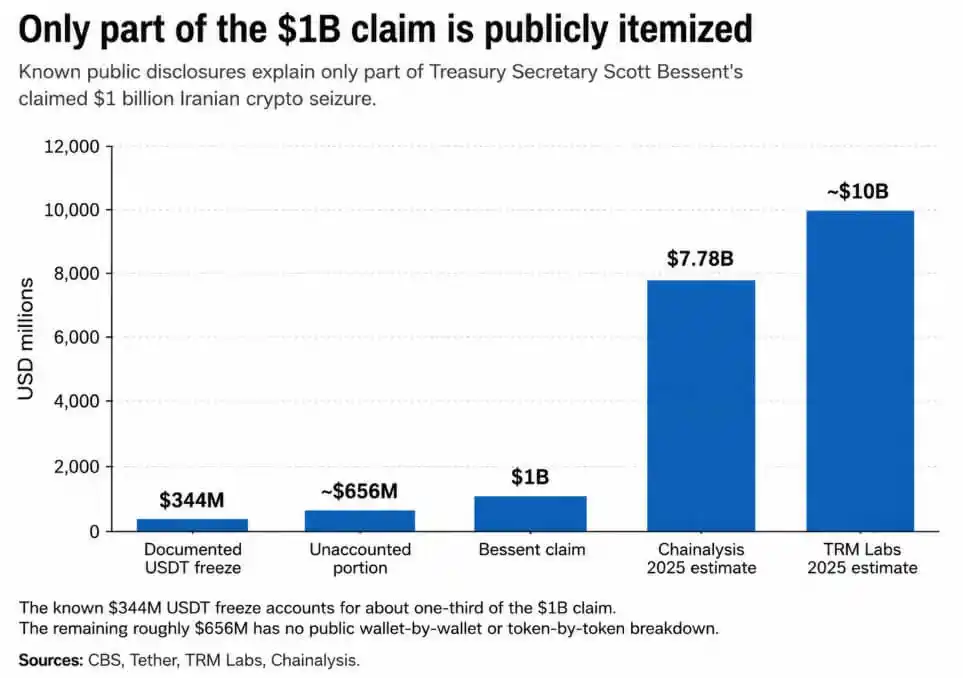
The known $344 million USDT freeze accounts for only 33% of the $1 billion in Iranian cryptocurrency that Bessent claims was seized, leaving $656 million publicly unaccounted for.

Projecting the Token Composition and Destination of the Seized Assets

If the $1 billion includes a significant amount of Bitcoin, and the U.S. completes the ownership forfeiture with no need for victim compensation and no diversion for enforcement expenses, the corresponding Bitcoin would enter the non-saleable strategic reserve. Crypto assets originally used by Iran to evade U.S. financial blockades would be transformed into a sovereign book reserve for the U.S. through sanction enforcement.

Currently, the only confirmed assets are $344 million USDT, frozen by Tether in cooperation with regulatory address freezes. If the remaining $656 million is also primarily stablecoins, the entire event essentially becomes a case of stablecoin regulatory compliance enforcement. Frozen USDT would remain locked; non-bitcoin assets, after forfeiture, would be transferred to the Digital Asset Reserve, with subsequent disposal plans determined entirely by the Treasury Secretary. A complete list of wallets and token types would directly change the nature of the event: it could either represent the implementation of U.S. sovereign Bitcoin accumulation or merely stablecoin regulatory compliance. Bessent has not disclosed any details at this stage.

The executive order also stipulates that forfeited assets can be returned to rightful victim claimants, allocated for case expenses, shared with state law enforcement agencies, or legally exempted from return. Any of these scenarios would prevent the assets from entering the reserve. These provisions represent multiple layers of hurdles for assets transitioning from "seized" to "treasury reserve," which can be triggered at any point before or after forfeiture.

The institutional framework established by Trump's reserve decree turns all future crypto seizures targeting adversarial nations into a matter of U.S. sovereign asset management.
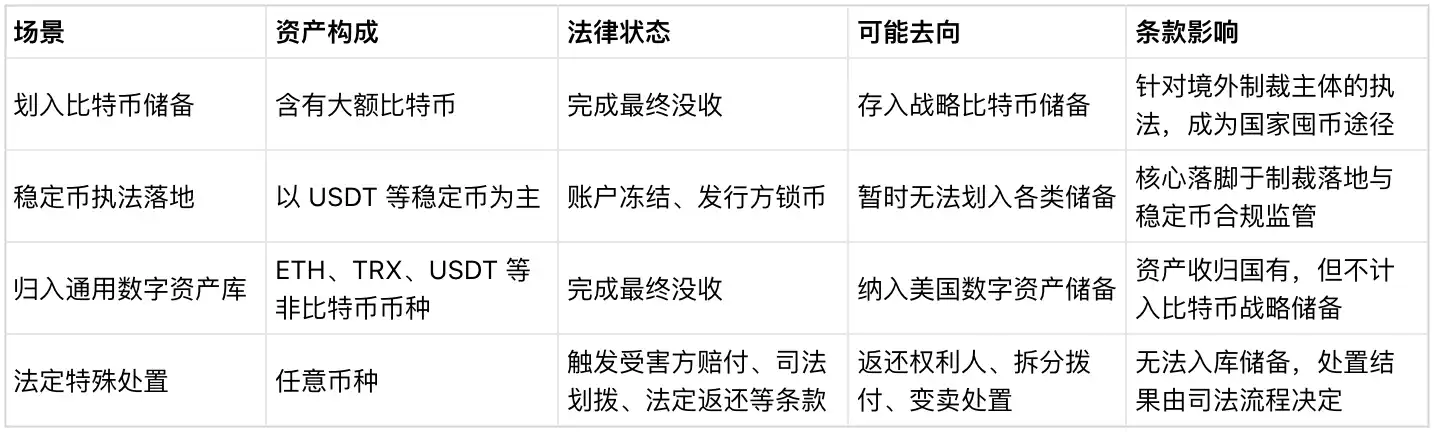
In the future, each U.S. crypto enforcement action against sanctioned entities like Iran and North Korea will involve three determinations: token type, legal status, and which treasury account to assign them to. Only by simultaneously meeting three conditions—the asset being Bitcoin, completing statutory forfeiture, and having no applicable compensation or allocation exemptions—can these Iranian assets potentially supplement the U.S. strategic reserve. As long as they successfully pass the two major hurdles of the forfeiture process and legal exemptions, crypto assets originally intended to circumvent U.S. financial controls would, in turn, become part of U.S. sovereign assets.


Related Questions

QWhat are the two distinct accounts designated by the 2025 executive order for U.S. government digital assets, and what is the primary difference between them?

AThe two accounts are the Strategic Bitcoin Reserve and the U.S. Digital Asset Reserve. The Strategic Bitcoin Reserve is specifically for holding Bitcoin that has been legally forfeited or collected via civil monetary penalties, and these Bitcoins are permanently prohibited from being sold. The U.S. Digital Asset Reserve holds other, non-Bitcoin digital assets that have undergone final forfeiture adjudication.

QWhat is the key legal distinction between 'freezing' or 'seizing' assets and 'forfeiting' them, as it relates to the potential transfer of the $1 billion in Iranian crypto assets to the U.S. Strategic Bitcoin Reserve?

AFreezing or seizing assets represents temporary control or blockage by authorities, but legal ownership remains with the original holder until a court order. Forfeiture is the final legal process that transfers permanent ownership to the government. Only assets that have been formally forfeited are eligible for transfer into the Strategic Bitcoin Reserve.

QAccording to the article, what are the three main factors that will determine the final disposition of the seized Iranian crypto assets?

AThe three main factors are: 1) The type of cryptocurrency (e.g., Bitcoin vs. stablecoins), 2) The legal status of the assets (whether they are merely frozen/seized or have been formally forfeited), and 3) Which government account they can be assigned to (Strategic Bitcoin Reserve or U.S. Digital Asset Reserve) based on the type and legal status.

QWhat are some of the potential financial obligations that could prevent seized assets from entering the U.S. Strategic Bitcoin Reserve, even after forfeiture?

AAfter forfeiture, assets may be allocated to: victim restitution, law enforcement investigative expenses, sharing proceeds with state and local law enforcement agencies, or being legally exempted and returned to claimants. Any of these allocations would prevent the assets from being deposited into the Strategic Bitcoin Reserve.

QWhat portion of the claimed $1 billion in seized Iranian crypto assets has been publicly identified, and what specific asset does it consist of?

AOnly $344 million of the claimed $1 billion has been publicly identified. This portion consists of USDT (Tether stablecoins) that were frozen in two wallets by Tether in coordination with U.S. sanctions. The composition and status of the remaining $656 million are not publicly disclosed.

Related Reads

Bloomberg Uncovered: How Do China's Wealthy Circumvent the Annual $50,000 Limit to Transfer Assets?

**Summary: How Wealthy Chinese Circumvent $50,000 Annual Foreign Exchange Limits** Despite China's strict capital controls, including an annual $50,000 per person foreign exchange quota, an estimated $150 billion in funds still leaves the country annually via various gray and underground channels. This report outlines the evolution of China's "capital wall" and the methods used to bypass it. **The Evolving Capital Controls:** * **Foundation (1994):** The system of "current account convertibility with strict capital account controls" was established. * **Quota Set (2007):** The $50,000 individual annual forex purchase limit was formalized. * **Crackdown Begins (2015-2017):** Following market volatility, enforcement tightened. Banks were required to scrutinize transactions, and channels like using UnionPay cards for Hong Kong insurance premiums or buying overseas property were blocked. * **Digital & Legal Upgrades (2024-2026):** Enhanced algorithms now flag suspicious patterns (e.g., "smurfing"). The Common Reporting Standard (CRS) provides Chinese tax authorities with data on citizens' offshore accounts. Unlicensed cross-border brokers have been targeted. **Five Primary Methods for Moving Capital:** 1. **Underground Banking / "Hawala" (Duiqiao):** The largest-scale method. No money crosses borders. Clients pay RMB to a domestic account; an overseas associate deposits equivalent foreign currency into the client's offshore account. Risks include high fees, account freezes, and legal penalties. 2. **"Smurfing" or "Ant Moving":** Using multiple individuals' $50,000 quotas to pool funds for one offshore recipient. Increasingly detected by anti-money laundering algorithms. 3. **Trade Invoice Manipulation:** Businesses over-invoice imports or under-invoice exports via offshore shell companies, creating a pretext to transfer excess funds abroad under the guise of trade. 4. **Channel Migration:** After a crackdown on internet brokers, funds flow toward more compliant but costly channels like major banks' cross-border wealth management services or Qualified Domestic Institutional Investor (QDII) quotas. 5. **Structural Arrangements:** High-net-worth individuals use complex, high-cost legal structures involving offshore trusts, insurance, and investment migration programs to transfer asset ownership. **Regulatory Response: Focusing on People, Not Just Money** The current strategy extends oversight from enterprises to **individual residents**. Tools like CRS allow retroactive visibility into offshore assets. Cryptocurrencies, once seen as a potential loophole, are now actively monitored and prosecuted as an illegal channel. The underlying driver remains: with significant wealth concentrated among millions of affluent households seeking diversification amid domestic economic shifts, the incentive to move assets offshore persists despite regulatory barriers.

marsbit10m ago

Bloomberg Uncovered: How Do China's Wealthy Circumvent the Annual $50,000 Limit to Transfer Assets?

marsbit10m ago

Ethereum's Ballmer Moment: As Everyone Is Bearish, the Circulating Supply Is Disappearing

"Ethereum's Ballmer Moment: Circulation Shrinks Amid Bearish Sentiment" Amid widespread bearish sentiment, with prominent figures like Bankless founder David Hoffman selling ETH and young developers flocking to Solana, some argue Ethereum is entering its "Ballmer era"—akin to Microsoft's perceived stagnation under Steve Ballmer. While surface-level criticisms about slow protocol development, cautious leadership, and competitive pressure are valid, underlying fundamentals tell a different story. Approximately 30% of ETH is staked, major holders like BitMine are accumulating, and spot ETFs continue to absorb supply. Regulatory clarity, including the SEC/CFTC's March ruling on staking rewards and the potential passage of the CLARITY Act, is transforming crypto from a regulatory threat into a legitimized framework. This institutionalization, alongside a shrinking circulating supply (with net issuance around 0.23% annually), creates significant buy-side pressure independent of fee-based value capture. The broader crypto total addressable market is expanding through regulated stablecoins, tokenized assets, and institutional adoption. While public chains face competition from permissioned alternatives, the winning model appears to be permissioned assets settling on public chains like Ethereum and Solana. The author advocates a non-maximalist, barbell strategy: holding ETH for its institutional role and supply squeeze, SOL for consumer/throughput trends, BTC as a macro hedge, and a basket of next-gen L1s. Key bullish drivers for ETH include rapid circulation shrinkage, potential Q2 staked ETF approvals, regulatory tailwinds solidifying its role as a default settlement layer, and the optionality of an eventual "Satya moment" leadership shift. Despite bearish consensus, the current setup—where crypto is "not hot" and regulatory groundwork is being laid—presents a compelling investment opportunity. The crypto cycle's focus may have shifted to AI, but blockchain infrastructure is gaining a legal and institutional foothold precisely while attention is elsewhere.

marsbit10m ago

Ethereum's Ballmer Moment: As Everyone Is Bearish, the Circulating Supply Is Disappearing

marsbit10m ago

Claude Code Introduces Dynamic Workflows: Enabling AI to Form Teams and Collaborate

Claude Code introduces dynamic workflows, enabling AI to coordinate teams of specialized agents for complex tasks. This transforms Claude from a code assistant into a programmable workbench. Workflows address key limitations of single-agent systems: agentic laziness (premature task completion), self-preferential bias (favoring own outputs), and goal drift (losing sight of original objectives). The system allows Claude to dynamically create execution frameworks using JavaScript. It can split tasks, dispatch parallel agents for isolated work (e.g., in separate worktrees), implement adversarial validation, run tournaments, and synthesize results. This multi-agent approach is valuable for tasks requiring deep research, factual verification, code migration, root cause analysis, large-scale triage, and qualitative sorting. Key patterns include: classify-and-route, fan-out-and-synthesize, adversarial verification, generate-and-filter, tournaments, and loop-until-done. While token usage is higher, workflows excel where tasks resemble programming—needing problem decomposition, isolated context, hypothesis testing, and handling many details. They extend Claude Code's utility beyond technical work to areas like business plan review, resume screening, and naming brainstorm. The feature is not a universal solution but points to a future where AI tool competitiveness depends on organizing reliable, reusable, and auditable execution flows for complex goals.

marsbit51m ago

Claude Code Introduces Dynamic Workflows: Enabling AI to Form Teams and Collaborate

marsbit51m ago

Hyperliquid, Wall Street's 24/7 Trading Convenience Store

Hyperliquid: The 24/7 Trading "Convenience Store" for Wall Street Hyperliquid, a decentralized cryptocurrency exchange, has become a go-to platform for Wall Street traders seeking to trade around the clock, especially during traditional market closures. Founded by Jeff Yan, a former quantitative trader, after the FTX collapse, the platform emphasizes user self-custody of assets. It offers a wide range of perpetual contracts—leveraged derivatives with no expiry—on assets from Bitcoin and crude oil to the S&P 500 and even pre-IPO companies like SpaceX. A notable example involves a hedge fund trader who capitalized on geopolitical news over a weekend, securing a 243% return on oil derivatives before markets reopened. The platform, run by just 11 employees, generated approximately $800 million in revenue last year, and its native token HYPE has seen significant growth. Its rise highlights the merging of traditional finance and crypto. While U.S. users are currently restricted, recent CFTC rule changes could open access. The platform is known for its transparency, having processed $10 billion in liquidations during a market crash while competitors faltered. Regulators warn of the high risks and complexity of perpetual contracts for retail investors. Key to its appeal is a strong community culture, direct engagement with founders, and a simple interface. Despite rules against VPN use, it attracts global users with its permissionless approach. Hyperliquid plans to expand into prediction markets and options, aiming to eventually host all financial activity.

marsbit52m ago

Hyperliquid, Wall Street's 24/7 Trading Convenience Store

marsbit52m ago

Trading

Spot
Futures

Hot Articles

What is $BITCOIN

DIGITAL GOLD ($BITCOIN): A Comprehensive Analysis Introduction to DIGITAL GOLD ($BITCOIN) DIGITAL GOLD ($BITCOIN) is a blockchain-based project operating on the Solana network, which aims to combine the characteristics of traditional precious metals with the innovation of decentralized technologies. While it shares a name with Bitcoin, often referred to as “digital gold” due to its perception as a store of value, DIGITAL GOLD is a separate token designed to create a unique ecosystem within the Web3 landscape. Its goal is to position itself as a viable alternative digital asset, although specifics regarding its applications and functionalities are still developing. What is DIGITAL GOLD ($BITCOIN)? DIGITAL GOLD ($BITCOIN) is a cryptocurrency token explicitly designed for use on the Solana blockchain. In contrast to Bitcoin, which provides a widely recognized value storage role, this token appears to focus on broader applications and characteristics. Notable aspects include: Blockchain Infrastructure: The token is built on the Solana blockchain, known for its capacity to handle high-speed and low-cost transactions. Supply Dynamics: DIGITAL GOLD has a maximum supply capped at 100 quadrillion tokens (100P $BITCOIN), although details regarding its circulating supply are currently undisclosed. Utility: While precise functionalities are not explicitly outlined, there are indications that the token could be utilized for various applications, potentially involving decentralized applications (dApps) or asset tokenization strategies. Who is the Creator of DIGITAL GOLD ($BITCOIN)? At present, the identity of the creators and development team behind DIGITAL GOLD ($BITCOIN) remains unknown. This situation is typical among many innovative projects within the blockchain space, particularly those aligning with decentralized finance and meme coin phenomena. While such anonymity may foster a community-driven culture, it intensifies concerns about governance and accountability. Who are the Investors of DIGITAL GOLD ($BITCOIN)? The available information indicates that DIGITAL GOLD ($BITCOIN) does not have any known institutional backers or prominent venture capital investments. The project seems to operate on a peer-to-peer model focused on community support and adoption rather than traditional funding routes. Its activity and liquidity are primarily situated on decentralized exchanges (DEXs), such as PumpSwap, rather than established centralized trading platforms, further highlighting its grassroots approach. How DIGITAL GOLD ($BITCOIN) Works The operational mechanics of DIGITAL GOLD ($BITCOIN) can be elaborated on based on its blockchain design and network attributes: Consensus Mechanism: By leveraging Solana’s unique proof-of-history (PoH) combined with a proof-of-stake (PoS) model, the project ensures efficient transaction validation contributing to the network's high performance. Tokenomics: While specific deflationary mechanisms have not been extensively detailed, the vast maximum token supply implies that it may cater to microtransactions or niche use cases that are still to be defined. Interoperability: There exists the potential for integration with Solana’s broader ecosystem, including various decentralized finance (DeFi) platforms. However, the details regarding specific integrations remain unspecified. Timeline of Key Events Here is a timeline that highlights significant milestones concerning DIGITAL GOLD ($BITCOIN): 2023: The initial deployment of the token occurs on the Solana blockchain, marked by its contract address. 2024: DIGITAL GOLD gains visibility as it becomes available for trading on decentralized exchanges like PumpSwap, allowing users to trade it against SOL. 2025: The project witnesses sporadic trading activity and potential interest in community-led engagements, although no noteworthy partnerships or technical advancements have been documented as of yet. Critical Analysis Strengths Scalability: The underlying Solana infrastructure supports high transaction volumes, which could enhance the utility of $BITCOIN in various transaction scenarios. Accessibility: The potential low trading price per token could attract retail investors, facilitating wider participation due to fractional ownership opportunities. Risks Lack of Transparency: The absence of publicly known backers, developers, or an audit process may yield skepticism regarding the project's sustainability and trustworthiness. Market Volatility: The trading activity is heavily reliant on speculative behavior, which can result in significant price volatility and uncertainty for investors. Conclusion DIGITAL GOLD ($BITCOIN) emerges as an intriguing yet ambiguous project within the rapidly evolving Solana ecosystem. While it attempts to leverage the “digital gold” narrative, its departure from Bitcoin's established role as a store of value underscores the need for a clearer differentiation of its intended utility and governance structure. Future acceptance and adoption will likely depend on addressing the current opacity and defining its operational and economic strategies more explicitly. Note: This report encompasses synthesised information available as of October 2023, and developments may have transpired beyond the research period.

363 Total ViewsPublished 2025.05.13Updated 2025.05.13

What is $BITCOIN

Discussions

Welcome to the HTX Community. Here, you can stay informed about the latest platform developments and gain access to professional market insights. Users' opinions on the price of BTC (BTC) are presented below.

活动图片