海面收比特币,海下扬言断网,伊朗正“绞杀”美元体系

Odaily星球日报Published on 2026-05-19Last updated on 2026-05-19

原创 |Odaily 星球日报(@OdailyChina)

作者|Golem(@web3_golem)

上个月,在美伊停火期间,伊朗宣布将对过霍尔木兹海峡油轮以比特币的形式征收通行费,消息发酵后引发了加密爱好者的讨论,认为比特币终于在最极端的地缘政治环境里发挥了“电子现金”的作用。Odaily 当时分析认为,伊朗此举可能是一种地缘政治战术,比特币在这场博弈里相当于一颗烟雾弹,核心目的是对美元体系进行公开挑衅。(相关阅读:比特币付海峡通关费,伊朗是在打嘴炮吗)

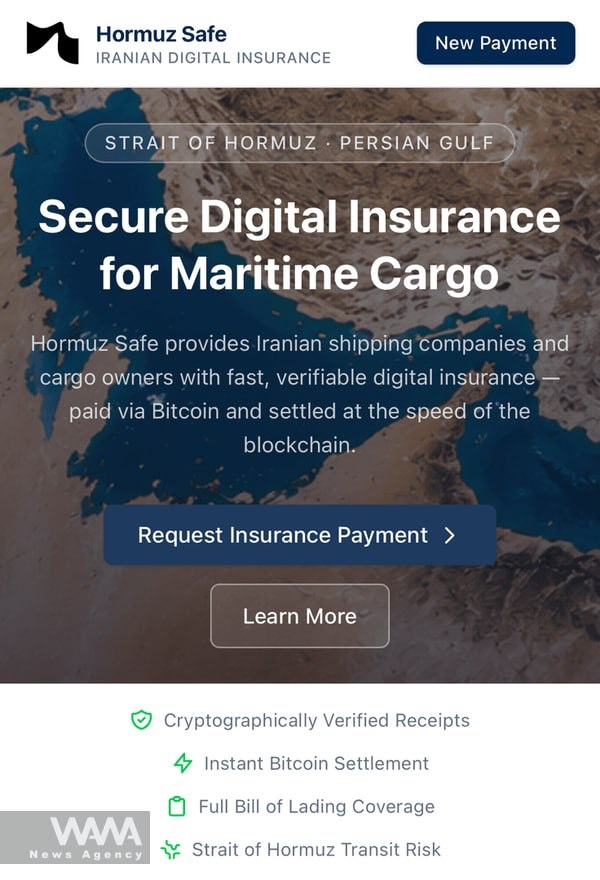
但在一个月后的今天来看,伊朗丢出来的是一颗货真价实的“金融炮弹”。5 月 18 日,伊朗宣布推出国家支持的数字海上保险平台 Hormuz Safe,为通过波斯湾和霍尔木兹海峡的船舶提供海上保险,并以比特币和其他加密货币结算

网上流传着一张 Hormuz Safe 官方页面,该图片显示,Hormuz Safe 的数字保险服务面向的是伊朗航运公司和货主,货物自确认发货之日起即受保险保障,并将向货主提供签字收据。

虽然该网站目前已经无法访问(也可能是受节点限制),但推出该平台的计划本身就在证明,伊朗想通过比特币收取海峡通关费这件事不再是打嘴炮,而是已经在搭建一套“准金融基础设施”将其一步步变为可落地、可执行的商业现实。

伊朗想重构霍尔木兹海峡金融秩序

当伊朗第一次向外界宣布要以比特币征收海峡通关费时,在我的脑海里是一个极其滑稽的场面:无数油轮在霍尔木兹海峡“堵车”,而拥堵原因是队伍前方一位年迈的船长看着手机里那条迟迟未被矿工打包的比特币交易......

这种粗糙、充满喜感的想象能把比特币的特性和重要地位放大,但若真考虑到“比特币付海峡通关费”的现实性,伊朗不会真傻到如征收高速通行费或车库停车费一样现场征收,甚至都不需要直接以通关费的名义来支付。因为现代国际原油航运真正背靠的,其实是保险。

霍尔木兹海峡扼住了全球约 20%的石油供应量,在这经过的每一艘油轮,只要航行于伊朗和阿曼之间这条狭窄的航道上就都需要购买海上保险。如果没有保险,不仅银行不会给融资,也没有任何船东和任何港口敢开船或提供靠泊。

而传统上,即过去几十年,这些保险都是由西方金融机构承保和结算,伦敦劳合社、欧美再保险公司、SWIFT 等共同构建了一套相互咬合的国际油轮保险秩序,伊朗基本上被排除在这些机构之外。

而现在,伊朗准备从支付角度将这个保险体系撕开一道口子,由伊朗经济部支持的数字海上保险平台 Hormuz Safe 打算使用比特币和加密货币直接结算保单,无需 SWIFT 网络,也无需任何西方中介机构

这是一种规避制裁的方案,该平台具有区块链即时结算和数字签名收据等特点,创建了一个无需任何西方监管机构许可即可运营的平行保险基础设施。同时,也使得伊朗掌握了金融主权,成功绕过了以美元为基础的金融体系,也避免了美国利用该体系施加压力。伊朗政府认为,若该平台占据波斯湾航运保险市场的可观份额,可能产生超 100 亿美元收入。

这甚至可以成为伊朗“去美元化”的起点,从重构结算体系到保险体系、最后再动摇整个波斯湾地区的金融秩序。但理性来看,完成这件事所遇到的阻力也是极大的。

Hormuz Safe 企图利用比特币和区块链技术绕过 SWIFT 网络和西方中介机构,减少对西方金融基础设施的依赖,理想是好的,但现实未必会得到认可。因为全球贸易体系不单纯只是个技术系统,更是一个建立在信用和暴力之上的权力系统。

因此直白的来说,没有美国的点头,Hormuz Safe 提供的保险也许没有任何机构、港口敢认可。即使船东愿意接受 Hormuz Safe,可一旦离开波斯湾和霍尔木兹海峡,整个世界的大部分港口、银行、保险公司、交易所,依然运行在美元体系里,由伊朗签发的保险也会变得毫无价值。甚至以美国的“处事原则”,若是有船东、贸易公司或港口管理机构敢与 Hormuz Safe 互动,极有可能触发二级制裁风险。

因此,Hormuz Safe 实际客户群体可能仅限于已经在美国制裁灰色地带运营的船舶了。

伊朗正在将地缘控制权金融化

不过,即使伊朗在国际金融体系中处于种种弱势,但现实是它仍掌握着地缘控制权,至少在霍尔木兹海峡开放问题上,美国单方面已无法说了算。

就目前美伊局势,特朗普方面对外界一直表现出形势乐观和势在必得的态度,5 月 19 日特朗普取消了原定对伊朗的打击计划,称谈判出现了一些“非常积极的进展”。但伊朗方面则向外界一直表现出的是不屈不挠的态度,伊朗最高领袖军事顾问雷扎伊回应特朗普取消最新军事打击时强硬的表示,“强大的武装力量与伟大的伊朗民族所形成的铁拳,将迫使他们退让并投降。”

并且,5 月 19 日伊朗最高领袖穆杰塔巴·哈梅内伊还在社交媒体上重申若“战争状态”持续,将考虑在敌人不擅长的领域开辟新战线,同时强调“敌人在这些领域经验极少且极度脆弱”。而伊朗所说的这些新战线的核心,或许就在于持续金融化地缘控制权。

美伊对峙刚形成时,伊朗以封锁霍尔木兹海峡作为战略筹码,给国际金融市场和美国政坛都造成了不小的扰动。但其实“封锁”只是地缘控制权最低级的一种使用方式,因为彻底关闭海峡,伊朗同样要付出巨大代价,真正高级的是将这种地缘优势直接转化成可持续性的金融收益和金融规则。前者只在破坏秩序,后者则是在重新制定秩序,地缘威胁与经济威胁叠加会使敌对方更加焦虑。

伊朗已经在这样做了,除了在海面上制定油轮通行规则,伊朗还盯上了海面下躺着的海底通信电缆。

5 月初,伊朗军方发言人 Ebrahim Zolfaghari 就在 X 平台发言表示伊朗“将对互联网电缆收取费用”(暂未具体披露收费方式)。在霍尔木兹海峡下,躺着连接阿拉伯国家与欧洲及亚洲之间海量互联网和金融数据流量的海底电缆,这些数据对金融系统、AI和人们的日常工作生活都有影响,所创造的经济价值更是无法估计。

并且伊朗扬言若是使用海底电缆的公司不缴纳许可费,可能就会实行“断网”策略,谷歌、微软、Meta、亚马逊等美国科技巨头都被点名。消息发酵后,据海事情报与数据提供商 Windward 称,伊朗等这一表态已促使全球最大的海底电缆安装商之一 ASN(Alcatel Submarine Networks)暂停该地区的所有维修作业。

从海面上的油轮保单,到海面下的光纤数据,所有经过霍尔木兹海峡的东西,都在被伊朗重新定义成一种“可收费资产”,“不给糖就捣蛋”,资本和金融市场的物理软肋在这一刻都成了伊朗最顺手的武器

霍尔木兹海峡表面风平浪静,但伊朗已经把刀架在了美国脖子上。

Related Reads

The World Cup is Approaching: Sports Entering the Era of 'Fragmented Finance'

With the approaching World Cup, sports are entering an era of "fragmented finance." This shift is exemplified by FIFA's new rule requiring debutant players to wear a special "World Cup debut patch." Post-tournament, these patches will be authenticated, cut, and embedded into collectible cards, potentially transforming into high-value assets. The global sports trading card market, valued at over $11.5 billion, represents a sophisticated alternative asset class with deep secondary markets and distinct bull/bear cycles. While football has a massive fanbase, its card market has historically lacked the liquidity and unified narrative of the NBA's system. The NBA's success stems from its centralized, star-driven storytelling—from draft nights to championships—which perfectly fuels financialization. The World Cup patch initiative is FIFA's attempt to create similar "financial raw material" for football. The NBA card market, evolving over 70 years, has matured into a financial ecosystem. After a 1990s crash due to overproduction, the industry rebounded by embracing scarcity: limited editions, autographs, game-worn memorabilia (patches), and serial numbering. Today, it features professional grading (e.g., PSA, BGS), auction platforms, live "break" streams, and dedicated marketplaces, mirroring aspects of cryptocurrency markets with their volatility, speculation, and community-driven trading. The core driver is narrative. A card's value is tied to a specific historic moment or player potential—like Stephen Curry's 1/1 card commemorating his Olympic game-winning shot selling for $518,500. This trade in "ownership of history" or "future greatness" parallels prediction markets, both monetizing collective emotion. Unlike many NFT projects that struggle to generate sustained narratives, sports are a perpetual emotion-generating machine. Leagues like the NBA and UFC constantly produce real-world drama—rivalries, comebacks, and triumphs—that fuels ongoing interest and investment. For younger audiences consuming sports via highlights and social media clips, trading cards become a direct financial instrument for engaging with these narratives. Thus, traditional sports leagues are leading the charge in assetization, leveraging their unique advantages: real events, global fan consensus, and endless storytelling. They are becoming platforms for issuing financial assets, turning fragments of history—a patch, a signature, a moment—into tradable commodities.

Odaily星球日报2m ago

The World Cup is Approaching: Sports Entering the Era of 'Fragmented Finance'

Odaily星球日报2m ago

Vitalik's Latest Long Read: In the AI Era, How Can Code Become More Secure?

Vitalik Buterin explores the role of formal verification as a critical tool for software security, especially in the AI era and for blockchain systems. He defines formal verification as using machine-checkable mathematical proofs to verify that code meets specified properties, moving beyond manual auditing. The article highlights that while AI can generate code and find vulnerabilities rapidly, it also makes formal verification more accessible by assisting in writing proofs. This is crucial for Ethereum's complex components like STARKs, ZK-EVMs, consensus algorithms, and high-performance EVM implementations, where bugs can lead to irreversible losses. Vitalik argues that formal verification enables a powerful "separation of concerns": AI can write highly optimized (e.g., assembly) code for efficiency, while a separate, human-readable specification defines correctness. A machine-checked proof then verifies their equivalence. This paradigm can create a more secure "trusted core" of software. However, he cautions that formal verification is not a panacea. "Proven correctness" depends on the accuracy of the specifications and proofs themselves, which can be wrong or incomplete. Risks include unverified code sections, hardware-level side-channel attacks, and overlooked assumptions. The true goal is not absolute proof but increased confidence through redundant expressions of intent—using code, tests, types, and formal proofs—and automatically checking their consistency. The article concludes that AI and formal verification are complementary: AI enables scale, while verification ensures accuracy. For critical systems, this combination offers a path toward stronger security in a future with powerful AI adversaries, helping to maintain the defensive advantage essential for a decentralized internet.

marsbit47m ago

Vitalik's Latest Long Read: In the AI Era, How Can Code Become More Secure?

marsbit47m ago

Trading

Spot
Futures

Hot Articles

What is $BITCOIN

DIGITAL GOLD ($BITCOIN): A Comprehensive Analysis Introduction to DIGITAL GOLD ($BITCOIN) DIGITAL GOLD ($BITCOIN) is a blockchain-based project operating on the Solana network, which aims to combine the characteristics of traditional precious metals with the innovation of decentralized technologies. While it shares a name with Bitcoin, often referred to as “digital gold” due to its perception as a store of value, DIGITAL GOLD is a separate token designed to create a unique ecosystem within the Web3 landscape. Its goal is to position itself as a viable alternative digital asset, although specifics regarding its applications and functionalities are still developing. What is DIGITAL GOLD ($BITCOIN)? DIGITAL GOLD ($BITCOIN) is a cryptocurrency token explicitly designed for use on the Solana blockchain. In contrast to Bitcoin, which provides a widely recognized value storage role, this token appears to focus on broader applications and characteristics. Notable aspects include: Blockchain Infrastructure: The token is built on the Solana blockchain, known for its capacity to handle high-speed and low-cost transactions. Supply Dynamics: DIGITAL GOLD has a maximum supply capped at 100 quadrillion tokens (100P $BITCOIN), although details regarding its circulating supply are currently undisclosed. Utility: While precise functionalities are not explicitly outlined, there are indications that the token could be utilized for various applications, potentially involving decentralized applications (dApps) or asset tokenization strategies. Who is the Creator of DIGITAL GOLD ($BITCOIN)? At present, the identity of the creators and development team behind DIGITAL GOLD ($BITCOIN) remains unknown. This situation is typical among many innovative projects within the blockchain space, particularly those aligning with decentralized finance and meme coin phenomena. While such anonymity may foster a community-driven culture, it intensifies concerns about governance and accountability. Who are the Investors of DIGITAL GOLD ($BITCOIN)? The available information indicates that DIGITAL GOLD ($BITCOIN) does not have any known institutional backers or prominent venture capital investments. The project seems to operate on a peer-to-peer model focused on community support and adoption rather than traditional funding routes. Its activity and liquidity are primarily situated on decentralized exchanges (DEXs), such as PumpSwap, rather than established centralized trading platforms, further highlighting its grassroots approach. How DIGITAL GOLD ($BITCOIN) Works The operational mechanics of DIGITAL GOLD ($BITCOIN) can be elaborated on based on its blockchain design and network attributes: Consensus Mechanism: By leveraging Solana’s unique proof-of-history (PoH) combined with a proof-of-stake (PoS) model, the project ensures efficient transaction validation contributing to the network's high performance. Tokenomics: While specific deflationary mechanisms have not been extensively detailed, the vast maximum token supply implies that it may cater to microtransactions or niche use cases that are still to be defined. Interoperability: There exists the potential for integration with Solana’s broader ecosystem, including various decentralized finance (DeFi) platforms. However, the details regarding specific integrations remain unspecified. Timeline of Key Events Here is a timeline that highlights significant milestones concerning DIGITAL GOLD ($BITCOIN): 2023: The initial deployment of the token occurs on the Solana blockchain, marked by its contract address. 2024: DIGITAL GOLD gains visibility as it becomes available for trading on decentralized exchanges like PumpSwap, allowing users to trade it against SOL. 2025: The project witnesses sporadic trading activity and potential interest in community-led engagements, although no noteworthy partnerships or technical advancements have been documented as of yet. Critical Analysis Strengths Scalability: The underlying Solana infrastructure supports high transaction volumes, which could enhance the utility of $BITCOIN in various transaction scenarios. Accessibility: The potential low trading price per token could attract retail investors, facilitating wider participation due to fractional ownership opportunities. Risks Lack of Transparency: The absence of publicly known backers, developers, or an audit process may yield skepticism regarding the project's sustainability and trustworthiness. Market Volatility: The trading activity is heavily reliant on speculative behavior, which can result in significant price volatility and uncertainty for investors. Conclusion DIGITAL GOLD ($BITCOIN) emerges as an intriguing yet ambiguous project within the rapidly evolving Solana ecosystem. While it attempts to leverage the “digital gold” narrative, its departure from Bitcoin's established role as a store of value underscores the need for a clearer differentiation of its intended utility and governance structure. Future acceptance and adoption will likely depend on addressing the current opacity and defining its operational and economic strategies more explicitly. Note: This report encompasses synthesised information available as of October 2023, and developments may have transpired beyond the research period.

363 Total ViewsPublished 2025.05.13Updated 2025.05.13

What is $BITCOIN

Discussions

Welcome to the HTX Community. Here, you can stay informed about the latest platform developments and gain access to professional market insights. Users' opinions on the price of BTC (BTC) are presented below.

活动图片