One year of the GENIUS Act: Progress, gaps, and what comes next

ambcryptoPublished on 2026-07-19Last updated on 2026-07-19

Abstract

One year after the GENIUS Act became law, key implementation rules for stablecoins remain unfinished. Regulators missed a July 18 deadline to finalize core standards covering issuer reserves, capital, liquidity, custody, and risk management. Agencies like the OCC, Federal Reserve, and FDIC are still drafting these rules and gathering public feedback on proposals. This regulatory uncertainty complicates planning for issuers like Circle and Paxos, even as the stablecoin market has grown to over $310 billion. Despite the delays, regulators aim to enforce the Act by January 18, 2027. Institutional adoption is gaining momentum, with firms like BlackRock and JPMorgan launching stablecoin-related products. Lawmakers, including Senator Cynthia Lummis, stress the urgency of completing the framework and passing further legislation like the CLARITY Act to solidify U.S. leadership in digital assets. Finalizing the remaining rules will be crucial for determining the pace of broad institutional adoption of regulated stablecoins in the United States.

A year after President Donald Trump signed the GENIUS Act into law, regulators still have not completed its implementation. However, regulators have yet to implement it. Agencies were required to finalize implementing rulemakings no later than the 18th of July.

As a result, the OCC, Federal Reserve, FDIC, Treasury Department, and other agencies continue drafting key regulations. Those rules cover issuer reserves, capital requirements, liquidity, custody, risk management, and state-level regulatory designations.


Source: CHAPMAN

Meanwhile, agencies continue gathering public feedback. Customer identification proposals remain open until the 21st of August. The FDIC will close its anti-money laundering consultation on the 4th of August.

Those consultations show regulators are still refining compliance standards. Still, agencies still plan to enforce the GENIUS Act by the 18th of January, 2027.

Until they complete the remaining rules, stablecoin issuers and financial institutions must prepare for a framework that still lacks several implementation details.

Key rules remain unfinished

That regulatory uncertainty continues because agencies have yet to finalize several core operating standards. Although federal agencies proposed rules throughout 2026, they failed to complete them by the 18th of July.

As a result, reserve eligibility, liquidity requirements, custody standards, and risk management frameworks remain under review. Meanwhile, issuers continue operating under statutory baselines and interim regulatory frameworks.

That approach has supported market activity, helping the stablecoin sector expand to roughly over $310 billion. Even so, unresolved liquidity and custody protocols still complicate capital planning, redemption processes, and operational resilience.
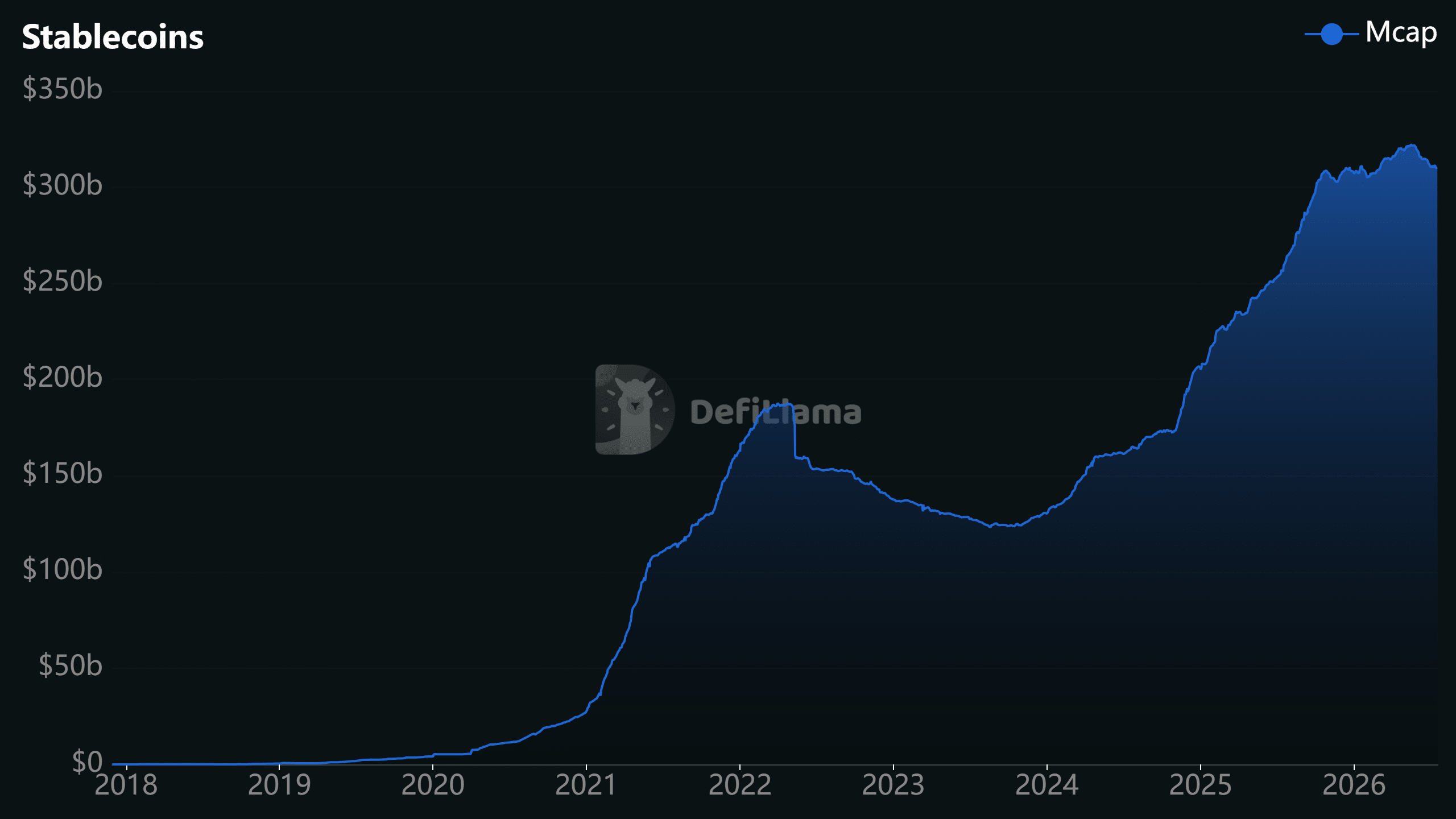
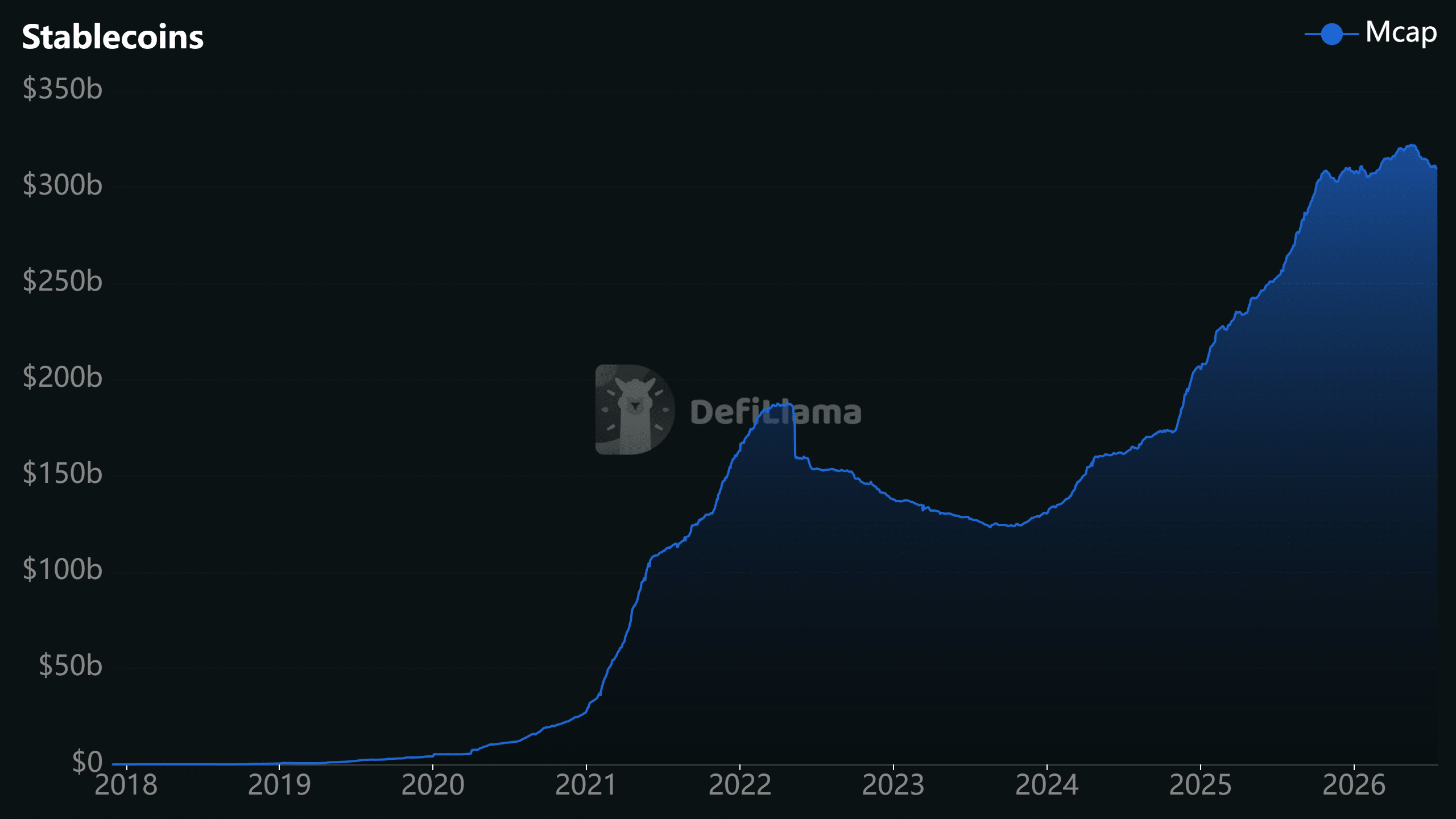
Source: DeFiLlama

Therefore, until these regulatory standards are finalized, issuers like Circle and Paxos will be forced to navigate innovation against evolving compliance regulations. This is as the market waits for a fully defined federal regulatory framework.

Institutional adoption gains momentum

Banks are still assessing their options for stablecoin strategies as they wait for the regulatory body to issue its final rulemaking. Meanwhile, Congress is running out of time with less than six months until the GENIUS Act goes into effect on January 18th, 2027.

Senator Cynthia Lummis echoed that urgency, calling the GENIUS Act “an important first step.” She also urged her fellow lawmakers to support the CLARITY Act, which would further solidify U.S. leadership in the development of digital assets.
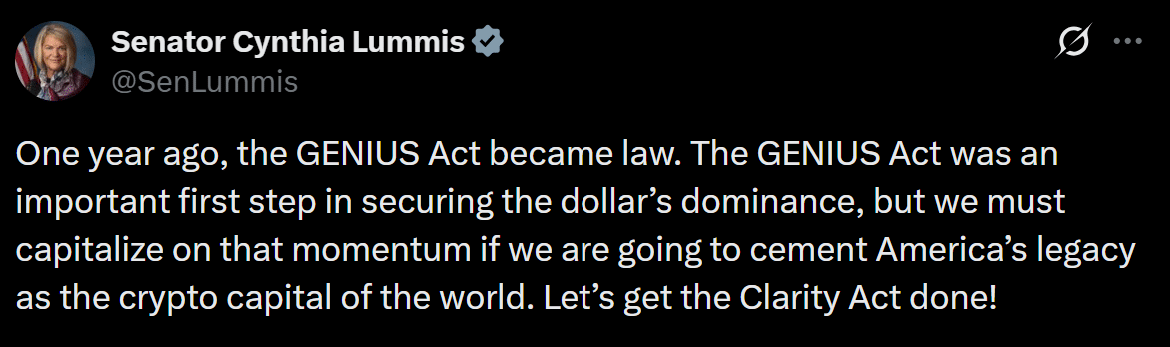
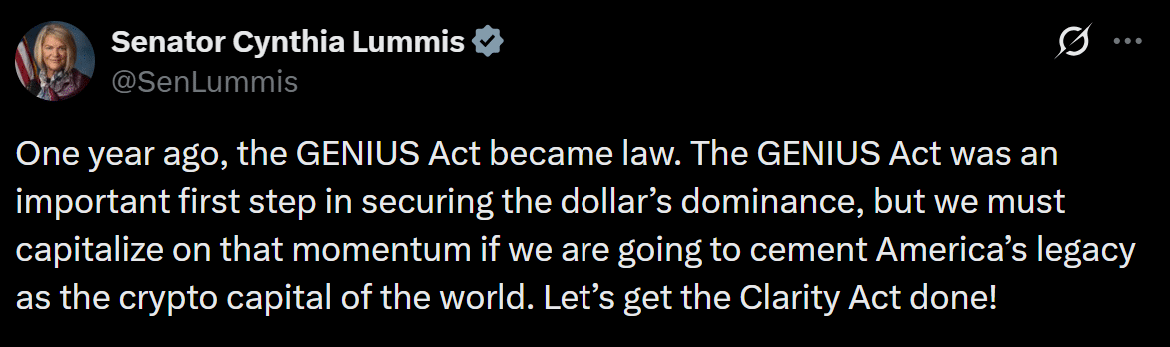
Source: X

Even before regulators finalize the remaining rules, the GENIUS Act has already encouraged institutional participation. Since lawmakers enacted the framework, institutions such as BlackRock and JPMorgan have launched or filed stablecoin reserve funds.

Meanwhile, Visa introduced a platform serving 15,000 institutions, while the first bank-issued on-chain dollar entered the market. Completing the remaining rules will determine how quickly regulated stablecoins achieve broad institutional adoption in the United States.


Final Summary

  • Stablecoins remain in regulatory limbo until agencies finalize the GENIUS Act’s remaining implementation rules.
  • Stablecoins could gain broader institutional adoption as the GENIUS Act and CLARITY Act advance regulatory certainty.

Trending Cryptos

Related Questions

QWhat is the current status of the GENIUS Act implementation one year after it was signed into law?

AOne year after being signed into law, the GENIUS Act's implementation is incomplete. Regulators have missed the July 18th deadline to finalize key implementing rules, leaving several core operating standards under review.

QWhich major US financial agencies are mentioned as still drafting regulations for the GENIUS Act?

AThe article mentions that the OCC, Federal Reserve, FDIC, Treasury Department, and other agencies are continuing to draft key regulations covering areas like issuer reserves, capital requirements, liquidity, custody, and risk management.

QWhat are some specific regulatory areas that remain unfinished under the GENIUS Act framework?

AKey unfinished regulatory areas include final rules for reserve eligibility, liquidity requirements, custody standards, and risk management frameworks.

QDespite the regulatory uncertainty, what positive market development is noted regarding stablecoins?

ADespite the regulatory uncertainty, the stablecoin sector has expanded to roughly over $310 billion, and the GENIUS Act has encouraged institutional participation from firms like BlackRock and JPMorgan.

QWhat upcoming deadline and related legislative act does Senator Cynthia Lummis highlight?

ASenator Cynthia Lummis highlights the urgency with less than six months until the GENIUS Act goes into effect on January 18, 2027, and urges support for the CLARITY Act to further solidify U.S. leadership in digital assets.

Related Reads

The Verdict in Choi Tae-won's Divorce Case: Revealing the Inheritance Undercurrent Behind SK Hynix's Trillion-Won Empire

SK Group Chairman Chey Tae-won's high-profile divorce case, involving a record 1.38 trillion won settlement, has drawn attention to the succession plans for Korea's second-largest conglomerate, especially its crown jewel, SK hynix. Unlike traditional chaebol scripts centered on the eldest son, Chey's three children from his marriage to former President Roh Tae-woo's daughter, Roh Soh-yeong, are carving distinct, non-traditional paths. Eldest daughter Chey Yun-jung (b. 1989) is seen as the most evident successor. With a scientific and consulting background, she holds executive roles at SK bioscience and SK Inc.'s growth support department, focusing on future strategy and biopharma. Her marriage is to an AI infrastructure entrepreneur, not a traditional business alliance. Second daughter Chey Min-jung (b. 1991) took a unique route, voluntarily serving as a South Korean naval officer, including an anti-piracy deployment. She later worked on policy and strategy for SK hynix in Washington D.C. before co-founding an AI-driven healthcare startup. She married a former U.S. Marine Corps officer, connecting her to U.S. defense and policy circles—networks crucial for a global semiconductor giant. The only son, Chey In-geun (b. 1995), who studied physics like his father, worked briefly at SK E&S before joining McKinsey. Despite fitting the traditional "heir" profile as the eldest son, he remains silent and holds no public position or shares in SK, suggesting the old succession playbook is obsolete. As SK hynix's valuation soars, becoming a geopolitical asset in the AI era, the heirs' legitimacy is no longer automatic. They must prove themselves in fields like AI biotech, global policy, and strategic consulting. Their marriages also reflect new elite networks in tech and defense, not old political alliances. Their inheritance is the complex challenge of navigating a globalized, tech-driven world, not just a corporate throne.

marsbitYesterday 09:06

The Verdict in Choi Tae-won's Divorce Case: Revealing the Inheritance Undercurrent Behind SK Hynix's Trillion-Won Empire

marsbitYesterday 09:06

From OpenSea to OpenRouter: Is Alex Atallah Repeating His 'Exit at the Peak' Playbook?

From OpenSea to OpenRouter: Is Alex Atallah Repeating His "Exit at the Peak" Playbook? According to the Wall Street Journal, payments giant Stripe is in talks to acquire the AI model aggregation platform OpenRouter in a potential deal valuing the company near $100 billion. This would mark founder Alex Atallah's second creation of a company reaching a $100 billion valuation, following his co-founding of NFT marketplace OpenSea. OpenRouter, founded just over three years ago, has grown rapidly by acting as a unified gateway for developers to access over 400 AI models. It currently has about 10 million users and processes over 200 trillion tokens monthly. While the platform's annualized revenue is around $50 million, its valuation has skyrocketed from $1.3 billion in March 2026. The potential acquisition by Stripe, a company OpenRouter's founder once likened it to, represents a major expansion into AI infrastructure for the payments leader. This move echoes Atallah's previous timing with OpenSea, where he departed before the NFT market's significant downturn. For OpenRouter, selling now may be strategic. Despite its scale, its business model—charging a 5-5.5% fee on AI inference calls—faces pressure from competition, open-source models, and potential price wars among model providers, limiting its profitability narrative for an IPO. A key asset for potential acquirers like Stripe is OpenRouter's vast repository of real-world AI usage data, which offers unique insights into model performance and developer preferences that are difficult to replicate. Whether this potential deal signifies a new valuation benchmark for AI infrastructure or another market peak signal remains to be seen.

链捕手Yesterday 08:42

From OpenSea to OpenRouter: Is Alex Atallah Repeating His 'Exit at the Peak' Playbook?

链捕手Yesterday 08:42

Trading

Spot

Hot Articles

How to Buy GENIUS

Welcome to HTX.com! We've made purchasing Genius (GENIUS) simple and convenient. Follow our step-by-step guide to embark on your crypto journey.Step 1: Create Your HTX AccountUse your email or phone number to sign up for a free account on HTX. Experience a hassle-free registration journey and unlock all features.Get My AccountStep 2: Go to Buy Crypto and Choose Your Payment MethodCredit/Debit Card: Use your Visa or Mastercard to buy Genius (GENIUS) instantly.Balance: Use funds from your HTX account balance to trade seamlessly.Third Parties: We've added popular payment methods such as Google Pay and Apple Pay to enhance convenience.P2P: Trade directly with other users on HTX.Over-the-Counter (OTC): We offer tailor-made services and competitive exchange rates for traders.Step 3: Store Your Genius (GENIUS)After purchasing your Genius (GENIUS), store it in your HTX account. Alternatively, you can send it elsewhere via blockchain transfer or use it to trade other cryptocurrencies.Step 4: Trade Genius (GENIUS)Easily trade Genius (GENIUS) on HTX's spot market. Simply access your account, select your trading pair, execute your trades, and monitor in real-time. We offer a user-friendly experience for both beginners and seasoned traders.

3.9k Total ViewsPublished 2026.04.29Updated 2026.06.02

How to Buy GENIUS

Discussions

Welcome to the HTX Community. Here, you can stay informed about the latest platform developments and gain access to professional market insights. Users' opinions on the price of GENIUS (GENIUS) are presented below.

活动图片