Tether CEO: ‘Demand for dollar settlement is a wages story’ – $7M Pact Labs investment proves it

ambcryptoPublished on 2026-07-15Last updated on 2026-07-15

Abstract

Tether is expanding the utility of stablecoins beyond crypto trading, targeting everyday financial infrastructure like payroll and real-time payments. Its $7 million investment in Pact Labs underscores a strategy to address the $11 trillion U.S. payroll system, where legacy settlement delays wage access. CEO Paolo Ardoino states that demand for dollar settlement is fundamentally a "wages story." This shift focuses on generating consistent, recurring payment flows rather than competing for trading volume. For this expansion to succeed, enterprise adoption in payroll and daily transactions is crucial. Tether is bolstering this push with compliance infrastructure, highlighted by Chainalysis's support for the USDT-native Stable network, providing real-time transaction screening and monitoring. The combination of faster settlement and robust compliance aims to overcome regulatory hurdles, encouraging businesses to move beyond pilot programs. Ultimately, the goal is to embed stablecoins like USA₮ into mainstream finance, transforming them from speculative assets into trusted infrastructure for recurring financial services.

Tether is shifting stablecoin adoption from crypto markets toward everyday financial infrastructure. By leading Pact Labs’ $7 million Series A, the company is targeting payroll, earned wage access, and real-time payments through USA₮.

That strategy addresses a U.S. payroll system processing more than $11 trillion annually, where legacy settlement still delays access to earned wages.

Supporting this, Tether CEO Paolo Ardoino noted,

This confirms what our transaction data has shown for years: the demand for dollar-denominated settlement is a wages story.
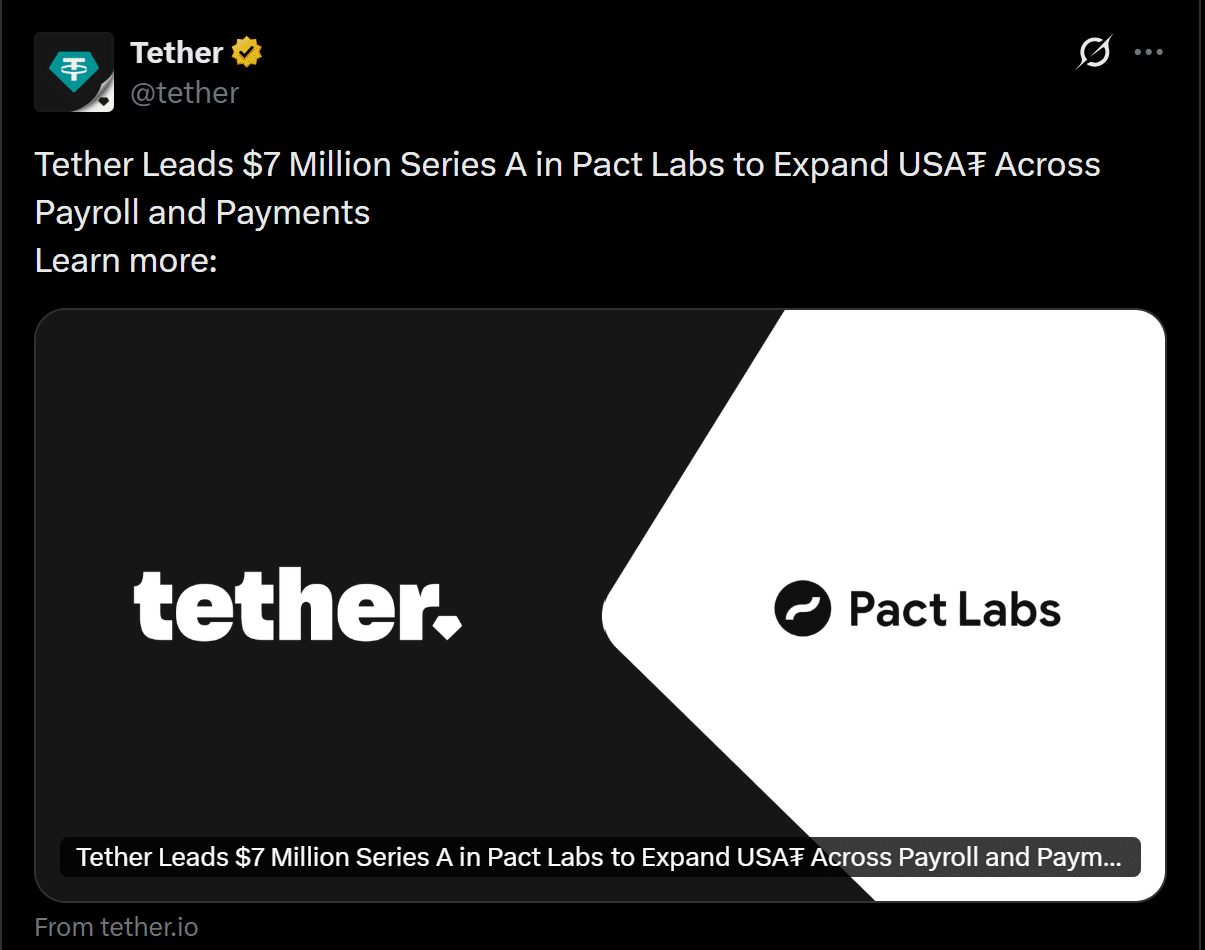
Source: Tether on X

Rather than competing for trading volume, Tether is pursuing recurring payment flows that generate consistent stablecoin demand. This marks a structural expansion of stablecoin utility beyond speculative markets.

Still, enterprise integrations, payroll adoption, and transaction growth will determine whether USA₮ becomes embedded in mainstream finance or remains a niche payment alternative.

Compliance reinforces Tether’s expansion

On one hand, building payment rails addresses just one-half of the problem. That makes Chainalysis’ support for Stable, a USDT-native Layer 1, more significant than another blockchain integration.

As Tether continues to push stablecoins into payroll and daily transactions, institutions will require continuous monitoring prior to committing larger transactional volume on-chain.

Chainalysis provides this critical layer. This is via real-time transaction screening, entity monitoring, and fund flow analysis.


Source: Chainalysis

Chainalysis’s automatic support for additional ERC-20 and ERC-721 tokens enables Stable to continue to grow. It does so while providing ongoing compliance coverage. Thus, the opportunities for Stable extend far beyond fast settlement.

If payment activity and institutional adoption grow together, compliance could become the catalyst that transforms stablecoins into trusted financial infrastructure.

Payment infrastructure now faces its most important challenge. It must show resilience in generating sustained real-world activity. Faster settlement and strong compliance have removed many of the regulatory hurdles for enterprises to adopt blockchain technology.

Rising enterprise wallets, larger transaction sizes, and expanding payment flows would signal businesses are moving beyond pilot programs.

That momentum gradually shifts blockchain’s role from facilitating digital asset transfers to supporting everyday financial services.

The competitive advantage is also changing. Networks that attract recurring payment activity, rather than simply launching new infrastructure, are increasingly positioning themselves at the center of mainstream finance.


Final Summary

  • Tether is expanding beyond trading by positioning stablecoins as infrastructure for payroll and everyday payments.
  • Stablecoin adoption now depends on recurring payment activity supported by scalable infrastructure and institutional-grade compliance.


Related Questions

QAccording to the article, what strategic shift is Tether making in stablecoin adoption?

ATether is shifting stablecoin adoption from crypto markets towards everyday financial infrastructure, specifically targeting payroll, earned wage access, and real-time payments through USA₮.

QWhat does Tether CEO Paolo Ardoino identify as the core driver for dollar-denominated settlement demand?

APaolo Ardoino identifies the demand for dollar-denominated settlement as 'a wages story,' a conclusion supported by Tether's transaction data over years.

QHow does Chainalysis's role support Tether's expansion into payroll and daily transactions?

AChainalysis provides a critical compliance layer through real-time transaction screening, entity monitoring, and fund flow analysis, enabling institutions to commit larger transactional volume with continuous monitoring.

QWhat will determine whether USA₮ becomes embedded in mainstream finance according to the article?

AEnterprise integrations, payroll adoption, and transaction growth will determine whether USA₮ becomes embedded in mainstream finance or remains a niche payment alternative.

QWhat is changing in terms of competitive advantage for networks in the financial space, as mentioned in the article?

AThe competitive advantage is shifting towards networks that attract recurring payment activity, rather than simply launching new infrastructure, positioning themselves at the center of mainstream finance.

Related Reads

The Verdict in Choi Tae-won's Divorce Case: Revealing the Inheritance Undercurrent Behind SK Hynix's Trillion-Won Empire

SK Group Chairman Chey Tae-won's high-profile divorce case, involving a record 1.38 trillion won settlement, has drawn attention to the succession plans for Korea's second-largest conglomerate, especially its crown jewel, SK hynix. Unlike traditional chaebol scripts centered on the eldest son, Chey's three children from his marriage to former President Roh Tae-woo's daughter, Roh Soh-yeong, are carving distinct, non-traditional paths. Eldest daughter Chey Yun-jung (b. 1989) is seen as the most evident successor. With a scientific and consulting background, she holds executive roles at SK bioscience and SK Inc.'s growth support department, focusing on future strategy and biopharma. Her marriage is to an AI infrastructure entrepreneur, not a traditional business alliance. Second daughter Chey Min-jung (b. 1991) took a unique route, voluntarily serving as a South Korean naval officer, including an anti-piracy deployment. She later worked on policy and strategy for SK hynix in Washington D.C. before co-founding an AI-driven healthcare startup. She married a former U.S. Marine Corps officer, connecting her to U.S. defense and policy circles—networks crucial for a global semiconductor giant. The only son, Chey In-geun (b. 1995), who studied physics like his father, worked briefly at SK E&S before joining McKinsey. Despite fitting the traditional "heir" profile as the eldest son, he remains silent and holds no public position or shares in SK, suggesting the old succession playbook is obsolete. As SK hynix's valuation soars, becoming a geopolitical asset in the AI era, the heirs' legitimacy is no longer automatic. They must prove themselves in fields like AI biotech, global policy, and strategic consulting. Their marriages also reflect new elite networks in tech and defense, not old political alliances. Their inheritance is the complex challenge of navigating a globalized, tech-driven world, not just a corporate throne.

marsbitYesterday 09:06

The Verdict in Choi Tae-won's Divorce Case: Revealing the Inheritance Undercurrent Behind SK Hynix's Trillion-Won Empire

marsbitYesterday 09:06

From OpenSea to OpenRouter: Is Alex Atallah Repeating His 'Exit at the Peak' Playbook?

From OpenSea to OpenRouter: Is Alex Atallah Repeating His "Exit at the Peak" Playbook? According to the Wall Street Journal, payments giant Stripe is in talks to acquire the AI model aggregation platform OpenRouter in a potential deal valuing the company near $100 billion. This would mark founder Alex Atallah's second creation of a company reaching a $100 billion valuation, following his co-founding of NFT marketplace OpenSea. OpenRouter, founded just over three years ago, has grown rapidly by acting as a unified gateway for developers to access over 400 AI models. It currently has about 10 million users and processes over 200 trillion tokens monthly. While the platform's annualized revenue is around $50 million, its valuation has skyrocketed from $1.3 billion in March 2026. The potential acquisition by Stripe, a company OpenRouter's founder once likened it to, represents a major expansion into AI infrastructure for the payments leader. This move echoes Atallah's previous timing with OpenSea, where he departed before the NFT market's significant downturn. For OpenRouter, selling now may be strategic. Despite its scale, its business model—charging a 5-5.5% fee on AI inference calls—faces pressure from competition, open-source models, and potential price wars among model providers, limiting its profitability narrative for an IPO. A key asset for potential acquirers like Stripe is OpenRouter's vast repository of real-world AI usage data, which offers unique insights into model performance and developer preferences that are difficult to replicate. Whether this potential deal signifies a new valuation benchmark for AI infrastructure or another market peak signal remains to be seen.

链捕手Yesterday 08:42

From OpenSea to OpenRouter: Is Alex Atallah Repeating His 'Exit at the Peak' Playbook?

链捕手Yesterday 08:42

Trading

Spot
活动图片




