Is Cardano’s price rally over? Here’s why ADA could target $0.30 next

ambcryptoPublished on 2026-07-06Last updated on 2026-07-06

Abstract

Cardano (ADA) has started Q3 with a strong 30% rally, outperforming many altcoins. However, it faces a key resistance at $0.20, a level it has failed to break previously, leading to a recent 2% pullback. On-chain data shows a concerning 68% yearly drop in Total Value Locked (TVL), suggesting liquidity hasn't kept pace with the price rise. Despite this, the network has consistently added thousands of new wallets since mid-2023, indicating growing user adoption beneath the surface. If ADA can decisively break above the $0.20 resistance, turning it into support, the next targets could be $0.25 and potentially $0.30, especially within a historically bullish July for altcoins. The current cooldown may represent a healthy reset rather than a trend reversal.

Every sharp parabolic rally can easily be written off as another hype cycle.

At first glance, Cardano [ADA] seems to fit that narrative. After three consecutive red quarters, each posting average losses of more than 40%, ADA had become one of the weakest-performing major altcoins this cycle. But is that trend finally starting to reverse?

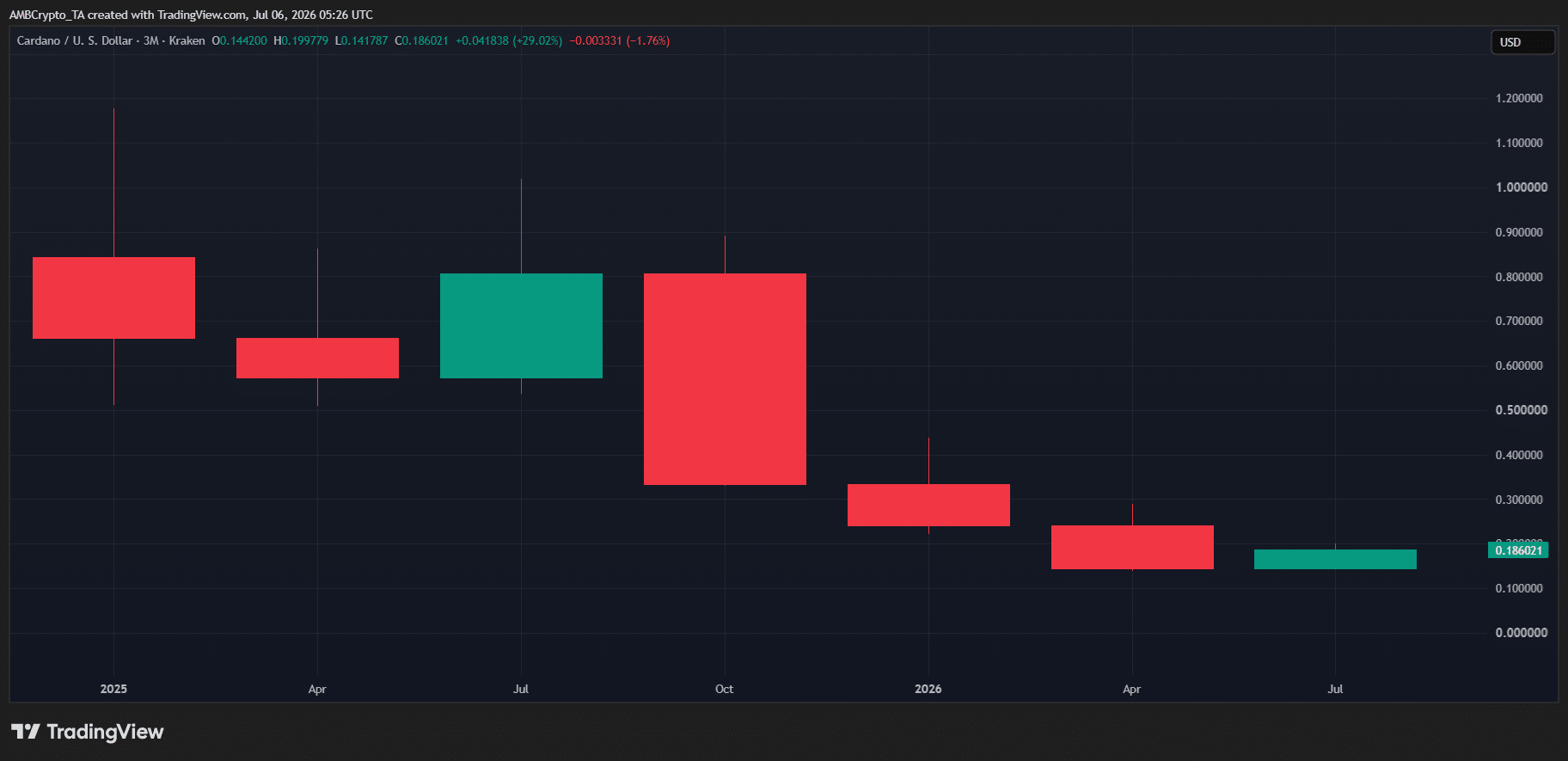
From the technical standpoint, ADA has kicked off Q3 with a strong 30% rally, outperforming the broader altcoin market. More notably, its gains are over 2.3x larger than Ethereum’s [ETH] so far this quarter, suggesting that capital may be rotating back into ADA as momentum begins to build.
Source: TradingView (ADA/USDT)

But zooming into the charts, things start looking a bit different.

On the daily timeframe, ADA has already pulled back more than 2% in under 48 hours after pushing above the $0.20 level, a resistance it also failed to clear back in mid-June. That repeated rejection keeps a breakdown firmly in play. Pair that with a near-parabolic run over the past week, and it’s not surprising to see traders taking profits instead of chasing higher prices.

At first glance, that makes it easy to label ADA’s rally as just another hype cycle. The fundamentals don’t help that case either. Cardano’s total value locked (TVL) has dropped nearly 68% over the past year. According to DefiLlama, TVL has fallen from $276.19 million to around $89.16 million today, a sharp decline that suggests on-chain liquidity has yet to catch up with the recent price action.

Taken together, the charts and on-chain data make ADA’s recent 2% pullback look like the start of a deeper correction. But markets are all about timing. And right now, the timing suggests FOMO is still in play.

On-chain data strengthens ADA’s bullish case

Cardano’s strong start to Q3 could be the first sign that momentum is finally shifting back in ADA’s favor.

The technicals, however, still have one job to do: flip resistance into support. Currently, $0.20 remains the key level to watch. A clean break above it could be enough to bring FOMO, with $0.25 acting as the next major hurdle. If that level gives way, a move toward $0.30 starts looking increasingly realistic.

The broader backdrop is also turning supportive. Altcoin momentum continues to build, and July has historically been one of the strongest months for the sector. That makes ADA’s recent cooldown look more like a healthy reset than a trend reversal, putting the focus on what the on-chain data is saying.
Source: Santiment

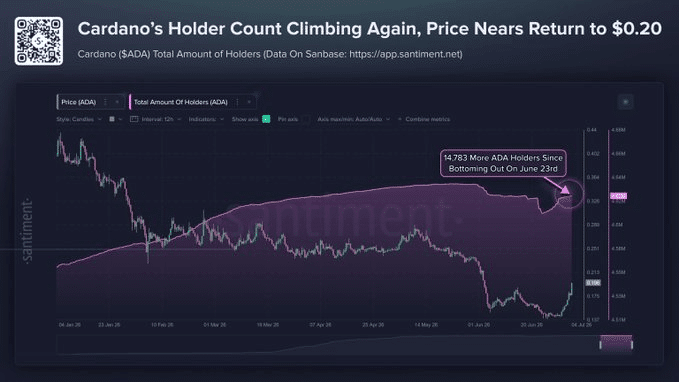
According to Santiment, Cardano has added 14,783 new non-empty wallets since its June 2023 low.

The timing is key. Just weeks ago, ADA was at the center of peak FUD, with concerns over ecosystem growth and technical weakness. Yet wallet growth continued to climb even as TVL kept slipping.

That’s an interesting divergence. Liquidity may still be lagging, but user participation isn’t. If anything, it suggests conviction is quietly building beneath the surface, increasing the odds that price eventually catches up. If ADA can reclaim $0.20, the path toward $0.30 starts looking much more realistic.


Final Summary

Trending Cryptos

Related Questions

QWhat is the key resistance level that ADA needs to break to potentially target $0.30, according to the article?

AThe key resistance level is $0.20. The article states that a clean break above this level could bring FOMO, with $0.25 as the next major hurdle, and if that level gives way, a move toward $0.30 becomes more realistic.

QHow much has Cardano's Total Value Locked (TVL) declined over the past year, according to the article?

ACardano's TVL has declined nearly 68% over the past year, falling from $276.19 million to around $89.16 million.

QWhat on-chain metric from Santiment does the article cite to support a potential bullish case for ADA?

AThe article cites wallet growth. According to Santiment, Cardano has added 14,783 new non-empty wallets since its June 2023 low, suggesting increasing user participation and conviction despite the decline in TVL.

QHow does the article characterize ADA's recent 2% pullback after reaching above $0.20?

AThe article suggests the pullback could look like the start of a deeper correction based on charts and on-chain data, but within the broader context of building altcoin momentum, it may instead appear more like a healthy reset than a trend reversal.

QHow did ADA's price performance in Q3 compare to Ethereum's, according to the technical analysis in the article?

AADA kicked off Q3 with a strong 30% rally, and its gains were over 2.3x larger than Ethereum's (ETH) gains so far in the quarter, suggesting capital may be rotating back into ADA.

Related Reads

The Verdict in Choi Tae-won's Divorce Case: Revealing the Inheritance Undercurrent Behind SK Hynix's Trillion-Won Empire

SK Group Chairman Chey Tae-won's high-profile divorce case, involving a record 1.38 trillion won settlement, has drawn attention to the succession plans for Korea's second-largest conglomerate, especially its crown jewel, SK hynix. Unlike traditional chaebol scripts centered on the eldest son, Chey's three children from his marriage to former President Roh Tae-woo's daughter, Roh Soh-yeong, are carving distinct, non-traditional paths. Eldest daughter Chey Yun-jung (b. 1989) is seen as the most evident successor. With a scientific and consulting background, she holds executive roles at SK bioscience and SK Inc.'s growth support department, focusing on future strategy and biopharma. Her marriage is to an AI infrastructure entrepreneur, not a traditional business alliance. Second daughter Chey Min-jung (b. 1991) took a unique route, voluntarily serving as a South Korean naval officer, including an anti-piracy deployment. She later worked on policy and strategy for SK hynix in Washington D.C. before co-founding an AI-driven healthcare startup. She married a former U.S. Marine Corps officer, connecting her to U.S. defense and policy circles—networks crucial for a global semiconductor giant. The only son, Chey In-geun (b. 1995), who studied physics like his father, worked briefly at SK E&S before joining McKinsey. Despite fitting the traditional "heir" profile as the eldest son, he remains silent and holds no public position or shares in SK, suggesting the old succession playbook is obsolete. As SK hynix's valuation soars, becoming a geopolitical asset in the AI era, the heirs' legitimacy is no longer automatic. They must prove themselves in fields like AI biotech, global policy, and strategic consulting. Their marriages also reflect new elite networks in tech and defense, not old political alliances. Their inheritance is the complex challenge of navigating a globalized, tech-driven world, not just a corporate throne.

marsbitYesterday 09:06

The Verdict in Choi Tae-won's Divorce Case: Revealing the Inheritance Undercurrent Behind SK Hynix's Trillion-Won Empire

marsbitYesterday 09:06

From OpenSea to OpenRouter: Is Alex Atallah Repeating His 'Exit at the Peak' Playbook?

From OpenSea to OpenRouter: Is Alex Atallah Repeating His "Exit at the Peak" Playbook? According to the Wall Street Journal, payments giant Stripe is in talks to acquire the AI model aggregation platform OpenRouter in a potential deal valuing the company near $100 billion. This would mark founder Alex Atallah's second creation of a company reaching a $100 billion valuation, following his co-founding of NFT marketplace OpenSea. OpenRouter, founded just over three years ago, has grown rapidly by acting as a unified gateway for developers to access over 400 AI models. It currently has about 10 million users and processes over 200 trillion tokens monthly. While the platform's annualized revenue is around $50 million, its valuation has skyrocketed from $1.3 billion in March 2026. The potential acquisition by Stripe, a company OpenRouter's founder once likened it to, represents a major expansion into AI infrastructure for the payments leader. This move echoes Atallah's previous timing with OpenSea, where he departed before the NFT market's significant downturn. For OpenRouter, selling now may be strategic. Despite its scale, its business model—charging a 5-5.5% fee on AI inference calls—faces pressure from competition, open-source models, and potential price wars among model providers, limiting its profitability narrative for an IPO. A key asset for potential acquirers like Stripe is OpenRouter's vast repository of real-world AI usage data, which offers unique insights into model performance and developer preferences that are difficult to replicate. Whether this potential deal signifies a new valuation benchmark for AI infrastructure or another market peak signal remains to be seen.

链捕手Yesterday 08:42

From OpenSea to OpenRouter: Is Alex Atallah Repeating His 'Exit at the Peak' Playbook?

链捕手Yesterday 08:42

Trading

Spot

Hot Articles

Discussions

Welcome to the HTX Community. Here, you can stay informed about the latest platform developments and gain access to professional market insights. Users' opinions on the price of S (S) are presented below.

活动图片
















