U.S., U.K. unveil stablecoin roadmap as CLARITY Act stalls: ‘For their own political gain!’

ambcryptoPublicado a 2026-07-15Actualizado a 2026-07-15

Resumen

The U.S. and U.K. have jointly affirmed their commitment to fostering innovation in digital assets by outlining a cooperative roadmap for stablecoins and tokenized assets. Their 10-point statement emphasizes reducing regulatory friction, particularly by avoiding disproportionately burdensome reserve requirements for stablecoin issuers. This follows the Bank of England's softened stance on reserve rules, now more aligned with the U.S. GENIUS Act framework. However, a divergence in regulatory progress is emerging. The U.K. is advancing towards a comprehensive crypto regulatory framework set for 2027, which includes measures like deferring capital gains tax on crypto lending. In contrast, the U.S. faces significant political hurdles, with the key crypto market structure bill, the CLARITY Act, stalled and its chances of passage dropping to yearly lows. This political deadlock, marked by anti-tech rhetoric, risks leaving the U.S. behind in establishing a clear and frictionless framework for digital assets.

The U.S. and U.K. have reaffirmed their commitment to reducing regulatory friction for digital assets and the modernization of capital markets.

In a joint statement issued on the 14th of July, the two governments shared a 10-point view on stablecoins and tokenized assets, with innovation as the anchor pillar.

The UK and United States affirm that stablecoins are an important vehicle for innovation in digital money. The UK and United States intend to enable the use of stablecoins in cross-border finance.

AD

Some of the issues addressed include reserves, liquidity, and prudential requirements for stablecoin issuers to operate across the two markets.

In particular, the countries pledged to avoid ‘imposing burdensome’ reserve requirements for stablecoins.

Neither government intends to impose burdensome reserve requirements that are disproportionate to risk and that create unwarranted barriers to entry.

The above stance is noteworthy given the recent U.K. softer stance on stablecoin reserves. Initially, it pushed for a strict plan where only 60% of reserves would earn interest, while 40% would be non-yielding at the central bank. The industry pushed against this and called it anti-competitive.

In response, the Bank of England softened the proposal, allowing up to 70% in yield-bearing bonds and reducing cash requirements to 30%. This somewhat mirrored the U.S. GENIUS Act framework, which mandates reserves to be backed by highly liquid assets like U.S. Treasury bonds.

Additionally, it scrapped its caps on individual stablecoin holdings to match the U.S. open market. Still, the two countries have divergences on some aspects of crypto regulation.

The U.S.’s CLARITY Act stalls as the U.K. eyes clear rules by 2027

First, the U.K. will defer capital gains tax for crypto lending to avoid burden and double taxation. The rules will be live in 2027, alongside its broader crypto regulatory framework covering stablecoins, exchanges, staking, and market abuse, among others.

However, a similar U.S. crypto market structure bill, the CLARITY Act, has stalled and risks being deferred to the 2030s. With ethics provisions becoming a sticky issue, odds of CLARITY Act passage dropped to a record yearly low of 32% before briefly hitting 38%.

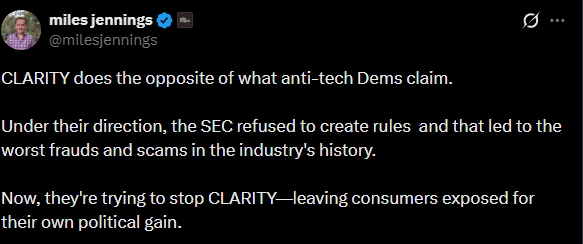
The bill has now become a political issue with increasing anti-tech rhetoric between Republicans and Democrats, according to Miles Jennings, legal chief at a16z VC firm.
Source: X

The U.S. and the U.K. are pushing for a frictionless stablecoin and tokenization framework. But the U.S. risks falling behind amid uncertainty around the CLARITY Act.


Final Summary

  • The U.S. and U.K. vowed to reduce friction for stablecoin usage as part of driving innovation in capital markets.
  • But the U.S. could fall behind as CLARITY Act passage expectations have fallen to record lows.

Criptos en tendencia

Preguntas relacionadas

QWhat is the main topic announced by the U.S. and U.K. in their joint statement?

AThe U.S. and U.K. reaffirmed their commitment to reducing regulatory friction for digital assets and the modernization of capital markets. They shared a 10-point view focused on enabling stablecoins and tokenized assets, with innovation as a key pillar, and intend to allow the use of stablecoins in cross-border finance.

QWhat specific regulatory issue regarding stablecoin reserves did the U.S. and U.K. address?

ABoth governments pledged to avoid imposing burdensome reserve requirements that are disproportionate to risk and create unwarranted barriers to entry. This stance follows the U.K.'s softened position on reserves, moving from a stricter plan to allowing up to 70% in yield-bearing bonds and reducing cash requirements to 30%.

QHow does the progress of crypto regulation in the U.K. compare to that in the U.S., according to the article?

AThe U.K. is moving forward with clear crypto rules, including deferring capital gains tax for crypto lending, set to be live by 2027. In contrast, the U.S.'s key crypto market structure bill, the CLARITY Act, has stalled, with passage expectations dropping to as low as 32%, risking delay into the 2030s due to political issues.

QWhat is the CLARITY Act and why has it become a contentious issue in the U.S.?

AThe CLARITY Act is a U.S. crypto market structure bill that has stalled in Congress. It has become a political issue with increasing anti-tech rhetoric between Republicans and Democrats. According to Miles Jennings of a16z, ethics provisions have become a sticky point, causing the odds of its passage to drop significantly.

QWhat is the potential consequence for the U.S. if the CLARITY Act continues to stall?

AIf the CLARITY Act continues to stall, the U.S. risks falling behind in establishing a clear regulatory framework for stablecoins and tokenized assets, while the U.K. moves forward with its plans. This could impact innovation and the U.S.'s competitive position in the digital asset space.

Lecturas Relacionadas

Fallo del caso de divorcio de Chey Tae-won: Revelando las líneas ocultas de sucesión detrás del imperio trillonario de SK Hynix

El caso de divorcio de Choi Tae-won, presidente de SK Group, concluyó con una sentencia histórica de división patrimonial. Este hecho pone bajo el foco la sucesión en el imperio de SK Hynix, cuyo valor se disparó un 700% alcanzando los 1.000 billones de wones. A diferencia del guion tradicional de los *chaebol* coreanos, centrado en el primogénito varón, los tres hijos de Choi Tae-won siguen trayectorias atípicas. La hija mayor, Choi Yoon-jung (1989), es considerada la candidata más visible. Con formación en biología y un doctorado, ocupa un puesto directivo en SK Bioscience y supervisa la estrategia de crecimiento del grupo. Se casó con el cofundador de una *startup* de IA. La segunda hija, Choi Min-jung (1991), forjó un camino único: sirvió como oficial en la Marina de Corea, trabajó en políticas globales para SK Hynix en Washington y ahora es fundadora de una empresa de salud con IA. Se casó con un ex oficial del Cuerpo de Marines de EE.UU. El hijo menor, Choi In-geun (1995), a pesar de ser el primogénito varón y seguir el patrón formativo típico (consultoría en McKinsey), permanece en un discreto silencio público sin un rol definido dentro del grupo. El divorcio de sus padres, Choi Tae-won y Roh Soh-yeong, hija del expresidente Roh Tae-woo, culminó en una batalla legal multimillonaria que involucró a los tres hijos, quienes presentaron peticiones judiciales no divulgadas. Mientras SK Hynix se convierte en un activo geopolítico global, la sucesión ya no es un asunto meramente familiar. Los herederos de la tercera generación no heredan simplemente una empresa, sino el complejo desafío de navegar la era de la IA, las políticas globales y encontrar nuevas fuentes de crecimiento, redefiniendo así el legado del *chaebol*.

marsbitHace 10 min(s)

Fallo del caso de divorcio de Chey Tae-won: Revelando las líneas ocultas de sucesión detrás del imperio trillonario de SK Hynix

marsbitHace 10 min(s)

¡En solo 2 meses su valoración ha pasado de 8.800 millones a 68.000 millones de euros! OpenRouter, la mayor centralita de la IA, podría ser adquirida

Stripe está en conversaciones para adquirir la startup de inteligencia artificial OpenRouter, el mayor mercado de modelos de IA que actúa como intermediario, por un monto cercano a los 100.000 millones de dólares. Esta valoración representa un aumento de casi siete veces respecto a los 13.000 millones de dólares de hace dos meses. La plataforma de OpenRouter permite a los desarrolladores acceder a más de 400 grandes modelos de lenguaje a través de una única API, optimizando automáticamente la selección del modelo según la complejidad de la tarea, el coste y la velocidad, similar a un comparador de precios. Fundada en 2023 por Alex Atallah (cofundador de OpenSea) y Louis Vichy, la empresa tiene un ingreso anualizado de 50 millones de dólares y más de un millón de desarrolladores usuarios. Para Stripe, líder mundial en pagos en línea, esta adquisición es un paso estratégico hacia la consolidación de su infraestructura para la economía de la IA, tras la compra reciente de Metronome, una plataforma de facturación por uso. El objetivo es ofrecer un paquete integral que gestione desde la selección de modelos y la facturación por tokens hasta los pagos, convirtiéndose en el centro de control para las aplicaciones de IA. Aunque la transacción aún podría fracasar, refleja la apuesta por el crecimiento explosivo del sector y el valor de controlar la capa de intermediación que decide cómo se distribuyen las consultas y los costes entre los distintos proveedores de modelos.

链捕手Hace 19 min(s)

¡En solo 2 meses su valoración ha pasado de 8.800 millones a 68.000 millones de euros! OpenRouter, la mayor centralita de la IA, podría ser adquirida

链捕手Hace 19 min(s)

Trading

Spot

Artículos destacados

Cómo comprar GAIN

¡Bienvenido a HTX.com! Hemos hecho que comprar GriffinAI (GAIN) sea simple y conveniente. Sigue nuestra guía paso a paso para iniciar tu viaje de criptos.Paso 1: crea tu cuenta HTXUtiliza tu correo electrónico o número de teléfono para registrarte y obtener una cuenta gratuita en HTX. Experimenta un proceso de registro sin complicaciones y desbloquea todas las funciones.Obtener mi cuentaPaso 2: ve a Comprar cripto y elige tu método de pagoTarjeta de crédito/débito: usa tu Visa o Mastercard para comprar GriffinAI (GAIN) al instante.Saldo: utiliza fondos del saldo de tu cuenta HTX para tradear sin problemas.Terceros: hemos agregado métodos de pago populares como Google Pay y Apple Pay para mejorar la comodidad.P2P: tradear directamente con otros usuarios en HTX.Over-the-Counter (OTC): ofrecemos servicios personalizados y tipos de cambio competitivos para los traders.Paso 3: guarda tu GriffinAI (GAIN)Después de comprar tu GriffinAI (GAIN), guárdalo en tu cuenta HTX. Alternativamente, puedes enviarlo a otro lugar mediante transferencia blockchain o utilizarlo para tradear otras criptomonedas.Paso 4: tradear GriffinAI (GAIN)Tradear fácilmente con GriffinAI (GAIN) en HTX's mercado spot. Simplemente accede a tu cuenta, selecciona tu par de trading, ejecuta tus trades y monitorea en tiempo real. Ofrecemos una experiencia fácil de usar tanto para principiantes como para traders experimentados.

586 Vistas totalesPublicado en 2025.09.24Actualizado en 2026.06.02

Cómo comprar GAIN

Discusiones

Bienvenido a la comunidad de HTX. Aquí puedes mantenerte informado sobre los últimos desarrollos de la plataforma y acceder a análisis profesionales del mercado. A continuación se presentan las opiniones de los usuarios sobre el precio de GAIN (GAIN).

活动图片