Dell Soars, Which Stocks Will This Wave of AI Sentiment Spread To?

marsbitPublished on 2026-05-29Last updated on 2026-05-29

Abstract

Dell's stock surged in after-hours trading after the company reported a strong earnings beat and significantly raised its full-year guidance, driven by soaring demand for AI-optimized servers. First-quarter revenue jumped 88% to $43.84 billion, far exceeding expectations. The company increased its fiscal 2027 AI server revenue forecast from $50 billion to approximately $60 billion, citing intense demand from clients like CoreWeave and tech giants Alphabet and Amazon who are making massive AI infrastructure investments. This indicates the AI boom is expanding beyond chips and models to downstream hardware and data center infrastructure providers. Dell's infrastructure unit, which includes servers and storage, saw revenue grow 181%. The company also announced a $9.7 billion U.S. Department of Defense contract, boosting confidence in its order pipeline. Dell's performance highlights its position as a key beneficiary in the AI supply chain, leveraging its scale, supplier relationships, and ability to navigate component shortages.

Editor's Note: Dell's after-hours stock surge is not merely due to earnings beating expectations, but rather the market is re-pricing the value of the AI infrastructure chain.

Driven by demand for AI data center construction, Dell's first-quarter revenue increased 88% year-over-year to $43.84 billion, and the company raised its fiscal 2027 AI server revenue expectation from $50 billion to approximately $60 billion. After the earnings release, the company's stock price rose about 39% in after-hours trading.

This indicates that the AI boom is further extending from models and chips to servers, memory, storage, and data center equipment. As tech giants like Alphabet and Amazon continue to increase their investments in AI infrastructure, hardware vendors like Dell, which possess supply chain capabilities, customer relationships, and delivery strength, are becoming direct beneficiaries in this new cycle of AI capital expenditure.

Additionally, a subsidiary of Dell securing a $9.7 billion contract with the U.S. Department of Defense has further strengthened market expectations for its order growth and revenue certainty. For investors, Dell's rise signifies that the AI trade is entering a more downstream and tangible phase: those who can turn chips into deliverable data center infrastructure are likely to receive the next round of valuation re-rating.

The following is the original text:

TL;DR

Dell raises full-year AI server revenue expectation to $60 billion

The company's Q2 guidance is higher than market expectations

Q1 revenue grew 88% YoY to $43.84 billion

Stock price rose about 39% in after-hours trading

A Dell subsidiary secures a $9.7 billion contract from the U.S. Department of Defense

Dell (Dell) on Thursday raised its full-year revenue and profit forecasts, showing that customer data center expansion is driving demand for its AI-optimized servers. These servers are equipped with Nvidia's advanced chips.

Dell's clients include CoreWeave, Honeywell International, and Samsung Electronics. After the earnings release, the company's stock rose about 39% in after-hours trading.

U.S. tech giants including Alphabet and Amazon plan to invest over $700 billion in AI infrastructure this year, which will boost demand for servers and data center equipment from suppliers like Dell and Super Micro Computer.

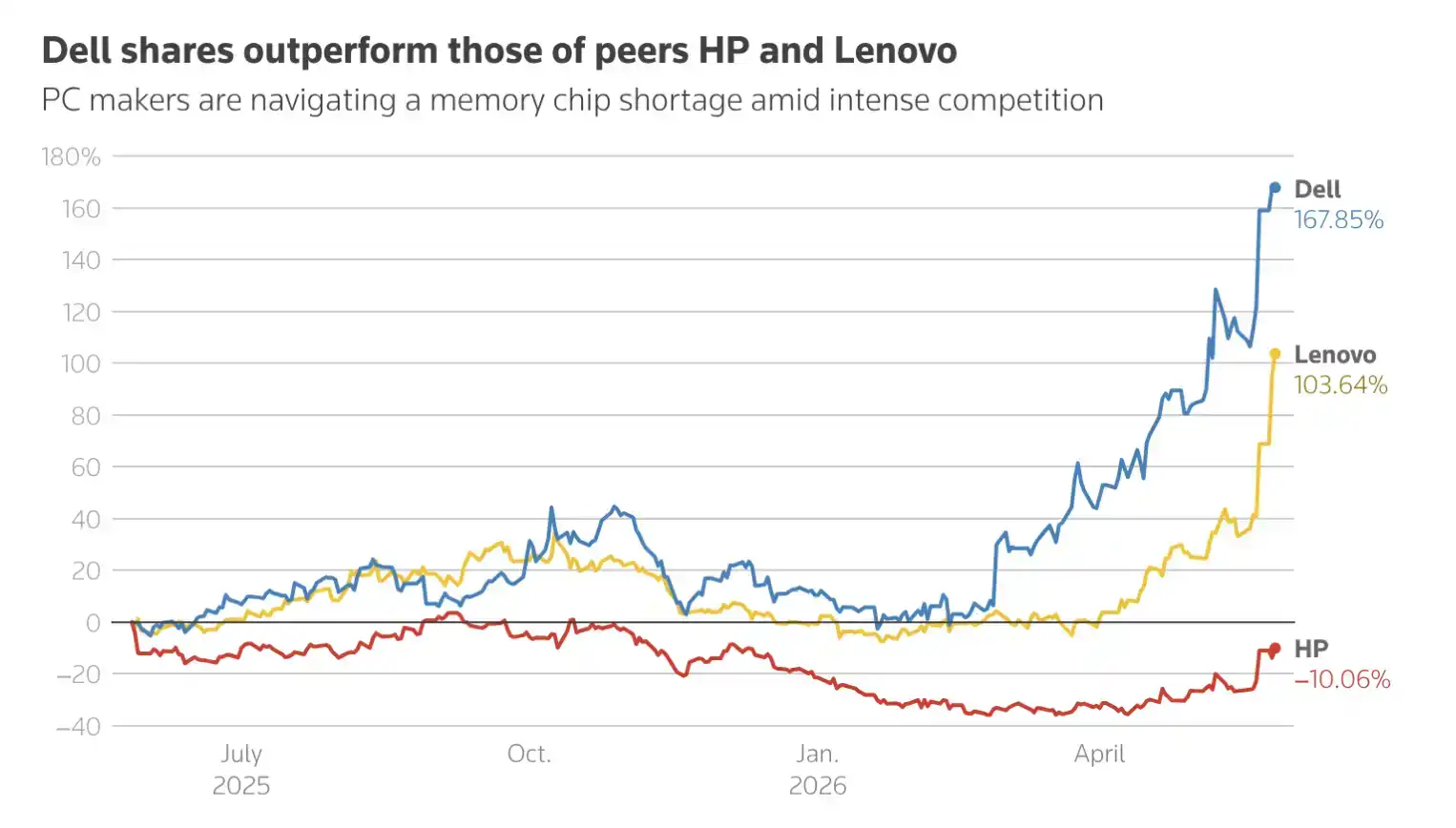
The strong results show that Dell has become one of the biggest beneficiaries of the generative AI boom. The company has navigated the memory chip shortage crisis relatively well through price increases and supply chain adjustments.

Dell's Chief Operating Officer, Jeff Clarke, said on the earnings call: "We feel like we're repricing almost daily. I think customers feel that too. Unfortunately, I don't think that's going to change, given the inflationary environment we're in."
Dell stated that it now expects fiscal 2027 AI server revenue to be approximately $60 billion, up from its previous expectation of $50 billion.

The company also raised its full-year revenue forecast to $165 billion - $169 billion, a significant increase from the previous forecast of $138 billion - $142 billion.
Concurrently, Dell raised its full-year adjusted EPS forecast from $12.90 to $17.90.

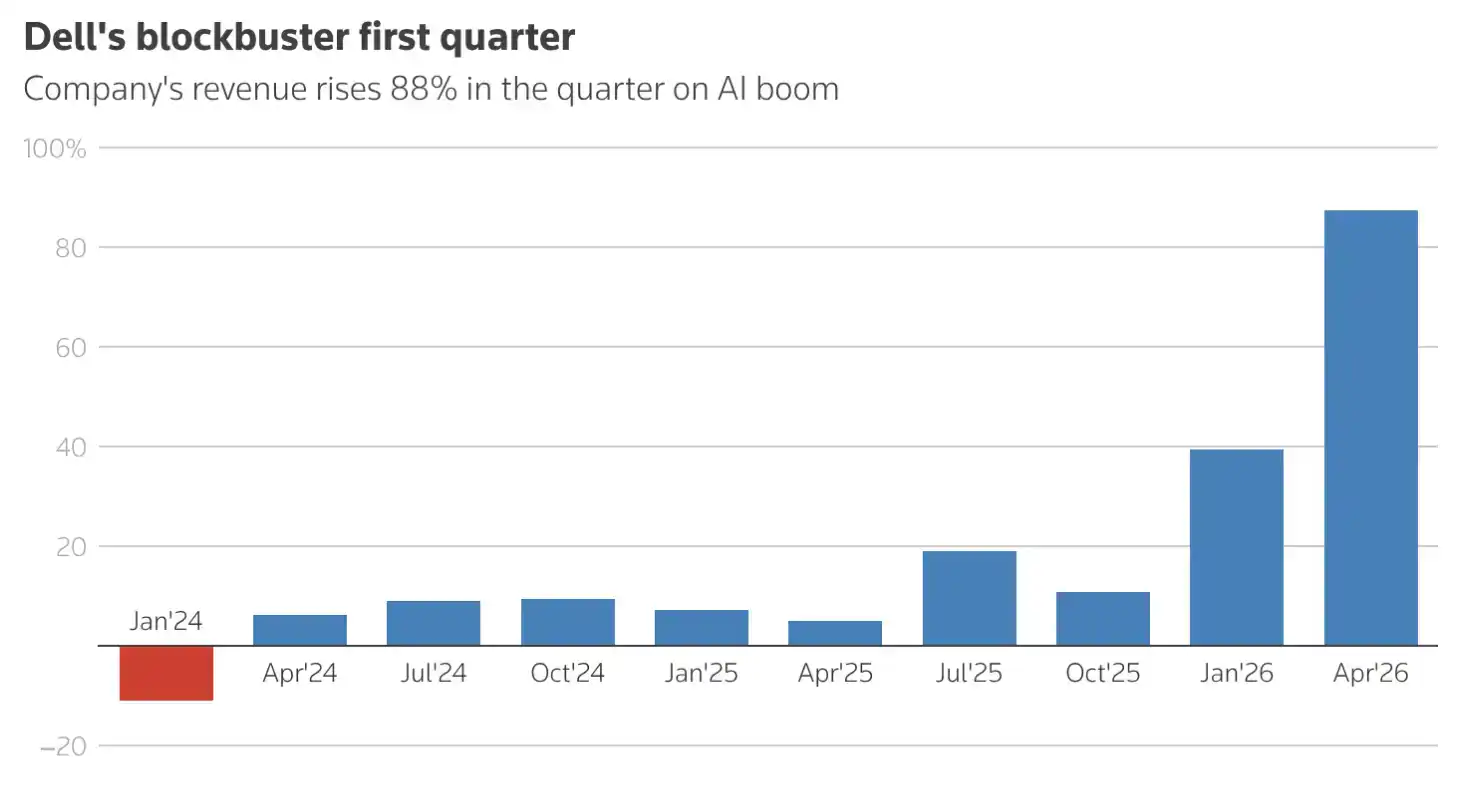
In the first quarter, Dell's revenue grew 88% year-over-year to $43.84 billion, significantly higher than the LSEG consensus analyst estimate of $35.43 billion. Adjusted EPS was $4.86, also above the market expectation of $2.94.
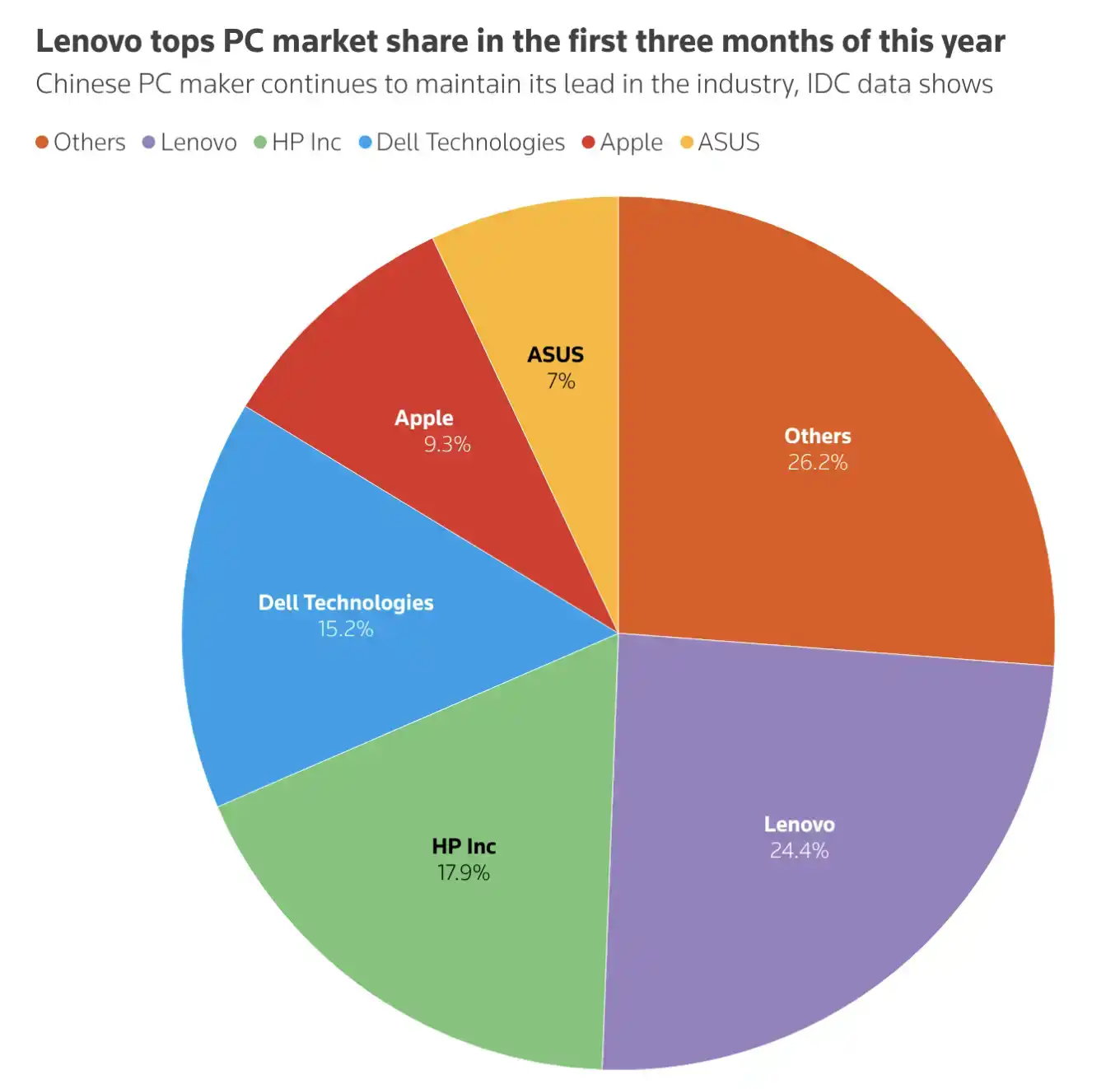
Melissa Otto, Head of Research at S&P Global Visible Alpha, said: "Dell is in a better position relative to competitors due to its scale, supplier relationships, and ability to prioritize demand, which has helped it gain market share during the memory shortage."

Revenue for Dell's Infrastructure Solutions Group, which includes storage, software, and server businesses, grew 181% for the quarter. Meanwhile, sales for the Client Solutions Group, which includes the PC business, increased 17%.

The company also provided Q2 revenue and adjusted EPS guidance that exceeded market expectations.

On Wednesday, the U.S. Department of Defense awarded a five-year, $9.7 billion contract to a Dell subsidiary to assist with managing Microsoft software licenses.
Trending Cryptos

Related Questions

QWhy did Dell's stock surge after its earnings report?

ADell's stock surged because its first-quarter revenue grew 88% to $43.84 billion, significantly exceeding expectations, and the company raised its full-year revenue and profit guidance. This was driven by strong demand for AI-optimized servers, leading the company to also raise its fiscal 2027 AI server revenue expectation from $50 billion to about $60 billion.

QWhat does Dell's performance indicate about the current AI market trend?

ADell's performance indicates that the AI boom is expanding downstream from models and chips to servers, memory, storage, and data center equipment. It shows that hardware companies with supply chain, customer relationships, and delivery capabilities are becoming direct beneficiaries of the new cycle of AI capital expenditure.

QWhat are Dell's updated financial expectations for fiscal 2027?

AFor fiscal 2027, Dell now expects AI server revenue to be about $60 billion, up from a prior expectation of $50 billion. The company also raised its full-year revenue forecast to $165 billion to $169 billion and its adjusted earnings per share forecast to $17.90.

QWhich other companies are mentioned as beneficiaries of increased AI infrastructure spending?

AThe article mentions that increased AI infrastructure spending by tech giants like Alphabet and Amazon (planning over $700 billion) will boost demand for suppliers including Dell and Super Micro Computer.

QWhat major contract did a Dell subsidiary recently secure?

AA subsidiary of Dell was recently awarded a five-year, $9.7 billion contract by the U.S. Department of Defense to help manage Microsoft software licenses.

Related Reads

The Verdict in Choi Tae-won's Divorce Case: Revealing the Inheritance Undercurrent Behind SK Hynix's Trillion-Won Empire

SK Group Chairman Chey Tae-won's high-profile divorce case, involving a record 1.38 trillion won settlement, has drawn attention to the succession plans for Korea's second-largest conglomerate, especially its crown jewel, SK hynix. Unlike traditional chaebol scripts centered on the eldest son, Chey's three children from his marriage to former President Roh Tae-woo's daughter, Roh Soh-yeong, are carving distinct, non-traditional paths. Eldest daughter Chey Yun-jung (b. 1989) is seen as the most evident successor. With a scientific and consulting background, she holds executive roles at SK bioscience and SK Inc.'s growth support department, focusing on future strategy and biopharma. Her marriage is to an AI infrastructure entrepreneur, not a traditional business alliance. Second daughter Chey Min-jung (b. 1991) took a unique route, voluntarily serving as a South Korean naval officer, including an anti-piracy deployment. She later worked on policy and strategy for SK hynix in Washington D.C. before co-founding an AI-driven healthcare startup. She married a former U.S. Marine Corps officer, connecting her to U.S. defense and policy circles—networks crucial for a global semiconductor giant. The only son, Chey In-geun (b. 1995), who studied physics like his father, worked briefly at SK E&S before joining McKinsey. Despite fitting the traditional "heir" profile as the eldest son, he remains silent and holds no public position or shares in SK, suggesting the old succession playbook is obsolete. As SK hynix's valuation soars, becoming a geopolitical asset in the AI era, the heirs' legitimacy is no longer automatic. They must prove themselves in fields like AI biotech, global policy, and strategic consulting. Their marriages also reflect new elite networks in tech and defense, not old political alliances. Their inheritance is the complex challenge of navigating a globalized, tech-driven world, not just a corporate throne.

marsbit22h ago

The Verdict in Choi Tae-won's Divorce Case: Revealing the Inheritance Undercurrent Behind SK Hynix's Trillion-Won Empire

marsbit22h ago

From OpenSea to OpenRouter: Is Alex Atallah Repeating His 'Exit at the Peak' Playbook?

From OpenSea to OpenRouter: Is Alex Atallah Repeating His "Exit at the Peak" Playbook? According to the Wall Street Journal, payments giant Stripe is in talks to acquire the AI model aggregation platform OpenRouter in a potential deal valuing the company near $100 billion. This would mark founder Alex Atallah's second creation of a company reaching a $100 billion valuation, following his co-founding of NFT marketplace OpenSea. OpenRouter, founded just over three years ago, has grown rapidly by acting as a unified gateway for developers to access over 400 AI models. It currently has about 10 million users and processes over 200 trillion tokens monthly. While the platform's annualized revenue is around $50 million, its valuation has skyrocketed from $1.3 billion in March 2026. The potential acquisition by Stripe, a company OpenRouter's founder once likened it to, represents a major expansion into AI infrastructure for the payments leader. This move echoes Atallah's previous timing with OpenSea, where he departed before the NFT market's significant downturn. For OpenRouter, selling now may be strategic. Despite its scale, its business model—charging a 5-5.5% fee on AI inference calls—faces pressure from competition, open-source models, and potential price wars among model providers, limiting its profitability narrative for an IPO. A key asset for potential acquirers like Stripe is OpenRouter's vast repository of real-world AI usage data, which offers unique insights into model performance and developer preferences that are difficult to replicate. Whether this potential deal signifies a new valuation benchmark for AI infrastructure or another market peak signal remains to be seen.

链捕手23h ago

From OpenSea to OpenRouter: Is Alex Atallah Repeating His 'Exit at the Peak' Playbook?

链捕手23h ago

Trading

Spot

Hot Articles

Discussions

Welcome to the HTX Community. Here, you can stay informed about the latest platform developments and gain access to professional market insights. Users' opinions on the price of S (S) are presented below.

活动图片