Hurun Report Interview with Justin Sun: New Paradigms of Value Circulation under the Web3 Transformation Cycle

marsbitPublished on 2026-05-29Last updated on 2026-05-29

Abstract

In a deep-dive interview with *Hurun Report*, Justin Sun, founder of TRON, outlines his vision for Web3's evolution from proof-of-concept to global adoption, emphasizing stablecoins as the cornerstone for building a new paradigm of value transfer. Sun defines the core mission as enabling low-cost, efficient global fund movement for anyone, anywhere, regardless of bank access. He argues that sustainable blockchain projects must be driven by genuine demand and usage, with stablecoin payments currently representing the most mature and scalable application. Citing TRON's position as a leading stablecoin network with over $86.3 billion in USDT circulation, he attributes this growth to real-world use in cross-border transfers, savings, and payments, viewing it as a "natural replacement" for traditional financial infrastructure's inefficiencies. On strategy, Sun advocates for a methodology combining data-driven iteration, rapid execution, and user-centricity. He highlights the pivotal decision to partner with Tether on TRC-20 USDT as a calculated move that capitalized on stablecoins' long-term trend and network effects. While Web3 is inherently global, Sun stresses the critical importance of local compliance and cultural adaptation for successful market entry. Looking ahead, Sun identifies the convergence of AI and blockchain as a key frontier. He sees AI as fundamentally reshaping thinking and decision-making, with blockchain providing decentralized infrastructure for AI, while ...

Against the backdrop of the Web3 industry entering deep waters and the accelerated restructuring of global financial infrastructure, blockchain is transitioning from early exploration to large-scale application. As an authoritative institution with extensive influence in the business and investment fields, an in-depth interview by the renowned magazine Hurun Report is regarded as a significant industry bellwether. Recently, in an exclusive interview with Hurun Report, Justin Sun, founder of TRON, systematically elaborated his judgments on industry evolution and long-term value around core issues such as stablecoin payments, globalization paths, and the AI integration trend. His perspectives also reflect the crucial phase where Web3 infrastructure is moving from "feasibility validation" to "global adoption."
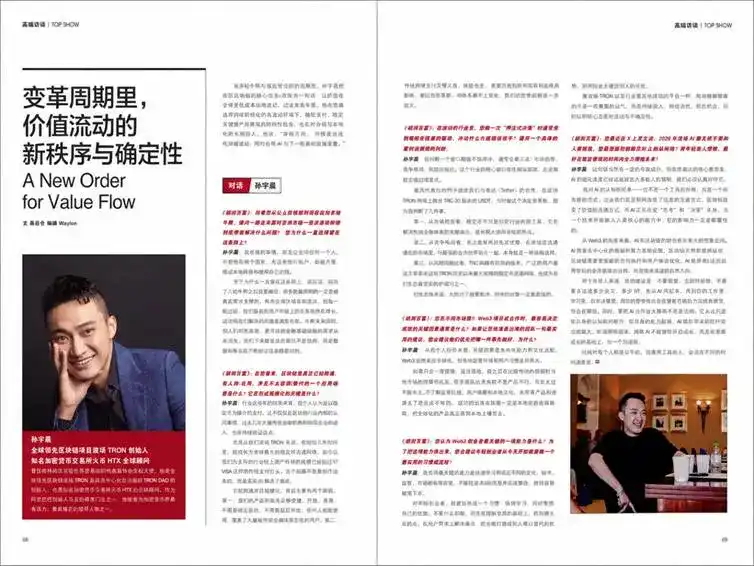
Stablecoins Build a Global Value Circulation Network, Web3 Infrastructure Enters Scaling Phase

In the Hurun Report interview, Justin Sun succinctly summarized his long-term core objective: "To enable anyone in the world, regardless of location or bank account access, to transfer and use their funds with low cost and high efficiency." This statement fundamentally reveals the value essence of blockchain technology — building an open and inclusive Internet of Value.

He further pointed out that after experiencing multiple bull and bear cycles, projects capable of enduring cycles must be built on real demand and practical usage. The sustained growth in on-chain user scale and transaction volume is an important basis for his judgment on industry direction. Against this backdrop, the on-chain payment system with stablecoins at its core has become the most mature and scalable application scenario.

In the Hurun Report interview, Justin Sun mentioned that TRON has rapidly developed into one of the world's largest stablecoin circulation networks, with its on-chain asset transfer volume even surpassing that of some traditional payment networks. This growth is not driven by short-term market sentiment but by continuous usage from real users in scenarios like cross-border transfers, value storage, and daily payments. Official data shows that the circulating supply of USDT on the TRON network currently exceeds $86.3 billion, reflecting robust network effects driven by genuine user demand.

In terms of structural advantages, the scalability of stablecoin payments benefits from two factors: on one hand, blockchain networks possess openness and permissionless characteristics, enabling them to reach user groups inaccessible to traditional financial systems; on the other hand, limitations in efficiency, cost, and user experience within traditional cross-border payment systems provide significant substitution space for new-generation infrastructure. Sun believes this trend is essentially a "natural substitution" of existing financial systems by technological advancement, rather than short-term competition.

Globalization Strategy and Technological Integration Advance in Tandem, Building Long-Term Competitive Advantage for Web3

When discussing enterprise growth and strategic decision-making, Sun presented a highly systematic methodology in the Hurun Report interview. He summarized the success factors as the combination of "data-driven iteration, rapid execution, and user-centric orientation," emphasizing that in a rapidly changing technological environment, single-dimensional capabilities can hardly sustain long-term competitiveness; instead, efficient trial-and-error and precise decision-making must be achieved through the synergy of these three.

At the organizational level, he proposed a management framework of "clear direction, layered support, and a sense of ownership among all members" to prevent deviation and loss of control during rapid expansion. This organizational structure emphasizing flatness and agility is seen as an important foundation for Web3 enterprises to maintain competitiveness in a highly uncertain environment.

Regarding specific key strategic decisions, Sun reflected on the case of TRON's collaboration with Tether to launch TRC-20 USDT in the Hurun Report interview. He stated that this decision was based on a comprehensive judgment of market trends, competitive landscape, and risk-reward ratio: stablecoins represent a long-term trend in financial system evolution, leading assets exhibit significant network effects, and the upside potential in this field far outweighs potential risks. This partnership has proven to be a major growth engine for the TRON ecosystem and has constructed its core competitive moat in the stablecoin domain.

Regarding global expansion, Sun emphasized that while Web3 has inherent cross-border attributes, its actual implementation still heavily depends on local compliance and cultural adaptation. In the Hurun Report interview, he noted that different markets have significant differences in regulatory frameworks, user habits, and business environments, and a project's success often hinges on the depth of understanding these differences and the ability to build local partnership networks.

Furthermore, Sun expressed clear judgment regarding AI technology development. He stated in the interview that AI is not merely a tool upgrade but a reconstruction of "thinking and decision-making capabilities." Its integration with blockchain in areas like data, computing power, and intelligent execution will be an important direction for the next phase of technological evolution. Blockchain provides decentralized infrastructure for AI, while AI enhances the intelligence and user experience of blockchain systems; the fusion of the two possesses long-term strategic value.

Addressing industry participants and young entrepreneurs, the core advice Sun offered in the Hurun Report interview is: in a highly uncertain environment, continuous learning and rapid adaptation are the most crucial capabilities. Simultaneously, one should focus investments and build irreplaceable core strengths based on an understanding of the industry's overall picture, rather than dispersing resources across multiple tracks.

Transitioning from early-stage technical validation and market exploration, to the large-scale application phase represented by stablecoins, and extending towards AI integration and global compliant implementation. In this process, TRON is continuously advancing the realization and evolution of the Internet of Value through infrastructure capabilities, globalization strategy, and technological foresight.


Trending Cryptos

Related Reads

The Verdict in Choi Tae-won's Divorce Case: Revealing the Inheritance Undercurrent Behind SK Hynix's Trillion-Won Empire

SK Group Chairman Chey Tae-won's high-profile divorce case, involving a record 1.38 trillion won settlement, has drawn attention to the succession plans for Korea's second-largest conglomerate, especially its crown jewel, SK hynix. Unlike traditional chaebol scripts centered on the eldest son, Chey's three children from his marriage to former President Roh Tae-woo's daughter, Roh Soh-yeong, are carving distinct, non-traditional paths. Eldest daughter Chey Yun-jung (b. 1989) is seen as the most evident successor. With a scientific and consulting background, she holds executive roles at SK bioscience and SK Inc.'s growth support department, focusing on future strategy and biopharma. Her marriage is to an AI infrastructure entrepreneur, not a traditional business alliance. Second daughter Chey Min-jung (b. 1991) took a unique route, voluntarily serving as a South Korean naval officer, including an anti-piracy deployment. She later worked on policy and strategy for SK hynix in Washington D.C. before co-founding an AI-driven healthcare startup. She married a former U.S. Marine Corps officer, connecting her to U.S. defense and policy circles—networks crucial for a global semiconductor giant. The only son, Chey In-geun (b. 1995), who studied physics like his father, worked briefly at SK E&S before joining McKinsey. Despite fitting the traditional "heir" profile as the eldest son, he remains silent and holds no public position or shares in SK, suggesting the old succession playbook is obsolete. As SK hynix's valuation soars, becoming a geopolitical asset in the AI era, the heirs' legitimacy is no longer automatic. They must prove themselves in fields like AI biotech, global policy, and strategic consulting. Their marriages also reflect new elite networks in tech and defense, not old political alliances. Their inheritance is the complex challenge of navigating a globalized, tech-driven world, not just a corporate throne.

marsbit18h ago

The Verdict in Choi Tae-won's Divorce Case: Revealing the Inheritance Undercurrent Behind SK Hynix's Trillion-Won Empire

marsbit18h ago

From OpenSea to OpenRouter: Is Alex Atallah Repeating His 'Exit at the Peak' Playbook?

From OpenSea to OpenRouter: Is Alex Atallah Repeating His "Exit at the Peak" Playbook? According to the Wall Street Journal, payments giant Stripe is in talks to acquire the AI model aggregation platform OpenRouter in a potential deal valuing the company near $100 billion. This would mark founder Alex Atallah's second creation of a company reaching a $100 billion valuation, following his co-founding of NFT marketplace OpenSea. OpenRouter, founded just over three years ago, has grown rapidly by acting as a unified gateway for developers to access over 400 AI models. It currently has about 10 million users and processes over 200 trillion tokens monthly. While the platform's annualized revenue is around $50 million, its valuation has skyrocketed from $1.3 billion in March 2026. The potential acquisition by Stripe, a company OpenRouter's founder once likened it to, represents a major expansion into AI infrastructure for the payments leader. This move echoes Atallah's previous timing with OpenSea, where he departed before the NFT market's significant downturn. For OpenRouter, selling now may be strategic. Despite its scale, its business model—charging a 5-5.5% fee on AI inference calls—faces pressure from competition, open-source models, and potential price wars among model providers, limiting its profitability narrative for an IPO. A key asset for potential acquirers like Stripe is OpenRouter's vast repository of real-world AI usage data, which offers unique insights into model performance and developer preferences that are difficult to replicate. Whether this potential deal signifies a new valuation benchmark for AI infrastructure or another market peak signal remains to be seen.

链捕手19h ago

From OpenSea to OpenRouter: Is Alex Atallah Repeating His 'Exit at the Peak' Playbook?

链捕手19h ago

Trading

Spot

Hot Articles

How to Buy SUN

Welcome to HTX.com! We've made purchasing SUN (SUN) simple and convenient. Follow our step-by-step guide to embark on your crypto journey.Step 1: Create Your HTX AccountUse your email or phone number to sign up for a free account on HTX. Experience a hassle-free registration journey and unlock all features.Get My AccountStep 2: Go to Buy Crypto and Choose Your Payment MethodCredit/Debit Card: Use your Visa or Mastercard to buy SUN (SUN) instantly.Balance: Use funds from your HTX account balance to trade seamlessly.Third Parties: We've added popular payment methods such as Google Pay and Apple Pay to enhance convenience.P2P: Trade directly with other users on HTX.Over-the-Counter (OTC): We offer tailor-made services and competitive exchange rates for traders.Step 3: Store Your SUN (SUN)After purchasing your SUN (SUN), store it in your HTX account. Alternatively, you can send it elsewhere via blockchain transfer or use it to trade other cryptocurrencies.Step 4: Trade SUN (SUN)Easily trade SUN (SUN) on HTX's spot market. Simply access your account, select your trading pair, execute your trades, and monitor in real-time. We offer a user-friendly experience for both beginners and seasoned traders.

7.5k Total ViewsPublished 2024.03.29Updated 2026.06.02

How to Buy SUN

Discussions

Welcome to the HTX Community. Here, you can stay informed about the latest platform developments and gain access to professional market insights. Users' opinions on the price of SUN (SUN) are presented below.

活动图片













