Tokenized US Treasurys surge 50x since 2024, marking shift toward on-chain finance

cointelegraphPublished on 2025-12-22Last updated on 2025-12-22

Abstract

Tokenized US Treasurys have experienced explosive growth, surging 50x from under $200 million in January 2024 to nearly $7 billion by late 2025. This rapid expansion is driven by rising institutional demand for on-chain yield and marks a significant shift toward blockchain-based finance. BlackRock's USD Institutional Digital Liquidity Fund (BUIDL) leads this market with almost $2 billion in assets, offering daily yield accrual and on-chain settlement. Other key products include offerings from Circle, Superstate, and Ondo Finance. Tokenized Treasury bills are becoming a crucial gateway for institutional DeFi adoption, combining the safety of US government debt with the efficiency of blockchain settlement. They are increasingly used for collateral management, margining, and improving capital efficiency.

Tokenized US Treasurys have emerged as one of the fastest-growing segments of the real-world asset (RWA) market, with data pointing to 50x growth in less than two years amid rising institutional demand for on-chain yield.

Data from Token Terminal shows that the combined market capitalization of tokenized US Treasury products has exploded from well under $200 million in January 2024 to almost $7 billion in late 2025. The growth underscores the rapid acceleration of onchain adoption for government-backed debt instruments.
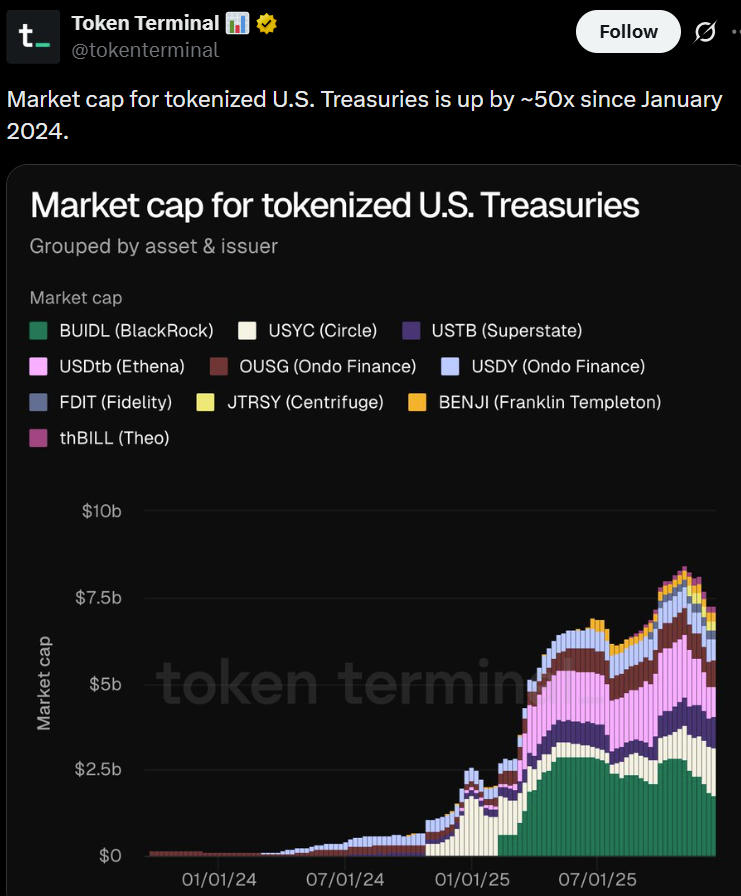
Source: Token Terminal

At the center of this expansion is BlackRock’s USD Institutional Digital Liquidity Fund (BUIDL), which is widely regarded as the flagship product of the tokenized Treasury market.

The blockchain-based fund provides investors with exposure to short-term US Treasurys while offering daily yield accrual and onchain settlement. Industry data shows that BUIDL has amassed close to $2 billion in assets under management.

Other prominent offerings include USD Coin Yield (USYC) from Circle, US Treasury Bill Token (USTB) from Superstate and Ondo Short-Term US Government Bond Fund (OUSG) from Ondo Finance.

Each product offers tokenized access to US government debt through regulated fund structures, reflecting a broader push to bring traditional fixed-income instruments onto blockchain rails.

Related: Goldman Sachs, BNY to offer tokenized money market funds for clients

Tokenized Treasury bills emerge as a key gateway to institutional DeFi

US Treasury bills are particularly well-suited for tokenization, as they combine the safety of US government backing with the efficiency of blockchain-based settlement, creating a regulated gateway into decentralized finance (DeFi) markets.

As Cointelegraph has reported, institutional adoption of tokenized Treasury bills is gaining traction, particularly for use in settlement and margining. Traditional financial institutions are using tokenized government debt to improve capital efficiency while maintaining exposure to low-risk assets.

DBS, Southeast Asia’s largest financial institution by assets, was among the first major lenders to test tokenized funds, including blockchain-based Treasury products. The bank has piloted tokenized money market funds and government securities as part of broader efforts to use onchain assets for collateral management and settlement.

Tokenized Treasury bills have grown in tandem with other onchain assets, contributing to the rapid evolution of the tokenization market. RedStone data shows that private credit has been the fastest-growing segment, buoyed by yields that exceed those of traditional investment vehicles.


Related: New protocol targets redemption delays in $20B tokenized market

Trending Cryptos

Related Questions

QWhat is the reported growth rate of the tokenized US Treasurys market since January 2024, according to Token Terminal?

AThe market has experienced 50x growth, surging from well under $200 million in January 2024 to almost $7 billion in late 2025.

QWhich fund is considered the flagship product of the tokenized Treasury market and how much in assets has it amassed?

ABlackRock’s USD Institutional Digital Liquidity Fund (BUIDL) is the flagship product, and it has amassed close to $2 billion in assets under management.

QName three other prominent tokenized US Treasury products mentioned besides BlackRock's BUIDL.

AThe other prominent products are USD Coin Yield (USYC) from Circle, US Treasury Bill Token (USTB) from Superstate, and Ondo Short-Term US Government Bond Fund (OUSG) from Ondo Finance.

QWhy are US Treasury bills described as being particularly well-suited for tokenization?

AThey combine the safety of US government backing with the efficiency of blockchain-based settlement, creating a regulated gateway into decentralized finance (DeFi) markets.

QWhich major Southeast Asian financial institution was mentioned as an early tester of tokenized funds, including Treasury products?

ADBS, Southeast Asia’s largest financial institution by assets, was among the first major lenders to test tokenized funds.

Related Reads

GPT-5.6 Countdown: Abandon the Illusion of a Single API, Computational Iteration Can't Outpace a Single Page of Compliance

In mid-June, three seemingly independent industry events—the compliance-driven throttling of Fable 5, the open-sourcing of GLM-5.2, and the leaked release timeline for GPT-5.6—are pushing the global AI industry toward a watershed moment. These shifts signal a fundamental restructuring of the industry's underlying logic. First, **"usability" has substantially overtaken "advanced capabilities"** as the primary weight, pushing the global large language model (LLM) supply chain into a "dual-track" phase of controlled closed-source and local open-source coexistence. Second, **the competitive moats of closed-source giants are shifting**. Their technical focus is moving from "language intelligence" toward "spatial intelligence (world models)"—a domain heavily reliant on computing power. Third, faced with常态化 transnational compliance risks, **a "model-agnostic" decoupled design has become a survival necessity for application-layer developers to maintain business continuity.** The article details how Anthropic's Fable 5, despite its advanced engineering feats, was restricted for non-U.S. citizens within 72 hours of launch, highlighting how geopolitical compliance can instantly limit even the most advanced models. In response, the open-source camp, exemplified by Zhipu AI's MIT-licensed GLM-5.2, is gaining market share by offering stable performance improvements and significant cost advantages (up to 70% savings for enterprises), while achieving full adaptation with domestic semiconductor platforms. Meanwhile, closed-source leaders like OpenAI are pivoting. The anticipated GPT-5.6 reportedly shifts focus from language to spatial intelligence and world models, aiming to rebuild a generational gap in areas like 3D understanding, simulation, and industrial design that demand immense compute. The core conclusion is that the LLM supply chain's logic has changed. Enterprises must now evaluate infrastructure based on a composite of technical performance and policy compliance. For developers, complete reliance on a single closed-source API poses unacceptable risk. Implementing a truly model-agnostic architecture—enabling swift switches to compliant, locally deployable open-source alternatives—is no longer just good practice but a fundamental baseline for business continuity.

marsbit2h ago

GPT-5.6 Countdown: Abandon the Illusion of a Single API, Computational Iteration Can't Outpace a Single Page of Compliance

marsbit2h ago

Is the 'Token Subsidy War' Among AI Giants Almost Over?

The article discusses the ongoing "token subsidy war" among AI giants like OpenAI and Anthropic, questioning whether it's nearing its end. It reveals that current AI subscription prices are heavily subsidized, with some plans offering tokens at up to 70 times the actual cost to attract and retain heavy users, especially developers and enterprises. This strategy mirrors past internet-era subsidy battles, but with a key difference: AI tokens lack "lock-in" effects. Unlike ride-hailing or food delivery apps, users can easily switch between AI providers as APIs become standardized, making it difficult for companies to raise prices post-subsidy. The piece highlights a structural asymmetry in the competition. Giants like Google, with massive advertising revenue, can afford to subsidize tokens indefinitely, akin to using "tokens as a weapon." In contrast, venture-backed companies like OpenAI and Anthropic face pressure to become profitable, especially as they approach IPO. The article cites Google Ventures founder Bill Maris, who suggests Google could slash token prices by 80%, putting immense pressure on competitors. Two potential endgames are presented: the "internet service" model (subsidize, monopolize, then raise prices) and the "utility" model (tokens become a standardized, low-margin commodity like electricity). Given the low switching costs, the latter seems more likely. The competition may not have a single winner but could instead accelerate AI's evolution into a foundational, infrastructure-level technology, akin to a public utility. For now, users continue to benefit from heavily subsidized token costs.

marsbit2h ago

Is the 'Token Subsidy War' Among AI Giants Almost Over?

marsbit2h ago

Beyond the Stadium: The Profitable Games Surrounding the World Cup

"Beyond the Pitch: The Profit Game Around the World Cup" The FIFA World Cup transcends being a sporting spectacle, evolving into a massive global arena for speculation and profit-seeking. The 2026 tournament has amplified this dynamic, creating a multi-layered ecosystem of financial opportunism alongside the football. **Prediction markets** have surged into the mainstream. Platforms like Polymarket and Kalshi saw trading volumes for World Cup contracts soar, attracting new users with their financial trading model and high-profile, chain-based wealth stories that overshadow traditional sports betting in terms of growth and narrative. However, **traditional sportsbooks** remain the dominant force, leveraging established user habits, legal markets, and comprehensive product offerings to handle the vast majority of speculative wagers, with projections suggesting record-breaking betting volumes. Capital markets also react. **"Concept stocks"** in countries like South Korea and Japan experience volatile price swings based on team performance and anticipated fan spending on items like chicken, beer, and viewing parties, effectively becoming a stock market reflecting fan sentiment. The **ticket resale market** has become a sophisticated arena for arbitrage. Prices fluctuate wildly based on team draws and star power, with sellers sometimes listing tickets they don't yet own in a practice akin to short-selling, while FIFA's own "Right to Buy" tokens add another layer of speculative trading. **Collectibles and merchandise** offer another avenue. Panini sticker albums, with their inherent scarcity and nostalgic value, can become high-value collectibles. Limited-edition or locally themed jerseys command significant premiums on secondary markets, and even counterfeit vendors profit from fans' desire for affordable match-day identity. The **cryptocurrency** space has seen a frenzy of speculative, unauthorized World Cup-themed meme coins on chains like Solana. These tokens, often exploiting team names and player imagery, experience extreme pump-and-dump cycles, creating stories of massive gains for a few early entrants and steep losses for many others. Finally, an entire industry thrives on **providing information and tools** to other speculators. Developers create platforms like SeatSidekick to track ticket inventory and prices, while paid Telegram groups and subscriptions sell betting tips and predictions, monetizing the widespread desire for an informational edge. In essence, the World Cup has become a compressed, global laboratory for speculation. While the games determine champions on the field, a parallel, complex network of financial transactions—spanning prediction contracts, bets, stocks, tickets, collectibles, crypto, and information services—settles its own scores in the global market.

marsbit3h ago

Beyond the Stadium: The Profitable Games Surrounding the World Cup

marsbit3h ago

Trading

Spot
Futures

Hot Articles

How to Buy US

Welcome to HTX.com! We've made purchasing Talus Network (US) simple and convenient. Follow our step-by-step guide to embark on your crypto journey.Step 1: Create Your HTX AccountUse your email or phone number to sign up for a free account on HTX. Experience a hassle-free registration journey and unlock all features.Get My AccountStep 2: Go to Buy Crypto and Choose Your Payment MethodCredit/Debit Card: Use your Visa or Mastercard to buy Talus Network (US) instantly.Balance: Use funds from your HTX account balance to trade seamlessly.Third Parties: We've added popular payment methods such as Google Pay and Apple Pay to enhance convenience.P2P: Trade directly with other users on HTX.Over-the-Counter (OTC): We offer tailor-made services and competitive exchange rates for traders.Step 3: Store Your Talus Network (US)After purchasing your Talus Network (US), store it in your HTX account. Alternatively, you can send it elsewhere via blockchain transfer or use it to trade other cryptocurrencies.Step 4: Trade Talus Network (US)Easily trade Talus Network (US) on HTX's spot market. Simply access your account, select your trading pair, execute your trades, and monitor in real-time. We offer a user-friendly experience for both beginners and seasoned traders.

4.9k Total ViewsPublished 2025.12.11Updated 2026.06.02

How to Buy US

Discussions

Welcome to the HTX Community. Here, you can stay informed about the latest platform developments and gain access to professional market insights. Users' opinions on the price of US (US) are presented below.

活动图片