Kalshi's Biggest Rival is Not Polymarket

链捕手Published on 2026-06-22Last updated on 2026-06-22

Abstract

Kalshi's CEO Tarek Mansour has identified the company's primary competitors not as the crypto-based prediction market Polymarket, but as established financial and gaming giants: CME Group, Robinhood, and DraftKings. This reflects a shift in the prediction market landscape, where the 2026 FIFA World Cup is expected to bring massive new trading volume. Traditional platforms are increasingly integrating prediction markets as a feature within their existing ecosystems. Robinhood has seen rapid growth with its prediction markets, contributing significantly to its "other transaction revenue." Similarly, Interactive Brokers (IBKR) integrates contracts from Kalshi and CME Group, while DraftKings and FanDuel (via CME) have launched their own prediction products. This allows these firms to leverage their vast user bases and infrastructure at low marginal cost, turning prediction markets from standalone apps into embedded functionalities. In response, prediction market platforms are evolving along two paths. First, they are expanding into new event categories like sports (e.g., the World Cup) and financial data to reduce reliance on election cycles. Second, they are moving towards becoming infrastructure and liquidity providers for distribution platforms. Kalshi's lead over Polymarket in trading volume is partly attributed to this channel strategy, integrating with brokers like Robinhood, Coinbase, and Webull. However, this strategy faces a challenge as distributors like Robinhood be...

Author: flowie, ChainCatcher

The 2026 FIFA World Cup may be becoming the largest traffic event in the history of prediction markets. Bernstein calls it an important "watershed" for the industry, estimating the event will bring $5 billion to $10 billion in new trading volume.

However, more notable than the growth in trading volume is the apparent shift in the competitive logic of prediction markets.

Over the past few years, market discussion has primarily focused on whether Polymarket or Kalshi would be the ultimate winner of the prediction market era.

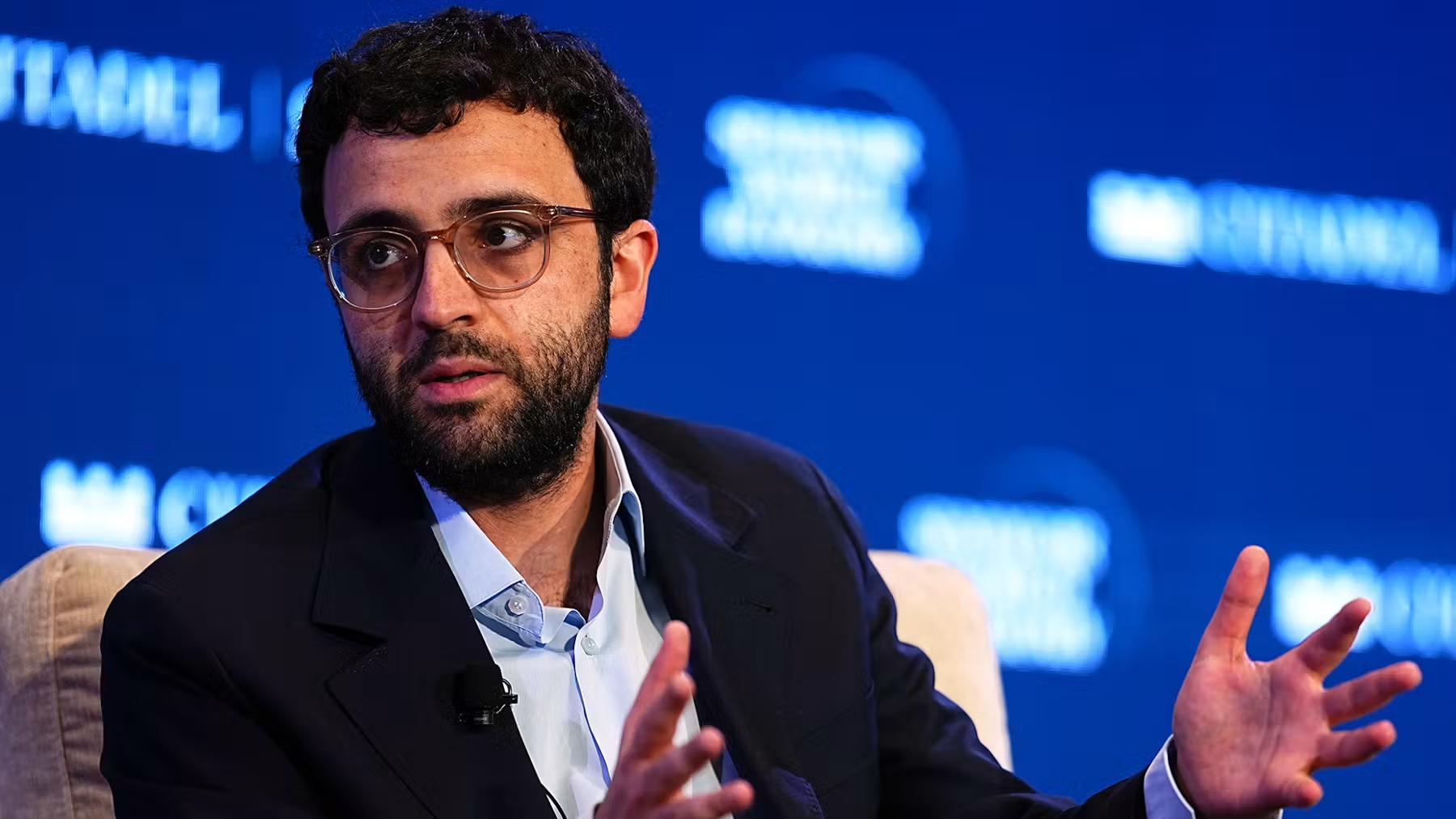
However, Kalshi CEO Tarek Mansour recently gave a thought-provoking answer in an interview with Front Office Sports.

In his view, Polymarket is not Kalshi's primary competitor. The ones to be truly wary of are CME Group, Robinhood, and DraftKings.

Meanwhile, Bernstein also believes that platforms with user gateways and distribution channels like Robinhood and DraftKings will become major beneficiaries of this World Cup.

This indicates that with traditional brokerages and exchanges collectively entering the fray, the competitive logic of prediction markets is being redefined.

The Threat from Traditional Trading Giants

If prediction markets were an independent sector in past years, a noticeable change over the past year is that more traditional financial platforms are starting to incorporate prediction markets as part of their existing business.

Among them, the most aggressive has been internet brokerage Robinhood. Robinhood not only launched its Prediction Markets Hub, but also, on the basis of cooperating with Kalshi, further integrated its own CFTC-regulated exchange, Rothera, formally incorporating event contracts into its platform ecosystem. Users can directly trade contracts on the World Cup, Fed interest rates, economic data, and even political events within their existing accounts without needing to download a new app.

For Robinhood, prediction markets have become one of its fastest-growing business lines. In 2025, the platform accumulated over 12 billion event contracts traded. By May 2026, this number reached approximately 16 billion. In Q1 this year, the company recorded 8.8 billion event contracts traded, driving "other trading revenue" up 320% year-over-year to $147 million.

The World Cup further serves as a significant catalyst for this business. In early June, Robinhood officially launched its World Cup prediction market service, using its proprietary prediction market product, Rothera. Following the announcement, its stock price rose over 5% in a single day.

Bernstein expects Robinhood's prediction market revenue to reach approximately $586 million in 2026, a year-on-year increase of about 286%, already accounting for double digits as a percentage of trading revenue, and is expected to become one of the largest drivers of the company's new revenue growth.

Beyond Robinhood, traditional exchanges and sports betting platforms have also accelerated their entry into prediction markets over the past year.

In May of this year, Interactive Brokers (IBKR) integrated event contracts from Kalshi, CME Group, and ForecastEx into its unified account system. Users can directly participate in prediction markets for economic data, political events, and some sports events while trading stocks, options, and futures, achieving unified access and price comparison across different platforms.

As one of the world's largest derivatives exchanges, CME Group has also entered this market via event contracts. In 2025, CME partnered with sports betting giant FanDuel and launched the prediction market platform FanDuel Predicts by the end of the same year, hoping to leverage the latter's massive user base to bring event contracts to a broader retail market.

On another front, DraftKings officially launched its standalone product DraftKings Predictions in late 2025, entering the CFTC-regulated prediction market, attempting to extend its existing sports betting users into event contract trading and gradually cover more categories including sports, finance, and entertainment.

Simultaneously, Webull has also integrated Kalshi's event contract services. More and more traditional brokerages, exchanges, and betting platforms are viewing prediction markets as part of their existing trading ecosystems, rather than an independent new sector.

This means prediction markets are evolving from a standalone product into a functional module within brokerage, exchange, and betting platforms. Users no longer need to download a dedicated prediction market app. They might open Robinhood to buy stocks and incidentally predict the World Cup champion; open FanDuel or DraftKings to place sports bets and incidentally trade an event contract; or speculate on the next Fed rate cut while managing their portfolio on Interactive Brokers.

For these platforms, prediction markets are not a core business, but they can leverage existing account systems, capital systems, and user bases to expand with extremely low marginal costs. This is changing the competitive boundaries of the prediction market.

How Can Prediction Markets Step Out of the Shadow of Giants?

As traditional trading giants begin to "incorporate" prediction markets into their own systems, the question that follows is: what space remains for the prediction market itself?

Currently, the industry's evolution is not heading towards a singular "breakthrough," but rather multiple paths.

The first path is the continuous expansion of tradable categories. Initially, the core assets of prediction markets primarily revolved around elections and political events. Subsequently, sports events, economic data, interest rate decisions, entertainment events, etc., gradually became new growth drivers. The reason this World Cup is called the industry's "watershed moment" by Bernstein is largely because sports events are expected to help prediction markets break free from dependency on election cycles and enter more mainstream consumer scenarios.

At the same time, prediction markets are also beginning to break trading boundaries, attempting to extend into broader trading markets. For example, both Polymarket and Kalshi began exploring products like perpetual contracts and derivatives this year, hoping to meet users' needs for more continuous trading and reduce the impact of single-event cycles.

However, compared to asset category expansion, another change may be even more noteworthy.

The second path is extending into infrastructure and distribution layers.

Over the past few years, the market primarily viewed Kalshi and Polymarket as direct competitors. But starting from the second half of 2025, their development paths began to diverge. According to Bernstein data cited by The Block, by May 2026, Kalshi's monthly trading volume reached $17.9 billion, capturing about 57% market share, while Polymarket's monthly trading volume fell to about $7.1 billion. Kalshi has already taken the lead in both volume and share.

Behind this reversal, beyond compliance advantages, the expansion of distribution channels is also a significant driving factor. Traditional trading platforms represented by Robinhood, Coinbase, Webull, and Interactive Brokers have successively integrated its event contract capabilities, gradually making it a cross-platform "event liquidity provider," bringing it massive traffic.

The problem is, a key aspect of this previously successful path is now loosening: distributors are starting to absorb infrastructure capabilities in reverse, no longer satisfied with revenue sharing, but building their own products. The aforementioned Robinhood is a case in point; it not only integrates Kalshi but also began building its own prediction market system through Rothera. This means that as more distribution platforms can directly reach end-users, the value boundary of being an "infrastructure provider" is becoming unstable.

Competition among prediction market platforms is gradually extending beyond simply competing for end-users to competing for channels, liquidity, and underlying capabilities.

This competitive dynamic is not unfamiliar from the internet era. For example, the competition between Zoom and Microsoft Teams, Google Meet around the video conferencing scenario.

Zoom once defined the video conferencing category with its excellent professional experience, but Microsoft and Google, with Teams and Meet deeply embedded in the Office 365 and Gmail ecosystems, compressed video calls from "a standalone app to download" into "a tab within a collaboration suite."

The outcome of this competition was not Teams replacing Zoom, but entry-point platforms continuously expanding their coverage based on distribution advantages, and to some extent, redrawing the product's growth boundaries. Zoom still exists, but it was forced to migrate towards higher-level capabilities like enterprise collaboration, AI, and workflow functionalities to counter the growth squeeze from being embedded within other platforms.

Prediction markets are currently at a similar historical intersection. Whether Kalshi and Polymarket can step out of the shadow of the giants remains to be seen over time.


Trending Cryptos

Related Questions

QWho does Kalshi's CEO see as the company's main competitors, according to the article?

AAccording to Kalshi CEO Tarek Mansour, the company's main competitors are not other dedicated prediction market platforms like Polymarket, but rather traditional financial and trading giants. He specifically mentioned CME Group, Robinhood, and DraftKings as the real threats.

QWhat major event is highlighted as a potential 'watershed moment' for the prediction market industry, and why?

AThe 2026 FIFA World Cup is highlighted as a potential 'watershed moment' for the prediction market industry. Bernstein research refers to it as such because the event is expected to drive a massive influx of new trading volume, estimated at $5 billion to $10 billion. More importantly, it represents a shift of the market into mainstream, mass-consumption scenarios beyond reliance on election cycles.

QHow is Robinhood integrating prediction markets, and what has been the business impact?

ARobinhood has deeply integrated prediction markets by launching its Prediction Markets Hub and integrating its own CFTC-regulated exchange, Rothera. Users can trade event contracts directly within their existing Robinhood accounts. This has become one of Robinhood's fastest-growing business lines, with significant revenue growth and a projected $586 million in prediction market revenue for 2026, according to Bernstein.

QWhat two main strategic paths are prediction market platforms like Kalshi and Polymarket exploring to compete, as described in the article?

APrediction market platforms are exploring two main strategic paths. First, expanding the range of tradable asset categories beyond politics to include sports, economic data, entertainment, and even exploring derivatives like perpetual contracts. Second, evolving from consumer-facing apps towards becoming infrastructure and liquidity providers, distributing their event contracts through third-party platforms like traditional brokerages and exchanges.

QWhat historical tech industry parallel does the article draw to the current situation in prediction markets?

AThe article draws a parallel to the competition in the video conferencing space, specifically between Zoom and Microsoft Teams/Google Meet. Just as Teams and Meet leveraged their existing ecosystems (Office 365, Gmail) to embed video calls as a feature, traditional financial platforms (Robinhood, IBKR) are now embedding prediction markets into their existing trading ecosystems. This forces dedicated platforms like Kalshi to evolve and add higher-level capabilities to maintain their growth and differentiation.

Related Reads

Soaring Export Data for Memory Chips, Market Is Redefining the Valuation Anchor for Memory Stocks

Korean storage export data for the first 20 days of June shows substantial year-on-year increases in both value and price-per-kilogram for categories like DRAM, NAND, and SSDs. This signals a potential shift beyond simple demand recovery, indicating rising prices and a product mix shift towards higher-value items, possibly influenced by AI infrastructure needs. A key point is that the surge in price-per-kilogram is not simply a uniform chip price hike. It reflects a combination of actual price increases and, more importantly, an export structure increasingly dominated by high-value-density products like HBM (High-Bandwidth Memory) and advanced DRAM, which are critical for AI servers. This suggests AI-driven demand may be spilling over from just HBM into broader memory markets. SK Hynix stands to benefit directly due to its leading HBM position. For Samsung and Micron, the implication is potential for greater margin elasticity if the tightness in high-end memory spreads to enterprise SSD and NAND prices. However, the storage sector remains cyclical. Risks include supply expansion, inventory changes, and potential slowdowns in broader AI capital expenditure. Ultimately, while the strong export data supports upward revisions for storage company earnings and fuels discussion of an "AI infrastructure bottleneck premium," a definitive valuation shift from a cyclical to a structural story depends on upcoming quarterly reports. Investors need confirmation from SK Hynix, Samsung, and Micron that improvements in average selling prices, product mix, and, crucially,毛利率 are sustained over multiple quarters.

marsbit17m ago

Soaring Export Data for Memory Chips, Market Is Redefining the Valuation Anchor for Memory Stocks

marsbit17m ago

Why Does SpaceX Have Such a High Valuation Ceiling? The Answer Lies in Musk's Business Blueprint

SpaceX achieved a record-breaking IPO on June 12, 2026, with its market cap surging past $2.1 trillion. This valuation reflects its central role within Elon Musk's expansive, interconnected technological ecosystem. The article details how four core components form a synergistic closed-loop system: 1) **The "Brain" (xAI & Orbital Compute):** xAI provides AI models and massive ground/space-based supercomputing for simulation and decision-making across the system. 2) **The "Neural Logistics Core" (Starlink & Starship):** Starlink's low-latency satellite network enables global data transmission, while Starship's low-cost, reusable launch capacity aims to make large-scale space deployment economically viable. 3) **The "Physical Body" (Tesla & Optimus):** Tesla's manufacturing prowess and energy products support hardware production and power, pivoting toward mass-producing the Optimus humanoid robot for terrestrial and potential space-based labor. 4) **The "Human Interface" (Neuralink & X):** Neuralink seeks direct brain-computer communication, and the X platform provides real-time societal data. Together, these elements create three reinforcing "flywheels": manufacturing/logistics, data-driven iteration, and energy/compute/network synergy. This integrated approach promises lower costs, faster innovation cycles, and potential infrastructure-as-a-service offerings. However, it also concentrates technical, regulatory, and corporate governance risks. Ultimately, SpaceX's high valuation stems from its position as the indispensable infrastructural backbone—handling space transport, global communications, and future orbital computing—tying together Musk's entire vision for a self-reinforcing technological empire.

marsbit22m ago

Why Does SpaceX Have Such a High Valuation Ceiling? The Answer Lies in Musk's Business Blueprint

marsbit22m ago

Snap, Unprofitable for Nine Years, and a Decade-Long AR Obsession Without Return

Snap's AR Obsession: A Decade of Betting Against the Odds On June 16, Snap CEO Evan Spiegel unveiled the new AR glasses, Specs, priced at $2,195, causing the company's stock (SNAP) to plummet nearly 10%. The launch was met with intense criticism online, with investors questioning why a consistently unprofitable company would stake its future on an expensive product its core young user base can't afford. Snapchat, known for pioneering features like ephemeral Stories and popular AR lenses (like the iconic dog filter), has a history of innovation often copied by rivals like Instagram and Meta. Despite this, it has struggled to translate first-mover advantage into commercial success. Since its 2017 IPO, Snap has reported annual net losses, with a Q1 2026 loss of $89 million. Its stock is down 94% from its 2021 peak, hampered by iOS privacy changes, competition, and a young demographic less attractive to major advertisers. In this challenging context, Spiegel is doubling down on AR. He calls 2026 a "crucible moment," having recently laid off 16% of staff while reportedly investing over $3.5 billion cumulatively in its AR glasses line over nearly a decade. The new Specs represent a significant leap from the 2016 camera-focused Spectacles, offering true AR overlays, gesture control, and standalone operation. However, at $2,195, it faces tough comparisons. While more advanced than Meta's $799 Ray-Ban smart glasses, critics point to its heavier weight, short battery life, and features largely replicable by a smartphone. Facing pressure from investors to cut losses on the Specs project, Spiegel has refused, framing it as essential to Snap's long-term vision. The company finds itself in a paradoxical position: cutting costs while heavily funding a decade-long, unproven bet. Some see Specs as an awkward but necessary step in AR's evolution, akin to early mobile phones. Whether Spiegel is a visionary outlier or a gambler destined to fail remains an open question, highlighting the tension between long-term ambition and short-term market demands.

marsbit43m ago

Snap, Unprofitable for Nine Years, and a Decade-Long AR Obsession Without Return

marsbit43m ago

Annualized Revenue Exceeds $20 Billion, Kalshi Aims to Become the First Prediction Platform IPO?

Kalshi, a leading U.S. prediction markets platform, is reportedly in early, informal discussions for an Initial Public Offering (IPO). The company's annualized revenue now exceeds $2 billion, fueled by its dominance of over 90% of the domestic prediction market activity. This growth stems from a surge in trading volume—reaching a total of $52.7 billion—and an increase in fee rates, largely driven by sports event contracts like the NBA playoffs and the 2026 FIFA World Cup. Monthly active users are approximately 2 million. Kalshi recently raised $1 billion in a funding round led by Coatue Management, valuing the company at $22 billion. It has also expanded its offerings to include Bitcoin perpetual contracts and plans to launch a dedicated trading platform, Kalshi Pro. However, Kalshi's path to an IPO faces significant regulatory hurdles. The core risk involves jurisdictional conflicts, as multiple U.S. states are challenging its operations under local gambling laws. For instance, Arizona has filed criminal charges against the platform, while states like Kentucky have filed lawsuits. Kalshi and the Commodity Futures Trading Commission (CFTC) argue that its event contracts fall under exclusive federal jurisdiction as "swaps." The outcomes of these ongoing legal battles could critically impact Kalshi's core revenue and its IPO timeline. Analysts suggest that while an IPO could theoretically occur by late 2026, a more likely timeframe is late 2027 or 2028, contingent on resolving legal issues and favorable market conditions. If successful, its fundraising could significantly exceed $1 billion, given its current valuation and revenue multiple.

Foresight News1h ago

Annualized Revenue Exceeds $20 Billion, Kalshi Aims to Become the First Prediction Platform IPO?

Foresight News1h ago

Trading

Spot
Futures

Hot Articles

Discussions

Welcome to the HTX Community. Here, you can stay informed about the latest platform developments and gain access to professional market insights. Users' opinions on the price of S (S) are presented below.

活动图片