Here’s The Demographic That Continues To Dominate XRP

bitcoinistPublished on 2025-12-16Last updated on 2025-12-16

Abstract

Amidst significant market volatility and XRP's price decline to new yearly lows, a dominant demographic continues to drive trading activity: whales. According to analysis from experts like Xaif Crypto and CryptoQuant, large holders are aggressively accumulating XRP during this period of weakness, a behavior typical of market bottoming phases. Their activity has provided liquidity and absorbed selling pressure, preventing sharper declines. Notably, XRP's Spot Taker CVD has shifted to a taker-buy dominant trend, indicating aggressive buyers now outweigh sellers—a potential signal of strengthening sentiment. Despite XRP falling over 6% in 24 hours to $1.82 and being down 22% year-to-date, daily trading volume surged over 97%, suggesting whales are positioning for a potential price recovery.

As volatility weighs heavily on the market, fresh insights are shedding light on who is really driving activity in the XRP ecosystem. A crypto analyst has shared new observations, revealing that a specific demographic continues to dominate XRP trading activity. The analyst explained that this trend has held steady despite the cryptocurrency experiencing notable downside momentum, with prices sliding to new lows amid broader market uncertainty.

Analyst Says Whales Are Dominating XRP

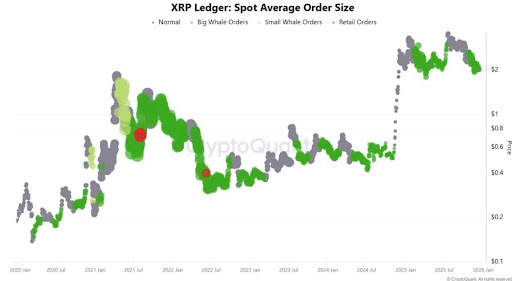
A recent analysis report by market expert Xaif Crypto suggests that whales remain the dominant demographic influencing price action. He shared a chart on X highlighting Spot Average Order Size on the XRP Ledger, showing normal, retail, and big and small whale orders.

The analyst noted that the recent spike in XRP trading has been driven primarily by whales. According to his report, this trend has persisted despite the altcoin entering a period of short-term price weakness. The cryptocurrency has recently declined toward its lowest price levels this year, raising concerns among smaller investors.
Source: CryptoQuant

Xaif Crypto explained that this type of behavior from whales is often seen during market bottoming phases. He emphasized that large holders typically increase accumulation when prices are depressed and avoid aggressive buying once a strong uptrend is already underway. The analyst also noted that this strategy suggests whales may be positioning themselves ahead of a potential recovery in XRP’s price.

The continued presence of whales has also helped stabilize liquidity to some degree during the ongoing decline. While retail traders may hesitate amid falling prices, whale activity tends to prevent sharp breakdowns by absorbing significant selling pressure.

Buying Sentiment Surges Amid Price Weakness

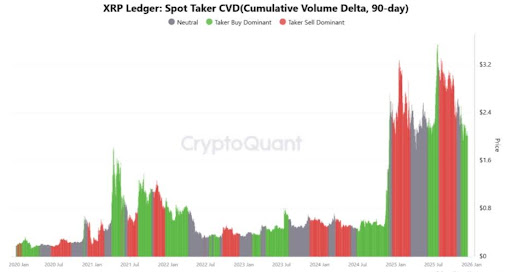
A CryptoQuant analyst who also highlighted that XRP’s trading activity continues to be dominated by whales has observed a notable change in the cryptocurrency’s Spot Taker CVD. According to the analyst’s report, XRP’s Spot Taker CVD has entered a taker-buy dominant trend. This shift suggests that aggressive buyers are now outweighing sellers, often interpreted as a sign of strengthening market sentiment and potential upside for price action.
Source: CryptoQuant

These market changes follow XRP’s sharp drop, which has pushed its price below $2 for the first time in months. The cryptocurrency has struggled to break through resistance zones needed to establish new highs, keeping overall sentiment cautious among traders.

At present, XRP is trading around $1.82, down more than 6% over the past 24 hours, according to CoinMarketCap. Over the past week, the cryptocurrency’s price has fallen by nearly 9%, adding to the broader bearish outlook. XRP’s year-to-date performance is also negative, with the cryptocurrency losing about 22% of its value so far.

Despite these severe declines, buying activity has increased significantly. Additionally, daily trading volume has surged by more than 97%, suggesting renewed interest as whales continue to shape the market’s direction.


Bears continue to dominate price | Source: XRPUSDT on Tradingview.com

Related Reads

147 Trillion vs 70 Billion: The Rise of On-Chain 'Risk Managers' and the Potential Dawn of a New Era in DeFi Asset Management

"147 Trillion vs 70 Billion: The Rise of On-Chain 'Risk Managers' and the Potential Dawn of a New Era in DeFi Asset Management" Key Points: The role of professional asset managers is emerging in DeFi, ending the era where protocols and governance dictated everything. While early DeFi protocols like Aave and Compound bundled risk management within their code, innovations like Morpho have separated infrastructure from risk judgment. This allows specialized "Risk Managers" to operate independent lending vaults, acting as on-chain asset managers. The market, though early with ~$7B in assets under management (AUM), is rapidly consolidating around top performers like SteakhouseFi (RWA focus), SentoraHQ (AI-driven models), and Gauntlet (crisis management). This modular structure mirrors TradFi's division of labor: distributors (e.g., exchanges) source capital, Risk Managers design strategies and set standards, and underlying protocols handle custody and execution. For traditional asset managers, this familiar structure presents clear entry paths: 1) **Distribution**: Partnering with Risk Managers as a backend service. 2) **Supply**: Bringing real-world assets (RWA) on-chain as collateral. 3) **Operation**: Becoming a Risk Manager themselves (e.g., Bitwise). The core competency required is shifting from coding to traditional risk underwriting and financial expertise—areas where established institutions hold a natural advantage. While the current DeFi market (~$80B) is minuscule compared to global asset management (~$147T), it represents a significant growth runway. The teams that build the trusted standards and rails for risk-managed capital now are poised to define the market's future as institutional capital seeks secure on-ramps.

marsbit6m ago

147 Trillion vs 70 Billion: The Rise of On-Chain 'Risk Managers' and the Potential Dawn of a New Era in DeFi Asset Management

marsbit6m ago

Sui Launches Gasless Stablecoin Transfers, Supported by Fireblocks

Sui has officially launched "Gasless Stablecoin Transfers," a new protocol-level feature enabling users and enterprises to send supported stablecoins on Sui without paying gas fees or needing a separate SUI token balance. As the feature rolls out, stablecoin transfer fees on Sui are now effectively $0. Major stablecoins like USDsui, suiUSDe, AUSD, FDUSD, USDB, USDC, and USDY are already supported. This aims to simplify payments and remove a key barrier to mass adoption: requiring users to hold another token for gas. The enterprise platform Fireblocks, securing over $14 trillion in digital asset transactions, has integrated the feature in advance, enhancing institutional accessibility. Other wallets and custodians are also set to support zero-gas transactions. Sui co-founder Adeniyi Abiodun stated this brings Sui closer to being a global payment rail. Fireblocks' Ran Goldi noted it removes a major friction point for businesses building on-chain payments. This is a permanent structural change to Sui's mainnet, not a subsidy. It positions Sui as low-cost infrastructure for enterprises, traders, and AI agents. Sui's stablecoin transfer volume has surpassed $1 trillion since August 2025, with its architecture supporting high-frequency payments. Recent growth includes three SUI Exchange-Traded Products (ETPs) launching in 2026 and the expansion of major stablecoin projects like USDsui and SuiUSDe on the network. Zero-gas stablecoin transfers are now being gradually deployed on the Sui mainnet.

marsbit7m ago

Sui Launches Gasless Stablecoin Transfers, Supported by Fireblocks

marsbit7m ago

Major AI Collaboration Breakthrough! Stanford and NVIDIA Jointly Eliminate AI Communication Overhead, Boosting Reasoning Speed by 2.4x

Title: AI Collaboration Breakthrough: Stanford & NVIDIA Eliminate Communication Overhead, Boost Reasoning Speed by 2.4x A new approach called RecursiveMAS, developed by UIUC, Stanford, NVIDIA, and MIT, tackles the major bottleneck in multi-agent AI systems: the "language tax." Currently, AI agents collaborate by generating and reading natural language text, a slow, costly, and information-lossy process akin to inefficient radio communication. RecursiveMAS bypasses this by enabling agents to communicate directly through their "thoughts"—latent space vector representations—instead of text. Inspired by recursive language models, it treats each agent like a reusable layer in a recursive loop. A special lightweight module called RecursiveLink passes these high-dimensional, semantic-rich internal states between agents. Only the final agent decodes the last latent representation into human-readable text. This process, described as "telepathic" communication, dramatically cuts the overhead of encoding and decoding text at each step. The system is highly efficient; the core AI model weights remain frozen, and only the small RecursiveLink modules are trained, requiring updates to just 0.31% of total parameters. This reduces training costs by over 50% compared to full fine-tuning. Comprehensive evaluations across math, science, coding, and QA benchmarks show significant improvements: - **Accuracy:** Average increase of 8.3%, with gains up to 18.1% on complex math problems (AIME2025). - **Speed:** End-to-end reasoning is 1.2x to 2.4x faster, with greater speedups as recursive depth increases. - **Cost:** Token usage is reduced by 34.6% to 75.6%. The research suggests a new scaling paradigm for multi-agent systems: deepening recursive collaboration depth rather than merely adding more agents. This could address key production barriers like compute cost, latency, and memory limits. However, challenges remain, including the need for independent verification, compatibility between different AI models (heterogeneous agents), reduced interpretability of the "black-box" latent communication, and adaptation to complex real-world workflows involving tools and human interaction. If validated, RecursiveMAS could fundamentally change how AI agents work together, moving beyond inefficient "textual handoffs" to more seamless and powerful collaborative reasoning.

marsbit1h ago

Major AI Collaboration Breakthrough! Stanford and NVIDIA Jointly Eliminate AI Communication Overhead, Boosting Reasoning Speed by 2.4x

marsbit1h ago

Trading

Spot
Futures

Hot Articles

Discussions

Welcome to the HTX Community. Here, you can stay informed about the latest platform developments and gain access to professional market insights. Users' opinions on the price of S (S) are presented below.

活动图片