Bitcoin Trades in Tight Range as Analysts Debate Whether the Four-Year Cycle Is Officially Over

bitcoinistPublished on 2025-12-12Last updated on 2025-12-12

Abstract

Bitcoin (BTC) is trading in a narrow range around $90,000–$93,000 amid mixed market signals and ongoing debate among analysts about the validity of its traditional four-year cycle. Some major firms, including Bernstein and ARK Invest, suggest the cycle may be elongating due to institutional adoption, reducing extreme volatility. Bernstein raised its 2026 price target to $150,000. However, a cautious Federal Reserve and bearish derivatives and on-chain data—such as increased put/call ratios and declining bullish momentum—signal rising uncertainty. Traders are watching key levels: holding above $90,000 is critical to avoid further downside, while a break above $94,500 could open a path toward $100,000.

Bitcoin (BTC) is once again moving within a narrow band, with price swings contained despite shifting macro signals and fresh debate over whether the cryptocurrency’s long-observed four-year cycle still applies.

Related Reading: Upcoming Crypto Market Structure Bill Markup Likely Pushed To Post-Holiday

As traders react to mixed Federal Reserve messaging, institutional flows, and rising caution across risk markets, analysts remain split on whether Bitcoin’s latest consolidation represents stability, or a deeper shift in how the asset behaves.
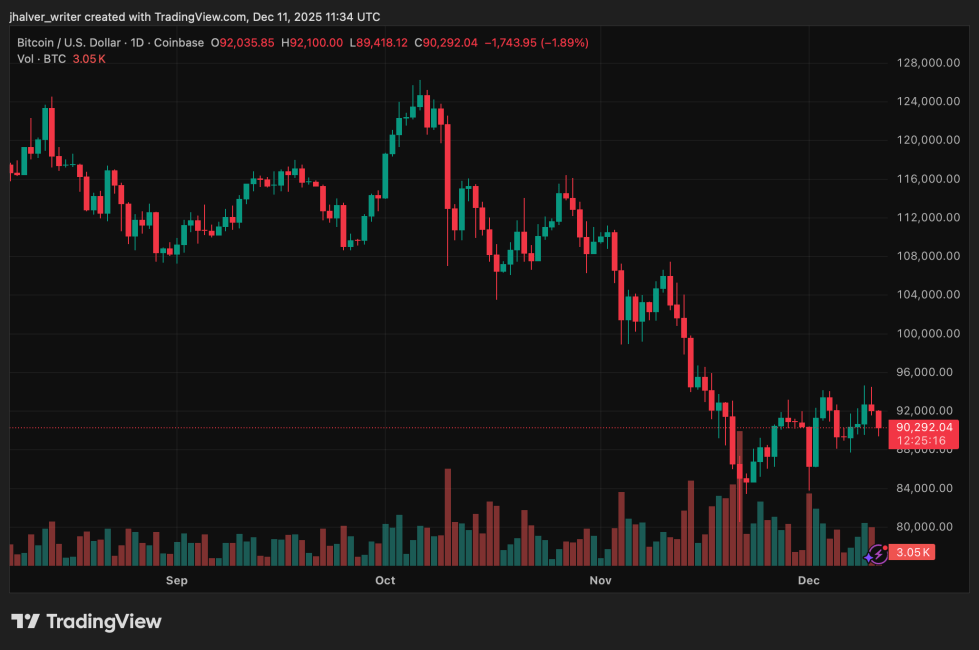
BTC's price trends downwards on the daily chart. Source: BTCUSD on Tradingview

Analysts Question Whether the Cycle Has Ended

A growing number of major firms now argue that Bitcoin may be moving beyond its historic halving-driven rhythm. Investment firm Bernstein said in a recent note that the asset is in an “elongated bull cycle,” pointing to minimal ETF outflows despite a nearly 30% correction.

The firm has raised its 2026 price target to $150,000, projecting a potential cycle peak of $200,000 in 2027 and maintaining a $1 million long-term estimate for 2033.

ARK Invest CEO Cathie Wood echoed this view, saying that institutional adoption is reducing the likelihood of the steep 75–90% drawdowns seen in previous cycles. Grayscale has also suggested Bitcoin could break the four-year pattern, forecasting renewed strength in 2026.

Bitcoin is currently trading near $90,000–$93,000 depending on the venue, with recent intraday swings highlighting a lack of strong directional conviction.

Fed Signals Keep Markets Cautious

The Federal Reserve’s 25 bps rate cut initially lifted risk sentiment, but a shift toward cautious, data-dependent language quickly reversed momentum.

Bitcoin and Ethereum slipped after the announcement, with BTC falling below $90,000 at one point as traders reassessed the macro backdrop. Liquidity remains thin, contributing to choppy movements across major crypto assets.

Analysts note that Bitcoin’s inability to sustain gains, despite the weaker dollar and softer Fed stance, reflects persistent uncertainty. Several commentators say BTC must hold above $90,000 to avoid strengthening bearish pressure, while a break above $94,500 could reopen a path toward $100,000 if inflows improve.

Derivatives and On-Chain Data Flag Rising Bearish Sentiment

Options and on-chain indicators are also signaling caution. Traders have increased bearish option positions, with the put/call ratio turning positive ahead of a significant expiry window. More than $500 million in crypto liquidations occurred within 24 hours, reflecting heightened volatility.

On-chain data shows declining bullish momentum. The Bitcoin Bull Score Index has fallen back to zero, and realized losses suggest further downside could be possible. Analysts warn that despite past buy-the-dip patterns, current readings do not yet reflect the levels typically associated with market bottoms.

Related Reading: Cardano Founder Reacts As NIGHT Token Crashes From $150 To $0.02

As Bitcoin continues to trade in a tight range, the broader debate remains unresolved. Whether the four-year cycle is fading, or simply paused, may depend on how markets digest macro uncertainty, institutional flows, and the next wave of economic data.

Cover image from ChatGPT, BTUSD chart from Tradingview

Related Reads

How Does x402 V2 Enable Autonomous Payments for AI Agents?

The x402 protocol, initially developed by Coinbase, leverages the HTTP 402 status code to embed payment logic directly into web requests. The newly released V2 upgrade introduces significant improvements to address limitations in cross-chain support, scalability, identity authentication, and repeated payments experienced in V1. Key enhancements include: - **Wallet Identity and Reusable Sessions**: Supports wallet-based authentication (e.g., Sign-In-With-X via CAIP-122), allowing reusable sessions after initial payment. This reduces latency and costs for high-frequency use cases like AI agent tasks and LLM inference. - **Unified Payment Interface**: Enables multi-chain payments (e.g., Base, Solana) and compatibility with traditional systems (ACH, SEPA, credit cards) via Facilitators. Dynamic payTo routing allows context-aware pricing and complex market structures. - **Modular Architecture**: A plugin-driven SDK simplifies integration, supporting easy expansion to new chains and payment methods without core changes. Multi-Facilitator support automates optimal payment path selection based on preferences. - **Automatic Discovery**: Services can expose metadata for automatic synchronization, ensuring real-time pricing and availability updates without manual intervention. For end-users, V2 enables seamless, subscription-like access with reduced friction. Developers benefit from flexible, low-maintenance payment integration and dynamic pricing models. AI agents gain autonomy to make economic decisions, such as purchasing API calls or compute resources independently using allocated budgets. x402 V2 evolves from a pay-per-use tool into a versatile economic layer, though challenges like ecosystem adoption, modular risks, and regulatory uncertainty remain.

比推13m ago

How Does x402 V2 Enable Autonomous Payments for AI Agents?

比推13m ago

Bitcoin (BTC) Price Trend and Investor Sentiment Suggest a Bullish December

Bitcoin (BTC) is showing signs of a potential bullish December, challenging a decade-old bearish seasonal pattern where November losses typically extend into year-end declines. Key factors supporting this shift include reduced leverage, with open interest dropping from $94 billion to $60 billion, and Bitcoin’s price reclaiming its monthly volume-weighted average price (rVWAP), indicating controlled distribution. Liquidity dynamics have also shifted, with deep liquidity clusters moving upward, and around $3 billion in short positions set to liquidate near $96,000. Market structure diverges from historical cycles due to spot ETF inflows, introducing constant structural demand and accelerating price discovery. Analysts note that Bitcoin’s four-year cycle, while not obsolete, is no longer time-aligned, resembling extended accumulation phases like mid-2016 or late-2019. Macro liquidity (M2) growth has plateaued, creating a late-cycle environment where risk assets rally despite underlying economic softening. Supporting indicators, such as CNY/USD and ETH/BTC correlations, along with improving PMI data and gold’s relative strength, suggest continued risk-on momentum rather than cycle fatigue. While buy-sell ratios show urgency, analysts caution this may reflect positioning squeeze rather than sustainable accumulation. Overall, December’s performance may depend more on structural forces—ETF flows, liquidity rotation, and shifting macro correlations—than traditional halving-driven周期 patterns.

cointelegraph_中文29m ago

Bitcoin (BTC) Price Trend and Investor Sentiment Suggest a Bullish December

cointelegraph_中文29m ago

Trading

Spot
Futures
活动图片