Earnings Beat Expectations and Cloud Business Soars, So Why Is Google Still Falling?

链捕手Publicado a 2026-07-24Actualizado a 2026-07-24

Resumen

Despite reporting better-than-expected Q2 earnings and explosive growth in its cloud business, Alphabet's stock price fell. Key results included total net revenue of $103.6B, beating estimates, and Google Cloud revenue surging 82% year-over-year to $24.8B. However, the market reacted negatively to a significant increase in the company's 2026 capital expenditure guidance, now projected between $195B and $205B, up approximately $15B. This elevated spending is expected to result in negative free cash flow for 2026 and 2027. Other concerns include the lack of share buybacks in Q2 and a planned $40B at-the-market equity offering, which could dilute shares. While search and YouTube revenues met or slightly exceeded expectations, they showed some moderation compared to prior quarters. Bank of America maintains a "Buy" rating with a $430 price target, arguing that the increased capital investment is directly linked to strong cloud demand, as evidenced by a massive $514B backlog. At current levels, the stock's valuation is seen as attractive relative to its growth prospects.

Author: Zhui Feng Trading Desk

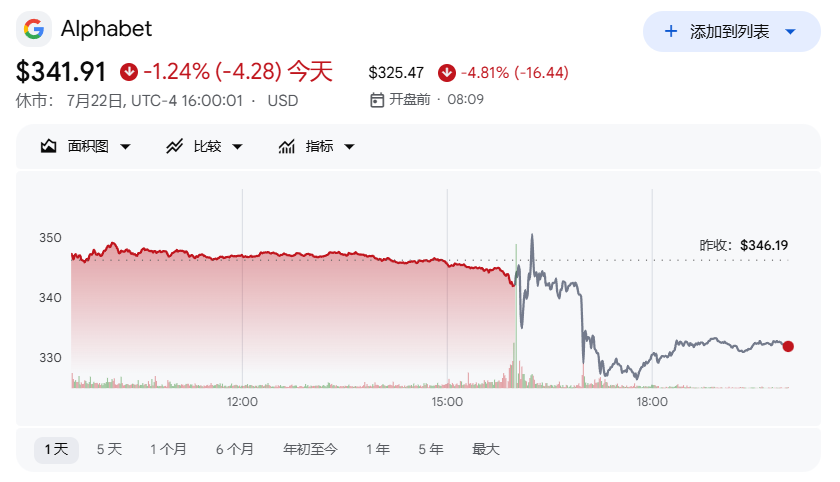
Alphabet, Google's parent company, delivered a stellar second-quarter report card, with cloud business growth far exceeding expectations, and overall revenue and earnings per share significantly beating Wall Street estimates. However, the stock still plunged, reflecting market concerns over deeper underlying issues such as a sharp spike in capital expenditures, negative free cash flow, and equity dilution.

According to a Bank of America Securities research report, Alphabet's Q2 net revenue reached $103.6 billion, higher than the market expectation of $101.1 billion. Google Cloud revenue grew 82% year-over-year, far surpassing the market expectation of 65%, with the acceleration being particularly notable.

Simultaneously, the company raised its fiscal year 2026 capital expenditure guidance by $15 billion to a range of $195 billion to $205 billion, a significant increase from the previous guidance of $180 billion to $190 billion. This news became the core variable suppressing the stock price.

Bank of America Securities analyst Justin Post maintained a "Buy" rating on Alphabet with a price target of $430 in the report. He pointed out that despite the negative market reaction to the raised capex guidance, the backlog of cloud business, customer overconsumption, and the continued expansion of cloud profit margins all indicate that incremental investments are directly translating into revenue growth.

In pre-market trading, Google's decline widened to nearly 5%.
Explosive Growth in Cloud Business, the Biggest Highlight of the Quarter

Google's cloud business achieved impressive accelerated growth this quarter.

Second-quarter cloud revenue reached $24.8 billion, an 82% year-over-year increase, not only significantly exceeding the market expectation of 65% but also accelerating by 19 percentage points compared to Q1's 63% growth. The cloud business operating margin rose to 35.6%, also higher than the market expectation of 31.3%, up 270 basis points from the previous quarter and nearly 15 percentage points from a year ago.

The Bank of America Securities report points out that behind the cloud business's strong performance, multiple data points support its sustainability: Cloud business backlog grew 11% sequentially and approximately 375% year-over-year in Q2, reaching $514 billion; actual customer spending exceeded contractual commitments by over 50%, higher than Q1's 45%; the rate of new customer acquisition is more than double that of the same period last year.

Furthermore, this quarter included new revenue from selling TPU chips to external customers. Management stated that even excluding TPU sales, cloud business growth would still be "significantly accelerating."

Google's model APIs currently process about 22 billion tokens per minute, a significant increase from last quarter's 16 billion; the weekly active users of the AI agent development platform AntiGravity have exceeded 2.4 million. Bank of America Securities expects Google Cloud revenue growth to further accelerate to 93% in Q3.

Search and Overall Performance: Exceeding Expectations but Highlights Uneven

Overall, Alphabet's Q2 GAAP earnings per share were $9.11, significantly beating the market expectation of $2.90. However, note that this included about $98 billion in other income, primarily from revaluation gains on Anthropic, whereas the market had previously expected this item to be only $0.8 billion. Excluding this one-time factor, the core business performance is more genuine.

Search revenue was $63.3 billion, a 17% year-over-year increase, roughly in line with market expectations but slightly weaker than the previous quarter's strong beat, seen by the market as a temporary "cooling" signal for the recent AI uptrend narrative.

Management also indicated that search business will face higher year-over-year comparables in Q3.

YouTube ad revenue was $11.1 billion, up 13% year-over-year, exceeding the market expectation of $10.8 billion, partially benefiting from brand advertising demand driven by the FIFA World Cup. Regarding operating margin, the Q2 GAAP operating margin was 39.3%, below the market expectation of 40.3%, mainly dragged down by G&A expense overruns—actual G&A spending was $6.46 billion, far above the market expectation of $5.1 billion. Management attributed this to several legal and other matters but did not provide detailed disclosure.

Soaring Capital Expenditures and Negative Free Cash Flow, the Market's Biggest Worry

The negative market reaction to this quarter's earnings stems from the core conflict surrounding the significant increase in capital expenditures and its impact on cash flow.

Alphabet raised its fiscal year 2026 capital expenditure guidance to $195 billion to $205 billion, an increase of about 8% from previous guidance and significantly higher than the market expectation of $187 billion. Bank of America Securities expects full-year 2026 free cash flow to be negative $16 billion, also negative in 2027.

Meanwhile, Alphabet did not conduct any share repurchases in Q2, and free cash flow was negative $5.9 billion. After completing a $45 billion hybrid capital financing in June this year, the company plans to launch a $40 billion at-the-market (ATM) equity offering in Q3. Bank of America Securities expects this will lead to an approximate 1% sequential increase in diluted shares outstanding in the second half of the year.

Bank of America Securities analyst Justin Post noted that while the above factors create short-term pressure, the increase in capital expenditures is directly linked to the rapid growth of the cloud business backlog—the $514 billion backlog size far exceeds the $15 billion incremental capital expenditure, meaning the logic of "more capacity equals more sales" still holds. He maintains his forecast for ~$200 billion in 2026 capital expenditures and raises his 2027 capital expenditure forecast to ~$300 billion, a ~51% year-over-year increase.

Valuation and Rating: Current Price Still Attractive

Bank of America Securities maintains its "Buy" rating on Alphabet and its $430 price target, based on a 27x P/E multiple applied to its 2027 adjusted GAAP EPS of $15.55, plus $11 per share in cash.

The report raises its 2026 net revenue forecast by 2% to $433.6 billion and EPS by 4% to $20.58; raises its 2027 net revenue forecast by 3% to $552.8 billion and EPS by 2% to $15.01.

At the after-hours price level of around $332, Alphabet trades at about 22x its 2027 GAAP EPS, in line with the company's 10-year historical average. However, Bank of America Securities expects 2027 revenue growth to be 27%, far above the average of 14% from 2023-2025.

From a sum-of-the-parts valuation perspective, after excluding assets like YouTube, the cloud business, Waymo, and cash, the implied valuation for Google's core ads and Play business is only 13x expected 2026 earnings, below the S&P 500's 20x.


Criptos en tendencia

Preguntas relacionadas

QWhy did Alphabet's stock fall despite exceeding earnings expectations and strong cloud growth?

AThe stock fell primarily due to concerns over significantly increased capital expenditure guidance, negative free cash flow, and upcoming equity dilution. The company raised its FY2026 capex guidance by $150 billion to $195-205 billion, leading to expected negative free cash flow for both 2026 and 2027. Additionally, no share buybacks were executed in Q2, and a $40 billion at-the-market (ATM) equity offering is planned for Q3, which will dilute existing shareholders.

QWhat were the key highlights of Alphabet's cloud business performance in Q2?

AGoogle Cloud revenue was $24.8 billion, up 82% year-over-year, significantly beating expectations of 65% growth. Cloud operating margins improved to 35.6%. Key supporting metrics include a 11% sequential increase in cloud backlog to $514 billion, customer consumption exceeding commitments by over 50%, and new customer acquisition being double the rate of a year ago. Revenue also included initial sales of TPU chips to external customers.

QWhat are the main concerns for investors regarding Alphabet's future financials?

AThe main concerns are the surge in capital expenditures, leading to projected negative free cash flow (-$16 billion for 2026, also negative for 2027), and expected shareholder dilution. The company plans a $40 billion ATM equity offering in Q3, which analysts estimate will increase diluted shares outstanding by approximately 1% in the second half of the year.

QHow did Alphabet's core advertising businesses perform in Q2?

ASearch revenue was $63.3 billion, up 17% year-over-year, essentially in line with market expectations but seen as a slight disappointment compared to prior outperformance. YouTube advertising revenue was $11.1 billion, up 13%, slightly beating expectations of $10.8 billion, partly benefiting from FIFA World Cup-related brand advertising. Overall GAAP operating margin was 39.3%, missing expectations due to higher-than-expected General & Administrative (G&A) expenses.

QWhat is Bank of America's investment rating and price target for Alphabet, and what is the valuation rationale?

ABank of America maintains a 'Buy' rating on Alphabet with a $430 price target. The target is based on a 27x P/E multiple applied to their 2027 adjusted GAAP EPS estimate of $15.55, plus $11 per share in cash. They view the current stock price (around $332) as attractive, trading at about 22x their 2027 GAAP EPS estimate, which is in line with its 10-year historical average, despite forecasted revenue growth of 27% in 2027, significantly higher than the 14% average from 2023-2025.

Lecturas Relacionadas

Hackers piratean una popular biblioteca para desarrolladores de JS: por qué la vulnerabilidad de npm es peligrosa para la cripto

Los hackers obtuvieron acceso a la cuenta de un desarrollador que mantiene keyv, un popular conjunto de herramientas de software utilizado por millones de programadores en todo el mundo. A través de este acceso, los atacantes insertaron código malicioso en nuevas versiones, en un incidente detectado por Aikido Security a partir del 4 de agosto de 2026. Este ataque comprometió cientos de paquetes de software descargados más de 2 mil millones de veces al mes. La infección ocurría automáticamente al ejecutar el comando `npm install`. Una vez en el sistema, el virus buscaba datos sensibles como contraseñas de npm, claves de acceso de GitHub, credenciales de AWS (Amazon), claves SSH, archivos de contraseñas de KeePass, configuraciones de editores de código (como VS Code y Claude) y, de forma crítica, archivos de carteras de criptomonedas (incluyendo Solana y Monero), frases semilla y claves privadas. Estos datos se enviaban a servidores controlados por los hackers. El virus se autorreplicaba utilizando las credenciales robadas para infectar más paquetes populares con la misma línea de código maliciosa, publicando actualizaciones falsas. Según informes, entre 444 y 868 paquetes, en miles de versiones, ya estaban comprometidos. Este caso es particularmente peligroso para la industria de las criptomonedas. Si el virus infecta a un desarrollador de un proyecto cripto, los atacantes pueden obtener acceso a claves de carteras, servidores y repositorios de código, facilitando grandes robos. Este incidente representa la tercera ola de la campaña "Shai-Hulud", iniciada en septiembre de 2025, lo que indica un problema sistémico de confianza en el ecosistema npm. Subraya la necesidad de una verificación extrema de las herramientas de software utilizadas en este sector.

cryptonews.ruHace 7 min(s)

Hackers piratean una popular biblioteca para desarrolladores de JS: por qué la vulnerabilidad de npm es peligrosa para la cripto

cryptonews.ruHace 7 min(s)

¡JP Morgan advierte sobre el peligro de este altcoin! ¿Por qué los inversores están retirando fondos? Aquí están los detalles

Aunque en el segmento de ETF de bitcoin y altcoins se observan diversas tendencias, un ETF en particular está siendo vigilado de cerca por los inversores. A pesar de que el ETF $HYPE logró un gran éxito en muy poco tiempo, su ritmo de crecimiento se ha ralentizado recientemente. JPMorgan señaló que el flujo de entrada de fondos hacia los ETF que ofrecen oportunidades de inversión en el token nativo de Hyperliquid, $HYPE, se desaceleró en julio y principios de agosto. Según el banco, esto sugiere que los inversores tienen cada vez más dudas sobre la competitividad futura de $HYPE. Los analistas de JPMorgan destacaron que, aunque los ETF $HYPE mostraron uno de los mayores flujos de entrada en mayo y junio (excluyendo los de bitcoin), esta situación favorable comenzó a cambiar en julio. El informe subraya no solo la desaceleración, sino también preocupaciones sobre la competitividad a largo plazo de Hyperliquid, pronosticando posibles dificultades para que plataformas descentralizadas como esta ganen cuota de mercado. Para los inversores, esta ralentización no significa que la demanda institucional haya desaparecido, pero la incapacidad de mantener el fuerte impulso previo puede indicar una mayor cautela. Según JPMorgan, una nueva aceleración en los flujos hacia el ETF $HYPE podría ser un indicador clave de que disminuyen las preocupaciones sobre su competitividad.

cryptonews.ruHace 1 hora(s)

¡JP Morgan advierte sobre el peligro de este altcoin! ¿Por qué los inversores están retirando fondos? Aquí están los detalles

cryptonews.ruHace 1 hora(s)

Trading

Spot

Artículos destacados

Cómo comprar BEAT

¡Bienvenido a HTX.com! Hemos hecho que comprar Audiera (BEAT) sea simple y conveniente. Sigue nuestra guía paso a paso para iniciar tu viaje de criptos.Paso 1: crea tu cuenta HTXUtiliza tu correo electrónico o número de teléfono para registrarte y obtener una cuenta gratuita en HTX. Experimenta un proceso de registro sin complicaciones y desbloquea todas las funciones.Obtener mi cuentaPaso 2: ve a Comprar cripto y elige tu método de pagoTarjeta de crédito/débito: usa tu Visa o Mastercard para comprar Audiera (BEAT) al instante.Saldo: utiliza fondos del saldo de tu cuenta HTX para tradear sin problemas.Terceros: hemos agregado métodos de pago populares como Google Pay y Apple Pay para mejorar la comodidad.P2P: tradear directamente con otros usuarios en HTX.Over-the-Counter (OTC): ofrecemos servicios personalizados y tipos de cambio competitivos para los traders.Paso 3: guarda tu Audiera (BEAT)Después de comprar tu Audiera (BEAT), guárdalo en tu cuenta HTX. Alternativamente, puedes enviarlo a otro lugar mediante transferencia blockchain o utilizarlo para tradear otras criptomonedas.Paso 4: tradear Audiera (BEAT)Tradear fácilmente con Audiera (BEAT) en HTX's mercado spot. Simplemente accede a tu cuenta, selecciona tu par de trading, ejecuta tus trades y monitorea en tiempo real. Ofrecemos una experiencia fácil de usar tanto para principiantes como para traders experimentados.

607 Vistas totalesPublicado en 2026.01.22Actualizado en 2026.06.02

Cómo comprar BEAT

Discusiones

Bienvenido a la comunidad de HTX. Aquí puedes mantenerte informado sobre los últimos desarrollos de la plataforma y acceder a análisis profesionales del mercado. A continuación se presentan las opiniones de los usuarios sobre el precio de BEAT (BEAT).

活动图片