Trump Backs Down on Ethics Provision, as 'CLARITY Act' Enters Senate's Critical Window

marsbitXuất bản vào 2026-07-21Cập nhật gần nhất vào 2026-07-21

Tóm tắt

On July 21st, sources report President Trump has agreed to include ethics provisions in the *CLARITY Act*, a major digital asset market structure bill, clearing a key obstacle after months of negotiation. The bill, which has already passed the House, aims to establish federal regulatory clarity for crypto by defining SEC and CFTC roles. The text is expected imminently, with a narrow window for Senate passage before the August recess. However, passage remains uncertain due to potential Democratic opposition over the ethics rules and the absence of key Republican senators. The ethics clause, a major sticking point, seeks to restrict federal officials, including the president, from profiting from digital assets while in office. This directly addresses controversies around Trump's own crypto holdings. While industry lobbyists urge Congress not to let ethics derail the broader bill, several Democratic senators have demanded stricter provisions covering family members and stronger consumer protections. Amid this legislative push, on-chain data shows significant Bitcoin accumulation by large holders ("whales") in recent weeks. After extended outflows, U.S. Bitcoin and Ethereum spot ETFs have seen two consecutive weeks of net inflows. Major corporate holders like Strategy and Metaplanet continue to accumulate or hold significant Bitcoin reserves. Notably, BitMEX co-founder Arthur Hayes recently made substantial Ethereum purchases, expressing a view that while AI is absorbing market...

July 21, according to reporting by crypto journalist Eleanor Terrett citing sources, U.S. President Donald Trump agreed to include ethics provisions in the 'CLARITY Act' (Digital Asset Market Structure Bill). The White House has reached a consensus on the ethics plan for the 'CLARITY Act', clearing the final major obstacle for this crypto regulatory legislation that has been contested for months. The bill text could be released as early as the same day, but may be slightly delayed; as of the report, the Democratic side had not yet seen the specific text.

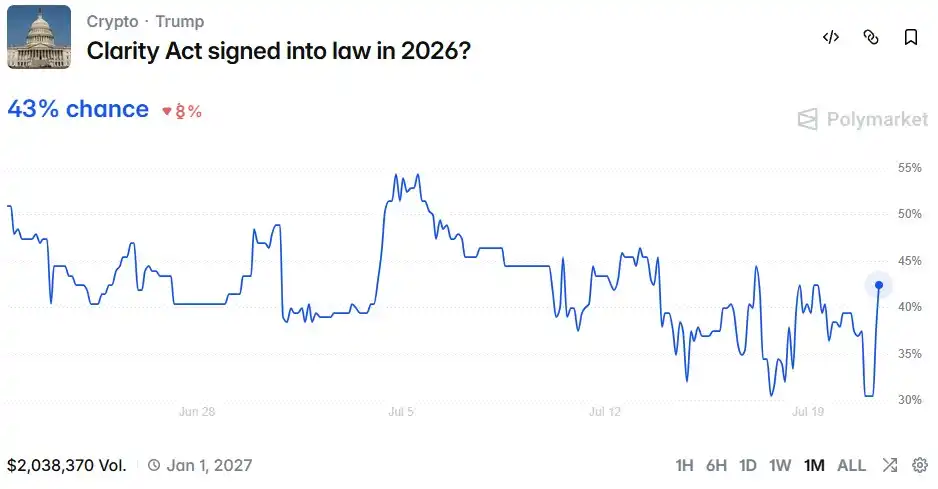
Following the news, the probability on Polymarket for "Will the 'CLARITY Act' be signed into law in 2026" rebounded to 43%. Research firm Galaxy Research had previously assessed its probability of passage in 2026 as roughly 50/50.
Previously, on July 16, a meeting between Trump, Republican Senators Bernie Moreno and Cynthia Lummis, and White House Crypto Advisor Patrick Witt did not result in an immediate agreement, but a deal was finalized by the President himself on the subsequent Monday evening. The provision aims to restrict the President, Vice President, members of Congress, and other federal officials from profiting from digital assets during their terms. The core controversy has centered around the Trump family's meme tokens and World Liberty Financial. Financial documents disclosed last month showed Trump's crypto income reached approximately $1.4 billion, which had once brought negotiations to a standstill.

The Final Stretch Before the August Recess

If ultimately enacted, the 'CLARITY Act' would, for the first time, provide comprehensive regulation for the digital asset industry at the federal level, clarifying the jurisdictional division between the SEC and the CFTC.

The U.S. House of Representatives previously passed the bill with a bipartisan majority of 294 to 134 votes in 2025. The Senate Banking Committee cleared it on May 14 this year with a 15 to 9 vote. It is currently stalled in final negotiations before a full floor vote.

The bill text is expected to be released in the coming days, then submitted for a full Senate vote; the window lasts only until the recess in the first week of August (the Senate will enter recess on August 7, returning on September 14). If passed, it would still need to go back to the House for reconsideration and text reconciliation, before finally reaching the President's desk for signature.

The vote count in the Senate tightened in mid-July. Following a visit to Ukraine, Republican Senator Lindsey Graham from South Carolina passed away suddenly from an aortic dissection on the night of July 11, at the age of 71, reducing the Republican seats in the Senate from 53 to 52 temporarily.

According to AP, the state's Governor Henry McMaster appointed Graham's sister, Darline Graham Nordone, to the seat two days later. She was sworn in on July 14, immediately restoring the seat.

However, Republican Senator Mitch McConnell has been absent from votes since being hospitalized on June 14. As of July 12, he himself stated he was not yet ready to return to the Senate, and there has been no further news about his potential return since.

Under the cloture procedure of Senate Rule XXII, if Mitch McConnell remains absent, the bill would need to secure at least 8 additional Democratic votes beyond the actual number of Republican votes present to pass.

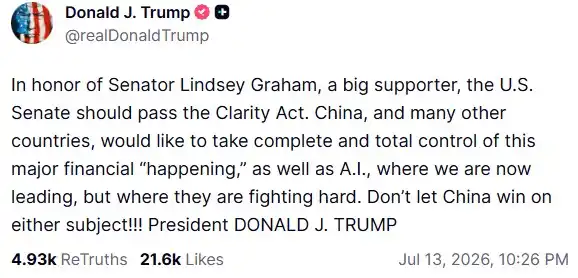
Trump previously posted on Truth Social, urging the Senate to quickly pass the 'CLARITY Act', stating it was in memory of the late Senator Lindsey Graham, and emphasizing it was also about preventing China from gaining dominance in digital finance and artificial intelligence.
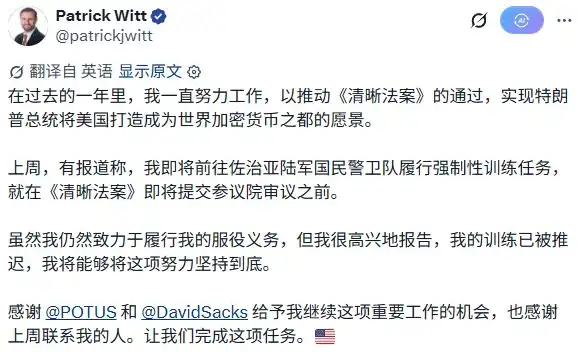
Personnel changes at the White House level also indicate the urgency of the push. Crypto Advisor Patrick Witt was originally scheduled to be away this week due to mandatory training with the Georgia Army National Guard; the training has been postponed, and he will remain in place to advance the legislation. His deputy, Harry Jung, announced he would leave in two weeks.
"One-Yard Line" or "Elephant in the Room"?

The industry lobbying side's stance is direct. Blockchain Association CEO and former CFTC Commissioner Summer Mersinger stated at the Injective Summit in Washington D.C. on July 16 that the core provisions of the bill were "very close to agreement, with only a few details left to iron out," and called the ethics issue the "elephant in the room," the biggest current obstacle.
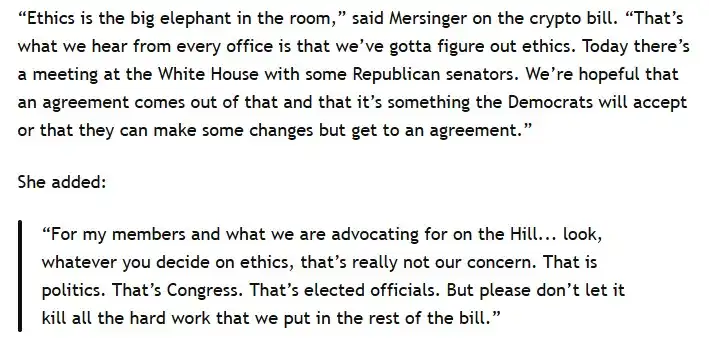
She called out to Congress: "Whatever decision you make on the ethics provision, that's really not what we care about, that's politics, that's Congress, that's elected officials. But please don't let it kill all the work we've done on the rest of the bill."

Coinbase Vice Chairman and former SEC official Ryan VanGrack's statement on CNBC in mid-July was more blunt: "The 'CLARITY Act' is at the one-yard line, the momentum to pass is obvious." Senate Majority Leader John Thune offered a more cautious judgment: "There is a path to a deal, but time is running out."

These statements essentially say the same thing: we don't care how the ethics clause is written, just don't let it derail the rest of the bill.

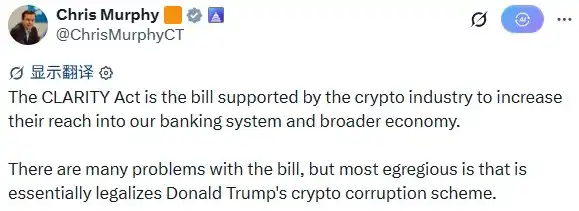
Skepticism comes mainly from the Democratic side, directly targeting the inadequacy of the ethics provision itself. Senator Chris Murphy criticized in a Facebook post on July 14, calling the 'CLARITY Act' "a bill supported by the crypto industry, aiming to expand its influence on the banking system and the broader economy," and explicitly demanded that "the bill must have provisions stating that the President and his family members cannot issue cryptocurrencies during their term, whether meme tokens or stablecoins... The ethics provision must cover the President and his immediate family members."

Senators Warren, Jack Reed, Chris Van Hollen, and others also jointly stated in mid-July that they "cannot support the current version of the 'CLARITY Act'," citing reasons including the need for stronger consumer protection, stricter conflict-of-interest and ethics rules, and more safeguards against crypto fraud and market manipulation. Senator Mark Warner said bluntly: "I am very pessimistic about the progress."
Whales, ETFs & Crypto Treasury Moves

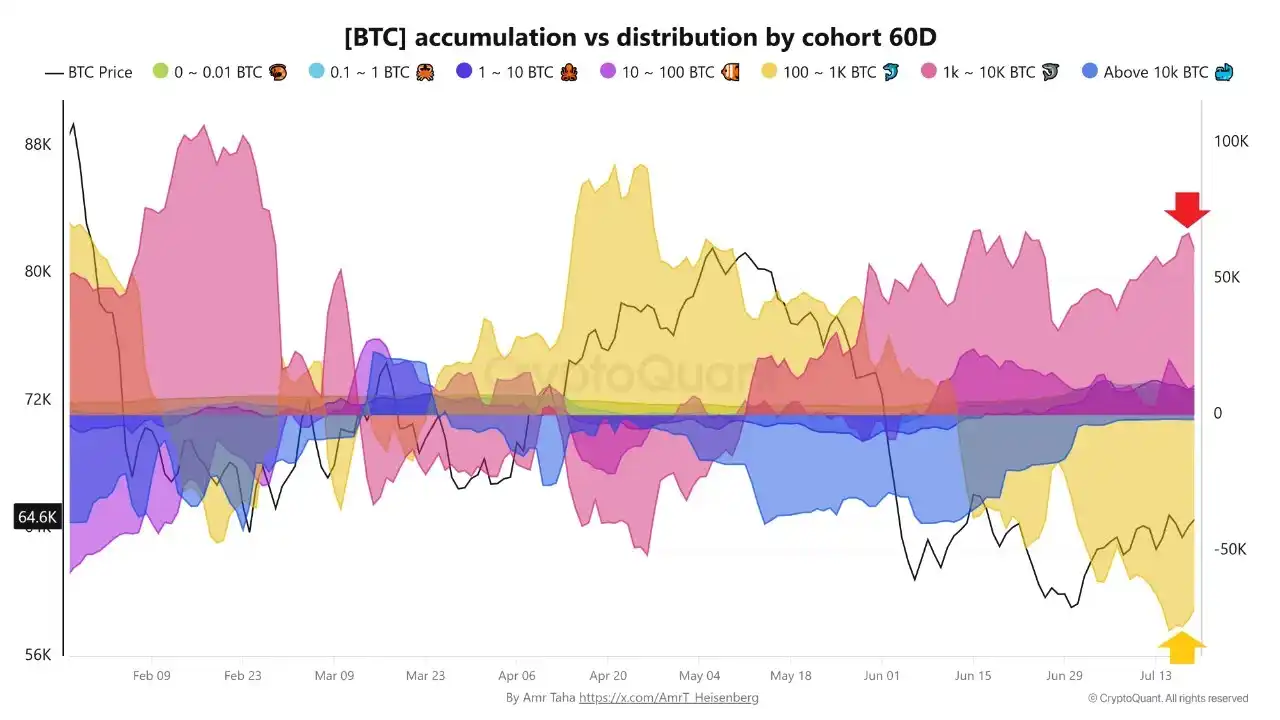
On-Chain Whales: According to CryptoQuant data from July 20, addresses holding 1,000 to 10,000 BTC saw a net increase of approximately 66,700 BTC over 60 days, the strongest wave of buying since mid-February; meanwhile, medium-holding addresses with 100 to 1,000 BTC sold off about 77,800 BTC in the same period. Data provided by Bitfinex analysts to CoinDesk shows that whale addresses collectively added over 270,000 BTC, worth about $16.7 billion, in the first two weeks of July.
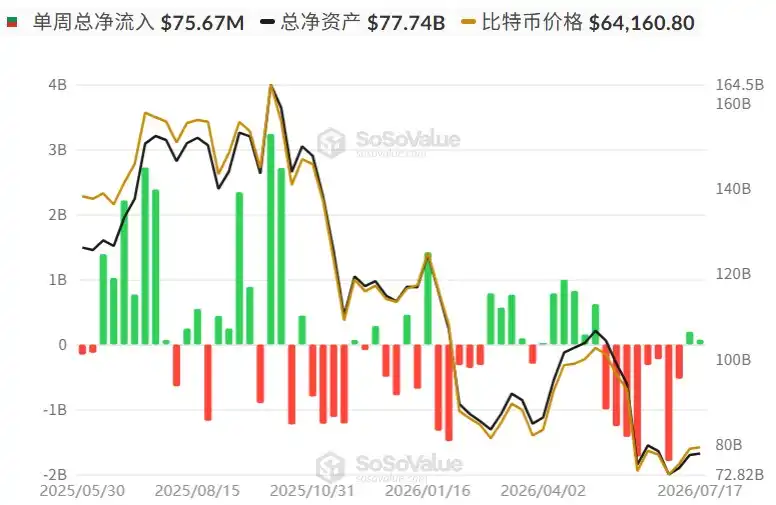
Spot ETFs: According to SoSoValue weekly data, U.S. Bitcoin spot ETFs saw net outflows for 8 consecutive weeks starting the week of May 15, with the week of June 26 experiencing the heaviest outflow at $1.79 billion. It wasn't until the week of July 10 that flows turned positive, with a net inflow of $197 million, followed by another net inflow of $75.67 million the week of July 17.
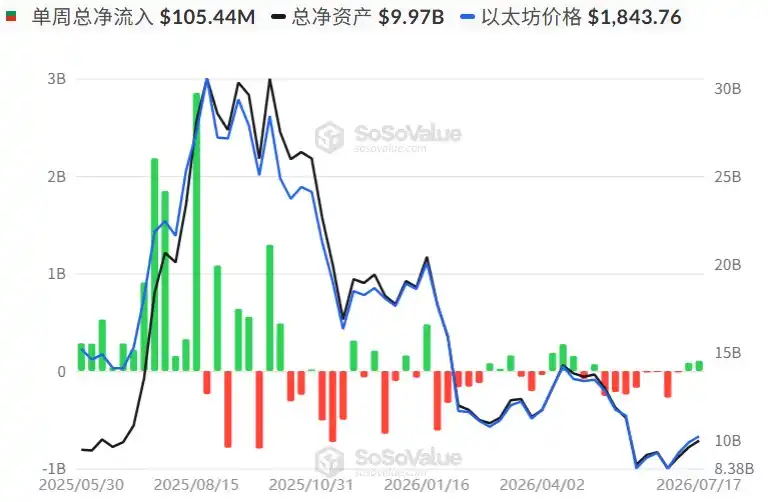
The trend for Ethereum spot ETFs was almost synchronized: also 8 consecutive weeks of net outflows from May 15 to July 2, turning to net inflows for the weeks of July 10 and 17, with $84.42 million and $105 million respectively.
Crypto Treasuries: Strategy holdings remained at approximately 844,000 BTC, having not purchased Bitcoin for two consecutive weeks. In mid-July, it raised $263.5 million in cash through a stock issuance but did not immediately add to its position, instead holding it as a buffer for preferred stock dividends and interest. Japanese-listed company Metaplanet added 2,823 BTC in Q2, bringing its total holdings to 43,000 BTC, ranking third globally among public companies; its subsidiary completed a convertible bond financing of approximately $59.5 million on July 21, planning to continue buying.

BitMine increased its holdings by 7,430 ETH last week, bringing its total to 5,777,468 ETH, accounting for about 4.8% of the total ETH supply. Of this, 85% is staked, generating an estimated annual staking yield of about $247 million. The company concurrently repurchased approximately 5.5 million common shares at an average price of $15.62. Tom Lee stated this slowed the buying pace, but weekly accumulation has never been interrupted since the reserve strategy launch on June 30, 2025.

Arthur Hayes: According to monitoring by Yu Jin, BitMEX co-founder Arthur Hayes spent 2.5 million USDC on July 15 to chase and buy 1,293 ETH at $1,933. On July 20, he bought another 2.5 million USDC worth of ETH via FalconX and Cumberland OTC at $1,876. The two transactions totaled 5 million USDC, purchasing 2,625.7 ETH at an average cost of $1,904. Hayes previously wrote that the AI sector is absorbing market liquidity, putting short-term pressure on BTC, but once liquidity returns, the crypto market still has room for a rebound.


Câu hỏi Liên quan

QWhat major obstacle did the inclusion of an ethics clause in the CLARITY Act overcome?

AThe major obstacle overcome was securing agreement from former President Trump, who reportedly has significant digital asset holdings (approximately $14 billion in crypto income), to include restrictions limiting federal officials from profiting from digital assets during their terms.

QWhat is the significance of the August recess deadline mentioned for the CLARITY Act?

AThe August recess (starting August 7th) creates a tight legislative window. The bill must pass a full Senate vote before the recess to avoid significant delays, as Congress will not reconvene until September 14th.

QAccording to industry lobbyists, what was the primary concern regarding the ethics clause negotiations?

AIndustry lobbyists, like the Blockchain Association's CEO, were concerned that the politically contentious ethics clause negotiations could derail the entire bill. Their primary stance was that the clause's specifics were a political matter for Congress, but it should not jeopardize the passage of the broader regulatory framework.

QWhat criticism did some Democratic senators have regarding the CLARITY Act?

ASome Democratic senators criticized the bill for needing stronger consumer protections, stricter conflict-of-interest and ethics rules (specifically covering the President's immediate family), and more safeguards against crypto fraud and market manipulation. They expressed skepticism and pessimism about the current version.

QWhat recent trend was observed regarding Bitcoin holdings by different wallet sizes, according to the article?

AAccording to CryptoQuant data, 'whale' addresses (holding 1,000 to 10,000 BTC) saw their strongest net accumulation since mid-February, adding approximately 66,700 BTC over 60 days. In contrast, mid-sized addresses (holding 100 to 1,000 BTC) were net sellers, offloading approximately 77,800 BTC in the same period.

Nội dung Liên quan

Sau ba quý liên tiếp suy giảm, thị trường tiền điện tử có thể đón cửa sổ ổn định trong quý III?

Thị trường tiền mã hóa vừa trải qua quý tồi tệ nhất kể từ năm 2022, với vốn hóa giảm 12.6% xuống 2.1 nghìn tỷ USD, khối lượng giao dịch sụt giảm và dòng tiền rút mạnh khỏi các quỹ ETF Bitcoin. Bitcoin và Ethereum lần lượt giảm 14.2% và 25.4% trong quý, đánh dấu sự đảo ngược so với mối tương quan trước đây với các tài sản rủi ro như Nasdaq. Dòng vốn ETF chứng khoán Mỹ ghi nhận dòng ròng rút khoảng 46.7 tỷ USD trong quý II, báo hiệu áp lực bán. Tuy nhiên, dấu hiệu tích cực ban đầu xuất hiện khi các nhà đầu tư dài hạn bắt đầu tích lũy trở lại và dòng ETF có đợt thu hút ngắn hạn. Toàn bộ thị trường hiện tập trung vào cuộc họp của Cục Dự trữ Liên bang Mỹ (FOMC) vào cuối tháng 7. Các tín hiệu chính sách tiền tệ sẽ quyết định xu hướng: tín hiệu ôn hòa có thể đẩy Bitcoin lên vùng 68,000-84,000 USD, trong khi lập trường cứng rắn có thể kéo giá về vùng 50,000-56,000 USD. Tiến trình pháp lý của Đạo luật CLARITY gần như đình trệ, làm giảm kỳ vọng và gia tăng phí rủi ro cho toàn ngành. Trong bối cảnh ảm đạm, hai lĩnh vực nổi bật là thị trường dự đoán (tăng trưởng 48.7%) và bộ sưu tập kỹ thuật số được mã hóa (tăng ~143%), cho thấy sự chuyển dịch nhu cầu thực tế. Nhìn chung, thị trường thiếu động lực cho một đợt tăng trưởng mạnh dựa trên tâm lý. Các quyết định giao dịch trong quý III sẽ chủ yếu xoay quanh diễn biến giá, lựa chọn chính sách và kỳ vọng lãi suất.

marsbitHôm qua 08:39

Sau ba quý liên tiếp suy giảm, thị trường tiền điện tử có thể đón cửa sổ ổn định trong quý III?

marsbitHôm qua 08:39

Giao Dịch SpaceX, Đã Mở Khóa: SPCXON Được Giao Dịch Trên WEEX

SpaceX đã thực hiện đợt IPO lớn nhất lịch sử vào tháng 6/2026, nhưng nhiều nhà giao dịch không thể tiếp cận do các rào cản như hạn chế môi giới và khu vực. Sàn giao dịch tiền điện tử WEEX đã giới thiệu SPCXON/USDT, một công cụ token hóa cho phép tiếp cận biến động giá của SpaceX thông qua tài khoản crypto được quyết toán bằng USDT, mà không cần môi giới Mỹ hay tài khoản ngân hàng. Sản phẩm này, xây dựng trên nền tảng cổ phiếu token hóa của Ondo, dành cho các nhà giao dịch bên ngoài Hoa Kỳ. Trường hợp đầu tư dựa trên đà tăng doanh thu Starlink và các cột mốc Starship, trong khi các yếu tố cần thận trọng bao gồm định giá cao, lượng cổ phiếu lưu hành công chúng ít và sự kiện mở khóa cổ phiếu nội bộ sắp tới. Lưu ý quan trọng: SPCXON cung cấp mức tiếp xúc với hiệu quả kinh tế, không phải quyền sở hữu cổ phiếu trực tiếp, và có thể giao dịch ở mức cao hơn hoặc thấp hơn giá trị tài sản ròng. WEEX tích hợp SPCXON cùng các sản phẩm TradFi token hóa khác như MicroStrategy (MSTRON) và Micron (MUON) vào một tài khoản thống nhất, cho phép luân chuyển giữa crypto và cổ phiếu dễ dàng. Sàn cũng đang chạy chiến dịch TradFi Trading Challenge với quỹ thưởng $50,000.

TheNewsCryptoHôm qua 08:32

Giao Dịch SpaceX, Đã Mở Khóa: SPCXON Được Giao Dịch Trên WEEX

TheNewsCryptoHôm qua 08:32

BIT Trading Hours: BTC Vẫn Chịu Áp Lực Từ Đường MA 200 Tuần, Bị Từ Chối Có Thể Tái Khởi Động Đợt Giảm, Ngành Lưu Trữ và Bán Dẫn Tăng Mạnh Đêm Qua Bắt Đầu Giảm Trong Khung Giờ Giao Dịch Ban Đêm

Bitcoin (BTC) hiện giao dịch quanh mức $66,000, đối mặt với vùng kháng cự mạnh gần $68,000 - nơi tập trung nhiều lệnh mua trước đó có thể chốt lời. Về mặt kỹ thuật, BTC đang nằm giữa đường trung bình động 200 tuần (MA ~$63,333) và đường trung bình động hàm mũ 200 tuần (EMA ~$68,328). Việc không thể vượt qua mức $68,000 có thể kéo giá về kiểm tra lại vùng hỗ trợ $63,000. Thị trường hiện có tính thanh khoản thấp và được xem là đang trong đợt phục hồi nhẹ. Trên thị trường chứng khoán Mỹ, các chỉ số tương lai giảm nhẹ. Nhóm cổ phiếu bán dẫn và lưu trữ, vốn tăng mạnh vào đêm trước, đã điều chỉnh giảm trong phiên giao dịch ngoài giờ. Tuy nhiên, Super Micro Computer (SMCI) tăng mạnh sau báo cáo doanh thu và đơn đặt hàng tích cực. Dầu thô tăng (trên $91) và lợi suất trái phiếu kho bạc Mỹ tăng cao tiếp tục gây áp lực lên thị trường cổ phiếu và làm dấy lên lo ngại lạm phát. Tại châu Á, thị trường Hàn Quốc phục hồi nhẹ cùng với cổ phiếu công nghệ, trong khi Nhật Bản thận trọng do đồng Yên yếu kỷ lục. Các sự kiện quan trọng sắp tới bao gồm báo cáo thu nhập từ các gã khổng lồ công nghệ như Alphabet, Tesla, IBM; sự kiện AI của AMD; và cuộc họp chính sách tiền tệ của Ngân hàng Trung ương châu Âu.

marsbitHôm qua 08:31

BIT Trading Hours: BTC Vẫn Chịu Áp Lực Từ Đường MA 200 Tuần, Bị Từ Chối Có Thể Tái Khởi Động Đợt Giảm, Ngành Lưu Trữ và Bán Dẫn Tăng Mạnh Đêm Qua Bắt Đầu Giảm Trong Khung Giờ Giao Dịch Ban Đêm

marsbitHôm qua 08:31

Chủ tịch CFTC cũ, Chủ tịch Circle Tarbert: Một mặt khuyên bạn chủ nghĩa dài hạn, mặt kia tự mình thoái vốn 30 triệu USD

Tác giả: Zen, PANews Trước tình cảnh cổ phiếu Circle (CRCL) giảm 70% so với đỉnh và bị hạ xếp hạng, Chủ tịch Heath Tarbert - cựu Chủ tịch CFTC - trong một cuộc phỏng vấn ngày 14/7 đã kêu gọi các nhà đầu tư kiên nhẫn và tập trung vào tầm nhìn dài hạn của công ty. Tuy nhiên, hành động của ông lại trái ngược hoàn toàn. Kể từ khi Circle IPO, Tarbert đã không ngừng bán cổ phiếu CRCL thông qua kế hoạch giao dịch 10b5-1 được lập trước, thu về tổng cộng khoảng 30 triệu USD. Ông chưa từng mua lại cổ phiếu trên thị trường mở, ngay cả khi giá cổ phiếu lao dốc. Bài viết nêu bật sự mâu thuẫn giữa lời nói "chủ nghĩa dài hạn" và hành động "thoái vốn" mạnh tay của Tarbert. Sự nghiệp của ông được mô tả là điển hình của "cánh cửa xoay" chính trị-thương mại Mỹ: từ các vị trí cấp cao tại Bộ Tài chính và CFTC, ông nghỉ hưu chỉ 27 ngày trước khi gia nhập Citadel Securities - một nhà tạo lập thị trường lớn - vào thời điểm công ty này đang đối mặt với cuộc điều tra của Quốc hội sau sự kiện GameStop. Sau đó, ông chuyển sang Circle, nơi ông được cho là đã sử dụng kinh nghiệm và quan hệ quản lý để giúp công ty vượt qua các rào cản pháp lý và niêm yết thành công. Bài báo đặt câu hỏi liệu Tarbert có thực sự tin vào tương lai dài hạn của Circle hay không, khi mà ông liên tục chốt lời trong khi lại khuyên các cổ đông nhỏ lẻ giữ vị thế. Nó gợi ý rằng mô hình của ông là tận dụng tối đa kiến thức về chu kỳ chính sách và cơ hội thị trường để biến các nguồn lực và uy tín tích lũy được thành lợi thế nghề nghiệp và tài chính cá nhân, trong khi rủi ro dài hạn được chuyển sang cho các nhà đầu tư tin tưởng vào những tường thuật công khai của ông.

marsbitHôm qua 08:08

Chủ tịch CFTC cũ, Chủ tịch Circle Tarbert: Một mặt khuyên bạn chủ nghĩa dài hạn, mặt kia tự mình thoái vốn 30 triệu USD

marsbitHôm qua 08:08

Gate Research: Làn sóng "phố Wall hóa" trong các sản phẩm tài chính tiền điện tử - Cạnh tranh hay Hội tụ?

Gate Research Institute: Sự hòa hợp hay cạnh tranh trong làn sóng "phố Wall hóa" các sản phẩm tài chính tiền mã hóa? Từ tầm nhìn ban đầu về một hệ thống tài chính phi tập trung, loại bỏ trung gian của Bitcoin, thị trường tiền mã hóa đang chứng kiến sự hội tụ mạnh mẽ với tài chính truyền thống (TradFi). Các quỹ ETF Bitcoin, tài sản thế giới thực được mã hóa (RWA) và trái phiếu chính phủ trên chuỗi cho thấy các tổ chức như BlackRock, Fidelity đang đưa tài sản mã hóa vào hệ thống phát hành, định giá, lưu ký và phân phối truyền thống. Tuy nhiên, đây không phải là một trò chơi tổng bằng không. Xu hướng này thể hiện sự bổ sung lẫn nhau: TradFi cung cấp khung pháp lý, mạng lưới phân phối rộng và sự tin cậy, trong khi Crypto mang lại tính mở, thanh khoản toàn cầu 24/7 và khả năng thanh toán lập trình được. Hai hướng đi tiêu biểu minh chứng cho sự hội tụ hai chiều: các sàn giao dịch tiền mã hóa (CEX) như Gate mở rộng sang giao dịch cổ phiếu thực, ETF thông qua cơ sở hạ tầng môi giới truyền thống; trong khi các công ty môi giới truyền thống như Robinhood tích hợp tài sản mã hóa và phát triển tài sản mã hóa (như cổ phiếu mã hóa) để thu hút người dùng. Mục tiêu chung của cả hai hướng là tranh giành "tài khoản tài chính tổng hợp" thế hệ tiếp theo - một điểm vào duy nhất nơi người dùng có thể giao dịch đa dạng tài sản từ cổ phiếu, tiền mã hóa đến RWA. Sự tăng trưởng mạnh mẽ của thị trường RWA, đặc biệt là cổ phiếu mã hóa, bất chấp xu hướng thị trường giảm, cho thấy đây là một xu hướng cấu trúc thực sự. Kết luận, "phố Wall hóa" không có nghĩa là thị trường tiền mã hóa bị TradFi thôn tính. Thay vào đó, đây là một sự chuyển đổi hai chiều, nơi cả hai hệ thống đang cùng nhau định hình lại thị trường vốn thành một cấu trúc hỗn hợp hiệu quả và toàn cầu hơn, với trải nghiệm người dùng liền mạch cho nhiều loại tài sản khác nhau.

marsbitHôm qua 08:06

Gate Research: Làn sóng "phố Wall hóa" trong các sản phẩm tài chính tiền điện tử - Cạnh tranh hay Hội tụ?

marsbitHôm qua 08:06

Giao dịch

Giao ngay
活动图片




