WeChat AI Card Hands-On Guide: Has the AI Shopping Era Arrived?

marsbitPublished on 2026-06-18Last updated on 2026-06-18

Abstract

**"WeChat AI Card" Practical Test Guide: Has the Era of AI Shopping Arrived?** WeChat has officially launched the "AI Exclusive Card," a feature integrated into its Workbuddy AI assistant. This card is designed to handle payments for AI-initiated purchases. Our hands-on test reveals it's not yet a tool for fully autonomous AI shopping, but rather a controlled payment layer for AI agents. The AI Card functions as an isolated sub-wallet within WeChat Pay. Users must bind the card and transfer funds into it from their main wallet. Crucially, every transaction requires explicit user confirmation via smartphone scan; AI cannot spend autonomously. Currently accessible through the Workbuddy agent, the card targets specific digital consumption scenarios: purchasing paid content (reports, data), calling paid APIs/tools, and subscribing to services. Its design prioritizes security and control by separating funds and mandating approval for each payment. We tested a real-world scenario: ordering bubble tea via Workbuddy using a "Meituan Life Assistant" skill. The process encountered multiple hurdles: high "skill" usage costs (exceeding daily free credits), and most importantly, while a payment was successfully initiated, the AI purchased an incorrect product (a mismatched group-buy coupon instead of the desired drink). This highlights the current limitation: the **AI Card only solves the payment step**. The broader challenge lies in the **AI agent's execution chain**—accurately unde...

Author: Alan | Biteye Content Team

On June 17th, WeChat's official account "微信派" announced that WeChat Pay has officially launched the AI-exclusive card. According to the official description, users can propose consumption needs in conversations with Workbuddy and complete related payments through the AI-exclusive card.

This sounds quite interesting: in the future, to order a milk tea, purchase a service, or subscribe to a tool, you could just let the AI handle the entire process seamlessly.

However, after practical testing, we found that the WeChat AI-exclusive card currently does not support "fully automated AI consumption." A more accurate understanding is: it is a layer of payment capability opened by WeChat Pay for AI Agents, but each transaction still requires user confirmation. Moreover, whether a purchase can actually be completed depends on the Agent, Skills, third-party platform authorization, and product fulfillment processes.

This article will explore two questions and one hands-on test:

  1. What exactly is the WeChat AI-exclusive card?

  2. What can it do now, and what can't it do?

  3. A practical test: using it to order a cup of milk tea to see how many pitfalls we can encounter.

1. Conclusion First: The WeChat AI-exclusive Card is Not a Card for "AI to Spend Freely"

From a product mechanism perspective, the WeChat AI-exclusive card is more like a "small wallet" isolated from the main WeChat wallet.

Users first need to bind the AI-exclusive card and then transfer funds from their WeChat wallet to this card. Subsequently, relevant consumption by AI Agents will be deducted from this independent balance first, rather than directly from the user's daily WeChat wallet funds.
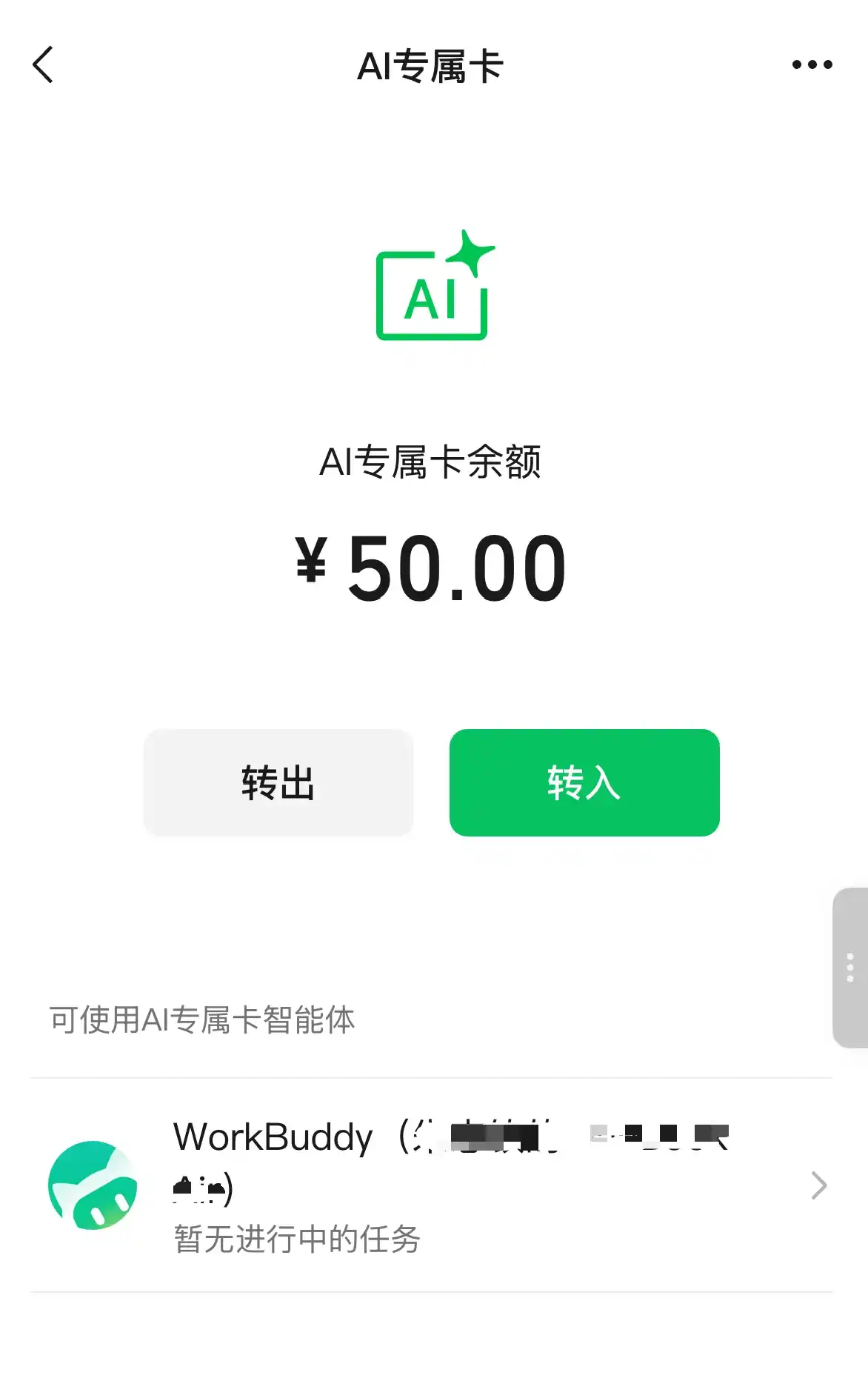
Simply put, it primarily addresses three questions:

First, where does the money for AI consumption come from.

The AI-exclusive card has an independent balance, making financial boundaries clearer.

Second, whether AI consumption can be controlled.

Each payment still essentially requires user confirmation on the mobile device after scanning a QR code; it's not automatic deduction by the AI.

Third, how AI consumption records are managed.

AI-related expenses are separated from ordinary WeChat Pay transactions, making them easier to view and manage.

2. How to Activate: Entry Point is in the Workbuddy Conversation

WorkBuddy is a desktop office efficiency agent launched by Tencent, closer to an Agent workbench, with an interface similar to CodeX. It can understand user goals in conversation and then use different "expert" Agents or Skills to call external capabilities to complete tasks, such as office processing, information queries, and local life services.
This time, WeChat Pay's AI-exclusive card was first integrated into WorkBuddy, which also implies that WeChat Pay is not directly opening up to all AI applications. Instead, it is first testing the complete process of "AI initiating payment, user confirming deduction" within a relatively controlled Agent scenario.

The actual activation process is not complicated:

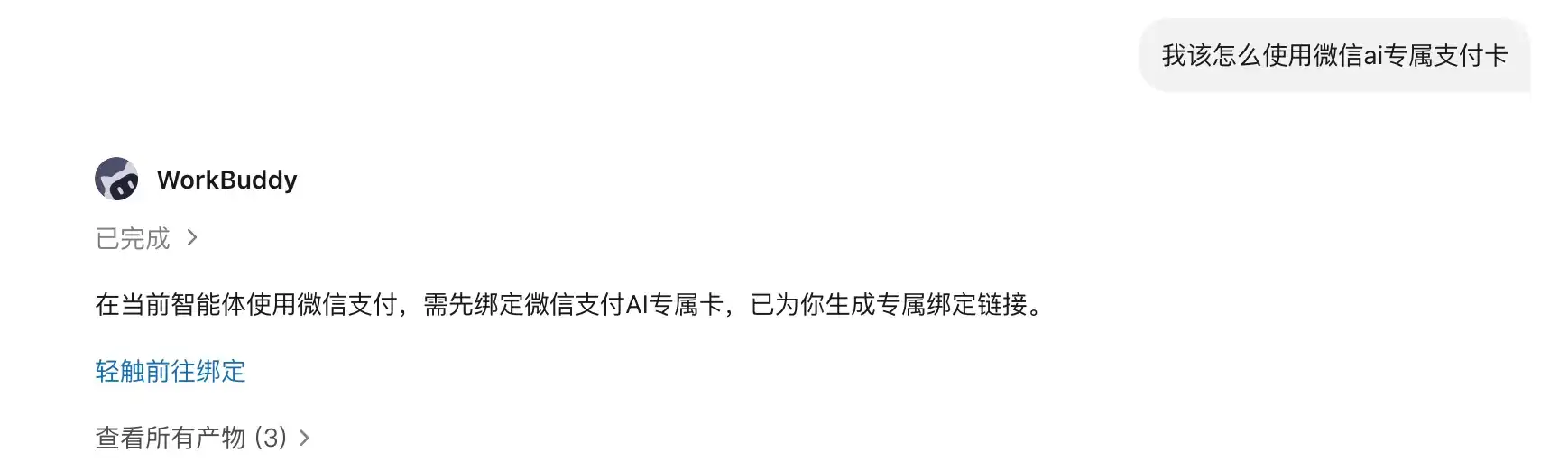
Step One, ask in the Workbuddy dialog:

"How do I use the WeChat AI-exclusive payment card?"

The Agent will return a jump link ⬇️
Step Two, after clicking the link, you need to scan a QR code with WeChat to complete the binding.
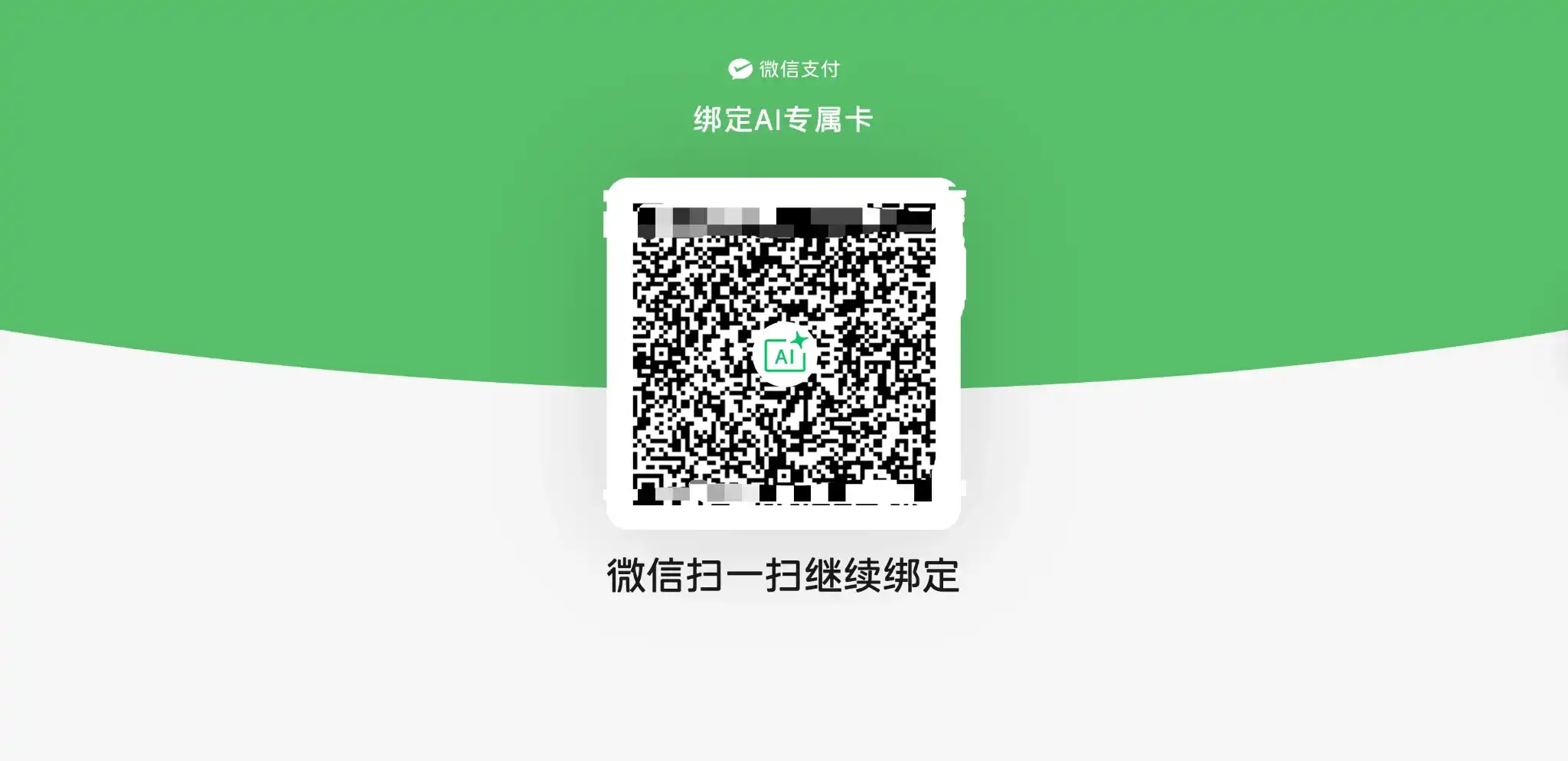
A small detail here: the binding link is only valid for 5 minutes after generation, so you need to scan the code promptly.

Step Three, read and agree to the relevant agreements, and after entering your payment password, you can complete the binding.

Step Four, after binding is complete, users can transfer funds from their original WeChat wallet to the AI-exclusive card.
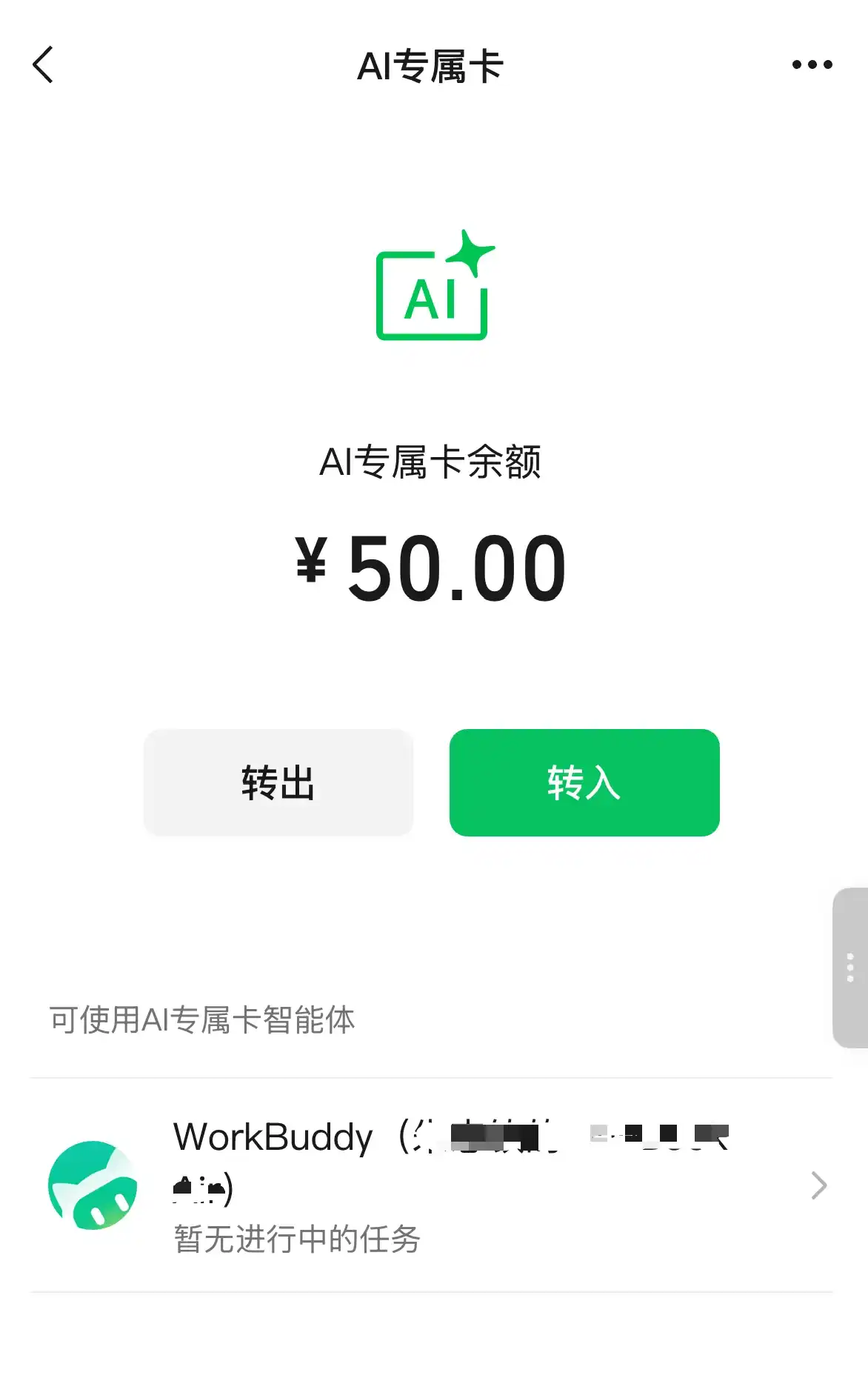
The activation and top-up experience is quite smooth. However, the real challenge with AI payment doesn't lie in "how to get the card," but in what happens after you get it—can the AI actually help users complete purchases smoothly?

3. What Scenarios Is It Currently Suitable For?

According to Workbuddy's explanation, the AI-exclusive card is mainly intended for several types of AI consumption scenarios:

1️⃣ Purchasing Paid Content

Such as reports, data, professional analysis services, etc.

2️⃣ Calling Paid APIs or Tools

Such as certain online plugins, professional database queries, tool capabilities charged per use.

3️⃣ Subscribing to or Renewing Services

Such as in-platform value-added features, membership services, etc.

These scenarios share a common point: the payment objects are relatively standardized, the consumption chain is short, and the fulfillment method is quite clear.

However, unfortunately, so far, our tests have not identified any of these three types of applications within Workbuddy that can directly trigger payment using the AI-exclusive card. According to Workbuddy, it needs to trigger certain specific built-in paid features ⬇️
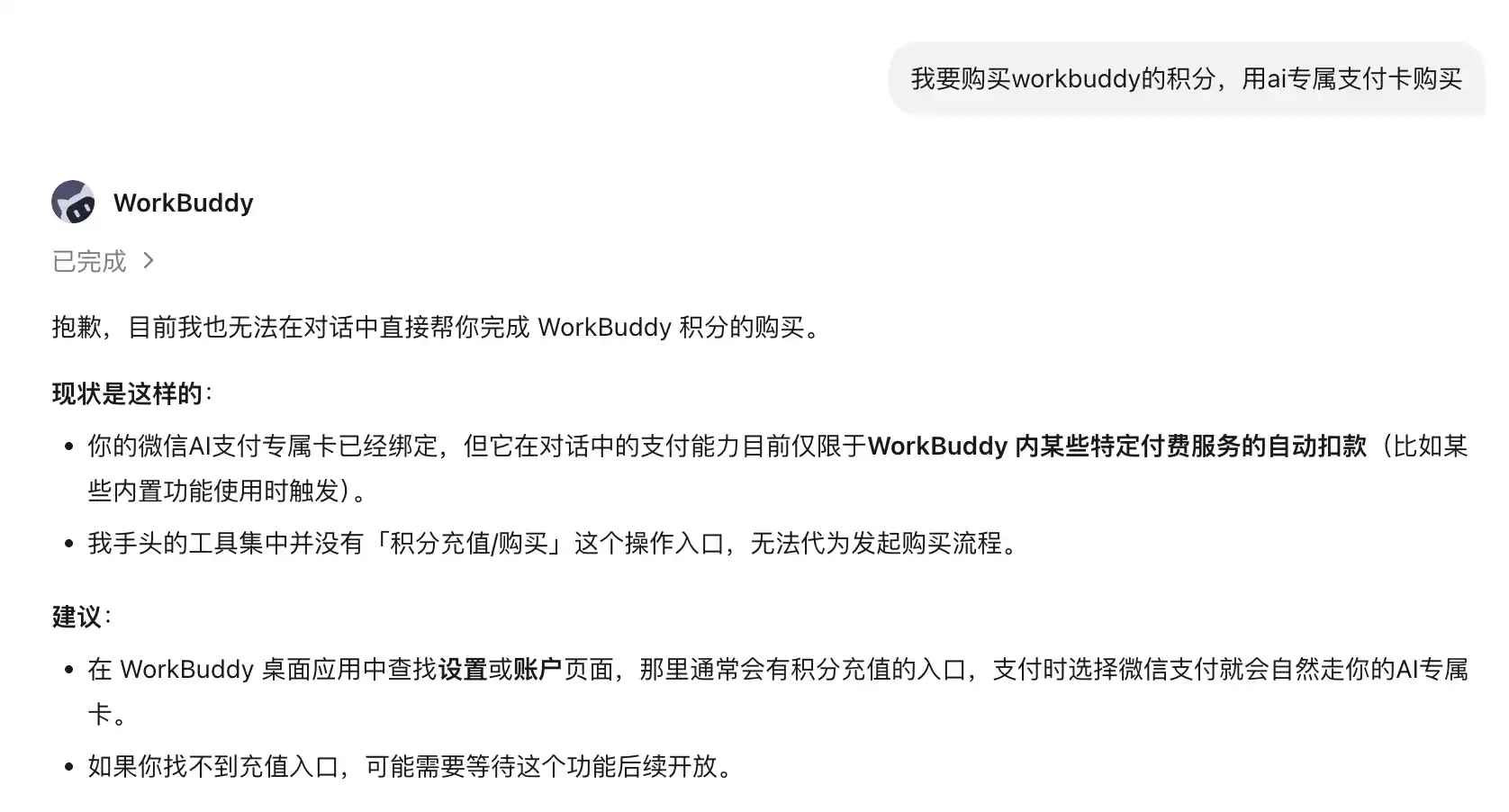
4. Hands-on Test: Asking Workbuddy to Order a Heytea for Me—Failed

🥤 We tried one of the most intuitive life scenarios: asking Workbuddy to order a cup of Heytea for me.

The first step encountered a limitation. Workbuddy itself cannot directly fulfill such takeout or beverage ordering needs; it requires calling the corresponding life service Skill.
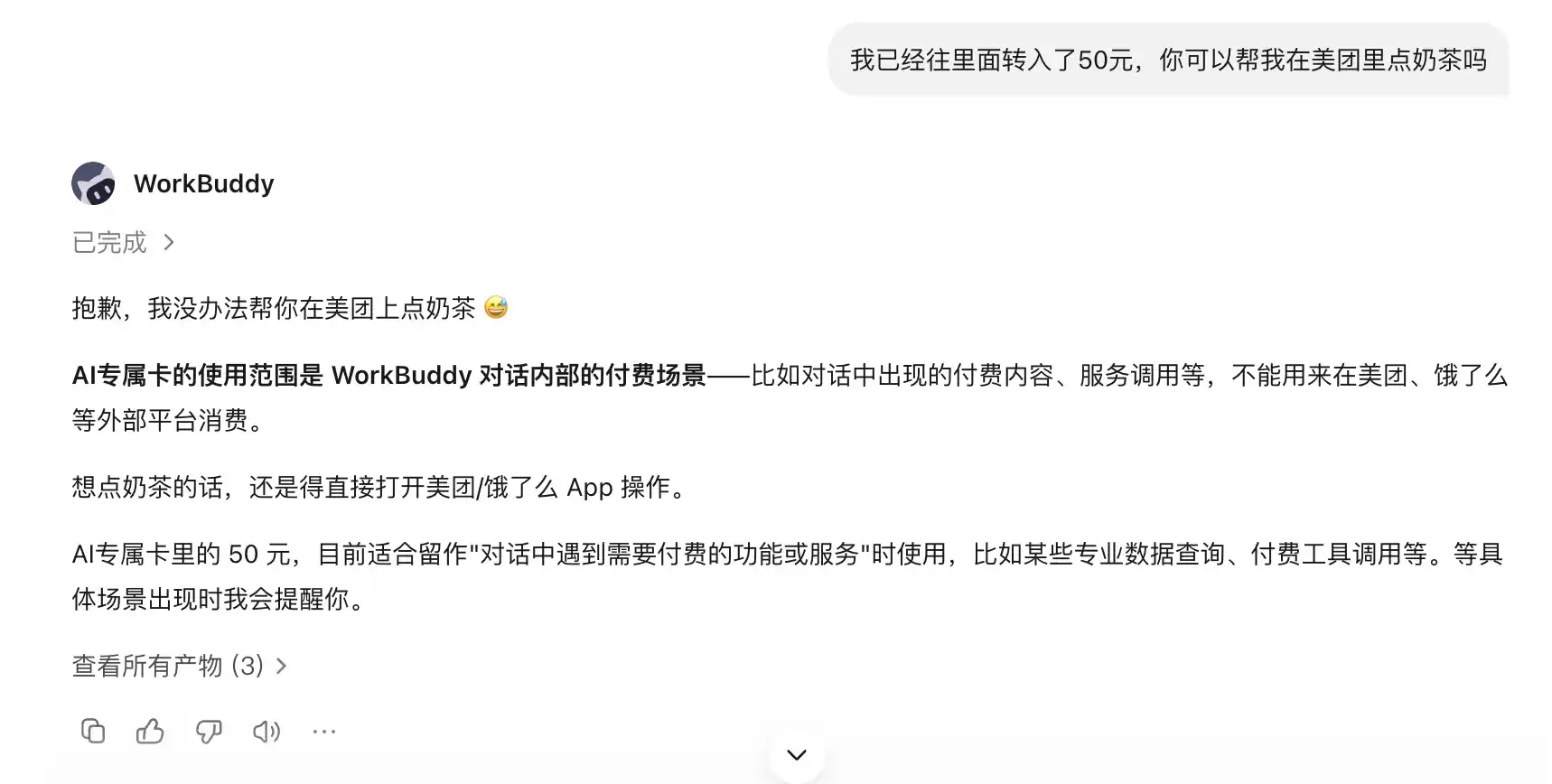
Therefore, following WeChat's official demonstration, we selected the "Meituan Life Assistant" Skill.

This step introduced a new cost issue: just generating the QR code to log into the Meituan account consumed 185.37 points. In comparison, Workbuddy awards 150 points daily upon login.

This means that before even starting the actual order, the step of just authorizing the login had already exceeded the daily free point allowance.

After completing the account login authorization, we continued to ask it to order milk tea. When the AI-exclusive card payment link popped up, the experience did indeed feel close to "AI buying something for me."
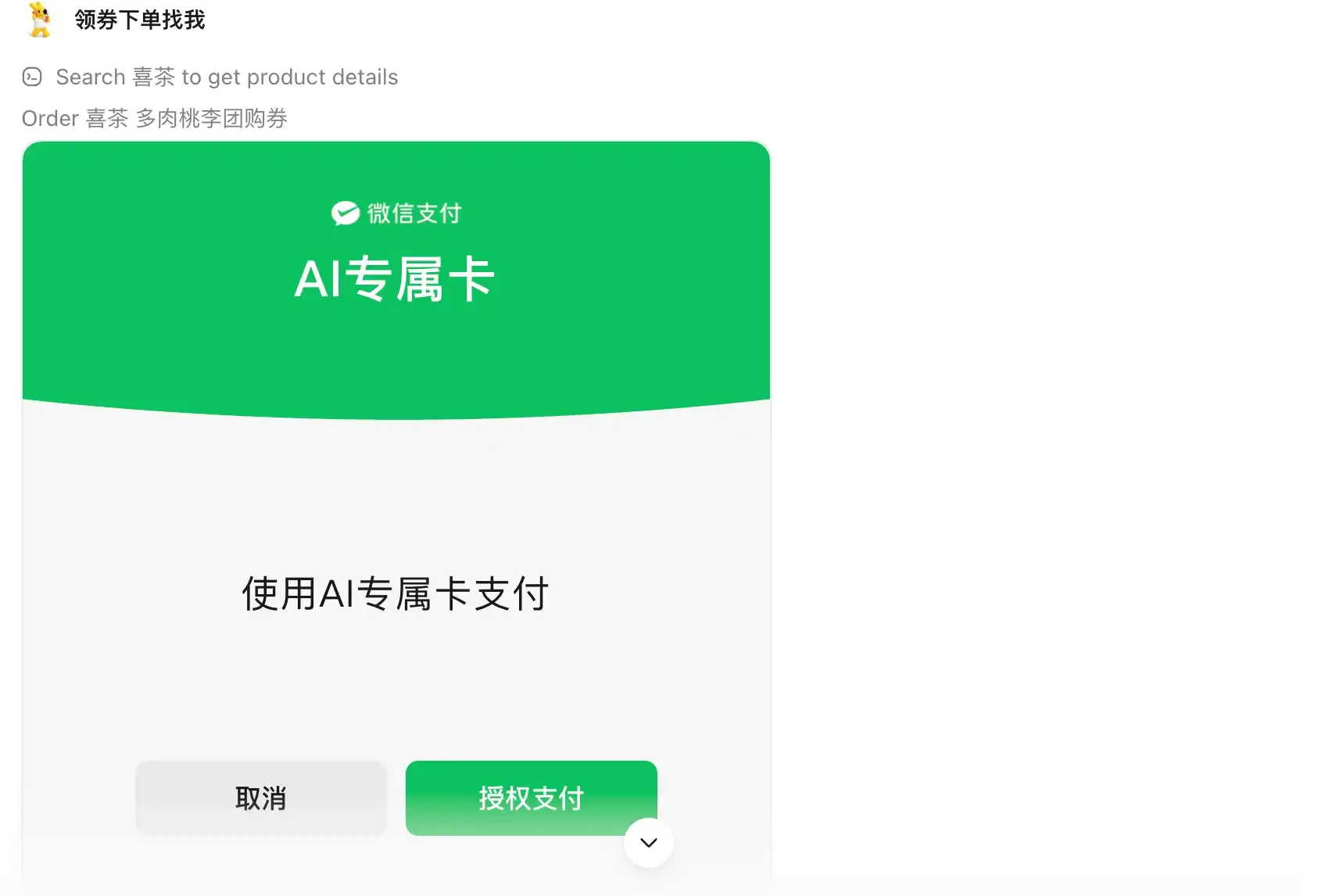
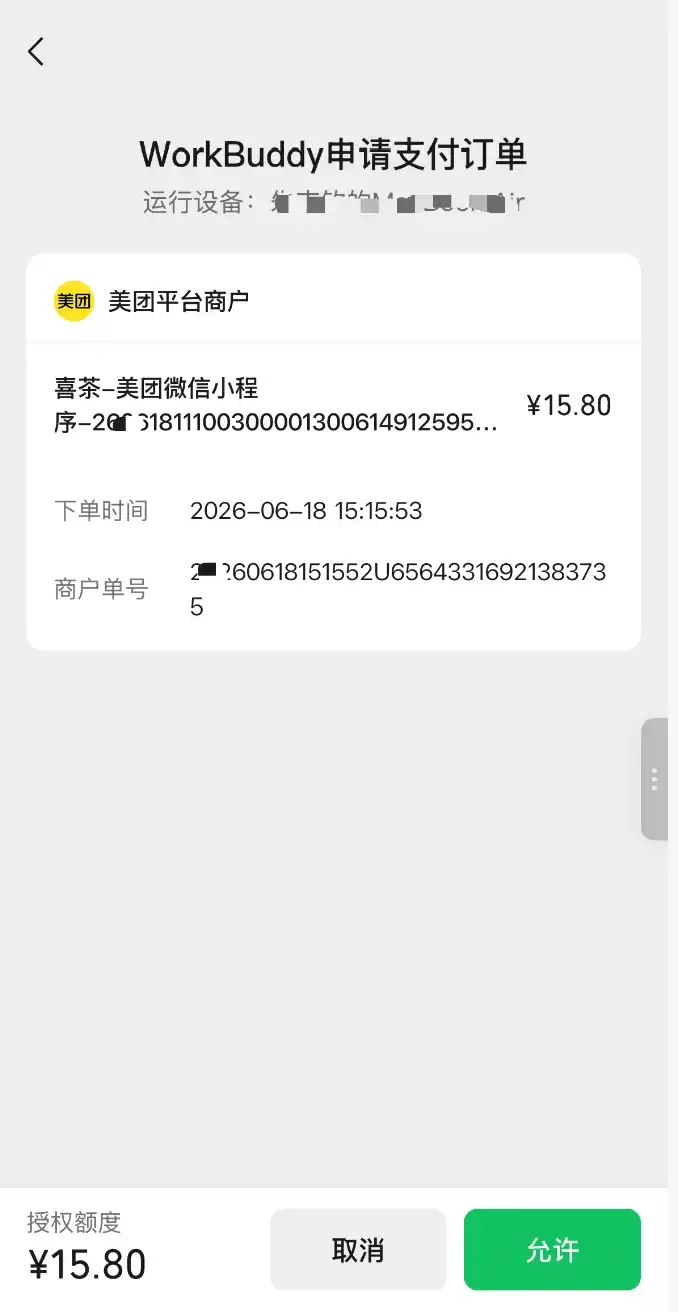
However, after payment, we discovered that what Workbuddy actually purchased was not the specific cup of milk tea we wanted, but a Meituan group-buying coupon that didn't match our needs.

The payment action was completed, but the purchase result did not align with the user's needs.

5. Reasons for Failure: The Problem Isn't with Payment, but with the Agent Execution Chain

In fact, this failure cannot be simply attributed to the AI-exclusive card being "not useful." More accurately, the AI-exclusive card is responsible for the payment capability, not the complete purchasing capability.

What really got stuck was the Agent execution chain.

A task like "help me order a cup of milk tea" involves at least the following steps:

Identifying user needs, calling a third-party platform, completing account authorization, selecting the correct product, confirming the fulfillment method, initiating payment, user confirming payment, completing subsequent fulfillment...

The AI-exclusive card only covers the "payment" part. As for the preceding steps like product identification, platform redirection, account authorization, product matching, and the subsequent delivery or verification, they all deeply rely on the capabilities of the Agent and third-party Skills.

Therefore, in this test, the AI did trigger the payment, but it did not complete the "correct purchase."

This is a common issue many AI Agents currently face: they can call tools, but they are not yet guaranteed to reliably complete complex real-world tasks.

6. Current Mechanism: Users Still Hold Final Payment Confirmation Authority

From a security perspective, the AI-exclusive card does not allow the AI to bypass the user and make payments directly.

The current mechanism can be roughly summarized as:

Aspect

Current Mechanism

Source of Funds

Only uses the independent balance in the AI-exclusive card

Payment Confirmation

Every payment requires user confirmation on the mobile device

Main Account

Does not directly deduct funds from the main WeChat account

In-Store Goods

After payment is completed, the user still needs to go to the store for verification/redemption

This design is relatively restrained and aligns with the current realistic state of AI consumption scenarios.

If the AI could directly and autonomously make payments, the risks would actually be very high: buying the wrong product, duplicate orders, accidental subscriptions, or induced consumption could all become real problems.

Therefore, the WeChat AI-exclusive card currently functions more like a small WeChat wallet with controllable limits, confirmation for each transaction, and isolation from the main account.

Final Thoughts

If you just want to experience the WeChat AI-exclusive payment card, you can try activating it. However, it is recommended to start with low-amount, low-risk, digital service scenarios first. But please keep the following three points in mind:

1️⃣ Top up with a small amount first; don't deposit too much at once.

2️⃣ Carefully check the product name, amount, and fulfillment method before paying.

3️⃣ Do not assume that the AI Agent has understood your real needs, especially when it involves specific stores, delivery, group-buying coupons, or packages.


Trending Cryptos

Related Questions

QWhat is the core function of WeChat's AI-specific card according to the article?

AAccording to the article, the core function of WeChat's AI-specific card is to act as an isolated 'small wallet' or a payment capability layer for AI Agents. It provides a separate balance for AI-related transactions, requiring user confirmation for each payment. It is designed to clarify the source of funds, give users control over payments, and manage AI spending records separately from regular WeChat Pay transactions.

QHow does a user bind the WeChat AI-specific card, and where is the binding entry?

AThe user binds the WeChat AI-specific card through the WorkBuddy desktop office efficiency Agent. The process involves: 1. Asking 'How do I use the WeChat AI-specific payment card?' in the WorkBuddy dialogue. 2. Clicking the returned jump link, which is only valid for 5 minutes. 3. Scanning the QR code with WeChat to bind. 4. Reading and agreeing to the relevant agreements and entering the payment password to complete the binding.

QWhat are the main payment scenarios that the AI-specific card currently supports?

AThe main payment scenarios supported by the AI-specific card include: 1. Purchasing paid content like reports, data, and professional analysis services. 2. Calling paid APIs or tools, such as online plugins or professional database queries. 3. Subscribing to or renewing services, such as platform add-on features or memberships. These scenarios are characterized by relatively standardized payment objects and shorter consumption chains.

QWhy did the article's test of using WorkBuddy to order bubble tea fail? What was the underlying issue?

AThe test to order bubble tea through WorkBuddy failed because the AI-specific card only handles the payment part of the transaction. The failure occurred earlier in the Agent's execution chain. While the AI successfully triggered a payment, it purchased an incorrect product—a Meituan group purchase coupon instead of the specific tea. The underlying issue is the Agent's inability to correctly handle the complex real-world task chain: identifying user needs, calling third-party platforms (Meituan), completing account authorization, selecting the correct product, and confirming fulfillment methods.

QWhat safety mechanisms are in place for the AI-specific card to prevent uncontrolled AI spending?

AThe safety mechanisms for the AI-specific card include: 1. Using only the independent balance pre-loaded into the AI-specific card, isolating it from the user's main WeChat wallet funds. 2. Requiring explicit user confirmation on their mobile device for every single payment. 3. After payment for physical goods or services, the user is still responsible for on-site verification or fulfillment. This design ensures the user retains ultimate control and prevents risks like buying wrong items, duplicate orders, or unauthorized subscriptions.

Related Reads

TechFlow Intelligence Bureau: Anthropic IPO Odds Exceed 80%, Iran Closes Strait of Hormuz Again, Triggering Oil Price Volatility

**Market Digest** **AI & Tech:** Anthropic is widely expected to announce an IPO before November 2026, raising questions about balancing its trillion-dollar valuation ambitions with its core "AI safety" mission. Brands are increasingly adopting AI-generated virtual influencers for marketing. Cloudflare introduced temporary accounts for AI agents to ease automation workflows. **Infrastructure & Hardware:** Google's IPv6 traffic surpassed 50%, marking a major internet milestone. Goldman Sachs warned that massive projected AI capital expenditure ($5.3T) is approaching credit saturation limits, potentially curbing the "AI arms race." **Space & Robotics:** SpaceX's IPO saw a historic $370M retail buying frenzy in three days. Hyundai Motor Group plans to acquire full ownership of Boston Dynamics. Elon Musk speculated about future "septillion-dollar" investments in antimatter for interstellar travel. **Energy & Geopolitics:** Iran's military announced another closure of the strategic Strait of Hormuz, accusing Israel of violating a ceasefire, causing oil market volatility. However, ship-tracking data indicated some traffic continued. Concurrently, Iran resumed crude loadings at Kharg Island, potentially releasing up to 20 million barrels to the market. **Finance & Macro:** A European CLO (collateralized loan obligation) experienced its first post-2008-crisis-era equity tranche default, raising alarms in credit markets. Nomura warned that new Federal Reserve Chair Wash's perceived hawkish debut speech could signal a significant policy shift. **The Undercurrent:** Seemingly disparate events—the Strait of Hormuz tension, the European CLO default, and warnings on AI spending—point to a tightening of global liquidity and rising marginal costs across energy, credit, and tech investment. Meanwhile, capital continues chasing grand narratives like space exploration and advanced AI, highlighting a divergence where old-world leverage frays as new-world stories grow more ambitious.

marsbit34m ago

TechFlow Intelligence Bureau: Anthropic IPO Odds Exceed 80%, Iran Closes Strait of Hormuz Again, Triggering Oil Price Volatility

marsbit34m ago

The Hunter Becomes the Hunted: The Most Profitable MEV Bot Gets Hacked

A well-known and highly profitable Ethereum MEV Bot, Jaredfromsubway.eth, suffered a sophisticated on-chain attack this Saturday, losing over $7.5 million. Analysis by Blockaid and others reveals this was not a conventional phishing or smart contract exploit, but a targeted "counter-MEV honeypot attack." The attacker meticulously laid a trap over several weeks, deploying 66 fake token contracts and liquidity pools disguised as major assets like WETH and USDC. These pools created the illusion of arbitrage opportunities. The MEV Bot's automated system detected these signals, executed trades, and in the process, granted approval permissions to attacker-controlled contracts. These approvals were not revoked, creating a persistent vulnerability. The attacker then exploited this in a single transaction, draining the bot's ETH, USDC, and USDT holdings. Jaredfromsubway.eth is notorious as one of Ethereum's most active and profitable MEV Bots, primarily known for executing "sandwich attacks" to profit from transaction slippage. Estimates suggest it has earned tens of millions in MEV revenue. The incident highlights escalating crypto security threats, demonstrating that even top-tier automated "predators" are vulnerable to novel, logic-based attacks designed to exploit their own operational rules. Following the hack, an unverified X account impersonating Jaredfromsubway.eth emerged, falsely offering a bounty for the return of funds, prompting developer warnings for users to stay vigilant.

marsbit1h ago

The Hunter Becomes the Hunted: The Most Profitable MEV Bot Gets Hacked

marsbit1h ago

The Reality of Payments in Latin America Is Not What You Think

The payment landscape in Latin America is undergoing a fundamental shift, driven by on-the-ground realities that challenge common perceptions. Based on over 500 hours of field research across the region, key insights emerge. Firstly, QR code payments, like Brazil's Pix, are becoming the dominant payment method in most emerging markets, overtaking cards. However, these domestic instant payment systems lack international interoperability, creating a significant gap for cross-border users. Secondly, the narrative around crypto cards is often misunderstood; their primary volume comes from high-net-worth professionals using them for salary conversions (e.g., USDT to local currency via Pix), not retail micro-payments. Competition in payments is shifting from customer acquisition to controlling the settlement layer, leading fintechs to acquire banking licenses for efficiency. Thirdly, treating "Latin America" as a single market is a mistake. Countries like Argentina, Brazil, and Mexico have distinct economic realities, user segments, and regulatory approaches. Brazil alone has at least five distinct user segments with different financial flows. Overlooked markets like Guatemala, Honduras, and El Salvador (the "forgotten five") offer high remittance volumes with lower competitive density. Finally, regulation in Latin America is often ahead of the US, with clearer frameworks for digital assets and a pragmatic approach from regulators focused on safety rather than obstruction. The margin on stablecoin forex is rapidly compressing toward zero, meaning future winners will be those building value-added services on top of the infrastructure, not just the cheapest exchange.

marsbit2h ago

The Reality of Payments in Latin America Is Not What You Think

marsbit2h ago

Trading

Spot
Futures

Hot Articles

Ethena: Building a New Era of Web3‑Native Digital Dollars

Ethena is an Ethereum‑based synthetic dollar protocol that delivers crypto‑native monetary solutions, including USDe, a synthetic dollar, and sUSDe, a globally accessible U.S. dollar savings asset.

53.3k Total ViewsPublished 2026.03.16Updated 2026.03.16

Ethena: Building a New Era of Web3‑Native Digital Dollars

Discussions

Welcome to the HTX Community. Here, you can stay informed about the latest platform developments and gain access to professional market insights. Users' opinions on the price of ERA (ERA) are presented below.

活动图片