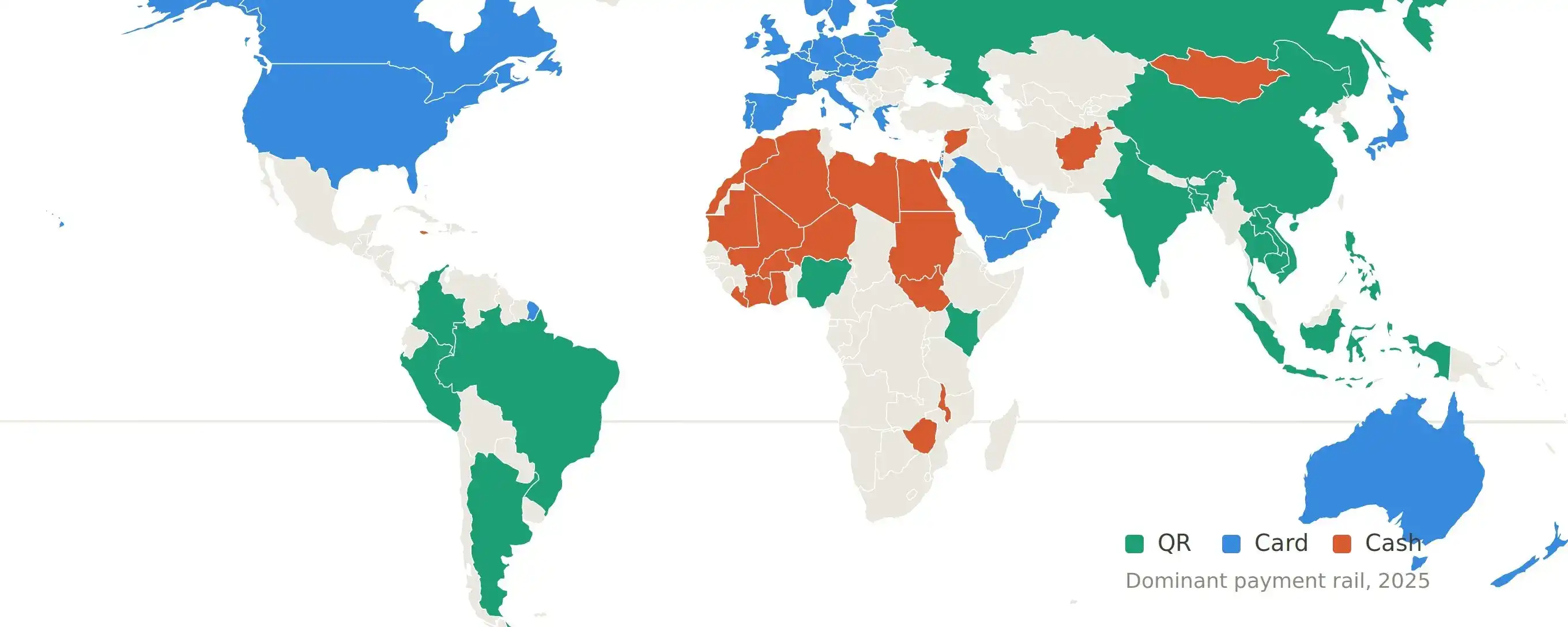
a16z Crypto Partner: Cash Flow is the Moat

marsbitPublished on 2026-06-12Last updated on 2026-06-12

Abstract

Cash Flow as the Moat: A Playbook for Crypto Founders Historically, the most enduring businesses have been built by positioning themselves within the "flow of funds"—facilitating the creation and transfer of value in a network and extracting a portion of it. Cryptocurrency is the first modern technology natively built for this purpose. For startups, failing to architect products and businesses to leverage these principles means missing a major opportunity. Blockchains are inherently network businesses. Each transaction settles on a shared ledger, and every new participant strengthens the underlying network for all. Well-designed network tokens amplify this by aligning users, developers, and validators around growing the network, with value flowing back to contributors in a transparent feedback loop. This model is not new; companies from railroads and Standard Oil to Google, Meta, and AWS have thrived by inserting themselves into critical flows of value (goods, attention, compute). Financial markets make it even clearer: firms like Visa and major market makers generate immense revenue not by predicting markets but by being in the path of transactions. The combination of fund flow and network effects creates one of the most durable business structures. The high margins in traditional finance (payments, custody, lending, FX) represent prime targets. Crypto founders have the opportunity to build the next version—programmable, instant, global, and natively in the flow of funds...

Author: Jason Rosenthal, a16z Operating Partner

Translation: Hu Tao, ChainCatcher Selection

Many of history's greatest businesses were built by positioning themselves in the "flow of funds"—facilitating the creation and transfer of value within a network and taking a cut of it. The more value that flows through the network, the larger the business typically becomes.

Cryptocurrency is the first modern technology natively built for this purpose. If your startup hasn't yet architected its product and business to benefit from these principles, you're missing an opportunity. Thanks to stablecoins, capital and value now flow at internet speed—settling globally, 24/7, with end-to-end programmability. Payment channels are unobstructed, unit economics are transparent, and every dollar flowing anywhere in the world is reachable.

The Model

Blockchains are network businesses by design. Every transaction settles on a shared ledger. Each new participant reinforces the same underlying network that the next builder can use. As more people use and build on it, the network becomes more valuable to all users.

Most companies spend years manufacturing network effects on top of traditional infrastructure. Crypto founders inherit them as a starting condition.

Network tokens amplify this. Well-designed tokens can align users, developers, suppliers, validators, and protocols around a single outcome—growing the network—and pay proportionally to each participant's contribution. But the protocol's revenue belongs to the people who use it. No partner rebates, no side deals. Just a feedback loop between value flowing through the system and value accruing to the hands of those building and growing it.

This isn't a new model. Cryptocurrency just makes it accessible and scalable for startups for the first time.

Railroads didn't make money from locomotives. They made money from every ton of grain, coal, and steel that crossed their tracks. Standard Oil, U.S. Steel, and AT&T were all companies in the flow of funds. Google and Meta displaced print and TV not because their ads were better, but because they sat at the chokepoint where attention converts to commerce, enabling them to take a cut of trillions in commercial intent. AWS is in the flow of computation.

The model is consistent: find where value flows, and position yourself in the middle of it.
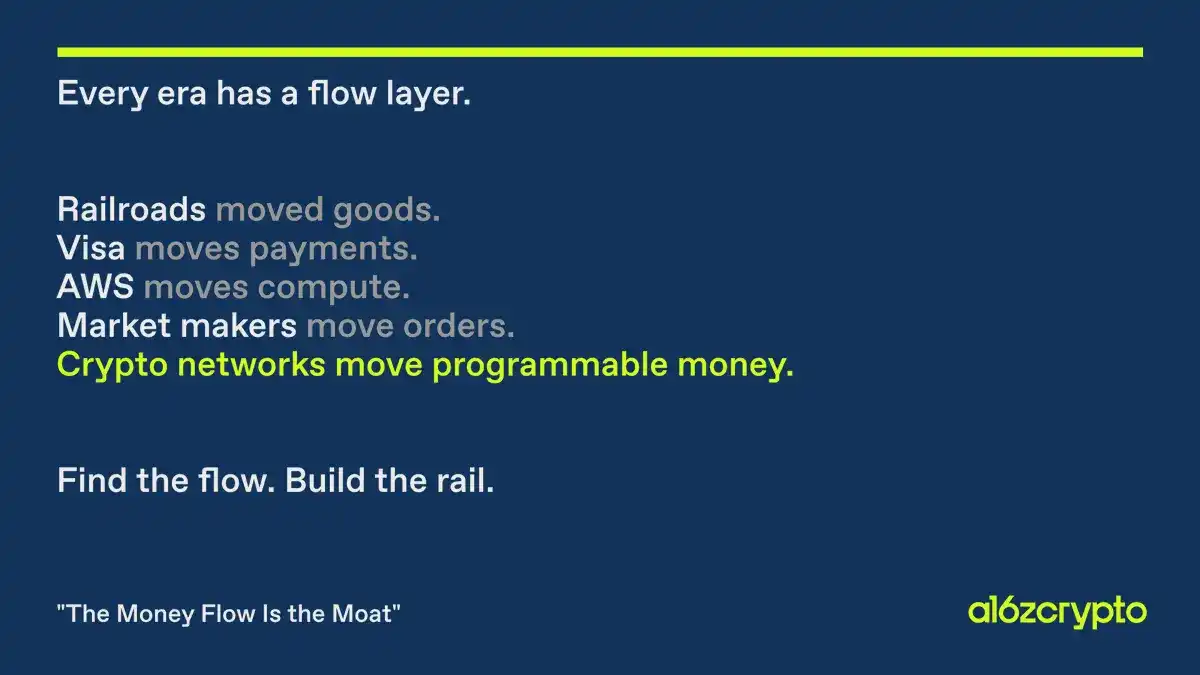
Financial markets make this model even clearer. Visa processed $15.7 trillion in payment volume in FY2024, reporting $35.9 billion in net revenue. Jane Street posted $20.5 billion in net trading revenue last year—more than Citigroup or Bank of America. The top five U.S. market makers handled 87% of order flow payment: they don't predict the market; they sit in the flow of every order and earn more as trading volume grows.

These businesses share another commonality: network effects. Visa is more useful to more merchants because there are more cards; more useful to more cardholders because more merchants accept it. It's the same with order flow—each additional broker narrows spreads, attracting more brokers, which attracts more flow.

The flow of funds plus network effects is one of the most durable business structures ever.

Your Margin is My Opportunity

Bezos called it "your margin is my opportunity." He was talking about retail, but it applies even more to traditional financial services—the world's largest pool of margin extraction. Payments, custody, lending, FX, securitization, settlement, market making—all of it. Visa and Mastercard charge 2-3% transaction fees on networks designed in the 1960s. Remittance corridors charge 6-9%. Prime brokers and custodians take a piece of every securities trade. Even after the U.S. shifted to T+1 settlement in 2024, money still sits idle overnight as a structural tax on every participant.

Each of these margins is a target. Compress cost, increase speed, and potentially expand the entire market. Stripe and Square proved this is possible in payments.

Crypto founders have the opportunity to build the next version—programmable, instant, global, and natively in the flow of funds.

And the frontier extends far beyond financial services. Compute and GPU markets. Memory chips. AI training data. Energy. Robotics. Space. Rare earth metals. Each category is an area where global value can begin to flow at volumes the existing rails were never designed to handle.

Each is an open field for building flow-of-funds businesses from the ground up on programmable infrastructure. These markets have no existing rails, no entrenched intermediaries, and nothing to defend.

As a founder, ask yourself:

1. Are you in the flow of funds today?

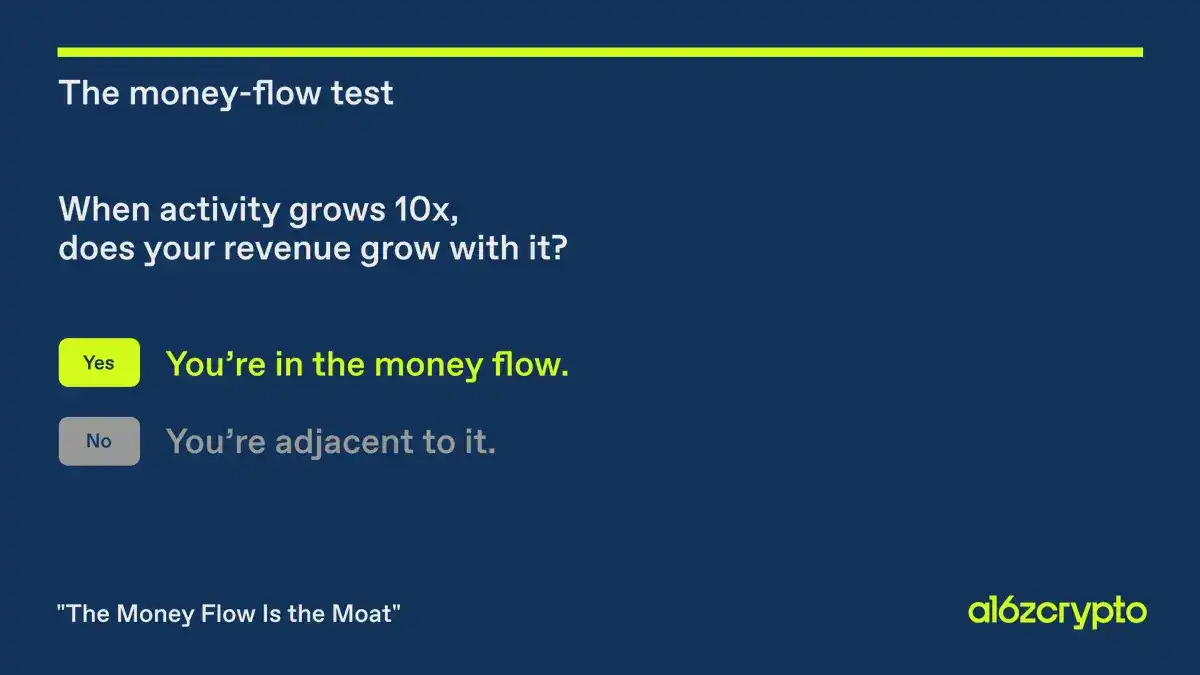
2. When the value of activity on your product grows 10x, does your revenue grow with it?

3. If you're building a new product, where in your target market is the margin extraction highest relative to the value being created?
The opportunity is there. Seize it, ride the new flow, and let the network compound from there.


Trending Cryptos

Related Questions

QAccording to the article, what are the core characteristics of successful business models historically?

AHistorically, many of the best businesses positioned themselves within 'cash flows'—facilitating the creation and transfer of value within a network and taking a cut of that flow. The more value that flows through the network, the larger the business typically becomes.

QHow does the article describe the fundamental advantage that cryptocurrency offers for startups?

ACryptocurrency is the first modern technology natively built for cash flow. It enables value to move at internet speed—24/7, global settlement, with end-to-end programmability—providing startups with accessible and scalable network effects and open unit economics from the start.

QWhat is the relationship between network tokens and business growth as explained in the text?

AWell-designed network tokens align users, developers, suppliers, validators, and the protocol around a single outcome: growing the network. Participants are paid proportionally to their contributions. This creates a feedback loop between the value flowing through the system and the value accumulating to those building it, without private deals or rebates.

QWhat does the phrase 'your margin is my opportunity' refer to in the context of the article?

AIt refers to the opportunity for new, often crypto-native, businesses to compete by targeting high-margin areas in traditional industries (especially financial services). By reducing costs, increasing speed, and building on programmable infrastructure, they can capture market share from established players with inefficient profit structures.

QWhat are the three key questions founders should ask themselves, according to the article's conclusion?

A1. Are you in the cash flow today? 2. When the value of activity on your product grows 10x, does your revenue grow with it? 3. If you're building a new product, where in your target market is the profit-taking highest relative to the value being created?

Related Reads

TechFlow Intelligence Bureau: Anthropic IPO Odds Exceed 80%, Iran Closes Strait of Hormuz Again, Triggering Oil Price Volatility

**Market Digest** **AI & Tech:** Anthropic is widely expected to announce an IPO before November 2026, raising questions about balancing its trillion-dollar valuation ambitions with its core "AI safety" mission. Brands are increasingly adopting AI-generated virtual influencers for marketing. Cloudflare introduced temporary accounts for AI agents to ease automation workflows. **Infrastructure & Hardware:** Google's IPv6 traffic surpassed 50%, marking a major internet milestone. Goldman Sachs warned that massive projected AI capital expenditure ($5.3T) is approaching credit saturation limits, potentially curbing the "AI arms race." **Space & Robotics:** SpaceX's IPO saw a historic $370M retail buying frenzy in three days. Hyundai Motor Group plans to acquire full ownership of Boston Dynamics. Elon Musk speculated about future "septillion-dollar" investments in antimatter for interstellar travel. **Energy & Geopolitics:** Iran's military announced another closure of the strategic Strait of Hormuz, accusing Israel of violating a ceasefire, causing oil market volatility. However, ship-tracking data indicated some traffic continued. Concurrently, Iran resumed crude loadings at Kharg Island, potentially releasing up to 20 million barrels to the market. **Finance & Macro:** A European CLO (collateralized loan obligation) experienced its first post-2008-crisis-era equity tranche default, raising alarms in credit markets. Nomura warned that new Federal Reserve Chair Wash's perceived hawkish debut speech could signal a significant policy shift. **The Undercurrent:** Seemingly disparate events—the Strait of Hormuz tension, the European CLO default, and warnings on AI spending—point to a tightening of global liquidity and rising marginal costs across energy, credit, and tech investment. Meanwhile, capital continues chasing grand narratives like space exploration and advanced AI, highlighting a divergence where old-world leverage frays as new-world stories grow more ambitious.

marsbit36m ago

TechFlow Intelligence Bureau: Anthropic IPO Odds Exceed 80%, Iran Closes Strait of Hormuz Again, Triggering Oil Price Volatility

marsbit36m ago

The Hunter Becomes the Hunted: The Most Profitable MEV Bot Gets Hacked

A well-known and highly profitable Ethereum MEV Bot, Jaredfromsubway.eth, suffered a sophisticated on-chain attack this Saturday, losing over $7.5 million. Analysis by Blockaid and others reveals this was not a conventional phishing or smart contract exploit, but a targeted "counter-MEV honeypot attack." The attacker meticulously laid a trap over several weeks, deploying 66 fake token contracts and liquidity pools disguised as major assets like WETH and USDC. These pools created the illusion of arbitrage opportunities. The MEV Bot's automated system detected these signals, executed trades, and in the process, granted approval permissions to attacker-controlled contracts. These approvals were not revoked, creating a persistent vulnerability. The attacker then exploited this in a single transaction, draining the bot's ETH, USDC, and USDT holdings. Jaredfromsubway.eth is notorious as one of Ethereum's most active and profitable MEV Bots, primarily known for executing "sandwich attacks" to profit from transaction slippage. Estimates suggest it has earned tens of millions in MEV revenue. The incident highlights escalating crypto security threats, demonstrating that even top-tier automated "predators" are vulnerable to novel, logic-based attacks designed to exploit their own operational rules. Following the hack, an unverified X account impersonating Jaredfromsubway.eth emerged, falsely offering a bounty for the return of funds, prompting developer warnings for users to stay vigilant.

marsbit1h ago

The Hunter Becomes the Hunted: The Most Profitable MEV Bot Gets Hacked

marsbit1h ago

The Reality of Payments in Latin America Is Not What You Think

The payment landscape in Latin America is undergoing a fundamental shift, driven by on-the-ground realities that challenge common perceptions. Based on over 500 hours of field research across the region, key insights emerge. Firstly, QR code payments, like Brazil's Pix, are becoming the dominant payment method in most emerging markets, overtaking cards. However, these domestic instant payment systems lack international interoperability, creating a significant gap for cross-border users. Secondly, the narrative around crypto cards is often misunderstood; their primary volume comes from high-net-worth professionals using them for salary conversions (e.g., USDT to local currency via Pix), not retail micro-payments. Competition in payments is shifting from customer acquisition to controlling the settlement layer, leading fintechs to acquire banking licenses for efficiency. Thirdly, treating "Latin America" as a single market is a mistake. Countries like Argentina, Brazil, and Mexico have distinct economic realities, user segments, and regulatory approaches. Brazil alone has at least five distinct user segments with different financial flows. Overlooked markets like Guatemala, Honduras, and El Salvador (the "forgotten five") offer high remittance volumes with lower competitive density. Finally, regulation in Latin America is often ahead of the US, with clearer frameworks for digital assets and a pragmatic approach from regulators focused on safety rather than obstruction. The margin on stablecoin forex is rapidly compressing toward zero, meaning future winners will be those building value-added services on top of the infrastructure, not just the cheapest exchange.

marsbit2h ago

The Reality of Payments in Latin America Is Not What You Think

marsbit2h ago

Trading

Spot
Futures

Hot Articles

How to Buy FLOW

Welcome to HTX.com! We've made purchasing Flow (FLOW) simple and convenient. Follow our step-by-step guide to embark on your crypto journey.Step 1: Create Your HTX AccountUse your email or phone number to sign up for a free account on HTX. Experience a hassle-free registration journey and unlock all features.Get My AccountStep 2: Go to Buy Crypto and Choose Your Payment MethodCredit/Debit Card: Use your Visa or Mastercard to buy Flow (FLOW) instantly.Balance: Use funds from your HTX account balance to trade seamlessly.Third Parties: We've added popular payment methods such as Google Pay and Apple Pay to enhance convenience.P2P: Trade directly with other users on HTX.Over-the-Counter (OTC): We offer tailor-made services and competitive exchange rates for traders.Step 3: Store Your Flow (FLOW)After purchasing your Flow (FLOW), store it in your HTX account. Alternatively, you can send it elsewhere via blockchain transfer or use it to trade other cryptocurrencies.Step 4: Trade Flow (FLOW)Easily trade Flow (FLOW) on HTX's spot market. Simply access your account, select your trading pair, execute your trades, and monitor in real-time. We offer a user-friendly experience for both beginners and seasoned traders.

3.3k Total ViewsPublished 2024.03.29Updated 2026.06.02

How to Buy FLOW

Discussions

Welcome to the HTX Community. Here, you can stay informed about the latest platform developments and gain access to professional market insights. Users' opinions on the price of FLOW (FLOW) are presented below.

活动图片