Cardano Founder Hoskinson Accused Of Selling 1.5 Billion ADA In 2021 Rally

bitcoinistPublished on 2026-06-10Last updated on 2026-06-10

Abstract

Cardano founder Charles Hoskinson faces new allegations from NFT creator Masato Alexander, who claims on-chain tracing reveals large ADA transactions linked to Hoskinson during the 2021 rally. Alexander's analysis suggests a 925 million ADA transaction and nine 20 million ADA payments had a closer common ancestor to IOG's funds than previously known, reducing intermediary hops. He published transaction graphs but noted this traces funding paths, not proving control or sales. This follows prior claims Hoskinson used "genesis keys" to move ~318 million unclaimed ADA into reserves. Hoskinson and a Cardano report denied this, stating most vouchers were redeemed. Separately, Thomas Braziel raised governance questions using Isle of Man filings, inquiring about foundation control and fund allocation during Cardano's early ICO period. Both sets of claims revisit debates over Cardano's early allocation and governance transparency.

Cardano founder Charles Hoskinson is facing a new round of allegations after NFT creator Masato Alexander published additional on-chain tracing work tied to large ADA movements during the 2021 market rally. The claims add another layer to an already contentious debate over Cardano’s early allocation history, governance structure, and voucher redemption process.

Large Cardano Flows To IOG-Linked Pool Pledges

Alexander, who previously became a central figure in the Cardano ADA voucher controversy, said on X that IOG’s on-chain footprint extended beyond its original Genesis UTxO and included several stake pools operated over the years. According to him, those pools required owners and pledged ADA, creating additional paths for tracing funds through Cardano’s UTxO model.

“However, IOG had a larger onchain footprint than just their Genesis UTxO, they operated a number of stake pools over the years,” Alexander wrote. “Each pool requires an owner and pledge ADA to be put up.”

The latest allegation is framed around large ADA transactions that critics claim were linked to Hoskinson and occurred during the 2021 rally. Alexander said his updated tracing work shows that both a 925 million ADA transaction and nine 20 million ADA payments had a closer common ancestor than IOG’s original genesis ADA. In his telling, that reduces the number of intermediary hops between IOG and the transactions from roughly 40 to between one and seven transactions.

“Turns out both the 925m AND the x9 20m payments have a closer common ancestor than IOG’s genesis ADA, which cuts the # of intermediary hops between IOG and these Txs from ~40 to ~1 to 7 Txs,” Alexander wrote. “They gather up ~21 of the 64m ADA pledge’s from IOG’s private pools.”

Alexander also published a dedicated transaction graph and a broader report containing what he described as a hop-by-hop trace, an interactive flow graph, and raw identifiers linked to Cardanoscan. He presented the work cautiously, saying it was not a final adjudication of intent or legal responsibility.

“This is best effort attempt at looking into what transpired on chain, draw your own conclusions,” he wrote. “If you find any errors in the data or methodology, please feel free to reach out and i’ll update it.”

The distinction matters. The material cited by Alexander focuses on tracing transaction ancestry and common funding paths. It does not, on its own, prove who controlled every wallet, whether funds were sold on exchanges, or what contractual obligations may have applied. It does, however, revive questions about Cardano’s early distribution and the transparency of large ADA movements during one of the asset’s most significant bull-market periods.

Isle Of Man Filings Add Another Governance Question

Alexander’s renewed claims follow his earlier allegation that Hoskinson used Cardano “genesis keys” during the 2021 Allegra hard fork to alter or sweep old ICO and voucher-related UTxOs, moving roughly 318 million ADA into Cardano reserves or treasury rather than leaving them directly claimable by original voucher holders.

Hoskinson denied that allegation, saying IOG did not give itself hundreds of millions of unclaimed ADA and that most vouchers were eventually redeemed.

A later Cardano redemption transparency report said the allegations had “no basis.” According to the report, 99.2% of vouchers representing 99.7% of ADA sold through the voucher program were redeemed. It also stated that after Byron-era on-chain redemption ended, 390 vouchers representing 318 million ADA remained unredeemed and were swept into the reserve while a post-sweep redemption process continued.

The scrutiny is not limited to Alexander’s on-chain work. Thomas Braziel of 117 Partners separately said he had collected original Isle of Man filings related to Cardano’s earliest foundation structure. Braziel said the documents appeared to show an early foundation involving Hoskinson, Jeremy Wood, Ken Kodama, and a corporate services provider, while later filings showed Hoskinson serving as the foundation’s “Enforcer.”

Under Isle of Man foundation law, Braziel argued, an Enforcer is not simply a passive observer but a key oversight role meant to ensure that the council follows the foundation’s purposes and governing documents. He linked that question to the timing of Cardano’s ICO, which began in September 2015, before the Swiss Cardano Foundation was established in September 2016.

“The question is not whether development companies should be compensated,” Braziel wrote. “The question is: who negotiated those arrangements on behalf of ICO participants and the Isle of Man Foundation?”

Braziel said he was “not alleging wrongdoing” but asking for documentation on who controlled the Isle of Man Foundation, what happened to roughly 1,090 BTC historical materials indicate were allocated to it, how development agreements were negotiated, and what governance protections existed for ADA purchasers.

At press time, ADA traded at $0.16.
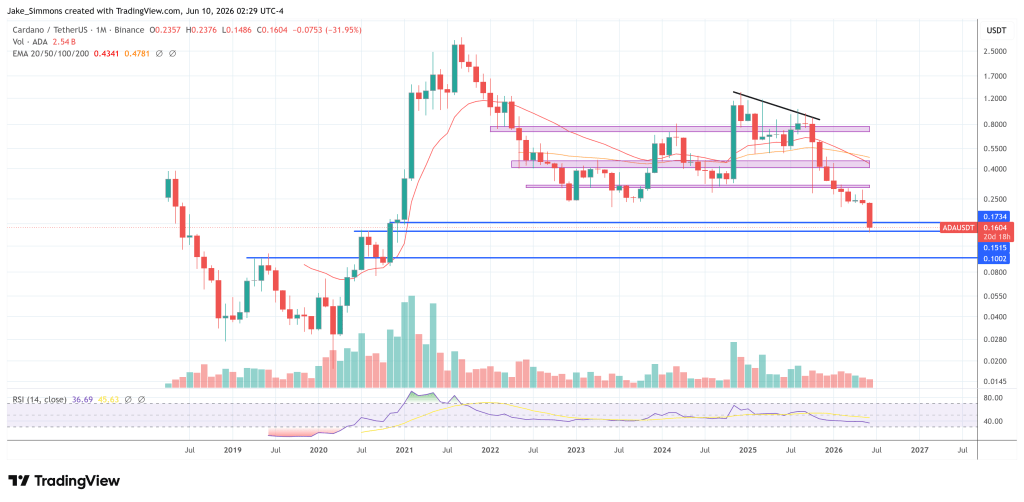
ADA hovers above key support, 1-month chart | Source: ADAUSDT on TradingView.com

Trending Cryptos

Related Questions

QWho published the on-chain tracing work that forms the basis of the new allegations against Charles Hoskinson?

AThe on-chain tracing work was published by NFT creator Masato Alexander.

QAccording to the article, what was the approximate total amount of ADA transactions that Alexander's tracing work focused on from the 2021 rally?

AThe tracing work focused on a 925 million ADA transaction and nine separate 20 million ADA payments, for an approximate total of 1.105 billion ADA.

QWhat does the article state was the outcome of the 318 million ADA in unredeemed vouchers after the Byron-era redemption ended?

AAccording to a later Cardano redemption transparency report cited in the article, the 318 million ADA from 390 unredeemed vouchers was swept into the Cardano reserve, while a post-sweep redemption process continued.

QWhat role in the early Isle of Man Foundation does Thomas Braziel claim Charles Hoskinson served, according to the filings he collected?

AThomas Braziel claims that later filings show Charles Hoskinson served as the "Enforcer" of the early Isle of Man Foundation.

QWhat is the core governance question Thomas Braziel raises based on the Isle of Man foundation documents and the timing of the ICO?

AThe core governance question he raises is: "who negotiated those arrangements [development agreements] on behalf of ICO participants and the Isle of Man Foundation?" given that the ICO began before the Swiss Cardano Foundation was established.

Related Reads

The Hunter Becomes the Hunted: The Most Profitable MEV Bot Gets Hacked

A well-known and highly profitable Ethereum MEV Bot, Jaredfromsubway.eth, suffered a sophisticated on-chain attack this Saturday, losing over $7.5 million. Analysis by Blockaid and others reveals this was not a conventional phishing or smart contract exploit, but a targeted "counter-MEV honeypot attack." The attacker meticulously laid a trap over several weeks, deploying 66 fake token contracts and liquidity pools disguised as major assets like WETH and USDC. These pools created the illusion of arbitrage opportunities. The MEV Bot's automated system detected these signals, executed trades, and in the process, granted approval permissions to attacker-controlled contracts. These approvals were not revoked, creating a persistent vulnerability. The attacker then exploited this in a single transaction, draining the bot's ETH, USDC, and USDT holdings. Jaredfromsubway.eth is notorious as one of Ethereum's most active and profitable MEV Bots, primarily known for executing "sandwich attacks" to profit from transaction slippage. Estimates suggest it has earned tens of millions in MEV revenue. The incident highlights escalating crypto security threats, demonstrating that even top-tier automated "predators" are vulnerable to novel, logic-based attacks designed to exploit their own operational rules. Following the hack, an unverified X account impersonating Jaredfromsubway.eth emerged, falsely offering a bounty for the return of funds, prompting developer warnings for users to stay vigilant.

marsbit27m ago

The Hunter Becomes the Hunted: The Most Profitable MEV Bot Gets Hacked

marsbit27m ago

The Reality of Payments in Latin America Is Not What You Think

The payment landscape in Latin America is undergoing a fundamental shift, driven by on-the-ground realities that challenge common perceptions. Based on over 500 hours of field research across the region, key insights emerge. Firstly, QR code payments, like Brazil's Pix, are becoming the dominant payment method in most emerging markets, overtaking cards. However, these domestic instant payment systems lack international interoperability, creating a significant gap for cross-border users. Secondly, the narrative around crypto cards is often misunderstood; their primary volume comes from high-net-worth professionals using them for salary conversions (e.g., USDT to local currency via Pix), not retail micro-payments. Competition in payments is shifting from customer acquisition to controlling the settlement layer, leading fintechs to acquire banking licenses for efficiency. Thirdly, treating "Latin America" as a single market is a mistake. Countries like Argentina, Brazil, and Mexico have distinct economic realities, user segments, and regulatory approaches. Brazil alone has at least five distinct user segments with different financial flows. Overlooked markets like Guatemala, Honduras, and El Salvador (the "forgotten five") offer high remittance volumes with lower competitive density. Finally, regulation in Latin America is often ahead of the US, with clearer frameworks for digital assets and a pragmatic approach from regulators focused on safety rather than obstruction. The margin on stablecoin forex is rapidly compressing toward zero, meaning future winners will be those building value-added services on top of the infrastructure, not just the cheapest exchange.

marsbit42m ago

The Reality of Payments in Latin America Is Not What You Think

marsbit42m ago

Making Music in a Bear Market: The Survival Experiment of a Bitcoin Band

"Orange Pill Jam: A Bitcoin Band's Survival in the Bear Market" Orange Pill Jam is a musical group exploring themes of financial sovereignty and privacy, born from the Bitcoin community. Formed after singer Mermaid performed her song "Dollar Apocalypse" at a 2022 conference, the band creates music intended for both Bitcoin enthusiasts and general audiences. Their creative process involves Mermaid writing lyrics and melodies, which producer/multi-instrumentalist Michi then shapes with a precise, rhythm-focused approach, often demanding numerous retakes to achieve his unique standard of timing. Their songs, like "Cypherpunks' Manifesto" and "Fire of Freedom," tackle concepts of digital privacy, the pitfalls of "free" services, and personal sovereignty, influenced by experiences in places like El Salvador. Despite operating in a crypto bear market with a Copyleft model (offering music for free sharing/remixing and accepting optional Bitcoin donations), they face practical challenges. Their growth is slow on platforms like YouTube and Spotify, which aren't optimized for their niche content. The band also navigates the rise of AI-generated music. While acknowledging AI's efficiency for certain tasks, they believe human creativity occupies a unique space that algorithms cannot replicate—the ability to create new genres and capture intangible rhythmic feeling. For Orange Pill Jam, the core argument for both Bitcoin in a downturn and human artistry in the AI age lies in this irreplaceable, intentional, and imperfectly human creative process. Their project persists as an anti-algorithm experiment, valuing the unquantifiable impact of music over scalable metrics.

marsbit49m ago

Making Music in a Bear Market: The Survival Experiment of a Bitcoin Band

marsbit49m ago

Trading

Spot
Futures

Hot Articles

Discussions

Welcome to the HTX Community. Here, you can stay informed about the latest platform developments and gain access to professional market insights. Users' opinions on the price of ADA (ADA) are presented below.

活动图片