Zcash Bug Could Have Minted Unlimited ZEC Undetected

bitcoinistPublished on 2026-06-05Last updated on 2026-06-05

Abstract

A critical vulnerability in Zcash's Orchard shielded pool, discovered by researcher Taylor Hornby on May 29, 2026, could have allowed an attacker to create an unlimited amount of undetectable counterfeit ZEC. The flaw, involving an under-constrained element in the Orchard circuit, existed from the pool's 2022 activation until an emergency fix was deployed by June 2, 2026. Hornby identified the bug using AI-assisted auditing tools and confirmed its exploitability in a test environment. Due to Orchard's privacy features, which hide transaction amounts and history, there is no cryptographic way to prove whether the vulnerability was exploited before the fix. While Shielded Labs assesses prior exploitation as unlikely, this uncertainty has sparked a debate on proving supply integrity in privacy-preserving systems. In response, Shielded Labs and other developers are exploring a network upgrade, potentially involving a new shielded pool and formal verification of the circuit rules to prevent future vulnerabilities and allow verification of the ZEC supply's integrity. ZEC's price fell nearly 45% following the disclosure.

A critical vulnerability in Zcash’s Orchard shielded pool could have allowed an attacker to create an unlimited amount of counterfeit ZEC without detection, according to a new disclosure from Zooko Wilcox, Jason McGee and security researcher Taylor Hornby. The flaw was discovered on May 29, remediated through an emergency ecosystem response completed by June 2, and has now triggered a broader debate over how Zcash can prove supply integrity in a privacy-preserving system.

Orchard Flaw Puts Zcash Supply Integrity Under Scrutiny

The vulnerability was found by Hornby, an experienced security engineer hired by Shielded Labs in April 2026 to conduct ongoing security research on the Zcash protocol. According to the disclosure, the mandate was straightforward: find protocol-level weaknesses before adversaries did. Hornby began reviewing Zcash with a combination of traditional security research and newer AI-assisted auditing methods.

The timing was unusually compressed. Shortly after Anthropic released its Opus 4.8 model on May 28, Hornby used it in a targeted review of the Orchard circuit. One day later, he found a critical counterfeiting flaw and disclosed it to Zcash Open Development Lab, or ZODL, whose engineers coordinated the emergency response with other ecosystem participants.

“The vulnerability could have been exploited to undetectably create an unlimited amount of counterfeit ZEC within Orchard,” the Shielded Labs post said. “Because of the privacy properties of Orchard, there is no way to cryptographically prove whether the vulnerability was exploited before it was remediated. However, a network upgrade can be deployed to protect users and prove the integrity of the Zcash supply.”

The disclosure states that the bug was “real and exploitable.” Hornby, with the help of Opus 4.8, wrote a complete exploit and tested it in a local regtest environment, where it generated unlimited counterfeit ZEC that could not be detected. The authors said that had the same tool been run on mainnet, it would have generated unlimited, undetectable counterfeit ZEC in Hornby’s mainnet wallet.

Technically, the issue involved an under-constrained element of the Orchard circuit. That made it possible to feed arbitrary false inputs into an elliptic curve multiplication while still passing the multiplication check. The vulnerability existed from Orchard’s activation in May 2022 until the emergency fix was deployed on June 1, 2026.

That timeline is central to the concern. In a transparent ledger, supply irregularities can generally be audited by inspecting public balances and transaction values. Orchard is different by design: it hides amounts and transaction history. That privacy model means the system depends heavily on the correctness of the circuit rules that define valid shielded transactions.

Josh Swihart, founder and CEO of Zcash Open Development Lab, the team behind the creation and launch of Zcash and builder of the Zodl wallet, framed the issue in those terms in a separate post. “A shielded Zcash transaction includes a proof that it followed the protocol’s rules, as defined in the rulebook (the circuit) that defines what constitutes a valid transaction. The Orchard vulnerability was in one of the rules, written loosely enough that it would accept false information and still pass. As a result, the engine could be convinced that a fake transaction was valid.”

Swihart added that the flaw was not in Zcash’s underlying cryptography or the proof engine itself, but in the handwritten rules. In his words, “This was a flaw in the handwritten rules, not in the underlying cryptography or the engine that creates proofs.”

Shielded Labs said prior exploitation appears unlikely, while emphasizing that users should not be asked to rely on that assessment alone. The authors pointed to several reasons for their view: the flaw had evaded years of scrutiny by leading cryptographers, Hornby was specifically hired to find such vulnerabilities, and the response window after discovery was sharply narrowed by the speed of ZODL and the broader Zcash ecosystem.

“The discovery was not accidental—it was the result of a deliberate effort to identify vulnerabilities of this kind before malicious actors could,” the post said. “Taylor is one of the most skilled people in the world at this. He used the most recent AI tools, available only to white-hat security researchers, along with a sophisticated custom-built AI harness and prompts, and worked hard to outrace the attackers. We think he probably succeeded.”

Still, the authors acknowledged the unresolved cryptographic uncertainty. Because of Orchard’s privacy properties and the nature of the bug, they said there is no definitive way to prove solely through cryptography whether the vulnerability was exploited before the fix.

Shielded Labs Eyes New Pool And Formal Verification

To address that, Shielded Labs is exploring a proposed network upgrade with other Zcash developers. The plan would deploy a new shielded pool and enforce turnstile accounting on coins moving from the existing Orchard pool, with the goal of allowing anyone to verify the integrity of the Zcash supply and prove the non-existence of counterfeit ZEC in Orchard. A follow-up post is expected next week with more details, including tradeoffs and implementation mechanics. Any major upgrade would still need community support and the standard governance process before activation.

Swihart said a second Orchard pool could, in principle, be targeted for NU7 at the end of July, though he did not take a fixed position on whether that path should be pursued. He argued that the larger issue is preventing this class of failure from recurring, with formal verification as the strongest answer.

“Formal verification fixes this,” Swihart wrote. “A mathematical proof can be constructed to reduce the parts humans must review to a concise, readable statement of the rules. A computer then checks the entire rulebook to ensure it matches. AI tools can now do the work of writing these proofs.”

Shielded Labs said it is already accelerating proactive security work with Hornby and Anthropic, initiating a project to formally verify the Orchard circuit, and opening searches for a Head of Security and a Cryptographer. The episode leaves Zcash with a difficult but clear path: repair the trust assumptions around Orchard, prove supply integrity where possible, and move future shielded design closer to machine-checked guarantees rather than human-reviewed complexity.

Over the past 24 hours, ZEC has fallen nearly 45% amid the uncertainty. At press time, it was trading at $337.
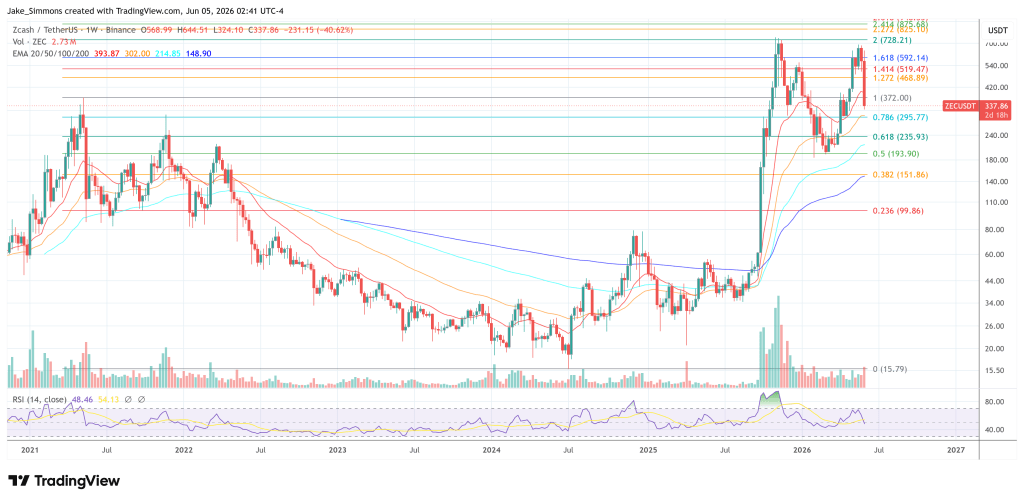
ZEC trades below the 1.618 Fib again, 1-week chart | Source: ZECUSDT on TradingView.com

Trending Cryptos

Related Questions

QWhat was the nature of the critical vulnerability discovered in Zcash's Orchard shielded pool?

AThe vulnerability was a critical counterfeiting flaw. An under-constrained element in the Orchard circuit allowed an attacker to feed arbitrary false inputs into an elliptic curve multiplication while still passing the multiplication check, potentially enabling the creation of an unlimited amount of counterfeit ZEC that could not be detected.

QWho discovered the vulnerability, and what tools aided in its discovery?

AThe vulnerability was discovered by security researcher Taylor Hornby, who was hired by Shielded Labs. He used a combination of traditional security research and newer AI-assisted auditing methods, specifically employing Anthropic's Opus 4.8 model released on May 28 in a targeted review of the Orchard circuit, which led to the discovery the next day.

QWhy is it impossible to cryptographically prove whether the Orchard vulnerability was exploited before it was fixed?

ADue to the privacy properties of the Orchard shielded pool, which hides transaction amounts and history by design. This means supply irregularities cannot be audited by inspecting public data, unlike transparent ledgers. The system relies on the correctness of the circuit rules, and the bug's nature leaves no definitive cryptographic trace of prior exploitation.

QWhat proposed solution is Shielded Labs exploring to address the supply integrity concerns raised by the Orchard bug?

AShielded Labs is exploring a proposed network upgrade to deploy a new shielded pool. This plan would enforce turnstile accounting on coins moving from the existing Orchard pool, with the goal of allowing anyone to verify the integrity of the Zcash supply and prove the non-existence of counterfeit ZEC in Orchard.

QAccording to Josh Swihart, what is the strongest long-term solution to prevent this class of failure from recurring?

AJosh Swihart identified formal verification as the strongest answer. This involves constructing a mathematical proof to reduce the human-reviewed parts to a concise statement of the rules, and then using a computer to check that the entire rulebook matches those rules, with AI tools now capable of writing these proofs.

Related Reads

TechFlow Intelligence Bureau: Anthropic IPO Odds Exceed 80%, Iran Closes Strait of Hormuz Again, Triggering Oil Price Volatility

**Market Digest** **AI & Tech:** Anthropic is widely expected to announce an IPO before November 2026, raising questions about balancing its trillion-dollar valuation ambitions with its core "AI safety" mission. Brands are increasingly adopting AI-generated virtual influencers for marketing. Cloudflare introduced temporary accounts for AI agents to ease automation workflows. **Infrastructure & Hardware:** Google's IPv6 traffic surpassed 50%, marking a major internet milestone. Goldman Sachs warned that massive projected AI capital expenditure ($5.3T) is approaching credit saturation limits, potentially curbing the "AI arms race." **Space & Robotics:** SpaceX's IPO saw a historic $370M retail buying frenzy in three days. Hyundai Motor Group plans to acquire full ownership of Boston Dynamics. Elon Musk speculated about future "septillion-dollar" investments in antimatter for interstellar travel. **Energy & Geopolitics:** Iran's military announced another closure of the strategic Strait of Hormuz, accusing Israel of violating a ceasefire, causing oil market volatility. However, ship-tracking data indicated some traffic continued. Concurrently, Iran resumed crude loadings at Kharg Island, potentially releasing up to 20 million barrels to the market. **Finance & Macro:** A European CLO (collateralized loan obligation) experienced its first post-2008-crisis-era equity tranche default, raising alarms in credit markets. Nomura warned that new Federal Reserve Chair Wash's perceived hawkish debut speech could signal a significant policy shift. **The Undercurrent:** Seemingly disparate events—the Strait of Hormuz tension, the European CLO default, and warnings on AI spending—point to a tightening of global liquidity and rising marginal costs across energy, credit, and tech investment. Meanwhile, capital continues chasing grand narratives like space exploration and advanced AI, highlighting a divergence where old-world leverage frays as new-world stories grow more ambitious.

marsbit35m ago

TechFlow Intelligence Bureau: Anthropic IPO Odds Exceed 80%, Iran Closes Strait of Hormuz Again, Triggering Oil Price Volatility

marsbit35m ago

The Hunter Becomes the Hunted: The Most Profitable MEV Bot Gets Hacked

A well-known and highly profitable Ethereum MEV Bot, Jaredfromsubway.eth, suffered a sophisticated on-chain attack this Saturday, losing over $7.5 million. Analysis by Blockaid and others reveals this was not a conventional phishing or smart contract exploit, but a targeted "counter-MEV honeypot attack." The attacker meticulously laid a trap over several weeks, deploying 66 fake token contracts and liquidity pools disguised as major assets like WETH and USDC. These pools created the illusion of arbitrage opportunities. The MEV Bot's automated system detected these signals, executed trades, and in the process, granted approval permissions to attacker-controlled contracts. These approvals were not revoked, creating a persistent vulnerability. The attacker then exploited this in a single transaction, draining the bot's ETH, USDC, and USDT holdings. Jaredfromsubway.eth is notorious as one of Ethereum's most active and profitable MEV Bots, primarily known for executing "sandwich attacks" to profit from transaction slippage. Estimates suggest it has earned tens of millions in MEV revenue. The incident highlights escalating crypto security threats, demonstrating that even top-tier automated "predators" are vulnerable to novel, logic-based attacks designed to exploit their own operational rules. Following the hack, an unverified X account impersonating Jaredfromsubway.eth emerged, falsely offering a bounty for the return of funds, prompting developer warnings for users to stay vigilant.

marsbit1h ago

The Hunter Becomes the Hunted: The Most Profitable MEV Bot Gets Hacked

marsbit1h ago

The Reality of Payments in Latin America Is Not What You Think

The payment landscape in Latin America is undergoing a fundamental shift, driven by on-the-ground realities that challenge common perceptions. Based on over 500 hours of field research across the region, key insights emerge. Firstly, QR code payments, like Brazil's Pix, are becoming the dominant payment method in most emerging markets, overtaking cards. However, these domestic instant payment systems lack international interoperability, creating a significant gap for cross-border users. Secondly, the narrative around crypto cards is often misunderstood; their primary volume comes from high-net-worth professionals using them for salary conversions (e.g., USDT to local currency via Pix), not retail micro-payments. Competition in payments is shifting from customer acquisition to controlling the settlement layer, leading fintechs to acquire banking licenses for efficiency. Thirdly, treating "Latin America" as a single market is a mistake. Countries like Argentina, Brazil, and Mexico have distinct economic realities, user segments, and regulatory approaches. Brazil alone has at least five distinct user segments with different financial flows. Overlooked markets like Guatemala, Honduras, and El Salvador (the "forgotten five") offer high remittance volumes with lower competitive density. Finally, regulation in Latin America is often ahead of the US, with clearer frameworks for digital assets and a pragmatic approach from regulators focused on safety rather than obstruction. The margin on stablecoin forex is rapidly compressing toward zero, meaning future winners will be those building value-added services on top of the infrastructure, not just the cheapest exchange.

marsbit2h ago

The Reality of Payments in Latin America Is Not What You Think

marsbit2h ago

Trading

Spot
Futures

Hot Articles

How to Buy ZEC

Welcome to HTX.com! We've made purchasing Zcash (ZEC) simple and convenient. Follow our step-by-step guide to embark on your crypto journey.Step 1: Create Your HTX AccountUse your email or phone number to sign up for a free account on HTX. Experience a hassle-free registration journey and unlock all features.Get My AccountStep 2: Go to Buy Crypto and Choose Your Payment MethodCredit/Debit Card: Use your Visa or Mastercard to buy Zcash (ZEC) instantly.Balance: Use funds from your HTX account balance to trade seamlessly.Third Parties: We've added popular payment methods such as Google Pay and Apple Pay to enhance convenience.P2P: Trade directly with other users on HTX.Over-the-Counter (OTC): We offer tailor-made services and competitive exchange rates for traders.Step 3: Store Your Zcash (ZEC)After purchasing your Zcash (ZEC), store it in your HTX account. Alternatively, you can send it elsewhere via blockchain transfer or use it to trade other cryptocurrencies.Step 4: Trade Zcash (ZEC)Easily trade Zcash (ZEC) on HTX's spot market. Simply access your account, select your trading pair, execute your trades, and monitor in real-time. We offer a user-friendly experience for both beginners and seasoned traders.

3.4k Total ViewsPublished 2024.03.29Updated 2026.06.02

How to Buy ZEC

Discussions

Welcome to the HTX Community. Here, you can stay informed about the latest platform developments and gain access to professional market insights. Users' opinions on the price of ZEC (ZEC) are presented below.

活动图片