Here’s why ‘under pressure’ ONDO could see a price reversal after strong RWA inflows

ambcryptoPublished on 2026-03-28Last updated on 2026-03-28

Abstract

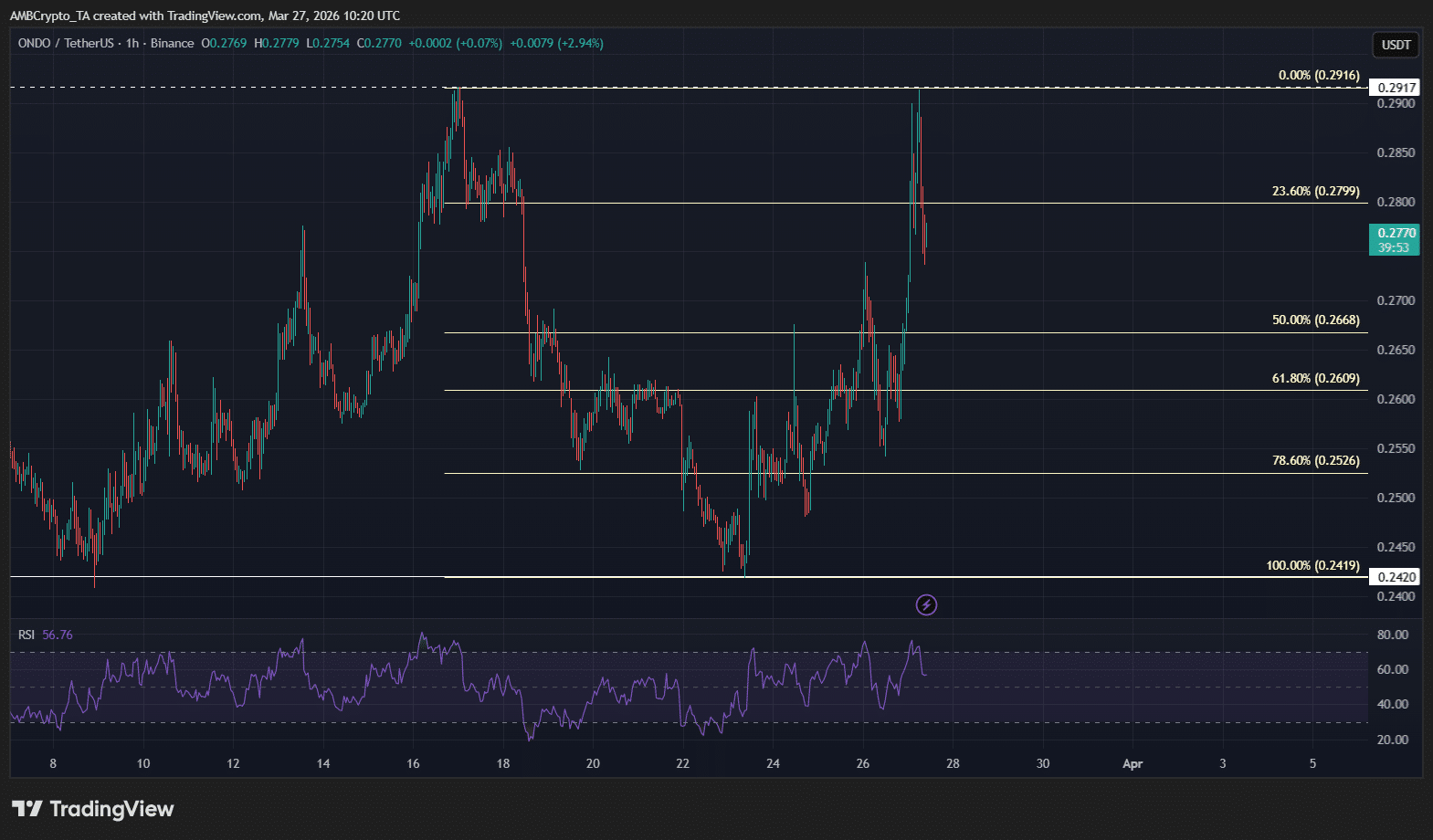
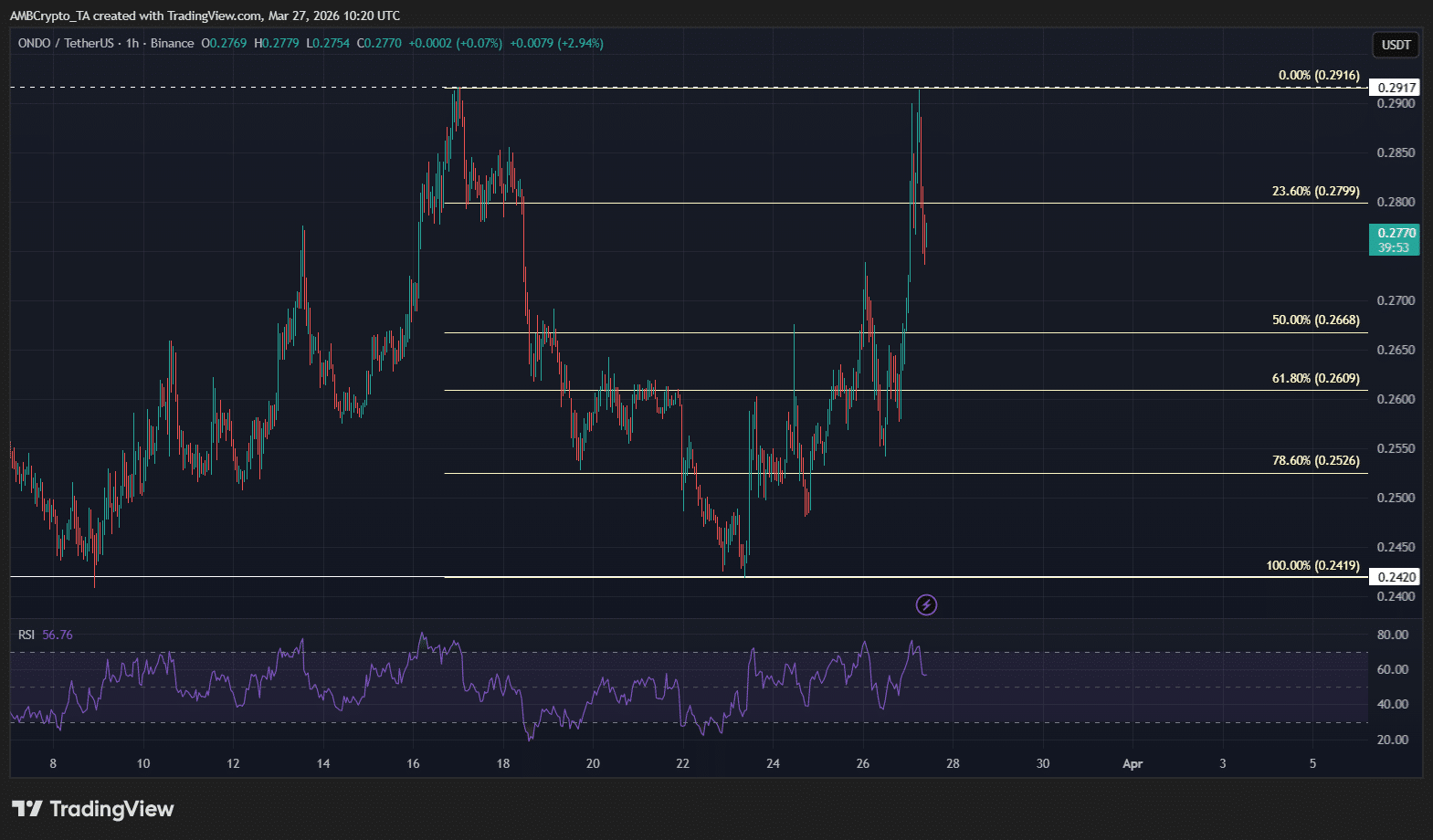
ONDO Finance (ONDO) is trading near $0.277 after rebounding from the $0.242 support level. Despite facing rejection at the $0.291 resistance zone, the price is holding near the 23.6% Fibonacci level at $0.2799, which now acts as immediate support. A break below this level could lead to further declines toward $0.2668 or even $0.255–$0.242. The RSI near 56 indicates neutral momentum. The token's resilience is partly attributed to strong real-world asset (RWA) inflows, fueled by Ondo Finance's partnership with Franklin Templeton to tokenize five ETFs, providing round-the-clock access to approximately $1.7 trillion in managed assets. This has strengthened ONDO's position in the RWA sector, attracting institutional capital seeking yield stability. ONDO's Distributed Asset Value has surpassed $2.65 billion, supported by steady demand for tokenized U.S. Treasuries and growing sector-wide interest, with Tokenized Treasuries exceeding $12 billion. Despite short-term selling pressure, underlying RWA-driven demand and capital rotation into yield-focused assets may support a potential price recovery.

ONDO Finance [ONDO]was trading near $0.277, at the time of writing, after rebounding from the $0.242-level. Around this level, buyers absorbed selling pressure and rebuilt the short-term structure.

As the price advanced, it tested the $0.291 resistance zone. This was followed by a sharp rejection, showing sellers remain active and continue to cap upside attempts. This reaction also highlights persistent overhead supply, with the pullback towards $0.279 reflecting short-term profit-taking rather than structural failure.
Source: TradingView

However, the price seemed to be still holding near the 23.6% Fibonacci level at $0.2799 – A level that now acts as immediate support, suggesting buyers may be defending higher lows and maintaining range control. If this level weakens, downside could extend towards $0.2668, followed by a deeper move towards $0.255–$0.242 if selling pressure accelerates.

The RSI near 56 reflected neutral momentum, reinforcing indecision. A reclaim above $0.291 could push ONDO towards $0.305–$0.315, while failure to hold $0.279 would likely shift structure towards a broader retracement.

Franklin Templeton deal fuels ONDO’s RWA strength

ONDO holding firm near its resistance may be illustrative of a shift in behavior as sustained bids absorb sell-side pressure instead of signaling exhaustion. Despite broader altcoins showing weak participation, ONDO has so far avoided any breakdowns – A sign that capital rotates selectively rather than exiting entirely.

This shift will only strengthen as narrative-driven demand grows, following Ondo Finance’s partnership with Franklin Templeton to tokenize five ETFs. This move enables round-the-clock access to about $1.7 trillion in managed assets through on-chain infrastructure, expanding real-world asset exposure.

As this development unfolds, it will reinforce ONDO’s positioning within a sector attracting institutional attention and sustained capital flows. Holding near resistance now signals positioning rather than indecision, where sustained demand could drive a breakout. All while fading interest risks weakening momentum.

ONDO gains as yield-focused capital reshapes altcoin flows

Finally, ONDO’s strength has continued to build as capital shifts towards RWA-linked assets, where tokenized yield offers stability over speculative volatility. As broader altcoins struggle to attract sustained flows, ONDO benefits from positioning within tokenized U.S. Treasuries. This draws institutional capital seeking consistent returns.

This dynamic became clearer as USDY climbed to about $1.337 billion, rising by 10.36% while offering a 3.55% yield. All while OUSG held near $681 million, reinforcing steady demand. Together, these pushed Ondo’s Distributed Asset Value above $2.65 billion, supported by monthly transfers near $2.55 billion – A sign of sustained usage rather than episodic spikes.

This trend also aligns with Tokenized Treasuries exceeding $12 billion sector-wide. This seemed to imply that ONDO remains positioned to capture further inflows as institutional demand strengthens.



Final Summary

  • ONDO weakened below $0.279 support as selling pressure built under $0.291 resistance, exposing downside towards $0.2668 and potentially, $0.255–$0.242.
  • ONDO retains underlying strength from RWA-driven demand and $2.65B asset growth.

Trending Cryptos

Related Questions

QWhat is the current trading price of ONDO and what key level did it rebound from?

AONDO was trading near $0.277 at the time of writing, after rebounding from the $0.242-level.

QWhat resistance zone did ONDO test and what does the rejection at this level indicate?

AONDO tested the $0.291 resistance zone, and the sharp rejection indicates that sellers remain active and continue to cap upside attempts, highlighting persistent overhead supply.

QWhat partnership has strengthened ONDO's position in the Real-World Asset (RWA) sector?

AOndo Finance's partnership with Franklin Templeton to tokenize five ETFs has strengthened ONDO's RWA position, enabling round-the-clock access to about $1.7 trillion in managed assets.

QWhat is the significance of ONDO holding near the 23.6% Fibonacci level at $0.2799?

AHolding near the 23.6% Fibonacci level at $0.2799 suggests buyers may be defending higher lows and maintaining range control. If this level weakens, downside could extend towards $0.2668.

QHow has ONDO's Distributed Asset Value been supported, and what does it indicate?

AONDO's Distributed Asset Value has exceeded $2.65 billion, supported by monthly transfers near $2.55 billion, indicating sustained usage rather than episodic spikes.

Related Reads

The Hunter Becomes the Hunted: The Most Profitable MEV Bot Gets Hacked

A well-known and highly profitable Ethereum MEV Bot, Jaredfromsubway.eth, suffered a sophisticated on-chain attack this Saturday, losing over $7.5 million. Analysis by Blockaid and others reveals this was not a conventional phishing or smart contract exploit, but a targeted "counter-MEV honeypot attack." The attacker meticulously laid a trap over several weeks, deploying 66 fake token contracts and liquidity pools disguised as major assets like WETH and USDC. These pools created the illusion of arbitrage opportunities. The MEV Bot's automated system detected these signals, executed trades, and in the process, granted approval permissions to attacker-controlled contracts. These approvals were not revoked, creating a persistent vulnerability. The attacker then exploited this in a single transaction, draining the bot's ETH, USDC, and USDT holdings. Jaredfromsubway.eth is notorious as one of Ethereum's most active and profitable MEV Bots, primarily known for executing "sandwich attacks" to profit from transaction slippage. Estimates suggest it has earned tens of millions in MEV revenue. The incident highlights escalating crypto security threats, demonstrating that even top-tier automated "predators" are vulnerable to novel, logic-based attacks designed to exploit their own operational rules. Following the hack, an unverified X account impersonating Jaredfromsubway.eth emerged, falsely offering a bounty for the return of funds, prompting developer warnings for users to stay vigilant.

marsbit28m ago

The Hunter Becomes the Hunted: The Most Profitable MEV Bot Gets Hacked

marsbit28m ago

The Reality of Payments in Latin America Is Not What You Think

The payment landscape in Latin America is undergoing a fundamental shift, driven by on-the-ground realities that challenge common perceptions. Based on over 500 hours of field research across the region, key insights emerge. Firstly, QR code payments, like Brazil's Pix, are becoming the dominant payment method in most emerging markets, overtaking cards. However, these domestic instant payment systems lack international interoperability, creating a significant gap for cross-border users. Secondly, the narrative around crypto cards is often misunderstood; their primary volume comes from high-net-worth professionals using them for salary conversions (e.g., USDT to local currency via Pix), not retail micro-payments. Competition in payments is shifting from customer acquisition to controlling the settlement layer, leading fintechs to acquire banking licenses for efficiency. Thirdly, treating "Latin America" as a single market is a mistake. Countries like Argentina, Brazil, and Mexico have distinct economic realities, user segments, and regulatory approaches. Brazil alone has at least five distinct user segments with different financial flows. Overlooked markets like Guatemala, Honduras, and El Salvador (the "forgotten five") offer high remittance volumes with lower competitive density. Finally, regulation in Latin America is often ahead of the US, with clearer frameworks for digital assets and a pragmatic approach from regulators focused on safety rather than obstruction. The margin on stablecoin forex is rapidly compressing toward zero, meaning future winners will be those building value-added services on top of the infrastructure, not just the cheapest exchange.

marsbit43m ago

The Reality of Payments in Latin America Is Not What You Think

marsbit43m ago

Making Music in a Bear Market: The Survival Experiment of a Bitcoin Band

"Orange Pill Jam: A Bitcoin Band's Survival in the Bear Market" Orange Pill Jam is a musical group exploring themes of financial sovereignty and privacy, born from the Bitcoin community. Formed after singer Mermaid performed her song "Dollar Apocalypse" at a 2022 conference, the band creates music intended for both Bitcoin enthusiasts and general audiences. Their creative process involves Mermaid writing lyrics and melodies, which producer/multi-instrumentalist Michi then shapes with a precise, rhythm-focused approach, often demanding numerous retakes to achieve his unique standard of timing. Their songs, like "Cypherpunks' Manifesto" and "Fire of Freedom," tackle concepts of digital privacy, the pitfalls of "free" services, and personal sovereignty, influenced by experiences in places like El Salvador. Despite operating in a crypto bear market with a Copyleft model (offering music for free sharing/remixing and accepting optional Bitcoin donations), they face practical challenges. Their growth is slow on platforms like YouTube and Spotify, which aren't optimized for their niche content. The band also navigates the rise of AI-generated music. While acknowledging AI's efficiency for certain tasks, they believe human creativity occupies a unique space that algorithms cannot replicate—the ability to create new genres and capture intangible rhythmic feeling. For Orange Pill Jam, the core argument for both Bitcoin in a downturn and human artistry in the AI age lies in this irreplaceable, intentional, and imperfectly human creative process. Their project persists as an anti-algorithm experiment, valuing the unquantifiable impact of music over scalable metrics.

marsbit50m ago

Making Music in a Bear Market: The Survival Experiment of a Bitcoin Band

marsbit50m ago

Trading

Spot
Futures

Hot Articles

Discussions

Welcome to the HTX Community. Here, you can stay informed about the latest platform developments and gain access to professional market insights. Users' opinions on the price of S (S) are presented below.

活动图片