Undercurrents of Capital in the Midst of Middle East Turmoil: Option Data Reveals BTC's Safe-Haven Logic

比推Published on 2026-03-02Last updated on 2026-03-02

Abstract

Amidst the unprecedented geopolitical shock triggered by the U.S.-Israel military strike on Iran on March 1, 2026, global markets witnessed a classic flight to safety, with oil and gold surging while risk assets faced initial sell-offs. Bitcoin, positioned between its “digital gold” narrative and high-risk asset attributes, showed resilience by holding the key support level of $67,000. Deribit期权数据揭示BTC期权隐含波动率 surged to 51.3%, reflecting heightened expectations of near-term volatility. The significant divergence between the spot price (~$67,400) and the options max pain point at $76,000 indicates persistent institutional bullish sentiment before the crisis. The put/call open interest ratio of 0.75 shows dominant call holdings, while the 24-hour volume put/call ratio of 1.37 reveals tactical hedging via puts amid the crisis. A break below $65,000 could trigger a sell-off due to market maker hedging, potentially testing $60,000. Conversely, if tensions ease, a gamma squeeze above $70,000 could rapidly push BTC toward the $76,000 max pain level. The event underscores Bitcoin’s growing role as a non-sovereign, uncorrelated asset in institutional portfolios amid escalating geopolitical risks.

On March 1, 2026, the global macro markets encountered an epic "black swan" event: direct military strikes by the United States and Israel against Iran resulted in the death of Iran's Supreme Leader, Ayatollah Khamenei.

This extreme tail-risk event instantly reshaped the risk premium models for global asset classes. The complete ignition of the Middle East powder keg not only caused violent fluctuations in traditional crude oil and safe-haven assets but also pushed the cryptocurrency market, at a critical juncture of博弈, to a crossroads of liquidity and pricing power.

Combining Binance spot market data with Deribit option data, this analysis delves into the immediate impact of this geopolitical crisis on the cryptocurrency market from a quantitative and derivatives博弈 perspective, offering a forward-looking projection of future volatility paths and market trends.

The essence of geopolitical conflict is the reshaping of global supply chains, energy prices, and the ensuing inflation expectations. The financial market transmission of this surprise US-Israel attack on Iran manifested as a textbook risk-aversion pattern: commodities like crude oil and gold became the preferred safe havens, while high-risk assets faced indiscriminate selling in the first instance.
With the outbreak of high-intensity conflict in the Middle East, the primary concerns are the global energy supply chain and the safe-haven sentiment towards the fiat currency credit system. In traditional financial markets, Brent crude oil is highly likely to gap up on open due to panic over potential supply disruptions, and traditional safe-haven assets like gold will also see intensive accumulation by institutional funds. However, in the crypto asset space, BTC's "digital gold" narrative and its "high-beta risk asset"属性 are experiencing intense internal conflict.

From a macro liquidity perspective, panic induced by geopolitics (a soaring VIX index) typically triggers cross-asset indiscriminate selling in the first instance to secure US dollar liquidity. But after a brief liquidity squeeze, Bitcoin, which is不受特定主权国家控制 and possesses抗审查与便携属性, often attracts capital fleeing from high-risk emerging market fiat currencies.

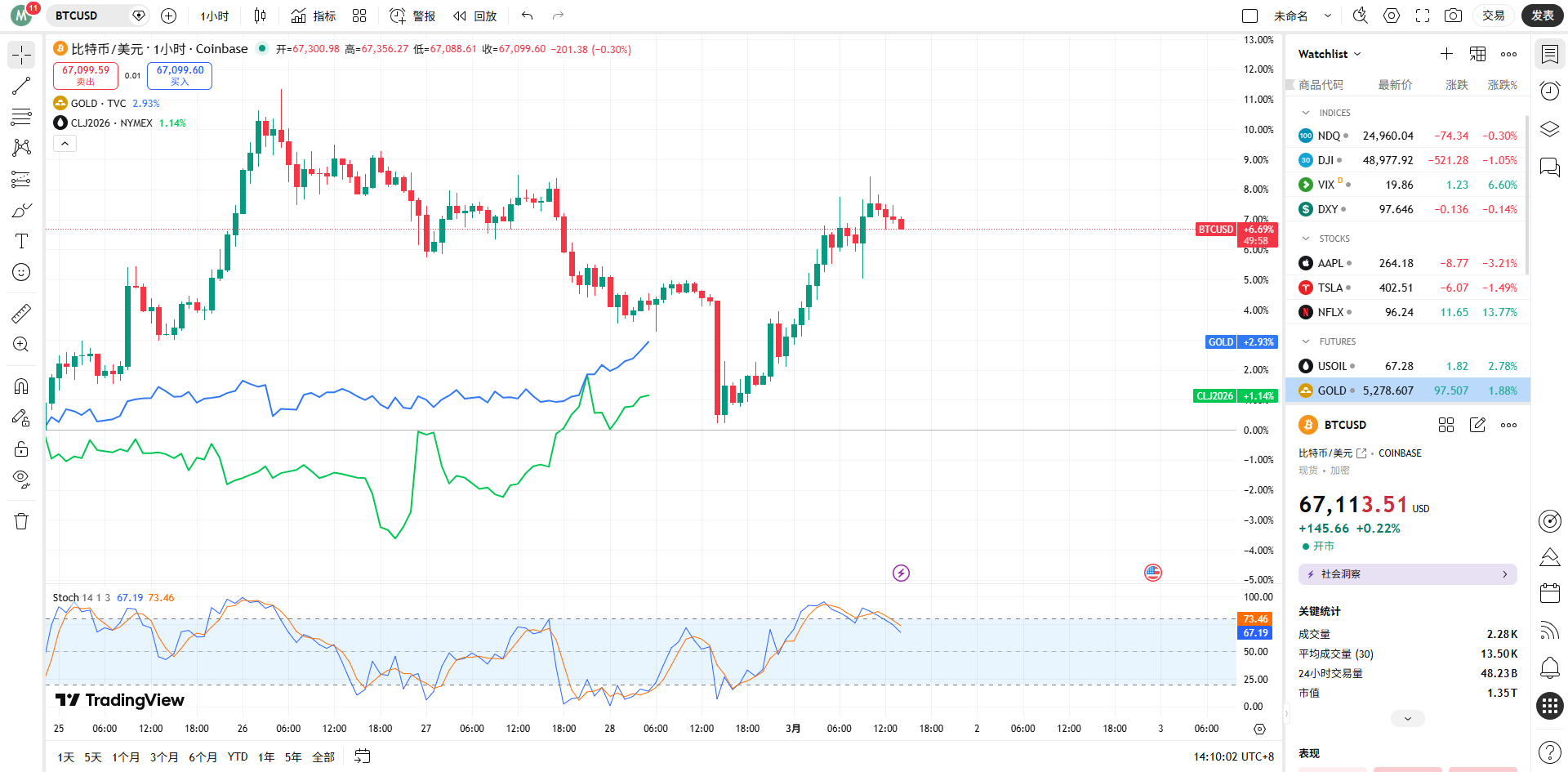
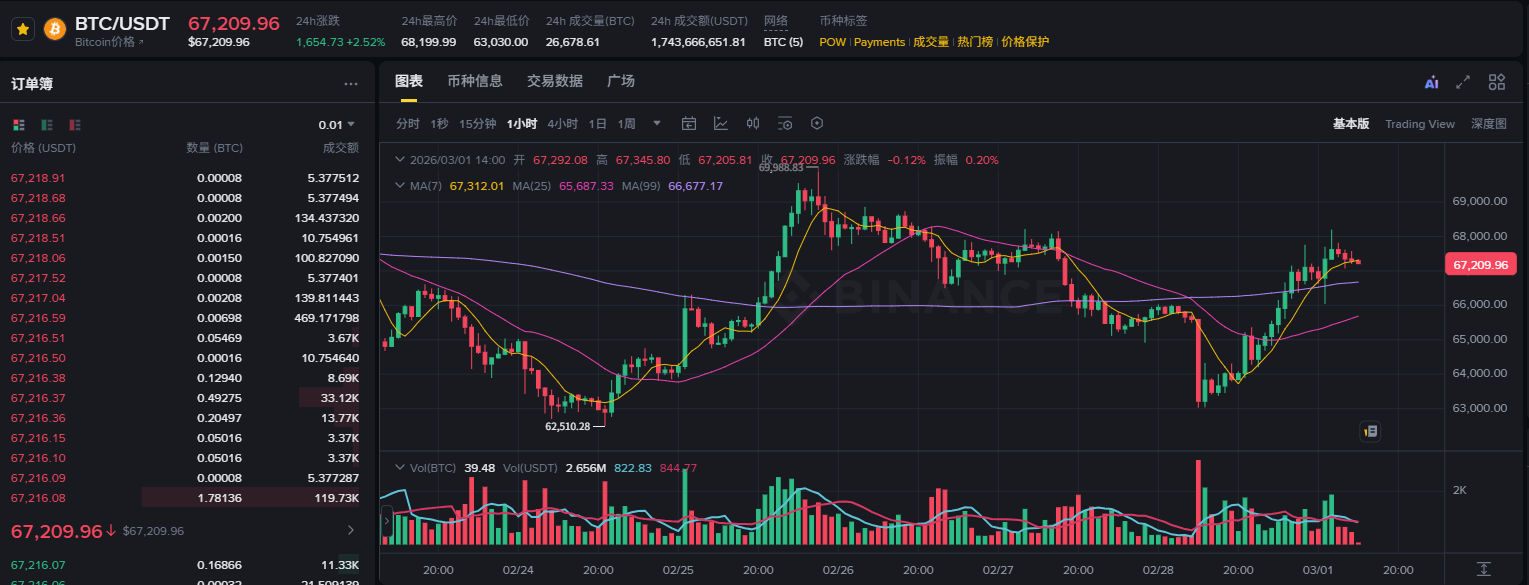
Combining Binance's spot and contract market data (as of 14:00 on March 1, 2026), the BTC/USDT spot price is oscillating around $67,392. In the initial phase of such a major geopolitical crisis, BTC did not experience a crash similar to the "312" event of 2020 but tenaciously held the key support level of $67,000.

The 24-hour trading volume reached a high of $1.74 billion, indicating significant disagreement and turnover between bulls and bears at this level. The moving average system in the price chart shows a pattern of high volatility after a多头排列, suggesting that, under the impact of sudden news, the承接盘力量 in the spot market is exceptionally robust, and the long-term配置底仓 of institutional funds has not fundamentally shifted.
To透视聪明资金的真实意图, the derivatives market, especially option data, provides the most直观的量化截面. By analyzing the current BTC option data expiring on March 27, 2026, on the Deribit platform, we can clearly outline the path projection of major institutions for the next month.

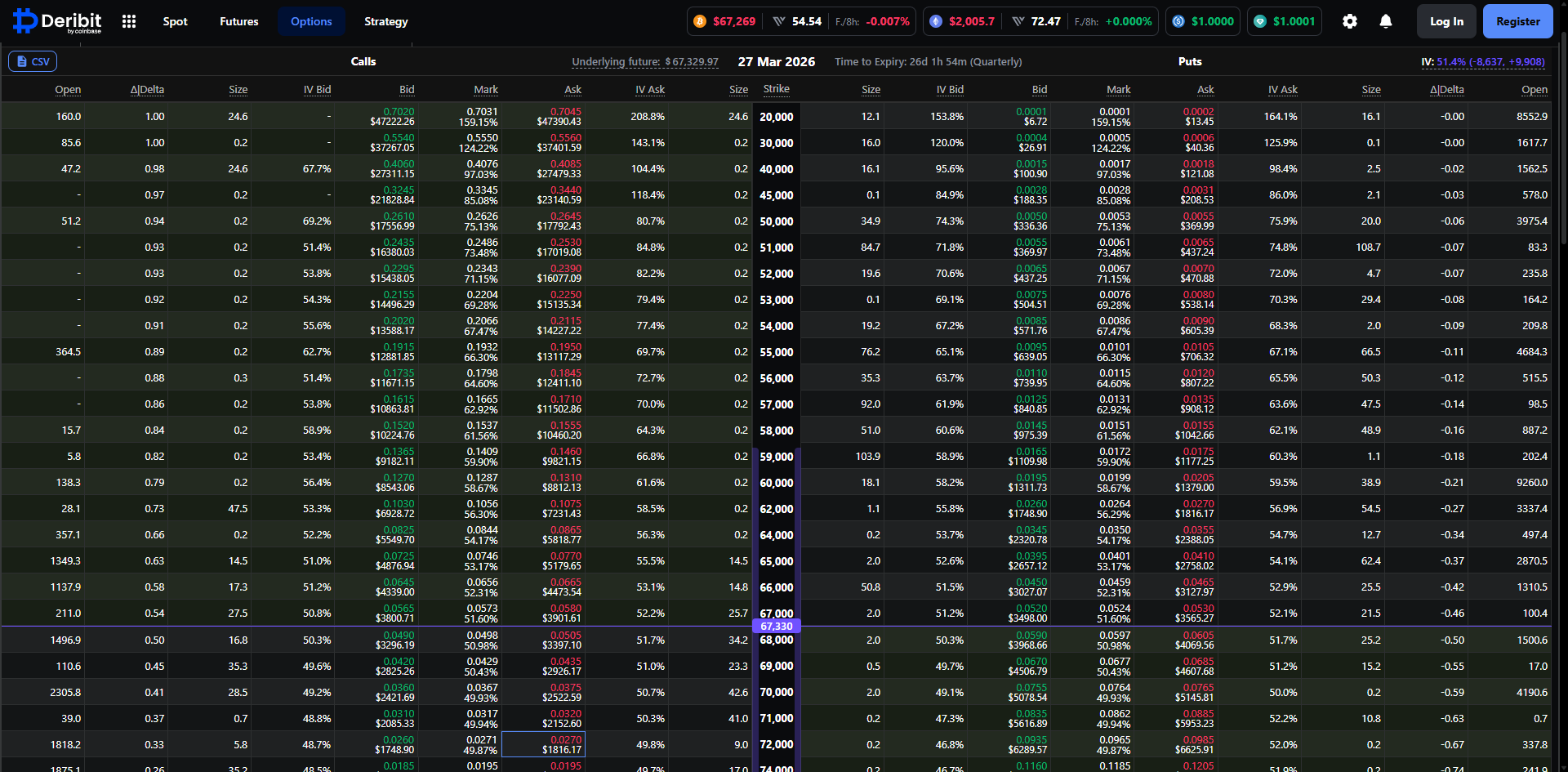
The current implied volatility (IV) for BTC options expiring on March 27 has reached a relatively high level of 51.3%. Against the backdrop of the geopolitical crisis, option sellers quickly raised the volatility surface to hedge against the Gamma exposure risks posed by extreme market movements. An IV above 51% indicates the market is hedging against potential wide fluctuations in the next two to three weeks. For quantitative traders, the risk-reward ratio for selling volatility at this time is extremely poor, and the market is overall in a frenzy of "buying straddles" or constructing tail-risk protection.
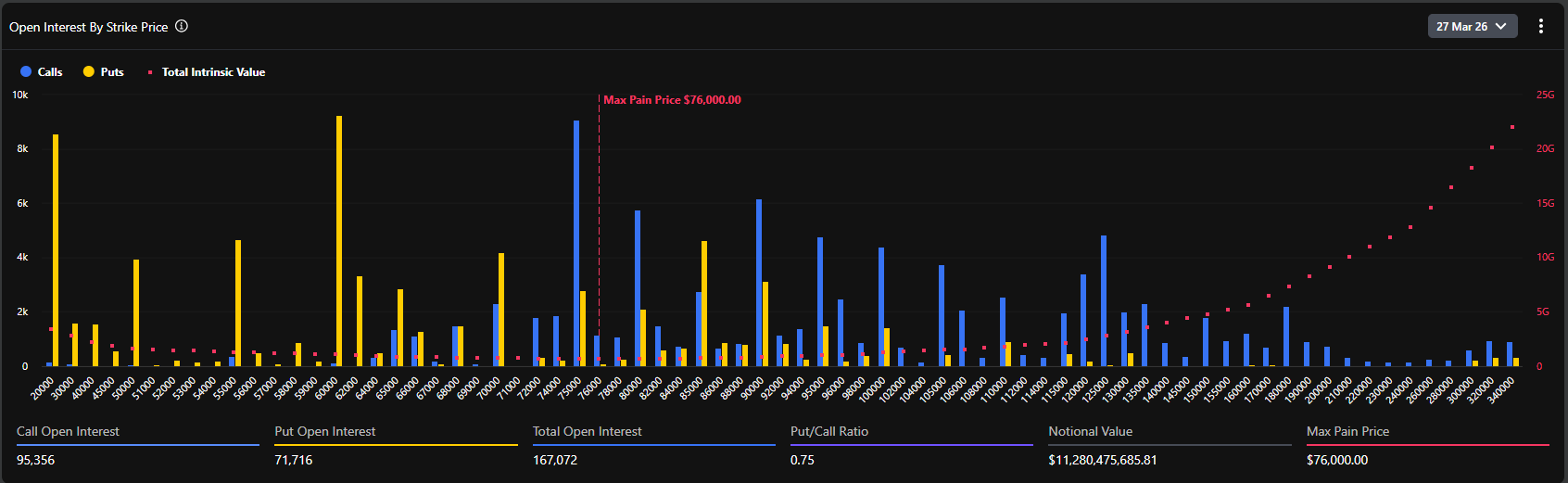
According to the open interest (OI) distribution chart for options, the current global maximum pain point is as high as $76,000. This is a highly forward-looking and controversial data point.

Typically, as expiration approaches, the underlying asset price tends to gravitate towards the maximum pain point to minimize the overall value for option buyers. However, the current spot price (around $67,400) is at a discount of nearly 12% to the maximum pain point ($76,000). This significant deviation reveals two core logics:

First, before the crisis erupted, the market was in an extremely optimistic bullish sentiment, with substantial funds betting on breaking through the all-time high (the $75,000–$80,000 range) by the end of March, which directly pushed the maximum pain point higher.

Second, the outbreak of the geopolitical crisis constituted a strong external shock, suppressing the upward momentum of the spot price. But judging from the total open interest of 167,072 BTC (notional value exceeding $11.2 billion), long positions did not experience large-scale unwinding and stampede due to the war news.

Data shows that the current put/call ratio (based on OI) is 0.75. This value, being below 1, indicates that from a global存量 perspective, call option (Call) open interest still dominates absolutely. Particularly at strike prices of $75,000, $80,000, and even $100,000, there are massive call open interest piles (with single strike open interest reaching nearly 10k BTC).

However, it is worth noting that the 24-hour volume PCR (Put/Call Volume Ratio) reached 1.37. The divergence between存量偏多 (0.75) and增量偏空 (1.37) perfectly captures the current market psychology: long-term institutions maintain their original long exposure (not selling spot, not closing long Calls), but in the short term following the outbreak of the Middle East war, substantial funds rushed in to buy out-of-the-money put options (OTM Puts) for tactical hedging, leading to a surge in short-term Put trading volume.

Combining detailed option data from Deribit, we observe that the distribution of Delta values is extremely dense in the $67,000 to $70,000 range. The current spot price of $67,495 is right in the "meat grinder" zone of the bull-bear struggle.

If the geopolitical situation further deteriorates, causing macro funds to withdraw en masse, and the spot price breaks below $65,000 (a strong support level), market makers, to hedge their short Put exposure, will be forced to sell in the spot or futures market, potentially triggering a wave of localized negative liquidity feedback, testing the psychological关口 of $60,000 downwards.

Conversely, if the Middle East situation enters a stalemate stage mediated by major powers after a brief violent conflict, and once the panic sentiment peaks and recedes, the rebound in the crypto market will be extremely fierce. Due to the massive accumulation of Call options in the $70,000 to $76,000 range above, once the spot price stabilizes and breaks through the $70,000 resistance level, market makers will be forced to buy spot to hedge their negative Gamma exposure. This classic "Gamma Squeeze" effect will propel the BTC price towards the maximum pain point of $76,000 at an unprecedented speed.

The aftershocks of the Middle East geopolitical tremor will continue to ferment. The subsequent actions of the US and Iran will determine the final destination of global safe-haven funds. In the foreseeable short term, BTC spot will experience violent whipsaws within a wide range of $62,000~$70,000. Leverage in the contract market will be反复清洗 during this process. Quantitative strategies should focus on "reducing leverage and capitalizing on volatility," suitable for constructing calendar spreads or grid market making at key support and resistance levels, avoiding unilateral trend exposure.

Judging from the option持仓结构, the massive expiration on March 27 is a gravitational center the market cannot bypass. Unless a global, uncontrollable World War III-level liquidity drought erupts, as panic sentiment marginally decreases, BTC's "safe-haven属性" and "anti-inflation属性" will be repriced. In mid-to-late March, the market is highly likely to initiate a restorative rebound, and the spot price has a strong incentive to move towards the $75,000–$76,000 range (the maximum pain point and dense Call strike zone).
This event marks the entry of geopolitics into a higher-risk phase. Whether it's the rekindling of inflation expectations brought by war (soaring crude oil) or the crisis of confidence in fiat currencies triggered by financial sanctions against specific countries, the strategic value of Bitcoin as a "borderless, non-sovereign hard asset" is being reinforced at the underlying logic level. For large institutions such as family offices and macro hedge funds, the单一的美元债+美股的60/40 portfolio can no longer cope with current tail risks. The allocation proportion of BTC as an "uncorrelated asset" in investment portfolios will undergo a systematic leap following this crisis.

The US and Israeli strike on Iran is the first thunderclap reshaping the global financial landscape in early 2026. Beneath the surface of panic, crypto option data冷静地揭示了机构资金's底牌 of "short-term defensive hedging, long-term依然看涨".

For professional financial practitioners, stripping away emotional noise and closely monitoring the trend of implied volatility changes and the transfer of market makers' Gamma exposure are the core codes to穿透战争迷雾 and grasp the next round of asset pricing power. With the $76,000 option maximum pain point standing like a lighthouse, every deep pullback caused by panic is accumulating potential energy for the future breakthrough.


Twitter:https://twitter.com/BitpushNewsCN

Bitpush TG Discussion Group:https://t.me/BitPushCommunity

Bitpush TG Subscription: https://t.me/bitpush

Original article link:https://www.bitpush.news/articles/7615676

Trending Cryptos

Related Questions

QWhat was the immediate impact of the US-Israel military strike on Iran on global financial markets, according to the article?

AThe strike triggered a classic risk-aversion pattern: crude oil and gold surged as safe-haven assets, while high-risk assets experienced indiscriminate selling. It also caused a significant repricing of global risk premiums.

QHow did the BTC price react initially to the geopolitical crisis, and what does its resilience at the $67,000 support level indicate?

ABTC did not crash but held firm at the $67,000 key support level with high trading volume ($1.74 billion in 24 hours), indicating strong buying interest and that long-term institutional holdings remained largely unchanged.

QWhat does the high Implied Volatility (IV) of 51.3% for BTC options expiring on March 27, 2026, suggest about market expectations?

AThe elevated IV indicates that the market is pricing in and hedging against the potential for wide price swings (high volatility) over the next few weeks due to the geopolitical crisis, making shorting volatility an unattractive strategy.

QWhat is the significance of the large discrepancy between the current BTC spot price (~$67,400) and the options market 'Max Pain' point at $76,000?

AThe 12%+ gap shows that the market was extremely bullish before the crisis, with heavy call option bets above $75k. The crisis temporarily suppressed the price, but the massive open interest suggests core bullish positions were not liquidated.

QHow does the Put/Call Ratio (PCR) analysis, showing a volume PCR of 1.37 against an open interest PCR of 0.75, reflect trader positioning?

AThis divergence shows that while the overall market structure is still net long (more calls held), there was a tactical, short-term surge in buying put options for downside protection immediately after the news broke, reflecting a 'long-term bullish, short-term cautious' stance.

Related Reads

TechFlow Intelligence Bureau: Anthropic IPO Odds Exceed 80%, Iran Closes Strait of Hormuz Again, Triggering Oil Price Volatility

**Market Digest** **AI & Tech:** Anthropic is widely expected to announce an IPO before November 2026, raising questions about balancing its trillion-dollar valuation ambitions with its core "AI safety" mission. Brands are increasingly adopting AI-generated virtual influencers for marketing. Cloudflare introduced temporary accounts for AI agents to ease automation workflows. **Infrastructure & Hardware:** Google's IPv6 traffic surpassed 50%, marking a major internet milestone. Goldman Sachs warned that massive projected AI capital expenditure ($5.3T) is approaching credit saturation limits, potentially curbing the "AI arms race." **Space & Robotics:** SpaceX's IPO saw a historic $370M retail buying frenzy in three days. Hyundai Motor Group plans to acquire full ownership of Boston Dynamics. Elon Musk speculated about future "septillion-dollar" investments in antimatter for interstellar travel. **Energy & Geopolitics:** Iran's military announced another closure of the strategic Strait of Hormuz, accusing Israel of violating a ceasefire, causing oil market volatility. However, ship-tracking data indicated some traffic continued. Concurrently, Iran resumed crude loadings at Kharg Island, potentially releasing up to 20 million barrels to the market. **Finance & Macro:** A European CLO (collateralized loan obligation) experienced its first post-2008-crisis-era equity tranche default, raising alarms in credit markets. Nomura warned that new Federal Reserve Chair Wash's perceived hawkish debut speech could signal a significant policy shift. **The Undercurrent:** Seemingly disparate events—the Strait of Hormuz tension, the European CLO default, and warnings on AI spending—point to a tightening of global liquidity and rising marginal costs across energy, credit, and tech investment. Meanwhile, capital continues chasing grand narratives like space exploration and advanced AI, highlighting a divergence where old-world leverage frays as new-world stories grow more ambitious.

marsbit36m ago

TechFlow Intelligence Bureau: Anthropic IPO Odds Exceed 80%, Iran Closes Strait of Hormuz Again, Triggering Oil Price Volatility

marsbit36m ago

The Hunter Becomes the Hunted: The Most Profitable MEV Bot Gets Hacked

A well-known and highly profitable Ethereum MEV Bot, Jaredfromsubway.eth, suffered a sophisticated on-chain attack this Saturday, losing over $7.5 million. Analysis by Blockaid and others reveals this was not a conventional phishing or smart contract exploit, but a targeted "counter-MEV honeypot attack." The attacker meticulously laid a trap over several weeks, deploying 66 fake token contracts and liquidity pools disguised as major assets like WETH and USDC. These pools created the illusion of arbitrage opportunities. The MEV Bot's automated system detected these signals, executed trades, and in the process, granted approval permissions to attacker-controlled contracts. These approvals were not revoked, creating a persistent vulnerability. The attacker then exploited this in a single transaction, draining the bot's ETH, USDC, and USDT holdings. Jaredfromsubway.eth is notorious as one of Ethereum's most active and profitable MEV Bots, primarily known for executing "sandwich attacks" to profit from transaction slippage. Estimates suggest it has earned tens of millions in MEV revenue. The incident highlights escalating crypto security threats, demonstrating that even top-tier automated "predators" are vulnerable to novel, logic-based attacks designed to exploit their own operational rules. Following the hack, an unverified X account impersonating Jaredfromsubway.eth emerged, falsely offering a bounty for the return of funds, prompting developer warnings for users to stay vigilant.

marsbit1h ago

The Hunter Becomes the Hunted: The Most Profitable MEV Bot Gets Hacked

marsbit1h ago

The Reality of Payments in Latin America Is Not What You Think

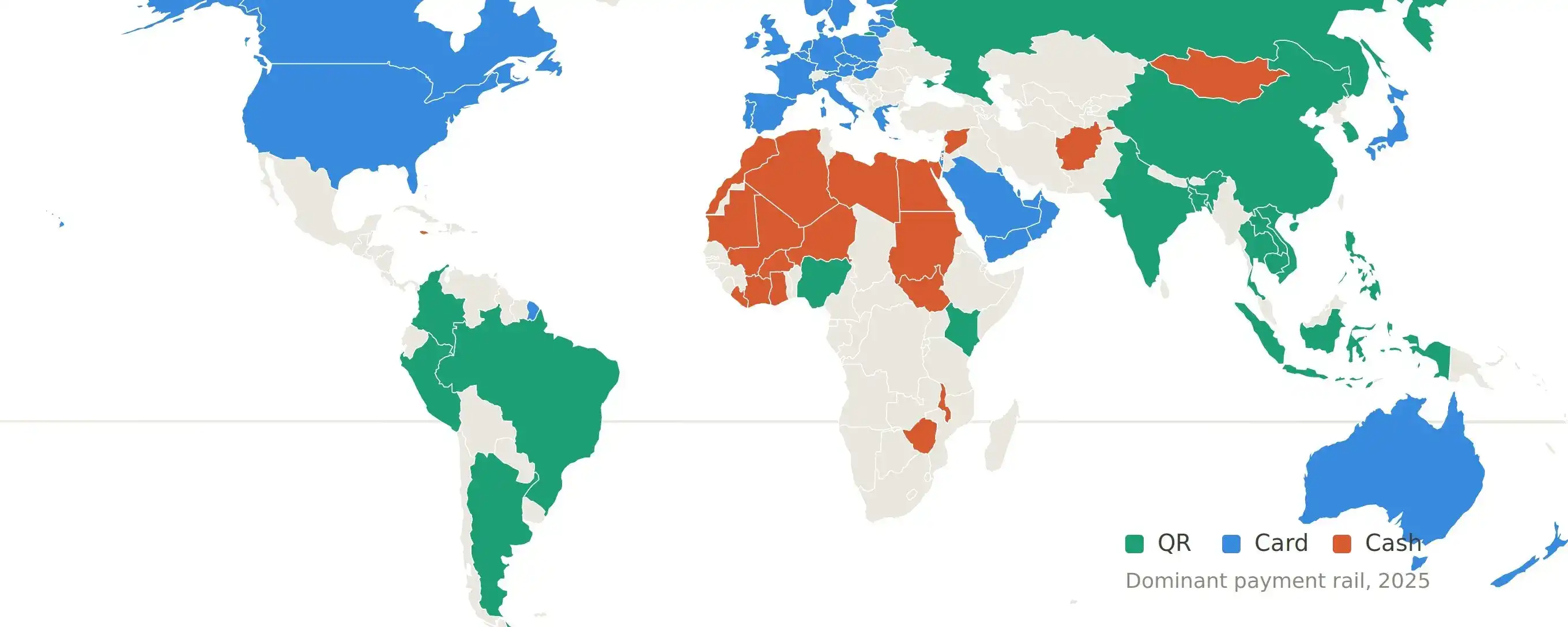
The payment landscape in Latin America is undergoing a fundamental shift, driven by on-the-ground realities that challenge common perceptions. Based on over 500 hours of field research across the region, key insights emerge. Firstly, QR code payments, like Brazil's Pix, are becoming the dominant payment method in most emerging markets, overtaking cards. However, these domestic instant payment systems lack international interoperability, creating a significant gap for cross-border users. Secondly, the narrative around crypto cards is often misunderstood; their primary volume comes from high-net-worth professionals using them for salary conversions (e.g., USDT to local currency via Pix), not retail micro-payments. Competition in payments is shifting from customer acquisition to controlling the settlement layer, leading fintechs to acquire banking licenses for efficiency. Thirdly, treating "Latin America" as a single market is a mistake. Countries like Argentina, Brazil, and Mexico have distinct economic realities, user segments, and regulatory approaches. Brazil alone has at least five distinct user segments with different financial flows. Overlooked markets like Guatemala, Honduras, and El Salvador (the "forgotten five") offer high remittance volumes with lower competitive density. Finally, regulation in Latin America is often ahead of the US, with clearer frameworks for digital assets and a pragmatic approach from regulators focused on safety rather than obstruction. The margin on stablecoin forex is rapidly compressing toward zero, meaning future winners will be those building value-added services on top of the infrastructure, not just the cheapest exchange.

marsbit2h ago

The Reality of Payments in Latin America Is Not What You Think

marsbit2h ago

Trading

Spot
Futures

Hot Articles

How to Buy EPIC

Welcome to HTX.com! We've made purchasing Epic Chain (EPIC) simple and convenient. Follow our step-by-step guide to embark on your crypto journey.Step 1: Create Your HTX AccountUse your email or phone number to sign up for a free account on HTX. Experience a hassle-free registration journey and unlock all features.Get My AccountStep 2: Go to Buy Crypto and Choose Your Payment MethodCredit/Debit Card: Use your Visa or Mastercard to buy Epic Chain (EPIC) instantly.Balance: Use funds from your HTX account balance to trade seamlessly.Third Parties: We've added popular payment methods such as Google Pay and Apple Pay to enhance convenience.P2P: Trade directly with other users on HTX.Over-the-Counter (OTC): We offer tailor-made services and competitive exchange rates for traders.Step 3: Store Your Epic Chain (EPIC)After purchasing your Epic Chain (EPIC), store it in your HTX account. Alternatively, you can send it elsewhere via blockchain transfer or use it to trade other cryptocurrencies.Step 4: Trade Epic Chain (EPIC)Easily trade Epic Chain (EPIC) on HTX's spot market. Simply access your account, select your trading pair, execute your trades, and monitor in real-time. We offer a user-friendly experience for both beginners and seasoned traders.

2.1k Total ViewsPublished 2025.03.17Updated 2026.06.02

How to Buy EPIC

Discussions

Welcome to the HTX Community. Here, you can stay informed about the latest platform developments and gain access to professional market insights. Users' opinions on the price of EPIC (EPIC) are presented below.

活动图片