KuCoin Consensus Hong Kong 2026 Participation Benefits LiquidChain and the L3 Narrative

bitcoinistPublished on 2026-02-09Last updated on 2026-02-09

Abstract

The pivot of crypto's center of gravity to Asia is accelerating, highlighted by events like Consensus Hong Kong 2026 and participation from major players like KuCoin. A key challenge in Asian markets is fragmented liquidity across major chains like Bitcoin, Ethereum, and Solana, leading to inefficiencies and risks with wrapped assets. LiquidChain ($LIQUID) emerges as a Layer 3 (L3) solution designed to unify these liquidity pools into a single execution layer, eliminating reliance on bridges and wrapped tokens. It offers a "deploy-once" model for developers to access users across all three chains seamlessly. The project’s presale has raised over $532K, with tokens priced at $0.0136, attracting early capital focused on infrastructure and interoperability. The $LIQUID token serves as transaction fuel and offers staking rewards, positioning it as a potential key player in the cross-chain narrative leading up to 2026.

The pivot of crypto’s center of gravity from West to East isn’t just a forecast anymore; it’s an active migration. With Consensus, the industry’s premier gathering, planting its flag in Hong Kong for 2025 and setting the stage for future iterations, the narrative has firmly shifted toward Asian liquidity dominance.

This momentum is further solidified by major players like KuCoin, which recently announced its participation in Consensus Hong Kong 2026. On February 12, Edwin Wong, KuCoin’s Vice President and Head of Risk Control, will join the featured panel ‘Turning Intelligence Into Action’ on the Explorations Stage to discuss how on-chain signals and AI capabilities can be translated into trust-first infrastructure and practical governance.

Hong Kong’s aggressive regulatory clarity has created a vacuum for liquidity hubs. While major exchanges figure out the licensing maze, the underlying trend is the unification of fragmented markets. Traders in the Asian session historically drive massive volume across Bitcoin, Ethereum, and increasingly, Solana. But there’s a catch: the friction of moving capital between these chains remains the industry’s glaring inefficiency.

Context matters. Bitcoin recently tested the $100K psych-level before retracing, while Ethereum struggles to maintain dominance against Solana’s monolithic speed. This ‘chain tribalism’ fractures liquidity, making execution expensive and slow. The winners of the 2026 cycle won’t be the L1s fighting for dominance. It’ll be the L3s that connect them. (It’s somewhat ironic that while users argue over which chain is ‘best,’ smart money is quietly funding the protocols that make the underlying chain irrelevant to the end-user.)

This infrastructure gap is where new interoperability layers enter the chat. As exchanges and institutions look toward the 2026 horizon, they need ‘deploy-once’ architectures. This macroeconomic setup creates a perfect storm for LiquidChain ($LIQUID), a project designed to dissolve the barriers between the industry’s three largest liquidity pools.

LiquidChain Solves the ‘Wrapped Asset’ Risk Plaguing Asian Markets

Fragmentation defines the current market structure. To trade $BTC on Solana, users rely on wrapped assets, derivatives that introduce counterparty risk and bridge vulnerability. LiquidChain flips this dynamic by operating as a Layer 3 (L3) infrastructure that fuses Bitcoin, Ethereum, and Solana liquidity into a single execution environment.

That matters for one big reason: institutional capital, the kind courted at events like Consensus Hong Kong, can’t tolerate bridge exploits. LiquidChain offers verifiable settlement without the complex user flows that currently plague DeFi. By enabling a ‘single-step execution’ model, it allows developers to build apps that access users on all three chains simultaneously.
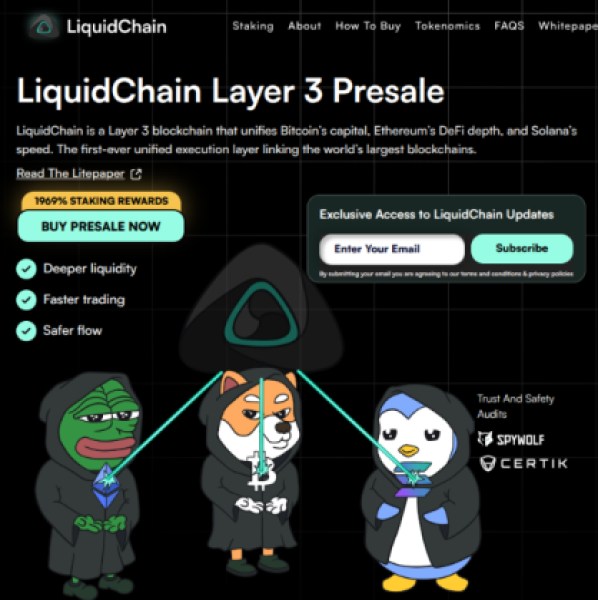
For a developer, the pitch is efficiency: deploy code once on LiquidChain, and instantly access liquidity from the top three ecosystems. No need to maintain fragmented liquidity pools across different networks, a redundancy that currently bleeds capital efficiency. As the dialogue moves toward the 2026 institutional horizon, protocols offering this level of unification are positioning themselves as the ‘TCP/IP’ of the blockchain era, invisible, essential, and highly valued.

CHECK OUT THE UNIFIED LIQUIDITY LAYER

Early Capital Flows into $LIQUID Presale Signal Infrastructure Demand

While headlines fixate on meme coin volatility, capital allocators are rotating into infrastructure plays that solve the interoperability crisis. The LiquidChain presale data reflects this methodical accumulation. It has already raised over $532K, and tokens are priced at $0.0136. Early investors also have access to staking rewards, currently sitting at 1943%.

This sub-million market cap entry point is notable compared to legacy interoperability protocols, which often trade in the billions. The pricing suggests the project is still in a discovery phase, distinct from the retail mania that usually follows major exchange listings.

The utility of the $LIQUID token extends beyond simple governance. It functions as the transaction fuel for the cross-chain VM and is required for liquidity staking. The tokenomics are designed to incentivize bonding assets from $BTC, $ETH, and $SOL into the LiquidChain ecosystem, rewarding users who provide the ‘glue’ for this unified layer. We see it as one of the next crypto to explode, due to its offering.

Investors are eyeing the $0.0136 price point not just for immediate gains, but as a derivative bet on cross-chain volume growth. If the thesis holds, that Asia will demand seamless execution across chains, LiquidChain’s ability to merge these ecosystems places it in a prime position to capture value from every transaction it facilitates.

CHECK OUT THE $LIQUID PRESALE

This article is for informational purposes only and does not constitute financial advice. Cryptocurrency investments, including presales like LiquidChain, carry high risks. Always conduct independent due diligence before participating.


Trending Cryptos

Related Questions

QWhat is the significance of KuCoin's participation in Consensus Hong Kong 2026?

AKuCoin's participation, with its Vice President Edwin Wong joining the 'Turning Intelligence Into Action' panel, signifies the exchange's commitment to discussing and shaping the future of trust-first infrastructure and practical governance using on-chain signals and AI, aligning with the event's focus on Asia's growing dominance in the crypto space.

QAccording to the article, what is the primary market inefficiency that LiquidChain aims to solve?

ALiquidChain aims to solve the industry's glaring inefficiency of friction and high cost when moving capital between major blockchains like Bitcoin, Ethereum, and Solana, which fractures liquidity and makes execution expensive and slow.

QHow does LiquidChain function to unify liquidity from Bitcoin, Ethereum, and Solana?

ALiquidChain operates as a Layer 3 (L3) infrastructure that fuses liquidity from Bitcoin, Ethereum, and Solana into a single execution environment, eliminating the need for wrapped assets and their associated counterparty risk by enabling verifiable settlement and a 'single-step execution' model.

QWhat are some key details about the LiquidChain ($LIQUID) presale mentioned in the article?

AThe LiquidChain presale has raised over $532,000, with tokens priced at $0.0136. Early investors have access to staking rewards, currently at 1943% APY, and the project's low market cap entry point is seen as a discovery phase distinct from typical retail mania.

QWhat is the core utility of the $LIQUID token within its ecosystem?

AThe $LIQUID token functions as the transaction fuel for the cross-chain Virtual Machine (VM), is required for liquidity staking, and is used to incentivize users to bond assets from $BTC, $ETH, and $SOL into the LiquidChain ecosystem, rewarding those who provide liquidity for the unified layer.

Related Reads

The Verdict in Choi Tae-won's Divorce Case: Revealing the Inheritance Undercurrent Behind SK Hynix's Trillion-Won Empire

SK Group Chairman Chey Tae-won's high-profile divorce case, involving a record 1.38 trillion won settlement, has drawn attention to the succession plans for Korea's second-largest conglomerate, especially its crown jewel, SK hynix. Unlike traditional chaebol scripts centered on the eldest son, Chey's three children from his marriage to former President Roh Tae-woo's daughter, Roh Soh-yeong, are carving distinct, non-traditional paths. Eldest daughter Chey Yun-jung (b. 1989) is seen as the most evident successor. With a scientific and consulting background, she holds executive roles at SK bioscience and SK Inc.'s growth support department, focusing on future strategy and biopharma. Her marriage is to an AI infrastructure entrepreneur, not a traditional business alliance. Second daughter Chey Min-jung (b. 1991) took a unique route, voluntarily serving as a South Korean naval officer, including an anti-piracy deployment. She later worked on policy and strategy for SK hynix in Washington D.C. before co-founding an AI-driven healthcare startup. She married a former U.S. Marine Corps officer, connecting her to U.S. defense and policy circles—networks crucial for a global semiconductor giant. The only son, Chey In-geun (b. 1995), who studied physics like his father, worked briefly at SK E&S before joining McKinsey. Despite fitting the traditional "heir" profile as the eldest son, he remains silent and holds no public position or shares in SK, suggesting the old succession playbook is obsolete. As SK hynix's valuation soars, becoming a geopolitical asset in the AI era, the heirs' legitimacy is no longer automatic. They must prove themselves in fields like AI biotech, global policy, and strategic consulting. Their marriages also reflect new elite networks in tech and defense, not old political alliances. Their inheritance is the complex challenge of navigating a globalized, tech-driven world, not just a corporate throne.

marsbitYesterday 09:06

The Verdict in Choi Tae-won's Divorce Case: Revealing the Inheritance Undercurrent Behind SK Hynix's Trillion-Won Empire

marsbitYesterday 09:06

From OpenSea to OpenRouter: Is Alex Atallah Repeating His 'Exit at the Peak' Playbook?

From OpenSea to OpenRouter: Is Alex Atallah Repeating His "Exit at the Peak" Playbook? According to the Wall Street Journal, payments giant Stripe is in talks to acquire the AI model aggregation platform OpenRouter in a potential deal valuing the company near $100 billion. This would mark founder Alex Atallah's second creation of a company reaching a $100 billion valuation, following his co-founding of NFT marketplace OpenSea. OpenRouter, founded just over three years ago, has grown rapidly by acting as a unified gateway for developers to access over 400 AI models. It currently has about 10 million users and processes over 200 trillion tokens monthly. While the platform's annualized revenue is around $50 million, its valuation has skyrocketed from $1.3 billion in March 2026. The potential acquisition by Stripe, a company OpenRouter's founder once likened it to, represents a major expansion into AI infrastructure for the payments leader. This move echoes Atallah's previous timing with OpenSea, where he departed before the NFT market's significant downturn. For OpenRouter, selling now may be strategic. Despite its scale, its business model—charging a 5-5.5% fee on AI inference calls—faces pressure from competition, open-source models, and potential price wars among model providers, limiting its profitability narrative for an IPO. A key asset for potential acquirers like Stripe is OpenRouter's vast repository of real-world AI usage data, which offers unique insights into model performance and developer preferences that are difficult to replicate. Whether this potential deal signifies a new valuation benchmark for AI infrastructure or another market peak signal remains to be seen.

链捕手Yesterday 08:42

From OpenSea to OpenRouter: Is Alex Atallah Repeating His 'Exit at the Peak' Playbook?

链捕手Yesterday 08:42

Trading

Spot

Hot Articles

How to Buy L3

Welcome to HTX.com! We've made purchasing Layer3 (L3) simple and convenient. Follow our step-by-step guide to embark on your crypto journey.Step 1: Create Your HTX AccountUse your email or phone number to sign up for a free account on HTX. Experience a hassle-free registration journey and unlock all features.Get My AccountStep 2: Go to Buy Crypto and Choose Your Payment MethodCredit/Debit Card: Use your Visa or Mastercard to buy Layer3 (L3) instantly.Balance: Use funds from your HTX account balance to trade seamlessly.Third Parties: We've added popular payment methods such as Google Pay and Apple Pay to enhance convenience.P2P: Trade directly with other users on HTX.Over-the-Counter (OTC): We offer tailor-made services and competitive exchange rates for traders.Step 3: Store Your Layer3 (L3)After purchasing your Layer3 (L3), store it in your HTX account. Alternatively, you can send it elsewhere via blockchain transfer or use it to trade other cryptocurrencies.Step 4: Trade Layer3 (L3)Easily trade Layer3 (L3) on HTX's spot market. Simply access your account, select your trading pair, execute your trades, and monitor in real-time. We offer a user-friendly experience for both beginners and seasoned traders.

4.7k Total ViewsPublished 2024.11.27Updated 2026.06.02

How to Buy L3

Discussions

Welcome to the HTX Community. Here, you can stay informed about the latest platform developments and gain access to professional market insights. Users' opinions on the price of L3 (L3) are presented below.

活动图片