Predicting Market True and False Gambling Gods: Debunking the 8300x Miracle; Price Manipulation Nets $230,000

marsbitPublished on 2026-01-19Last updated on 2026-01-19

Abstract

The article exposes two controversial cases on the prediction market platform Polymarket, highlighting issues of manipulation and deception. First, a trader named "ascetic" claimed to have turned $12 into over $100,000—an 8300x return—through 16 consecutive successful bets on Bitcoin volatility. However, another trader, "Moses," accused ascetic of using multiple fake accounts (a "Sybil farm") to fabricate the results. Moses provided evidence suggesting ascetic operated several accounts that started with small amounts and only promoted the one that succeeded, while others failed. Despite denials, the credibility of the "miracle" was heavily questioned. Second, a different trader exploited Polymarket’s "15-minute XRP price prediction" by manipulating the market. Using $1 million in capital on Binance, the trader bought XRP shortly before the prediction window closed, artificially inflating the price by 0.5% to ensure a winning "up" bet. After cashing out $233,000 in profit on Polymarket, the trader quickly sold the XRP, incurring minimal cost in slippage and fees. This manipulation drained liquidity from automated trading bots on Polymarket, one of which lost $160,000 in annual profits. The piece warns users to be cautious of sensational claims and manipulative strategies in prediction markets, where rules and outcomes can be exploited.

Original|Odaily Planet Daily(@OdailyChina)

Author|Wenser(@wenser 2010)

As a hot sector that has continued to rise since the beginning of the year, the prediction market is no stranger to wealth creation miracles.

But behind these miracles, it takes a discerning eye to tell whether they are genuine wonders achieved through shrewd timing and nimble maneuvering, or false hype created through artificial manipulation and obfuscation. Recently, a Polymarket trader on X claimed to have achieved an "8300x miracle," turning a $12 initial stake into over $100,000 through betting, but was quickly exposed for allegedly using multiple accounts for造假 (fraud) and traffic炒作 (hype). Meanwhile, another trader leveraged price manipulation of XRP to net $230,000 in the "15-minute price prediction" section, executing a one-sided harvest against Polymarket's betting bots.

On the stage of betting for or against, some want to dance with lies, while others exploit rule loopholes for clever plunder. In the bet of right and wrong, there is no unbeatable strategy, only flexible tactics.

The 8300x Miracle from $12 to $100,000: Polymarket's Living Billboard VS Traver's Fabricated Scheme

The story begins with a post "recounting the journey from a $12 principal to $100,000 in profit, achieving an 8300x return."

On January 16th, trader ascetic posted, stating that through "all-or-nothing bets on Bitcoin's short-term volatility," they doubled their principal 16 times consecutively, ultimately achieving the milestone of $100,000 in profit from $12. They also emphasized that they "specifically shared their betting strategy and reasoning" during the process.

Subsequently, they dropped their Polymarket account link in the comments, bluntly stating that such wealth creation miracles can only happen on Polymarket (Odaily Planet Daily Note: Does this sound familiar? Similar phrases have been used by traders for platforms including but not limited to OpenSea, Blur, Pump.fun, Hyperliquid, Aster, etc.).

The comments section then erupted into a "frenzied celebration by Polymarket community members," with countless congratulations, even Polymarket's Head of Global Growth, LeGate, chiming in: "Congrats bro! I think you deserve it! Congrats on the @PolymarketTrade badge!" (Odaily Planet Daily Note: This account is for Polymarket's active trader community.)

If you thought this was a常规 (routine) "overnight riches brag post," you might have underestimated the drama level.

Soon, the narrative of the "8300x return miracle on Polymarket" took a sharp turn.

From Betting Miracle to Fabricated Scam: 8300x Return Data Questioned

On the same day, January 16th, a trader named Moses, who自称 (claimed to be) "ranked 515th in Polymarket trading for 2025," questioned trader ascetic's account data: "Did you ever wonder why his account balance was $3000 in the first post? The answer is simple: he runs a massive 'Sybil farm.' He didn't start with $12, but with hundreds of accounts, each funded with $10 to $20. Once one account reached $2900, he started posting. Since then, he's made seven trades, all wins.

But note, he bets his entire stack every time. Real traders don't do that. He's just chasing clout, doing whatever it takes to get it.

Failing to get enough volume, he even seems to use other accounts for wash trading to hit his desired price.

Please do your own research before blindly trusting 'influencers.' The attached images show some of his failed Sybil accounts, which only made up to $1000."

Moses later added in the comments that all accounts were created 7 months ago and consistently participated in random markets, all starting the same challenge on the same day 2 months ago. The whole "$10 to $100,000" story is fake!

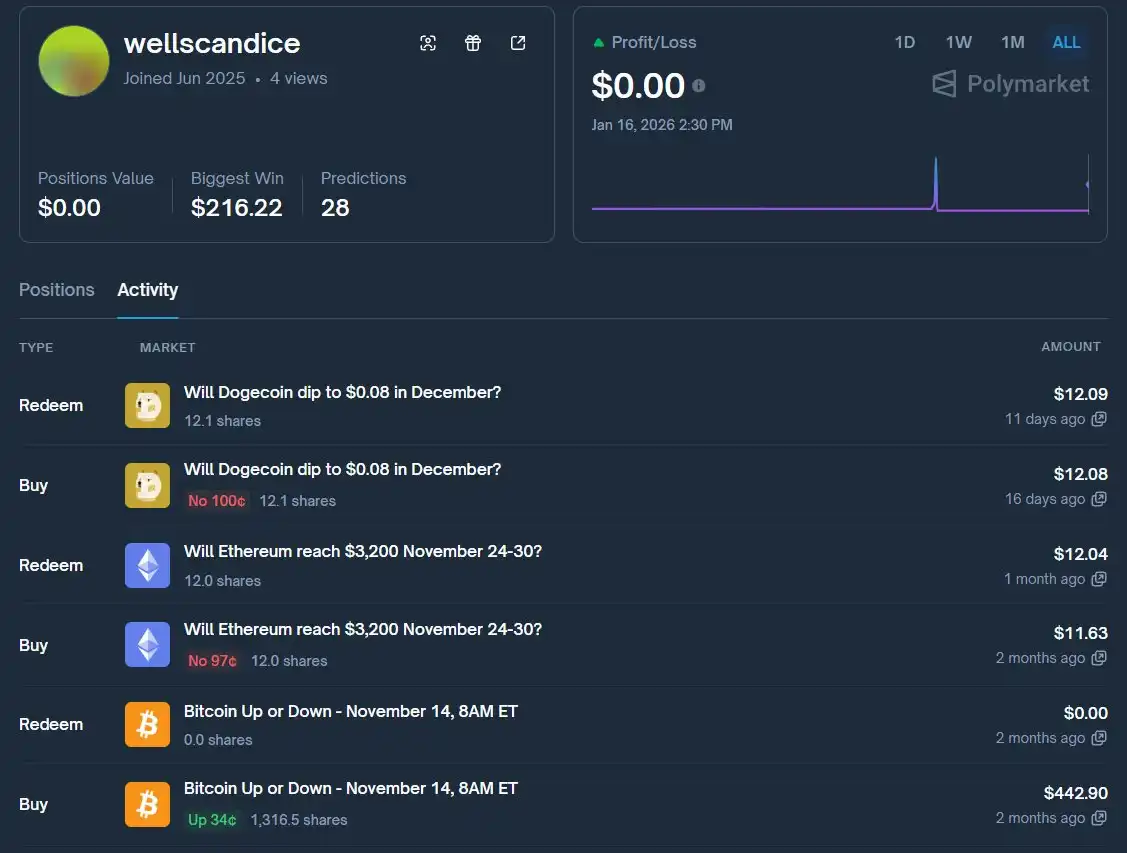
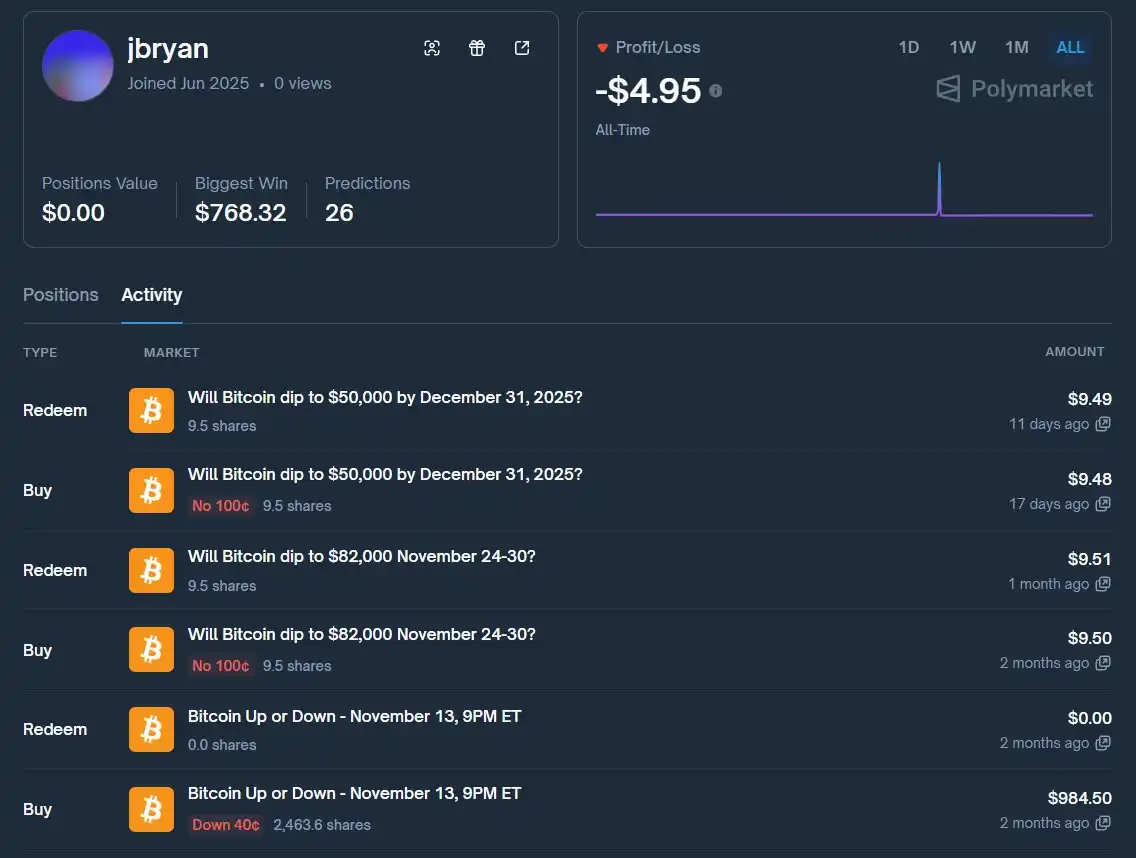
Not only that, he posted screenshots and links to the alleged Sybil account homepages:

  • Account 1: https://polymarket.com/@brockmatthew;
  • Account 2: https://polymarket.com/@wellscandice;
  • Account 3: https://polymarket.com/@jbryan.
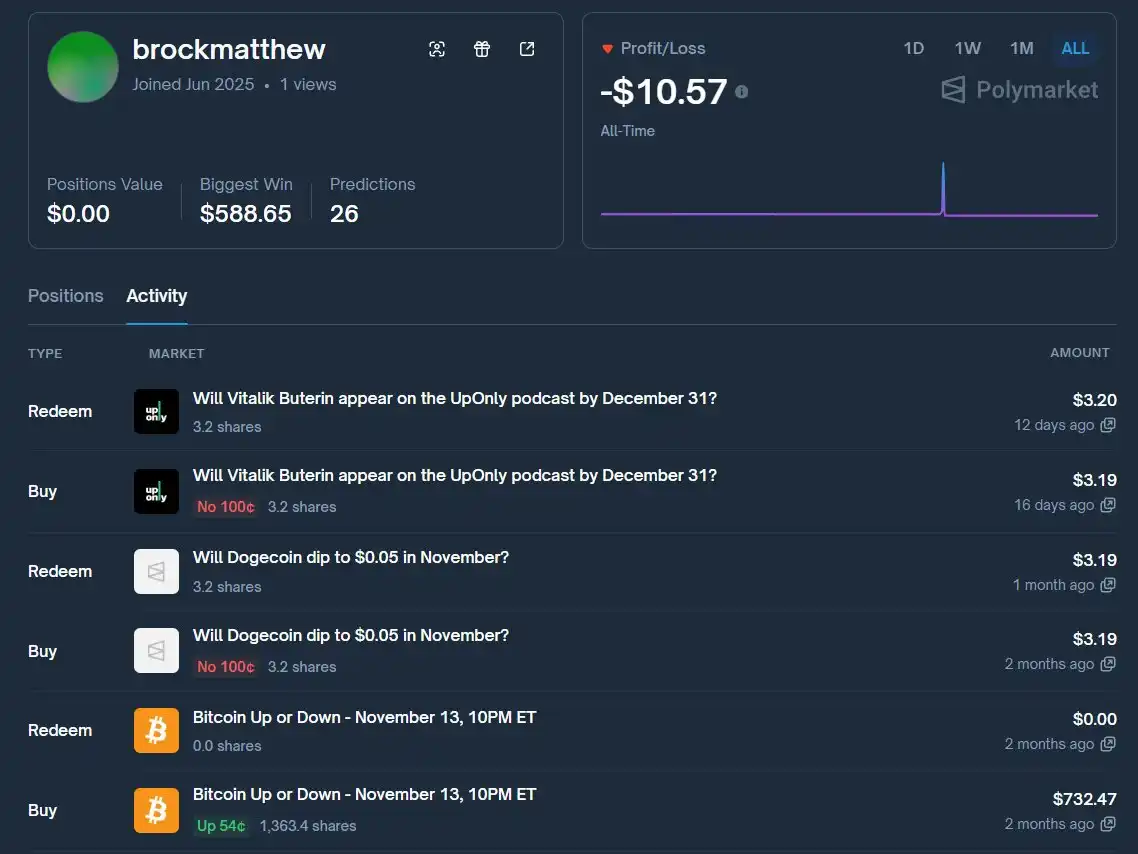
Although ascetic later responded in the comments that the wallets and accounts mentioned by Moses were unrelated to him, and some members of the ZSC DAO (a Polymarket trader community) also voiced support, calling Moses's actions a cyber attack, the association between ascetic's previous bot-like reply content, his Polymarket account, and numerous accounts with similar behavioral patterns significantly undermined the credibility of this "8300x return miracle."

Some commenters also expressed confusion about the motive, stating that "winning 7 consecutive bets" itself is impressive; but others pointed out it was still a game of "bot-like widespread casting of nets."

Somewhat ironically, Moses's own bio reads "The journey from $1 to $1,000,000"—whether this is a real track record or a personal goal remains unknown.

Compared to the hard-to-verify ascetic, the following case of a trader profiting $230,000 through price manipulation in the XRP "15-minute up/down betting market" might be more worthy of study for whale players.

Trader Uses Binance Spot to Counter-Harvest Prediction Market: $1M Principal Nets $230K Profit

On January 18th, Polymarket trader PredictTrader revealed a trader's操作 (operation) worthy of a "Wolf of Wall Street" drama—by harvesting liquidity from trading bots, he made $233,000 in just a few hours, largely unnoticed by the market.

The timing chosen by this trader, a4385, was also extremely clever—it was Saturday evening, with thin market liquidity and relatively poor liquidity on the Binance spot order book.

In the "XRP Up/Down—Jan 17th, 12:45-1:00 PM ET" market, he heavily bought "Yes" shares.

His counterparties were the common "individual market makers" on Polymarket—various trading bots. (Odaily Planet Daily Note: Market making on Polymarket is relatively simple, with low barriers to entry for individual developers, making trading bots very popular). By 10 minutes into the event, XRP was down about 0.3% from the opening price, but he had pushed the price of "Yes" shares up to 70%. The trading bots saw a profit opportunity but instead fell into the price trap set by this trader, selling him more "Yes" shares.

Ultimately, the trader bought $77,000 worth of "Yes" shares at an average price of 48%.

Then, just 2 minutes before the event settled, a wallet on Binance bought approximately $1 million worth of XRP spot, pushing its price up about 0.5%; seconds after the event settled, this $1 million in spot was quickly sold off.

In other words, the cost of this price manipulation was—approximately 0.25% one-way trade slippage + fees.

Using a Binance VIP Level 4 account (0.06%) (easily obtainable) and 0.25% two-way slippage, the total cost would be around $6,200, and the actual operational cost might be lower. By repeating this operation multiple times and exploiting the weekend liquidity漏洞 (loophole), this trader drained the funds of several bot wallets.

Some bots were shut down in time, while others reacted too slowly and lost all their funds—including @aleksandmoney, who lost an entire year's profits (about $160,000).

a4385 Polymarket account link: https://polymarket.com/profile/0x506bce138df20695c03cd5a59a937499fb00b0fe

In conclusion, we hope traders betting for or against on prediction markets can distinguish fact from appearance. Sometimes, the truth is not always objective, and the standards and rules judged by the platform are man-made.


Trending Cryptos

Related Questions

QWhat was the alleged 8300x return story on Polymarket, and who was accused of fabricating it?

AA trader named ascetic claimed to have turned $12 into over $100,000 in profit on Polymarket, achieving an 8300x return through 16 consecutive successful bets. However, another trader, Moses, accused ascetic of fabricating the story by using a 'sybil farm'—multiple accounts each starting with small amounts—to create the illusion of a single account's miraculous success, and even engaging in wash trading to manipulate market prices.

QHow did a trader allegedly manipulate the price of XRP to profit $230,000 on Polymarket?

AA trader (a4385) manipulated the 'XRP up/down - 15-minute' market on Polymarket by first accumulating a large position in 'up' shares at low prices, pushing their value to 70% despite XRP's price dropping. Then, just before the market settled, they bought approximately $1 million worth of XRP on Binance, artificially pumping its price by 0.5% to ensure the 'up' outcome. After settlement, they quickly sold the XRP, netting a $230,000 profit on Polymarket at a minimal cost of slippage and fees, while draining liquidity from automated market maker bots.

QWhat role did trading bots play in the XRP price manipulation incident on Polymarket?

ATrading bots on Polymarket, which act as automated market makers, were the counterparties selling 'up' shares to the manipulative trader (a4385) as he accumulated his position. These bots, perceiving an arbitrage opportunity as the 'up' share price was artificially high relative to the actual XRP price trend, continued selling to him. Their lack of speed and adaptability in a low-liquidity environment (a weekend) made them vulnerable, and several bots, including one run by @aleksandmoney, lost significant funds—in one case, an entire year's profits (~$160,000).

QWhat evidence did Moses provide to dispute ascetic's 8300x return claim?

AMoses provided links to several Polymarket accounts (e.g., brockmatthew, wellscandice, jbryan) that he alleged were ascetic's 'sybil' accounts. He pointed out that these accounts were all created around the same time (7 months ago) and started the same 'challenge' on the same day two months prior. He also noted that ascetic's main account shown in the initial post already had a balance of $3,000, suggesting the starting point was not $12 but a larger combined sum spread across many accounts, and that the all-in betting strategy was not typical of genuine traders but was for clout chasing.

QAccording to the article, what is a common vulnerability or challenge highlighted about prediction markets?

AThe article highlights that prediction markets like Polymarket are vulnerable to manipulation through both social engineering (e.g., fabricating success stories to gain influence) and direct market manipulation (e.g., using capital on external exchanges like Binance to influence the outcome of the event being predicted). It underscores that the 'truth' or outcome of a market can be manipulated, and the platform's rules and judgment criteria are ultimately human-defined and can be exploited.

Related Reads

GPT-5.6 Countdown: Abandon the Illusion of a Single API, Computational Iteration Can't Outpace a Single Page of Compliance

In mid-June, three seemingly independent industry events—the compliance-driven throttling of Fable 5, the open-sourcing of GLM-5.2, and the leaked release timeline for GPT-5.6—are pushing the global AI industry toward a watershed moment. These shifts signal a fundamental restructuring of the industry's underlying logic. First, **"usability" has substantially overtaken "advanced capabilities"** as the primary weight, pushing the global large language model (LLM) supply chain into a "dual-track" phase of controlled closed-source and local open-source coexistence. Second, **the competitive moats of closed-source giants are shifting**. Their technical focus is moving from "language intelligence" toward "spatial intelligence (world models)"—a domain heavily reliant on computing power. Third, faced with常态化 transnational compliance risks, **a "model-agnostic" decoupled design has become a survival necessity for application-layer developers to maintain business continuity.** The article details how Anthropic's Fable 5, despite its advanced engineering feats, was restricted for non-U.S. citizens within 72 hours of launch, highlighting how geopolitical compliance can instantly limit even the most advanced models. In response, the open-source camp, exemplified by Zhipu AI's MIT-licensed GLM-5.2, is gaining market share by offering stable performance improvements and significant cost advantages (up to 70% savings for enterprises), while achieving full adaptation with domestic semiconductor platforms. Meanwhile, closed-source leaders like OpenAI are pivoting. The anticipated GPT-5.6 reportedly shifts focus from language to spatial intelligence and world models, aiming to rebuild a generational gap in areas like 3D understanding, simulation, and industrial design that demand immense compute. The core conclusion is that the LLM supply chain's logic has changed. Enterprises must now evaluate infrastructure based on a composite of technical performance and policy compliance. For developers, complete reliance on a single closed-source API poses unacceptable risk. Implementing a truly model-agnostic architecture—enabling swift switches to compliant, locally deployable open-source alternatives—is no longer just good practice but a fundamental baseline for business continuity.

marsbit2h ago

GPT-5.6 Countdown: Abandon the Illusion of a Single API, Computational Iteration Can't Outpace a Single Page of Compliance

marsbit2h ago

Is the 'Token Subsidy War' Among AI Giants Almost Over?

The article discusses the ongoing "token subsidy war" among AI giants like OpenAI and Anthropic, questioning whether it's nearing its end. It reveals that current AI subscription prices are heavily subsidized, with some plans offering tokens at up to 70 times the actual cost to attract and retain heavy users, especially developers and enterprises. This strategy mirrors past internet-era subsidy battles, but with a key difference: AI tokens lack "lock-in" effects. Unlike ride-hailing or food delivery apps, users can easily switch between AI providers as APIs become standardized, making it difficult for companies to raise prices post-subsidy. The piece highlights a structural asymmetry in the competition. Giants like Google, with massive advertising revenue, can afford to subsidize tokens indefinitely, akin to using "tokens as a weapon." In contrast, venture-backed companies like OpenAI and Anthropic face pressure to become profitable, especially as they approach IPO. The article cites Google Ventures founder Bill Maris, who suggests Google could slash token prices by 80%, putting immense pressure on competitors. Two potential endgames are presented: the "internet service" model (subsidize, monopolize, then raise prices) and the "utility" model (tokens become a standardized, low-margin commodity like electricity). Given the low switching costs, the latter seems more likely. The competition may not have a single winner but could instead accelerate AI's evolution into a foundational, infrastructure-level technology, akin to a public utility. For now, users continue to benefit from heavily subsidized token costs.

marsbit2h ago

Is the 'Token Subsidy War' Among AI Giants Almost Over?

marsbit2h ago

Beyond the Stadium: The Profitable Games Surrounding the World Cup

"Beyond the Pitch: The Profit Game Around the World Cup" The FIFA World Cup transcends being a sporting spectacle, evolving into a massive global arena for speculation and profit-seeking. The 2026 tournament has amplified this dynamic, creating a multi-layered ecosystem of financial opportunism alongside the football. **Prediction markets** have surged into the mainstream. Platforms like Polymarket and Kalshi saw trading volumes for World Cup contracts soar, attracting new users with their financial trading model and high-profile, chain-based wealth stories that overshadow traditional sports betting in terms of growth and narrative. However, **traditional sportsbooks** remain the dominant force, leveraging established user habits, legal markets, and comprehensive product offerings to handle the vast majority of speculative wagers, with projections suggesting record-breaking betting volumes. Capital markets also react. **"Concept stocks"** in countries like South Korea and Japan experience volatile price swings based on team performance and anticipated fan spending on items like chicken, beer, and viewing parties, effectively becoming a stock market reflecting fan sentiment. The **ticket resale market** has become a sophisticated arena for arbitrage. Prices fluctuate wildly based on team draws and star power, with sellers sometimes listing tickets they don't yet own in a practice akin to short-selling, while FIFA's own "Right to Buy" tokens add another layer of speculative trading. **Collectibles and merchandise** offer another avenue. Panini sticker albums, with their inherent scarcity and nostalgic value, can become high-value collectibles. Limited-edition or locally themed jerseys command significant premiums on secondary markets, and even counterfeit vendors profit from fans' desire for affordable match-day identity. The **cryptocurrency** space has seen a frenzy of speculative, unauthorized World Cup-themed meme coins on chains like Solana. These tokens, often exploiting team names and player imagery, experience extreme pump-and-dump cycles, creating stories of massive gains for a few early entrants and steep losses for many others. Finally, an entire industry thrives on **providing information and tools** to other speculators. Developers create platforms like SeatSidekick to track ticket inventory and prices, while paid Telegram groups and subscriptions sell betting tips and predictions, monetizing the widespread desire for an informational edge. In essence, the World Cup has become a compressed, global laboratory for speculation. While the games determine champions on the field, a parallel, complex network of financial transactions—spanning prediction contracts, bets, stocks, tickets, collectibles, crypto, and information services—settles its own scores in the global market.

marsbit3h ago

Beyond the Stadium: The Profitable Games Surrounding the World Cup

marsbit3h ago

Trading

Spot
Futures

Hot Articles

How to Buy GODS

Welcome to HTX.com! We've made purchasing Gods Unchained (GODS) simple and convenient. Follow our step-by-step guide to embark on your crypto journey.Step 1: Create Your HTX AccountUse your email or phone number to sign up for a free account on HTX. Experience a hassle-free registration journey and unlock all features.Get My AccountStep 2: Go to Buy Crypto and Choose Your Payment MethodCredit/Debit Card: Use your Visa or Mastercard to buy Gods Unchained (GODS) instantly.Balance: Use funds from your HTX account balance to trade seamlessly.Third Parties: We've added popular payment methods such as Google Pay and Apple Pay to enhance convenience.P2P: Trade directly with other users on HTX.Over-the-Counter (OTC): We offer tailor-made services and competitive exchange rates for traders.Step 3: Store Your Gods Unchained (GODS)After purchasing your Gods Unchained (GODS), store it in your HTX account. Alternatively, you can send it elsewhere via blockchain transfer or use it to trade other cryptocurrencies.Step 4: Trade Gods Unchained (GODS)Easily trade Gods Unchained (GODS) on HTX's spot market. Simply access your account, select your trading pair, execute your trades, and monitor in real-time. We offer a user-friendly experience for both beginners and seasoned traders.

4.1k Total ViewsPublished 2024.03.29Updated 2026.06.02

How to Buy GODS

Discussions

Welcome to the HTX Community. Here, you can stay informed about the latest platform developments and gain access to professional market insights. Users' opinions on the price of GODS (GODS) are presented below.

活动图片