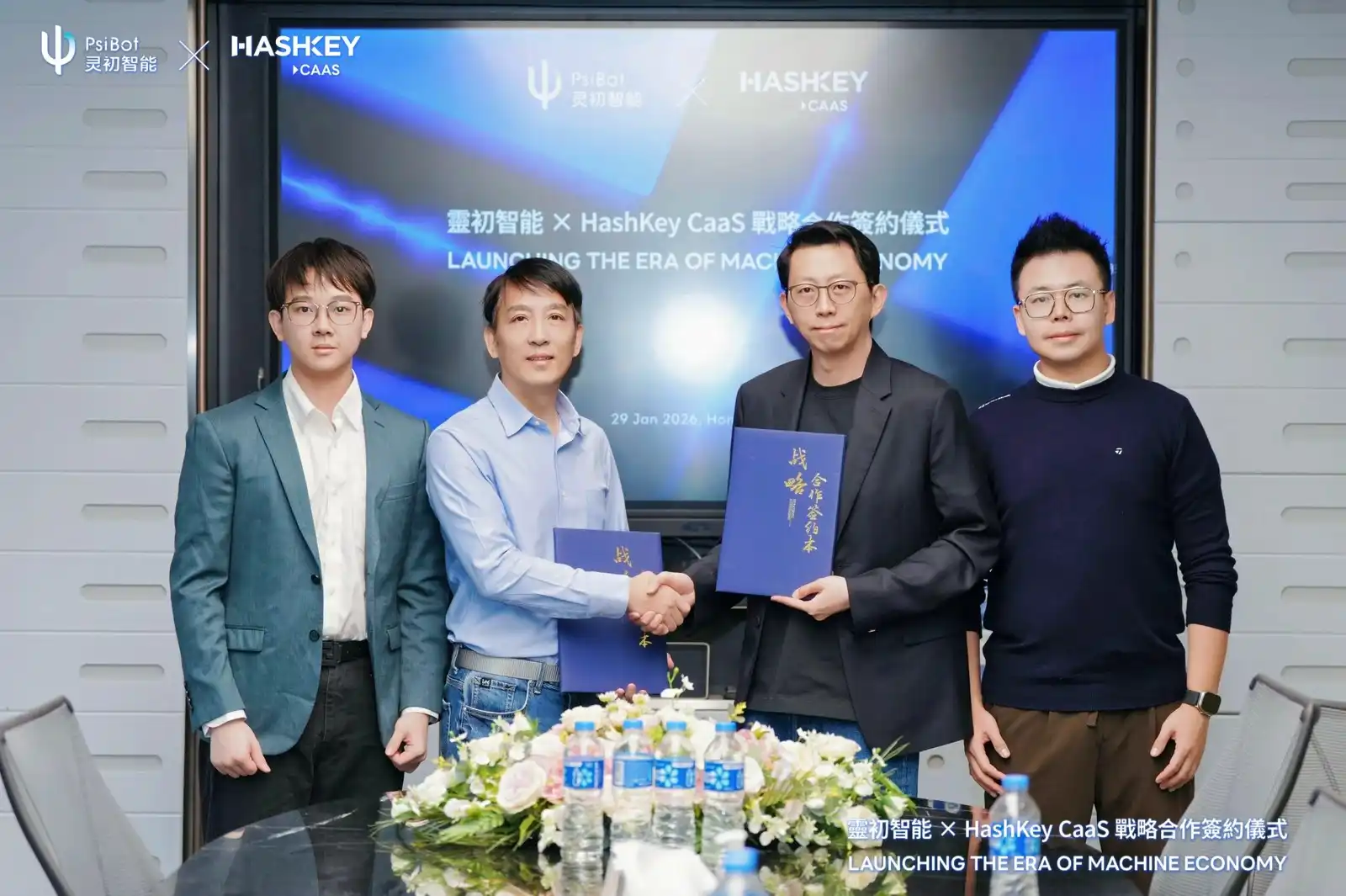
HashKey CaaS and Lingchu Intelligence Form Strategic Partnership to Jointly Build AI Autonomous Payment Infrastructure

marsbit發佈於 2026-01-29更新於 2026-01-29

文章摘要

HashKey CaaS and Lingchu Intelligence have entered into a strategic partnership to jointly develop AI autonomous payment infrastructure. The collaboration will focus on data tokenization for robots and the implementation of the HP2 (HashKey Payment Protocol) autonomous payment network, aiming to integrate AI with the digital financial system and build key infrastructure for the embodied intelligence economy. As part of the agreement, Lingchu will deploy 10 dual-arm robots integrated with HashKey CaaS’s HP2 payment protocol, designed for Web3 and AI agents. These robots will gain controlled payment permissions, enabling them to act as autonomous agents to conduct on-chain transactions—such as purchasing services, accessing data interfaces, and earning on-chain income through task execution. Each autonomous transaction will be recorded as an auditable on-chain financial record, transforming the robots from mere smart devices into independent participants in the digital economy. Additionally, HashKey CaaS will tokenize the operational data generated by Lingchu’s robots, turning them into tradable digital assets with monetary value. HashKey’s CEO of On-Chain Business Group, Li Chen, stated that this partnership marks the first application of the HP2 protocol in embodied AI, supporting the integration of robots into the digital financial ecosystem. Wang Qibin, CEO of Lingchu Intelligence, emphasized that the collaboration will help accelerate the transition from R&D to an ecosy...

HashKey CaaS has announced a strategic partnership with Lingchu Intelligence, a robotics company focused on the field of embodied AI. The two parties will engage in in-depth collaboration around robot data tokenization and the HP2 (HashKey Payment Protocol) autonomous payment network, promoting the integration of AI and the digital financial system, and jointly building the key infrastructure for the embodied intelligent economy.

As part of this collaboration, Lingchu Intelligence will deploy 10 dual-arm robots and integrate them with HashKey CaaS's HP2 payment protocol, which is specifically designed for Web3 and AI Agents. Through HP2, the robots will gain controlled payment permissions, enabling them to perform on-chain interactions as "autonomous agents," including autonomously purchasing services, calling data interfaces, and earning on-chain revenue by executing tasks. Throughout this process, every autonomous transaction generated by the robots will be fully recorded as auditable on-chain financial credentials, transforming the robots from traditional "intelligent devices" into genuine "digital economic entities" capable of independently participating in economic activities.

Simultaneously, HashKey CaaS will convert the operational data generated by Lingchu Intelligence's robots during actual operation into tradable tokenized digital assets, endowing "robot data" with asset attributes and transactional value.

Li Chen, CEO of HashKey On-Chain Business Group, stated: "This collaboration marks the first application of the HP2 protocol in the field of embodied AI. HashKey CaaS's on-chain new financial infrastructure will support robots and AI in truly integrating into the digital financial system, achieving autonomous on-chain data transactions and value circulation, and laying the foundation for embodied intelligence to participate in the real economy."

Wang Qibin, CEO of Lingchu Intelligence, stated: "The widespread application of embodied intelligence relies on the confirmation of data value and an automated value exchange system. Through the partnership with HashKey, Lingchu Intelligence will accelerate its transition from technological research and development to ecosystem development oriented towards the machine economy."

In the future, the two parties will continue to explore more applications of embodied intelligence in scenarios such as payment and autonomous services, accelerate the implementation of related technologies and models, and promote the shift of the AI economy from conceptual validation to large-scale practice.


相關問答

QWhat is the strategic partnership between HashKey CaaS and Lingchu AI about?

AThe strategic partnership between HashKey CaaS and Lingchu AI focuses on robot data tokenization and the HP2 (HashKey Payment Protocol) autonomous payment network. They aim to integrate AI with the digital financial system and build key infrastructure for the embodied intelligent economy.

QHow many robots will Lingchu AI deploy as part of this collaboration?

ALingchu AI will deploy 10 dual-arm robots as part of this collaboration.

QWhat is the HP2 payment protocol designed for?

AThe HP2 payment protocol is designed for Web3 and AI Agents, enabling robots to have controlled payment permissions, act as autonomous agents for on-chain interactions, purchase services, call data interfaces, and earn on-chain income through task execution.

QHow will HashKey CaaS utilize the operational data from Lingchu AI's robots?

AHashKey CaaS will convert the operational data generated by Lingchu AI's robots into tokenized digital assets, giving the data asset attributes and transactional value.

QWhat did HashKey's On-Chain Business Group CEO, Li Chen, say about this partnership?

ALi Chen stated that this partnership is the first application of the HP2 protocol in the embodied intelligence field. HashKey CaaS's on-chain financial infrastructure will support robots and AI in integrating into the digital financial system, enabling autonomous on-chain data settlement and value transfer, laying the foundation for embodied intelligence to participate in the real economy.

你可能也喜歡

美国参议员敦促银行监管机构制定‘公平’的加密货币资本规则

美国参议员呼吁制定“公平”的加密资本规则。由参议院数字资产小组委员会主席辛西娅·卢米斯牵头,多名共和党参议员致信美联储、联邦存款保险公司(FDIC)及货币监理署(OCC)负责人,要求为银行从事加密资产活动建立更清晰、公平的资本框架。 信中批评了巴塞尔银行监管委员会现行的加密资产资本标准,该标准对加密资产施加了1250%的风险权重,参议员们认为这并非基于实际风险评估,而像是一种按资产类别“一刀切”的惩罚,实质上阻碍了银行持有此类资产,与监管机构倡导的“技术中立”原则相悖。 议员们赞赏了监管机构近期关于代币化证券的联合指引,该指引明确了此类资产应获得与其非代币化对应物同等的资本待遇。他们敦促监管机构将这一风险导向原则一致性地应用于其他数字资产,并基于近期在加密市场结构法案方面的进展,开始为银行的资产负债表加密资产活动制定新的资本框架。 与此同时,FDIC、OCC和美联储负责人近期在国会作证时,概述了其转向更“基于风险”的监管方向,旨在改革监管框架以提高效率,并审查过去的监管措施。他们强调,强有力的资本标准对保障银行体系韧性和支持经济增长至关重要,同时监管应促进而非阻碍负责任的创新。

bitcoinist15 分鐘前

美国参议员敦促银行监管机构制定‘公平’的加密货币资本规则

bitcoinist15 分鐘前

从以太坊到AI的“CROPS”:Vitalik反复强调的这套“慢变量”,究竟是什么?

以太坊创始人Vitalik Buterin近期频繁强调一个概念——CROPS,它代表抗审查性(Censorship Resistance)、抗捕获性(Capture Resistance)、开源(Open Source)、隐私(Privacy)和安全(Security)。这一理念源于以太坊基金会发布的指导文件,旨在确保用户在数字生活中不依赖单一平台、不丧失最终控制权。 随着AI技术深入钱包和自动化执行场景,CROPS的内涵超越了以太坊的原有范畴,成为AI时代用户能否掌控自身数字生活的关键问题。Vitalik指出,真正的“CROPS AI”应支持多种硬件平台,而不仅仅是“去中心化AI”。当AI成为用户的数字代理人,处理资产管理和链上操作时,确保其抗审查、开放、隐私和安全变得至关重要。 CROPS Ethereum与CROPS AI存在显著交集。例如,通过零知识证明实现付费远程大模型调用和私密以太坊RPC读取,旨在让用户在获取远程服务的同时避免暴露敏感信息。未来,可能出现更多针对以太坊场景微调的AI模型,用于提升智能合约和生态安全。 这一理念将深刻影响Web3生态,尤其是钱包等入口层产品。在市场关注短期热点的背景下,CROPS提醒我们关注那些决定长期方向的技术变量:在AI加速接管数字世界的时代,确保系统可理解、可验证、注重隐私和安全,才是以太坊持续价值的真正体现。

marsbit2 小時前

从以太坊到AI的“CROPS”:Vitalik反复强调的这套“慢变量”,究竟是什么?

marsbit2 小時前

交易

現貨
合約
活动图片




