Eric Trump Sets A “Beyond Catastrophic” Bar To Sell Bitcoin — How Far Are We From That?

bitcoinist發佈於 2026-05-25更新於 2026-05-25

文章摘要

Eric Trump, Chief Strategy Officer of American Bitcoin Corp., has declared that the company would only sell its Bitcoin holdings under circumstances he describes as "beyond catastrophic." In an interview, he framed this as a strategic commitment to permanent accumulation, driven by the goal of increasing "satoshis per share" and competing in both the race for the largest Bitcoin holdings and the lowest acquisition cost. The company mines its Bitcoin at a claimed 53% below spot price and retains all coins, drawing a distinction from Michael Saylor's MicroStrategy, which has signaled some flexibility. Trump's stance sets a new benchmark for long-term commitment in the Bitcoin treasury sector. As of the report, Bitcoin trades near $82,000, with American Bitcoin's treasury holding over 7,000 BTC.

Eric Trump, co-founder and Chief Strategy Officer of American Bitcoin Corp., has revealed the conditions under which he would sell Bitcoin — and the threshold he has set is so extreme it amounts to a declaration that, under any foreseeable market scenario, he is not selling.

Speaking in an interview for the Bonnie Blockchain channel published on May 12, Trump was asked directly about the circumstances that could force American Bitcoin to liquidate its holdings. His answer was unambiguous.

Selling would require something “beyond catastrophic,” per the interview — a framing that places the sell threshold so far outside normal market volatility, regulatory pressure, or even prolonged bear markets that it functions less as a risk management policy and more as a philosophical commitment to permanent accumulation.

The Two Races — And Why Selling Bitcoin Loses Both

The broader context behind Trump’s sell-never posture is the dual competitive framework he laid out in the same interview. According to Trump, the Bitcoin treasury space is defined by two simultaneous races: one for the largest total Bitcoin holdings, and one for the lowest possible acquisition cost. American Bitcoin, he argued, is competing in both — and selling Bitcoin loses ground in the first race immediately while undermining the entire logic of the second.

The company’s north star metric, per Trump’s interview, is growing “satoshis per share” — a measurement of how much Bitcoin each outstanding share of ABTC represents. Every Bitcoin sold dilutes that figure. Every Bitcoin mined and retained compounds it. The accumulation model only works if the coins stay, which makes the “beyond catastrophic” sell threshold not a rhetorical flourish but a structural requirement of the strategy itself.

The Saylor Reference — And The Divergence

Trump acknowledged Michael Saylor’s role in building the Bitcoin treasury category, describing him as a visionary and praising Strategy’s approach, per the interview. But he drew a pointed distinction. Saylor recently suggested that Strategy could sell some Bitcoin to help fund dividend payments — a hint of flexibility in the accumulation model that Trump appears unwilling to replicate.

American Bitcoin, he made clear, is following a stricter retention framework. Where Strategy accumulates primarily through capital markets and has signaled some exit flexibility, ABTC accumulates through mining — at a cost it claims is approximately 53% below spot — and holds without exception, per the interview.

The distinction matters for how investors read both companies. A sell-never posture from a mining-integrated treasury firm is more operationally credible than the same posture from a pure accumulator, because the marginal cost of each new coin is structurally lower and the balance sheet pressure to monetize is reduced accordingly.

For the nascent sector’s growing cohort of Bitcoin treasury companies, Trump’s “beyond catastrophic” framing marks a pivotal benchmark — the most unambiguous long-term accumulation commitment any publicly listed executive has put on record this cycle. Whether the market rewards that conviction or punishes the rigidity will depend on where Bitcoin trades over the next several years.
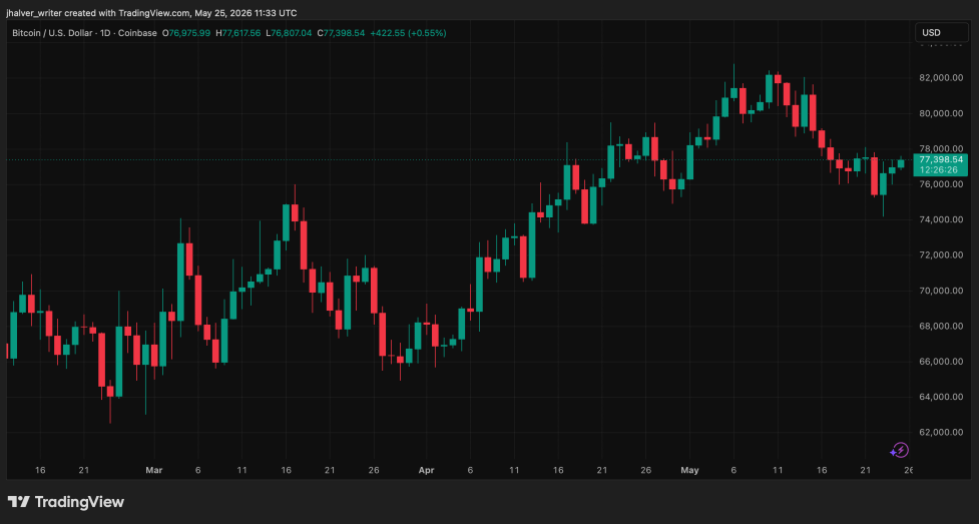
BTC's price trends to the upside, as seen on the daily chart. Source: BTCUSD on Tradingview

As of this writing, Bitcoin trades at around $82,000, with American Bitcoin’s treasury holding over 7,000 BTC as the company continues what its co-founder has now publicly described as an unconditional accumulation strategy.

Cover image from Grok, BTCUSD Chart from Tradingview

相關問答

QAccording to the article, what is the specific condition under which Eric Trump says he would sell Bitcoin?

AEric Trump would only sell Bitcoin under conditions he describes as "beyond catastrophic," a threshold so extreme it effectively amounts to a commitment to never sell under any foreseeable market scenario.

QWhat are the two key competitive races in the Bitcoin treasury space as outlined by Eric Trump in the interview?

AThe two key competitive races are: 1) the race for the largest total Bitcoin holdings, and 2) the race for the lowest possible acquisition cost for Bitcoin.

QWhat is the key metric American Bitcoin Corp. focuses on, and how does selling Bitcoin affect it?

AAmerican Bitcoin Corp.'s key metric is growing "satoshis per share," which measures how much Bitcoin each outstanding share represents. Selling Bitcoin immediately dilutes this figure.

QWhat is the main operational difference between American Bitcoin Corp.'s and MicroStrategy's Bitcoin accumulation strategies mentioned in the article?

AThe main difference is that American Bitcoin Corp. (ABTC) accumulates Bitcoin primarily through mining at a claimed low cost and follows a strict 'sell-never' policy, while MicroStrategy accumulates primarily through capital markets and has signaled some flexibility to potentially sell Bitcoin to fund dividends.

QHow does the article characterize the credibility of a 'sell-never' posture from a mining company compared to a pure accumulator?

AThe article states that a 'sell-never' posture from a mining-integrated treasury firm is more operationally credible than from a pure accumulator because the marginal cost of each new coin is structurally lower, reducing balance sheet pressure to monetize the holdings.

你可能也喜歡

Bitwise观点:全球债务清算或将使比特币受益

资产管理公司Bitwise发布报告,认为全球债务压力可能最终有利于比特币。报告指出,2026年将有近30万亿美元的全球债务需要再融资,日本国债收益率上升和国际货币基金组织对政府债务需求减弱的警告可能将市场逼入困境。Bitwise认为,若央行因此注入新流动性,作为独立于政府资产负债表、不依赖中央发行机构的资产,比特币可能发挥不同作用。 报告将比特币的吸引力与实际利率挂钩,指出在实际收益率下降时比特币往往表现更好,而顽固通胀与美联储暂停加息可能促成这一环境。比特币在5月一度突破83,000美元后失去动力,回落至70,000美元附近,主要因ETF资金流出加速和市场情绪降温。 Bitwise称,比特币在70,000至73,000美元区间获得支撑,但未能突破80,000至85,000美元的关键阻力带,该区域被视为市场健康与否的分界线。尽管需求疲软,比特币供应正趋于紧张:长期持有者持有的比特币数量创历史新高,占流通供应量的73%,且大量比特币处于长期休眠状态。 报告还指出,与估值接近历史高位的美国科技股相比,比特币的MVRV比率仍低于长期平均水平,显得相对便宜。关键价格位方面,78,000至80,000美元为重要观察区域,83,000至85,000美元是首要阻力位,73,000美元为重要支撑位,上行目标看向95,000美元。截至报告发布时,比特币交易价格约为69,460美元。

bitcoinist1 小時前

Bitwise观点:全球债务清算或将使比特币受益

bitcoinist1 小時前

以太坊基金会主席打破沉默,阐述新使命及内部紧张关系

以太坊基金会主席Aya Miyaguchi阐述了该组织的新使命,称这一转变是内部争论日益紧张、基金会同时面临过多压力后的必要调整。她表示,新使命由董事会提出,但由她于去年年底建议。触发因素并非单一争议,而是结构性问题:EF已成为各种竞争期望的焦点,技术讨论变得政治化、个人化,同时基金会规模扩张导致其核心被多方不同愿景拉扯。 Miyaguchi强调,以太坊基金会只是以太坊众多节点之一,其中心性的减弱并非责任退缩,而是以太坊成熟超越其最初机构的证明。她回顾了自己自2012年以来的行业经历,指出自2018年担任执行董事以来,目标就是帮助以太坊超越基金会发展。基金会通过孵化Uniswap、ENS等项目,支持ETHGlobal黑客松,以及通过Gitcoin等“资助资助者”来刻意分散权力而非保留控制权。 目前,EF持有的ETH已不足总量的0.2%,其角色也按设计变得更集中。新使命的核心是维护和加速使以太坊“具有独特价值、竞争力且值得构建”的特性与目标,聚焦于CROPS及“不可剥夺的用户自我主权和自我主权协调”。Miyaguchi否认更专注的EF意味着减少对应用推广的关心,认为恰恰相反,日常用户和机构都依赖于以太坊的根本价值主张。 此番表态之际,EF在2026年经历了多位高级贡献者的离职潮。Miyaguchi承认,随着基金会变得更加专注和有主见,团队规模自然会变小、更集中,这是选择的一部分。Vitalik Buterin此前也发文描述了基金会向更精简、更专注结构的过渡,减少作为以太坊中心的作用,更注重维护网络的长期特性。

bitcoinist2 小時前

以太坊基金会主席打破沉默,阐述新使命及内部紧张关系

bitcoinist2 小時前

交易

現貨
合約
活动图片





