There’s a two tier world for High Performance Compute (HPC). Hyperscalers (OpenAI, XAi, OpenAI, Google, etc), have access to near infinite financing, but are constrained by power, water, and land. Building a 1 GW data center to meet the needs of frontier models is an industrial marvel. Smaller operators and emerging neoclouds, however, have access to small 1-50mw sites, but they have not had easy access to financing. HPC clusters can generate stable leasing cash flows, making them high-quality income-producing assets, but banks and private credit have denied financing to mid to smaller operators. The only available option for these operators was to issue convertible bonds, heavily diluting investors and adding lengthy due diligence cycles. As a result, many small and medium-sized GPU providers serving overseas AI startups continue to face liquidity pressure despite holding valuable productive assets.
USD.AI addresses this gap by using GPU hardware and the leasing cash flows generated by compute capacity as on-chain collateral. The protocol is building a decentralized credit market focused specifically on financing AI infrastructure.
I. A Two-Sided Market Connecting GPU Borrowers and Stablecoin Depositors
USD.AI adopts a standard two-sided market structure.
On the borrower side, AI infrastructure operators apply for financing through one of USD.AI’s underwriting partners. The protocol uses asset-level underwriting, with each GPU or GPU cluster evaluated and collateralized independently. Loan-to-value parameters are determined through $CHIP governance voting, while independent underwriting teams participate in due diligence.
The loans are structured on a non-recourse basis, meaning that in the event of default, recourse is limited to the collateralized GPUs and their associated cash flows. At the same time, the structure includes a springing recourse provision: fraudulent or malicious behavior can trigger full recourse against the borrowing entity.
On the depositor side, users deposit PYUSD to mint USDai, a fully collateralized synthetic dollar that does not itself accrue interest. After staking USDai, users receive sUSDai, a yield-bearing receipt token. Returns accrue through a dynamic exchange-rate mechanism.
Yield comes from two sources: GPU loan interest when capital is actively deployed, and Treasury income generated from PYUSD reserves when capital is idle. The current realized APR is approximately 7.1%, while projected APR can reach 11-12% at full utilization. Total value locked has reached $346 million, with more than 74,000 active users.
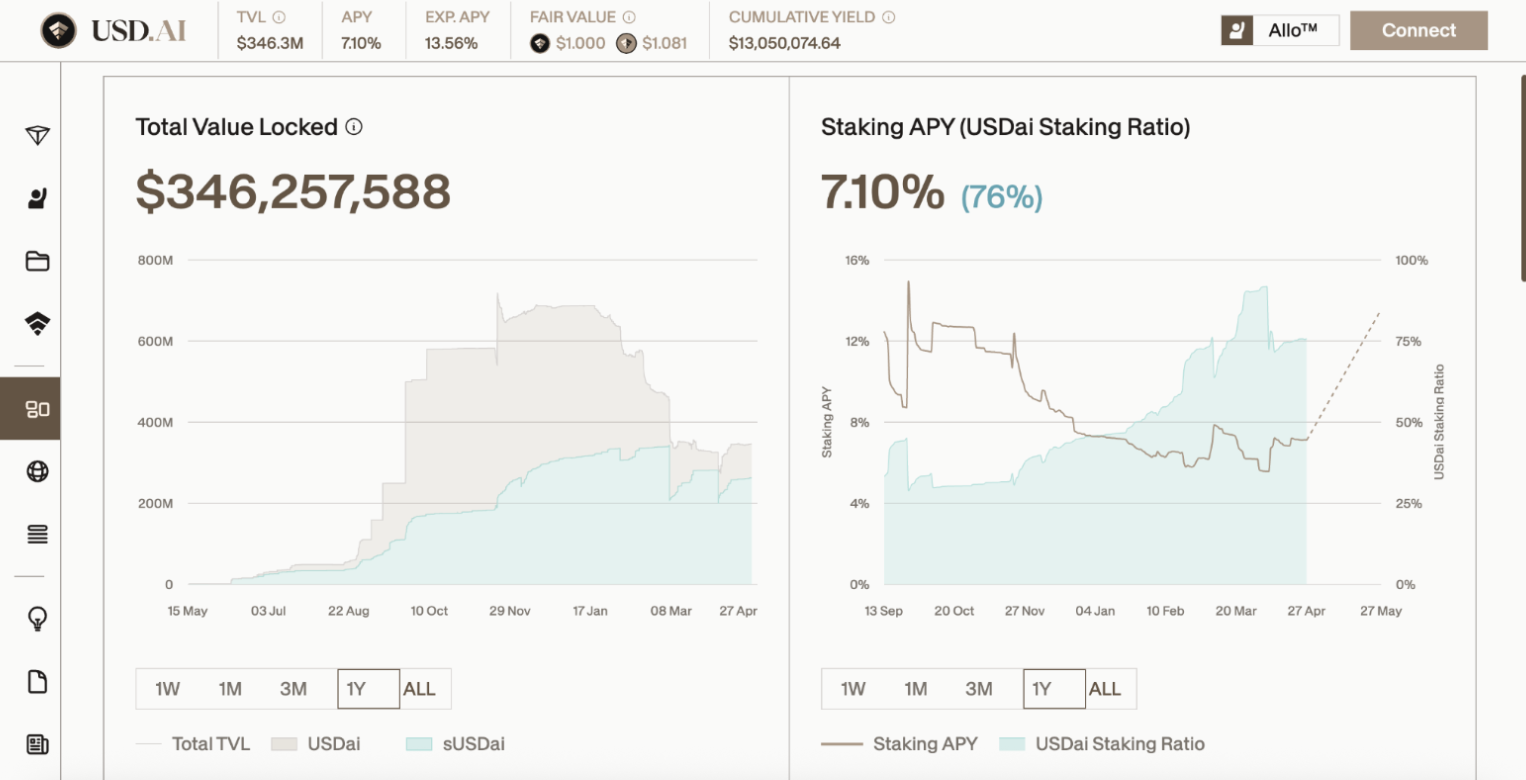
Figure: USD.AI TVL and Staking APY, Source: Official Website, April 27, 2026
II. Technical Architecture: Combining RWA Tokenization with DeFi Liquidity
USD.AI’s core advantage lies in its modular architecture. The protocol uses PYUSD as the base collateral layer while integrating RWA tokenization, DeFi liquidity mechanisms, and AI infrastructure financing needs.
USDai functions as a fully collateralized stablecoin with 1:1 minting and redemption. sUSDai serves as the core yield-bearing receipt token, automatically accumulating returns from the protocol’s dual yield sources.
GPU Loans, accessible through gpuloans.com, serves as the lending frontend and supports the protocol’s non-recourse plus springing-recourse structure. The CALIBER module enables on-chain tokenization and legal recognition of GPU hardware assets. QEV, the protocol’s liquidity mechanism, addresses the long lock-up periods typically associated with RWAs by using queue-based management to support near-instant redemptions, significantly reducing the liquidity premium.
$CHIP serves as the core governance token of the protocol, with its role discussed in greater detail in Section IV.
III. Financing in Practice: Protocol Fundraising and GPU-Backed Lending
USD.AI’s own fundraising reflects a hybrid model that combines real-world assets with DeFi capital efficiency. In August 2025, Permian Labs completed a $13.4 million Series A round led by Framework Ventures, bringing cumulative financing to approximately $36.8 million. The funds are being used for technical development and collaboration with traditional financial institutions.
The protocol’s core value proposition is most visible in its GPU lending business. As of the end of April 2026, USD.AI had approved more than $1.2 billion in credit lines and completed several landmark transactions. On April 6, for example, the protocol issued a $26.8 million loan to Crucible Capital, collateralized by 576 B300 GPUs, with a 70% LTV and a 10% interest rate. Another $9.8 million loan was collateralized by H200 and B200 GPUs at an 11.5% interest rate.
All loans are brought on-chain after due diligence and asset verification The current active pipeline stands at $314 million, while capital utilization continues to rise. Through springing recourse provisions and value insurance coverage from Barkr, the protocol seeks to control risk while offering small and medium-sized operators a faster, lower-dilution financing channel.
IV. $CHIP Token: Growth-Oriented Asset Governance Token Driven by Governance Utility
$CHIP was launched on April 21–22, 2026, and quickly drew attention across the AI infrastructure sector. Holders can vote on the scope of eligible collateral, LTV parameters, interest-rate structures, fee distribution, and future expansion directions. By staking $CHIP, holders can gain additional voting weight and participate in revenue sharing, aligning their incentives closely with the protocol’s growth.
According to CoinMarketCap data as of April 27, 2026, CHIP was trading at $0.078, up more than 120% from its post-launch low. Its market capitalization reached $156 million, while its trading-volume-to-market-cap ratio stood as high as 248.25%, reflecting strong market interest.
CHIP’s market performance has been supported not only by fundamentals such as TVL and APR, but also by its genuine governance utility. The token is increasingly becoming a growth-oriented asset tied to USD.AI’s long-term value capture.
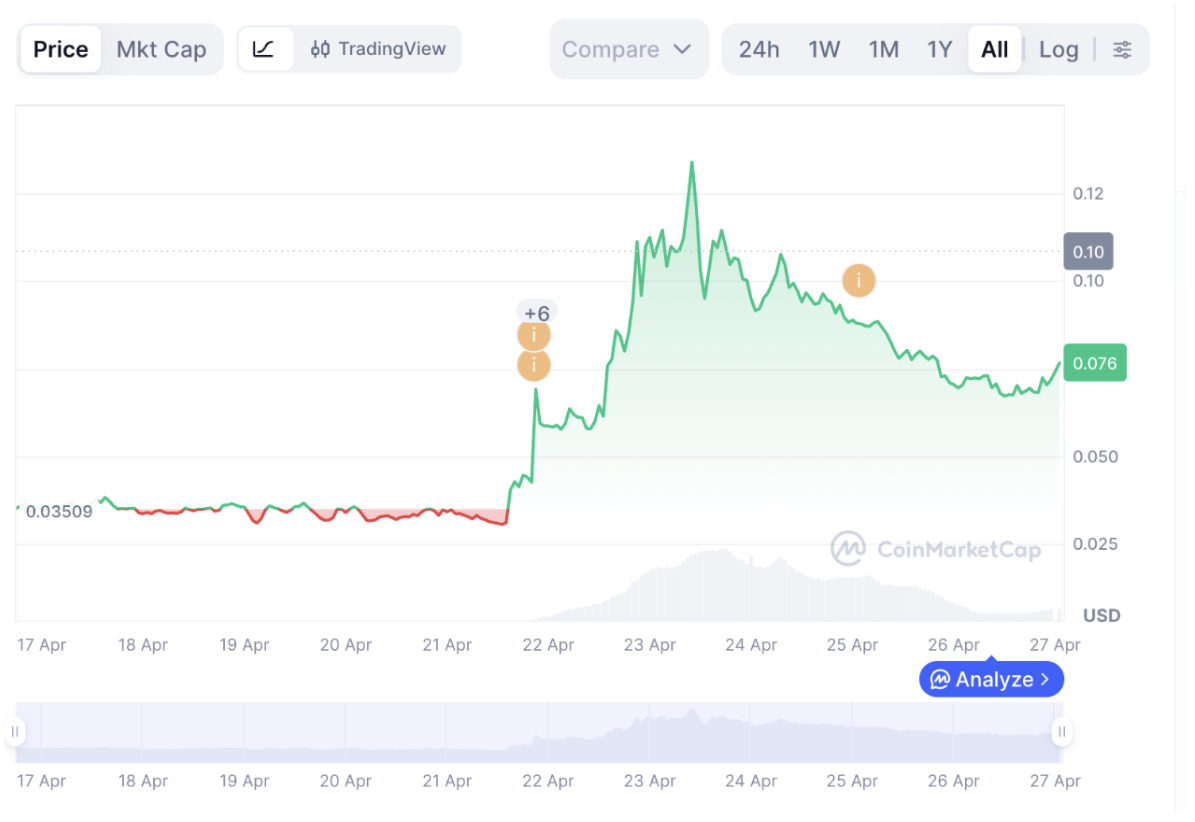
Figure: CHIP Token Price Trend, Source: CoinMarketCap, April 27, 2026
Conclusion
With its “compute as collateral” model, USD.AI addresses a key financing bottleneck in AI infrastructure. It provides operators with efficient on-chain credit while giving DeFi capital access to real AI growth yields.
Against the backdrop of a global compute financing gap measured in the hundreds of billions of dollars, USD.AI is attempting to reshape the financial infrastructure behind AI. As next-generation GPUs are added to the collateral pool and governance mechanisms continue to evolve, compute-backed lending could become a foundational financial utility for the AI era.
By enabling real compute cash flows to circulate efficiently on-chain, USD.AI offers an early glimpse of how AI infrastructure financing and decentralized credit markets may converge at scale.