The Mag7 Myth Shatters: 9 Consecutive Drops, Amazon Follows Microsoft into Bear Market

marsbit發佈於 2026-02-14更新於 2026-02-14

文章摘要

Amazon's stock has experienced a nine-day losing streak, its longest in nearly two decades, officially entering a bear market after falling more than 23% from its recent high. It becomes the second member of the "Magnificent Seven" (Mag7) to do so, following Microsoft, which entered a bear market in late January and is down 27.8%. Meta is also nearing bear market territory, down 19.6% from its peak, as investor confidence is shaken by aggressive AI spending plans. The four major cloud hyperscalers—Amazon, Microsoft, Meta, and Alphabet—are projected to spend a combined $650 billion on capital expenditures in AI by 2026, with Amazon leading at $200 billion. This massive spending is raising significant concerns among investors about returns on investment and its impact on free cash flow. For Amazon, this level of expenditure could push its free cash flow into negative territory this year, potentially forcing it to raise more capital from debt markets. Analysts note a rotation within the Mag7, with investors moving away from companies like Microsoft and Nvidia to favor others like Alphabet, whose vertically integrated tech infrastructure helps alleviate some spending concerns. The next key catalyst for AI-related stocks is expected to be Nvidia's earnings report on February 25th, which will indicate whether the AI boom is sustaining.

Author: Zhao Ying, Bao Yilong, Wall Street Insights

Amazon's stock has fallen for nine consecutive days, marking its longest losing streak in nearly 20 years.

After entering a technical bear market on Thursday, becoming the second Mag7 company to fall into a bear market, Amazon's stock continued to decline on Friday.

Investors are strongly resisting the aggressive AI spending plans of tech giants, leading to significant declines in these star stocks.

On Friday, Amazon's stock closed at $198.79, down more than 23% from its recent high, officially crossing the bear market threshold the previous day, Thursday.

Among the four major hyperscale cloud service providers, Amazon has the highest planned capital expenditure for 2026, reaching $200 billion.

Amazon, Microsoft, Meta, and Alphabet are expected to collectively spend $650 billion on capital expenditures in the AI field by 2026.

Meta could be the next Mag7 member to fall into a bear market. As of Friday's close, it was down 19.6% from last year's high, just 0.4% away from the bear market threshold of a 20% decline. Although Meta's Q4 revenue and profits exceeded Wall Street expectations, increased AI spending and margin pressures have dampened investor confidence.

Microsoft was the first Mag7 member to enter a bear market. The company's stock fell into a bear market on January 29, after the Azure cloud business growth reported the previous day fell short of investor expectations. As of Friday's close, Microsoft's stock was down 27.8% from its recent high.
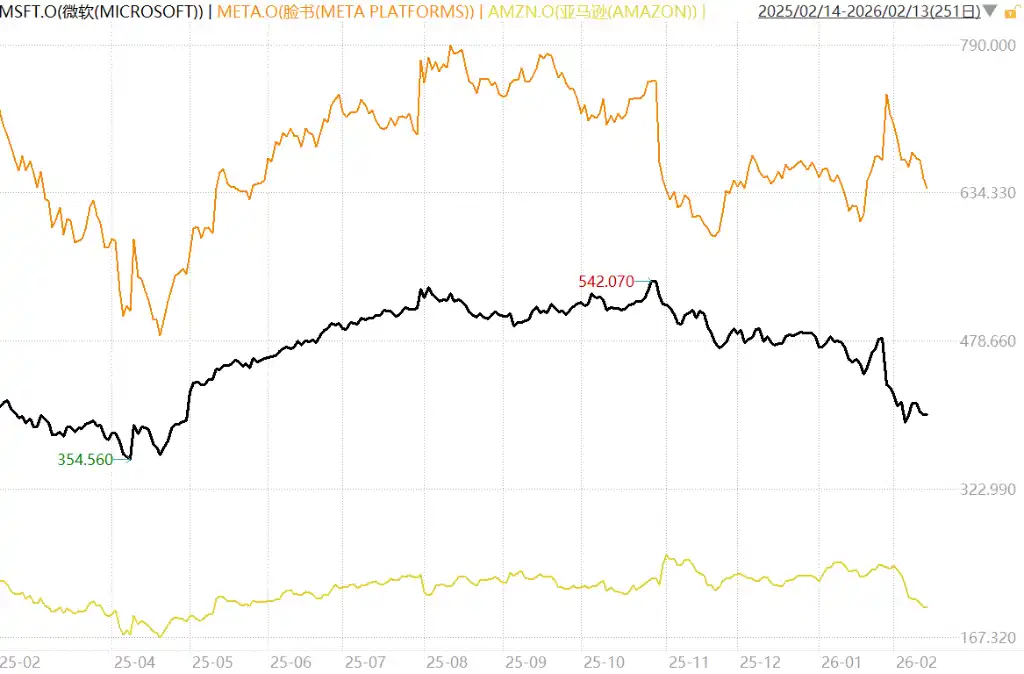
(Chart of Amazon, Microsoft, and Meta's performance over the past year)

Investors Rotate Within Mag7, Free Cash Flow Pressure Highlights

Mike Treacy, Vice President of Risk at Apex Fintech Solutions, stated that the recent sell-off highlights the growing divergence among Mag7 members.

Since last fall, investors have shifted away from OpenAI-related deals involving Microsoft, NVIDIA, and Oracle, favoring the Alphabet and Broadcom ecosystems instead.

Treacy pointed out that Alphabet's vertically integrated technology stack has somewhat offset concerns about excessive spending, shielding the stock from the worst of the tech sell-off. Alphabet's stock closed Thursday down 9.2% from its recent high.

Treacy noted that Google's self-sufficiency should command a premium relative to other companies that may be adversely affected by a single link in the industry chain.

Amazon, Microsoft, and Meta's stocks have been hit harder because investors lack confidence that these companies' AI spending will yield sufficient returns on investment.

For Amazon, the increased level of expenditure could lead to negative free cash flow this year, meaning the company may need to start raising more funds in the debt market.

Treacy believes that the next major catalyst for AI trades will be NVIDIA's earnings report on February 25. This report will show whether the AI boom is cooling down or if NVIDIA has successfully captured the tens of billions of dollars its largest clients are investing into the field.

Related reading: Trading Moment: AI Panic Escalates Ahead of CPI, Bitcoin Grinds Bottom, May Struggle to Repeat "Spring Festival Rally"


相關問答

QWhat is the main reason for the recent decline in Mag7 stocks, particularly Amazon and Microsoft?

AInvestors are strongly resisting the aggressive AI spending plans of tech giants, leading to significant sell-offs in these star stocks.

QWhich Mag7 company was the first to enter a bear market, and when did it happen?

AMicrosoft was the first Mag7 member to enter a bear market, with its stock falling into bear territory on January 29.

QHow much is Amazon's planned capital expenditure for 2026, and what is the total AI-related capital expenditure expected from the four major cloud service providers?

AAmazon plans a capital expenditure of $200 billion for 2026. The four major cloud service providers (Amazon, Microsoft, Meta, and Alphabet) are expected to spend a total of $650 billion in AI-related capital expenditures by 2026.

QWhich Mag7 company is at risk of being the next to fall into a bear market, and how close is it to the 20% decline threshold?

AMeta is at risk of being the next Mag7 member to fall into a bear market. As of Friday's close, it was down 19.6% from last year's high, just 0.4% away from the bear market threshold of a 20% decline.

QWhat potential financial pressure does Amazon face due to its increased capital expenditure in AI?

AThe increase in capital expenditure levels could lead Amazon's free cash flow to turn negative this year, meaning the company may need to raise more capital by entering the debt market.

你可能也喜歡

SpaceX交易权限现已开放:WEEX上线SPCXON交易对

2026年6月,SpaceX完成了史上最大规模的IPO,但大量投资者因券商限制、开户障碍和地域壁垒而无法参与。加密货币交易所WEEX推出了解决方案SPCXON/USDT现货交易对。SPCXON是一种基于Ondo代币化股票框架构建的产品,旨在为美国以外的合格交易者提供追踪SpaceX经济收益的途径,以USDT结算,交易便捷,无传统券商门槛。 SpaceX IPO定价为135美元,首日收盘接近161美元,随后一度冲高至225美元,公司估值约1.75万亿美元。看涨理由基于星链收入增长、无可匹敌的发射频率以及星舰里程碑。看跌观点则认为,其估值已达营收的90-110倍,且存在流通股稀少和即将到来的内部持股解锁等风险。 需注意,SPCXON提供的是价格敞口,而非股票所有权,不包含投票权和直接股息。其价格可能相对净资产价值出现溢价或折价,交易者需关注价差。 WEEX平台整合了包括SpaceX、MicroStrategy和Micron在内的多种代币化股权产品,用户可在统一账户内交易加密货币和股权敞口。平台还提供高达400倍杠杆的加密货币期货交易。 WEEX成立于2018年,全球用户超过620万,提供超过1200个现货交易对,并设有1000 BTC保护基金。平台亦提供跟单交易和AI工具等功能。 免责声明:本文内容不构成投资建议。

TheNewsCrypto21 小時前

SpaceX交易权限现已开放:WEEX上线SPCXON交易对

TheNewsCrypto21 小時前

Gate 研究院:加密金融产品掀起“华尔街化”浪潮,是竞争还是融合?

2009年比特币的创世区块暗含对传统金融体系的批判,其理想是建立去中心化、去中介、去银行的点对点金融系统。然而十七年后,比特币现货ETF获批、贝莱德等巨头发行相关产品、CME推出受监管衍生品、RWA(真实世界资产)和代币化国债市场快速增长等现象,显示传统金融正系统性地介入加密资产的发行、定价、托管和分销环节,引发了加密市场是否“华尔街化”的讨论。 文章认为,这并非单方面的吞并,而是加密体系与传统金融的双向融合与互补。加密领域提供无许可开放性、24小时交易和可编程结算,但缺乏合规通道、机构级托管和主流分销网络;传统金融则拥有牌照、信任、资金和渠道,但受限于交易时间、跨境门槛和结算效率。双方正朝彼此的核心优势靠拢。 这种融合体现为两条路径:一是以Gate为代表的加密交易所,逐步从提供代币化美股、CFD差价合约,发展到接入真实股票、港股、韩股交易,成为连接加密账户与传统券商基础设施的前端入口;二是以Robinhood为代表的传统券商,通过收购加密交易所、推出股票代币和建设自有Layer 2,将加密资产和链上代币化产品整合进其平台。两者的共同目标是争夺下一代综合金融账户的入口,让用户在一个界面内交易多种资产。 同时,RWA和链上国债作为资产层的融合正在加速。尽管规模尚小,但代币化国债等产品为链上提供了低波动收益资产,并吸引JP摩根、贝莱德等传统机构参与,测试未来资本市场的底层结算方式。 最终,加密与华尔街并非谁征服谁,而是在共同塑造一个更高效、全球化的统一资本市场。用户未来或将在同一个账户中自由交易比特币、股票、ETF、链上国债等多种资产,体验无缝的跨资产配置。去中心化的理想仍在底层协议中延续,而在应用层,一个融合了双方优势的新金融形态正在形成。

marsbit21 小時前

Gate 研究院:加密金融产品掀起“华尔街化”浪潮,是竞争还是融合?

marsbit21 小時前

交易

現貨
活动图片




