Liquidity Pledge's Impact on $HTX Prices

#HTX Tutorial

Many people are curious about how liquidity pledges benefit $HTX, compared to simply burning tokens.
Burning tokens reduces the total supply. If market demand remains constant, a reduced supply can help increase the price, thus preserving the token's value. This method is straightforward and commonly used by many projects, such as through halving or burning mechanisms.
How Does Liquidity Pledge Impact Token Prices?
Does pledging liquidity produce the same result as burning tokens? Let's look at some hypothetical scenarios.
1. 100% of $HTX is pledged to liquidity. In this scenario, no tokens would be left in the market, and the tokens in the liquidity pool would be permanently locked, preventing them from circulating and trading. This situation is practically meaningless and unlikely to occur.
2. 80% of $HTX is pledged to liquidity. Since liquidity is added by buying back $HTX at market prices, 80% of the tokens are locked at a certain value, X (the average buyback price). To withdraw $HTX from the pool, one would need to pay X, thereby stabilizing the price of $HTX above X. If the remaining 20% of $HTX were sold off, it could lower the price, but the 80% locked in the pool could absorb the selling pressure, limiting the potential price drop to a maximum of 20%.
3. 50% of $HTX is pledged to liquidity. In this case, 50% of the $HTX tokens are locked at X. If all the remaining tokens are sold, the maximum price drop could be 50%.
4. 20% of $HTX is pledged to liquidity. Here, 20% of the $HTX tokens are locked at X. If all the remaining tokens are sold, the price could drop by up to 80%.
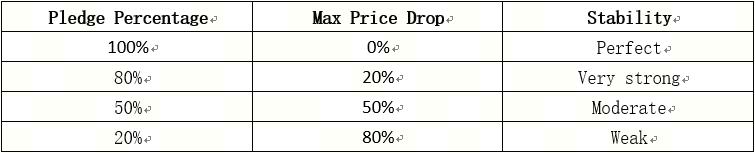
From the above table, we can see that the higher the percentage of $HTX pledged to liquidity, the greater the token's resistance to price drops, resulting in stronger price stability for $HTX.
Why Is Pledging Liquidity Better Than Burning Tokens?
HTX DAO aims to become a decentralized autonomous organization (DAO). Simply burning $HTX tokens cannot achieve this goal.
By being added to the liquidity pool and burning LP tokens, $HTX can be redistributed to those who genuinely support it, fostering decentralization. This does not impact the current circulating supply of $HTX, thus helping to stabilize its price.
Liquidity pledges function as a form of value locking. The more $HTX that is locked, the more stable the token's price becomes. This stability depends on the proportion of tokens pledged to liquidity relative to the total circulating supply. As the HTX exchange's revenue increases, so does the amount of liquidity pledged, further enhancing price stability.
However, $HTX can still be exchanged for $TRX after being added to the pool. If a substantial amount is accumulated, sell-offs may occur, depending on the strength of community consensus. Whether through burning or liquidity pledges, it is challenging to completely avoid price drops caused by mass sell-offs.
Therefore, liquidity pledges are just one of many drivers for HTX DAO. The potential for $HTX price increases ultimately depends on market demand and a variety of internal and external factors.
We recommend conducting a comprehensive analysis when evaluating token prices. Burning tokens or pledging liquidity is not the only factor to consider for predicting price movements.