Author: Stepan | squads.xyz
Original Title: Random end of year shower musings on the state of the stablecoin economy and its participants
Compiled and Arranged by: BitpushNews

2025 has made one thing clear: stablecoins have firmly established themselves, and their underlying infrastructure will become the cornerstone for the financial services industry's construction over the next decade.
As the year draws to a close, I've been reflecting on where we are, the revelations of 2025, and the path ahead. Below are some loose observations on the state of the stablecoin economy as we step into 2026.
First, a few preliminary notes:
-
Special thanks to Claude and Deni for content contributions and feedback.
-
Squads is a fintech company, not a bank or a digital asset custodian.
-
None of the content in this article constitutes financial advice.
-
The charts and images in this article were generated by Nano Banana, with a style inspired by the Tom Sachs aesthetic, which I greatly admire.
Data Overview
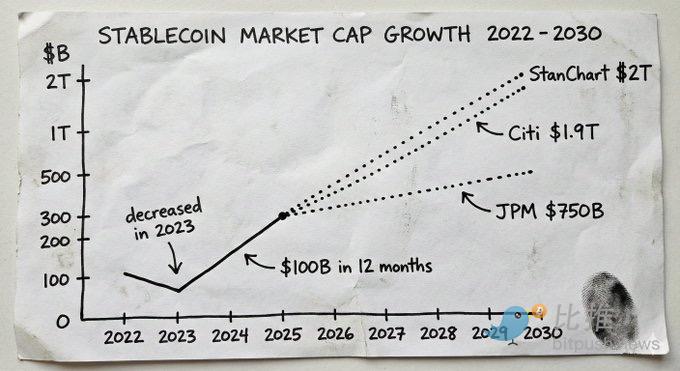
In 2025, the stablecoin market cap surpassed $300 billion, up from just $205 billion at the start of the year. In less than twelve months, nearly $100 billion in new supply was added.
For comparison: total supply grew by $70 billion throughout all of 2024, and actually declined in 2023.
These projections reflect strong institutional conviction. J.P. Morgan expects the stablecoin market cap to reach $500 billion to $750 billion in the coming years. Citibank's base case forecasts $1.9 trillion by 2030. Standard Chartered predicts $2 trillion by 2028. Stablecoin issuers are now among the top ten holders of US Treasuries globally.
This is no longer primarily a cryptocurrency story. It is a story about money. And the infrastructure, services, and product layers that capture this growth will be among the most valuable things built in the next decade.
What We Learned from the Synapse Incident
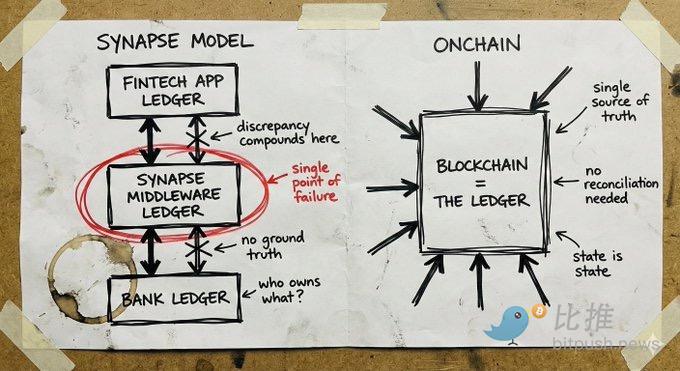
Part of the reason driving this shift is the growing recognition that stablecoin infrastructure offers fundamentally different trust assumptions. It's not just that building on stablecoins is cheaper and faster (though it is), but more importantly, you are trusting math and code, not a centralized entity's "trust me" promises about "where your money is."
To understand why this matters, look at what happened with Synapse.
Synapse Financial Technologies was once the poster child for Banking-as-a-Service (BaaS) companies. It was backed by top investors, connected over 100 fintech partners with FDIC-insured banks, and served about 10 million end users. Its pitch was brilliant: fintechs get banking capabilities without becoming a bank; banks get distribution without building apps; consumers get a modern experience with traditional protections.
In April 2024, Synapse filed for Chapter 11 bankruptcy. Over 100,000 people lost access to their funds. The court-appointed trustee found a shortfall of $65 million to $96 million between what customers were owed and what the banks actually held. At a hearing in December 2024, the trustee (a former FDIC chair) compared the situation to her father's experience of his deposits becoming worthless during the breakup of Yugoslavia.
The root cause was a failure in record-keeping and reconciliation at the middleware layer. Synapse was responsible for tracking asset ownership between fintechs and banks. When that system broke down, there was no single "source of truth" to refer back to. Banks blamed each other. Fintechs had no direct relationship with customer funds. Ordinary people watched their savings disappear into bureaucratic uncertainty.
The crypto space has had its own catastrophic failures: FTX, Celsius, Terra/Luna. But these failures stemmed from centralized custodial entities making high-risk bets with deposit assets. They failed for the same reason Synapse did: they were opaque systems where no one could see what was actually happening until it was too late.
The lesson from both traditional fintech failures and crypto failures is the same: when you can't see where the money is, you can't know if it's safe.
Self-Custody and the Insurance Question
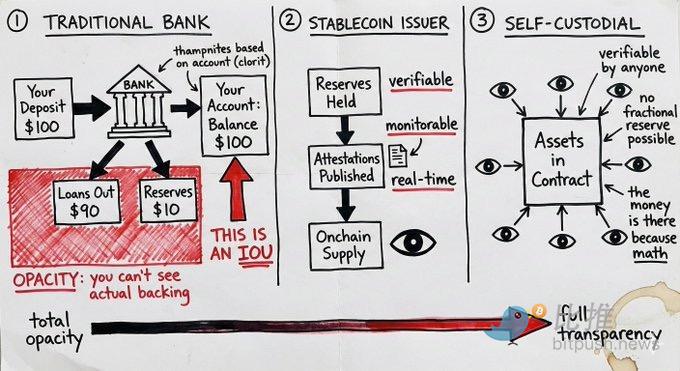
Self-custodied stablecoin accounts change the risk model in a way that makes FDIC insurance less necessary for many use cases.
Traditional banking operates on a fractional reserve system. When you deposit funds, the bank lends most of it out, keeping only a fraction on hand. Your "balance" is just an IOU. If enough people ask for withdrawals at once, or if the bank's loans go bad, the money isn't there. FDIC insurance is there to protect against this failure mode. It's insurance against the bank mismanaging your money.
Self-custodied stablecoin accounts work differently. The assets exist in a smart contract. At any moment, anyone can verify that the funds are there. Not as an IOU, not as a claim on fractional reserves, but as the actual asset under the user's control. There is no counterparty risk from the bank's lending decisions.
But this argument often misses a point: the stablecoin itself carries issuer risk. A smart contract full of USDC is useless to you if its issuer, Circle, faces a regulatory crisis or a run on its reserves. Holding USDT is essentially a bet on Tether's ability to manage its reserves. Self-custody removes intermediary risk, but it does not remove issuer risk.
The difference is that issuer risk is monitorable. You can check the proof of reserves. You can observe on-chain fund flows. You can diversify across issuers. Traditional bank risk is hidden inside the black box of the institution until a catastrophic event occurs.
This doesn't mean self-custody is for everyone. Large institutions may still need regulatory frameworks and insurance products. But for many use cases, the self-custody model with monitorable issuer risk is superior to the opaque institutional trust model that requires insurance as a backstop.
Global Reach and the Last-Mile Problem
Stablecoins offer something traditional fintech cannot: true global reach from day one.
A wallet works anywhere. A smart contract doesn't care which jurisdiction its user is in. Transactions between stablecoins are inherently borderless. For businesses paying remote contractors, managing funds across entities, or settling with suppliers who accept stablecoins, this infrastructure works instantly and globally.
Contrast this with the playbook for traditional international expansion: you need local banking partners, local licenses (often different ones for different business lines), local compliance teams, local legal entities. Each country is essentially a new startup. This is why most digital banks either operate only domestically or spend years expanding to just a handful of markets.
Revolut has been working on this for nearly a decade and still isn't fully rolled out everywhere.
The bottleneck for stablecoin infrastructure is the "last mile": connection to fiat currency. Fiat on-ramps and off-ramps still require local licenses and local partners. You can't get away from that entirely.
But there's a world of difference between "we need to solve fiat connection in this market" and "we need to rebuild the entire banking tech stack in this market." The "last mile" is modular. You can partner with local orchestration service providers for fiat conversion without rebuilding the core infrastructure from scratch. You can reach most of the world via the stablecoin channel, then plug in fiat partners where needed.
Traditional fintech cannot launch without building a full tech stack in each market. Native stablecoin companies are global from birth, then solve the last mile incrementally as needed. It's a fundamentally different expansion equation.
The Battle of Purpose-Built Blockchains
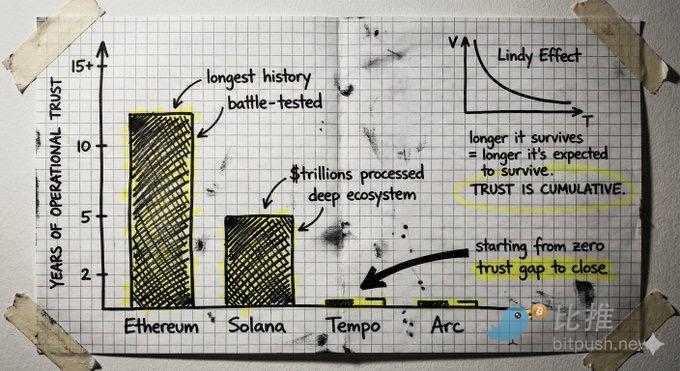
Several well-funded teams are building new blockchains specifically for stablecoin payments. The core idea: existing blockchains are optimized for trading, not payments, and a purpose-built infrastructure can offer better throughput, lower latency, and compliance tools tailored to payment-specific needs.
It's a reasonable idea, put forward by a group of smart people. Stripe and Paradigm are building Tempo, Circle is building Arc.
But there's a counter-argument worth considering.
Building a new Layer 1 from scratch means trust must be built from zero. Blockchains are trust machines, and trust is accumulated through operation. It comes from a track record of years without catastrophic failure, from securing billions without bugs, from a developer ecosystem that deeply understands edge cases, from code that has been battle-tested by attacks. It's the Lindy effect applied to infrastructure.
Mature chains have this accumulated trust. Solana has processed trillions in transaction value, with mature tools, wallets, bridges, and integrations. Ethereum has an even longer operational history. The question is whether the gap between what these chains currently offer and payment-specific needs is greater than the trust gap a new chain must fill.
There's also the consideration of neutrality. A chain controlled by a large payments company, no matter how "neutral" it's positioned, has that company's interests baked into its architecture. Building on a truly neutral public infrastructure offers different guarantees.
Agentic Finance
When people talk about Agentic Finance today, they often imagine agents that manage your financial life: making investment decisions, managing your portfolio, optimizing your entire financial existence on your behalf.
That's not the real opportunity, at least not yet.
The real opportunity is in the mundane and boring parts. It's about having agents handle the day-to-day financial processes that currently require manual operation: monitoring invoices, matching them to purchase orders, initiating payments, processing reimbursements, executing recurring transactions. Not replacing human judgment on important decisions, but automating the tedious tasks that consume time and create operational friction.
The question is: how does an agent actually move money?
Traditional payment channels are designed for humans. They assume the entity initiating the transaction is a person with credentials. Giving an agent bank login credentials is both a security nightmare and a compliance violation. Agents can hallucinate, be manipulated, or err at machine speed.
This is where stablecoin channels and smart contracts become truly important. The agent doesn't get credentials; it gets a set of restricted permissions encoded in a smart contract: move at most $X per transaction, only to pre-approved addresses, only at certain times or for specific purposes. These constraints are enforced by code. The agent is architecturally incapable of overstepping because the permission definition is part of its architecture.
The verifiable, bounded, transparent trust assumptions provided by blockchains are the core elements needed when software moves money autonomously. Traditional systems require you to trust the agent not to misbehave. Smart contract systems architecturally make it impossible to misbehave outside of defined constraints.
This doesn't eliminate all problems. What happens when an agent makes a mistake within its constrained permissions? Who is responsible when an agent approves an invoice that technically meets all coded criteria but is actually fraudulent? These questions need answers.
But this starting point of architecturally enforced permission boundaries is something blockchain systems have natively and is very difficult to retrofit onto traditional channels. Autonomous finance is coming. And the infrastructure that makes it safe will necessarily be stablecoin-native.
Rethinking Security
The gold rush in the stablecoin space is attracting teams with vastly different attitudes towards security. This will not end well for some of them (and unfortunately, for their customers).
A pattern is emerging: move fast, get users, figure out the hard problems later. Teams use vague definitions of "self-custody" that obscure the actual trust model. They rush to integrate without proper security and vendor due diligence. They take shortcuts on key management. They treat operational security as a cost center.
Some of this is understandable. The market is moving quickly. Competitive pressure is intense. Spending an extra X months getting security right could mean a competitor captures the market.
That trade-off makes sense in most industries. It does not in financial infrastructure.
Building a bank, or anything bank-like, means building trust over decades, not quarters. It means managing risk conservatively even when aggressive approaches might grow faster. It means creating systems that can handle unforeseen edge cases.
The teams that will win in 2026 and beyond are those with genuine domain expertise and a security-first mindset.
The Privacy Conundrum
A contrarian view of mine: privacy in crypto has largely been a checkbox concern so far. For trading, DeFi, and speculation, the lack of substantive privacy hasn't been a blocker. The whole ecosystem mostly functions fine with pseudonymous addresses and public transaction histories.
But this will change as stablecoin infrastructure brings real business activity and productive economic activity on-chain.
When real companies use stablecoin channels for their treasury, privacy becomes critical. Competitive intelligence leakage is a real concern: your suppliers, your customers, your cash flow, all visible to anyone willing to look. No serious company wants its financial operations exposed to competitors, and no CFO will move significant treasury activity to a channel where every transaction is publicly analyzable.
This is a problem we need to solve today, lest it become a bottleneck for future adoption.
The good news is that the privacy model for stablecoins doesn't require the full cypherpunk vision to become reality. We don't need full anonymity. We need selective disclosure, which is a fundamentally different goal.
Selective disclosure means: proving what needs to be proven without exposing everything else. Proving you have sufficient funds without showing your balance; proving a transaction is compliant without exposing counterparty details; proving your identity meets requirements without submitting documents. The owner of the funds can see everything, the system can verify everything needed for compliance, and everyone else sees only what is intentionally disclosed.
We have the technology to solve this. I've spoken with many brilliant teams building great privacy infrastructure.
The problem is that this technology is early. These codebases are large, difficult to audit, difficult to formally verify, and unproven in battle. They require completely different trust and security assumptions from the infrastructure we've already built. The crypto ecosystem spent years hardening core protocols, accumulating the kind of operational trust that only comes from experiencing attacks and edge cases. Layering new, unproven privacy on top risks undermining that foundation.
The real challenge is how to add privacy features without making significant security compromises. This might mean embedding privacy features deeper into the Layer 1 protocol, or finding ways that don't require massive trust in new cryptographic systems.
Looking Ahead
The growth story for stablecoins in 2025 was mostly about moving what already exists in fintech onto better infrastructure: payments, yield, spending, card services. Like a global Mercury, or an on-chain Revolut. That's good. It's faster, cheaper, and can enter markets that traditional fintech takes years to reach.
But what stablecoin channels unlock is much larger than just doing the same things more efficiently. You get programmable money. You plug into the internet capital markets, where genuinely novel financial primitives are being built every day. You get the ability to have agents manage money under real guarantees, not just trust that they won't misbehave.
This is our chance to rethink what financial services should actually look like.
I'm not seeing enough teams pursuing this yet. The opportunity is right there, and most players in the industry are still just running the 2015 fintech playbook on a new rail. I hope to see that change in 2026.
Twitter:https://twitter.com/BitpushNewsCN
Bitpush TG Discussion Group:https://t.me/BitPushCommunity
Bitpush TG Subscription: https://t.me/bitpush






