When 'Stability' Begins to Fluctuate: A Complete Review and Structural Analysis of the USD1 Depegging Incident

marsbitXuất bản vào 2026-02-25Cập nhật gần nhất vào 2026-02-25

Tóm tắt

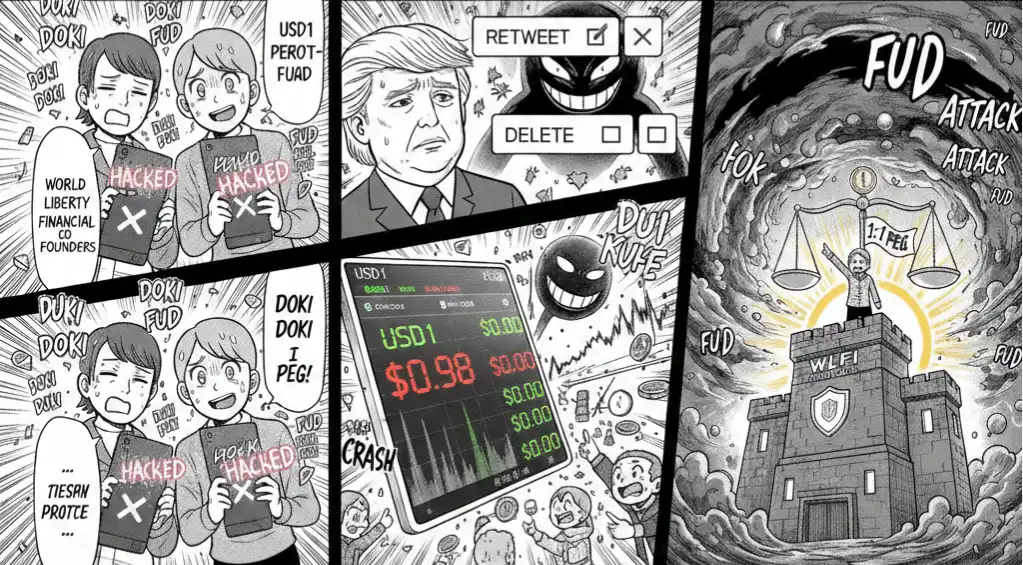
USD1, a stablecoin issued by World Liberty Financial (WLFI), experienced a brief depegging event on February 23, with its secondary market price dropping to around $0.98. WLFI attributed the incident to a "coordinated attack," claiming reserves and redemption mechanisms remained unaffected, and the price quickly recovered. The event raised questions about whether the depegging was a liquidity issue or a solvency crisis. Unlike TerraUSD's algorithmic collapse in 2022, USD1’s price dip appeared more related to temporary market liquidity stress rather than fundamental reserve failures. However, the incident highlighted that stablecoin stability relies not only on assets but also on market trust. USD1 operates under a centralized reserve model, where risks involve reserve transparency, asset liquidity, and market depth. In a low-liquidity, risk-averse market environment, even minor instability can trigger concerns about collateral devaluation, liquidations, and broader financial contraction. While the rapid price recovery suggests no systemic solvency issue, the event underscores how stablecoin depegging—even if temporary—can amplify market anxiety, reduce leverage, and increase funding costs. Trust, once questioned, takes time to restore, and credit repricing often precedes price changes in stressed markets.

Author: 137Labs

On February 23, a stablecoin named USD1 suddenly showed a significant discount in the secondary market.

On-chain quotes once fell to around 0.98 USDT, and social media quickly amplified the news.
The project team, World Liberty Financial (WLFI), subsequently stated publicly that this was a "coordinated attack" and emphasized that the reserve and redemption mechanisms were unaffected.

The price then recovered.

But the problem had already emerged——

When a "stablecoin" begins to trade at a discount, is it merely a liquidity friction, or a precursor to a crack in the credit structure?

I. Timeline: From the Wicking to the "Attack" Narrative

Based on reports from CoinDesk, The Block, Decrypt, WuBlockchain, PANews, ChainCatcher, and others, the sequence of events is roughly as follows:

1️⃣ Abnormal Volatility in the Secondary Market

  • USD1 quickly fell to around 0.98 in some trading pairs

  • The discount lasted for a short time

  • The price subsequently recovered

Unlike the brief depegging of USD Coin in 2023 due to banking risks, no clear systemic banking shock occurred this time.

2️⃣ WLFI's Official Response

WLFI stated externally:

  • This was an organized short attack coupled with a public opinion coordination attack

  • Reserve assets showed no abnormalities

  • Redemption function is normal

  • The 1:1 peg structure remains unchanged

This explanation was subsequently reported by Chinese media including WuBlockchain and ChainCatcher.

3️⃣ Social Media Amplification Effect

The event spread rapidly on platform X.

Some related tweets were deleted, fueling further market speculation.
In the current emotionally charged market environment, "deletion behavior" is often interpreted as a signal, not a random operation.

Thus, the question shifted from "Is the price depegged?" to:

  • Is there a reserve risk?

  • Is there a concentrated bank run?

  • Is there insufficient information disclosure?

II. The Nature of Depegging: A Liquidity Problem or a Solvency Problem?

Judging a stablecoin depegging event hinges on distinguishing between two completely different risk structures.

The first is a liquidity shock.
In this case, reserves are still sufficient, the redemption mechanism remains unimpeded, but due to insufficient trading depth, market maker withdrawal, or concentrated selling pressure, the secondary market experiences a brief imbalance. Once the arbitrage mechanism kicks in, the price usually recovers quickly.

The second is a solvency crisis.
If the reserve assets themselves are problematic, or if the assets suffer from maturity mismatches and cannot be liquidated immediately, then the depegging is no longer a trading-level fluctuation but a repricing of the balance sheet. In this case, the discount often widens persistently, accompanied by redemption delays or a collapse in trust.

Based on the information disclosed so far, USD1 is closer to the former.

It is completely different from the algorithmic death spiral of TerraUSD (UST) in 2022. UST's collapse stemmed from mechanism failure, while USD1's wicking更像 (more like) a liquidity tilt within a short period.

But even so, this event still holds significance.

Because the true anchor of a stablecoin is not just the reserve assets, but market trust.

Once trust is questioned, the price reacts ahead of the fundamentals.

III. The Credit Structure of Stablecoins: Where Exactly is Their "Stability"?

Stablecoins are essentially the "base money" of the crypto market.

Their credit support generally comes from three models:

  1. Algorithmic

  2. Collateralized

  3. Centrally Custodied Reserve-backed

USD1 belongs to a more centralized reserve structure.

The risk of this model lies not in the algorithm, but in:

  • Reserve Transparency

  • Asset Liquidity

  • Maturity Structure

  • Market Making Depth

Once the market suspects that reserves are discounted or face liquidation risks, the price often falls first.
This is highly similar to a "shadow bank run" in traditional finance—as soon as depositors start to doubt, the act of withdrawal itself amplifies the risk.

IV. Why Was the Market Reaction Particularly Sensitive This Time?

The fear index was already at an extreme low that day.

In an environment where liquidity was already tight:

  • Leverage levels decreased

  • Risk appetite weakened

  • The market became highly sensitive to uncertainty

Stablecoins are not just trading tools; they are the cornerstone of lending and liquidity.

Once a discount appears, the chain reaction may include:

  • Decrease in collateral ratios

  • Triggering of liquidations

  • Further compression of leverage

  • Capital outflow from the market

Therefore, even though the price recovered quickly, the psychological shock did not disappear simultaneously.

V. Is the "Attack" Narrative Valid?

WLFI attributed this volatility to a "coordinated attack".

Short attacks and public opinion resonance are not uncommon in the crypto market.
When trading depth is insufficient and market sentiment is fragile, prices are easily subject to amplified volatility.

But whether an attack can be sustained depends on one core factor:

Does the market believe the reserves are real, redeemable, and sustainable?

If the reserve structure is transparent and redemptions remain smooth, attacks often find it difficult to be effective in the long term;
If reserve disclosure is insufficient, panic is more easily self-reinforcing.

VI. The Differences Between USD1, USDC, USDT, and the True Meaning of This Depegging

Historically, USDC fell to $0.88 in 2023 due to banking risks; its problem stemmed from exposure to custodian bank risks and limitations on the pace of reserve liquidation.

Meanwhile, Tether has experienced minor depegging multiple times, usually during extreme panic phases or under concentrated withdrawal pressure, but the key to its eventual recovery lies in the continuous availability of the redemption mechanism and the verification of reserve redemption capability.

USD1 currently seems to be in the midst of a "trust stress test".

This event is closer to a liquidity shock than a solvency crisis.
The rapid price recovery indicates that a systemic bank run has not yet formed.

But what is truly worth paying attention to is not that single price of 0.98, but whether the market has begun to reassess the risk premium of "stability".

Stablecoins are the monetary base of the crypto market.

When the market questions their safety, the impact transmits outward along the credit chain:

  • Leverage decreases

  • Lending contracts

  • Collateral assets are repriced

  • Capital flows back to mainstream assets or exits the market

Even if the event itself is just short-term volatility, it will increase the cost of future financing and liquidity.

Depegging is never just a price problem; it is a credit pricing problem.

The price can recover quickly,
but trust takes time to repair.

USD1's depegging may not necessarily evolve into a systemic risk,
but it reminds the market——

During periods of liquidity contraction,
credit always changes before the price.

And once credit begins to be revalued,
the entire risk structure也随之 (also随之 -也随之) changes accordingly.


Câu hỏi Liên quan

QWhat was the main event described in the article regarding the USD1 stablecoin?

AOn February 23rd, the USD1 stablecoin experienced a significant discount, with its price dropping to approximately 0.98 USDT on secondary markets.

QHow did the issuer, World Liberty Financial (WLFI), characterize the price drop of USD1?

AWLFI characterized the event as a 'coordinated attack,' stating that the reserve and redemption mechanisms were unaffected and the 1:1 peg structure remained intact.

QWhat is the fundamental difference between a liquidity shock and a solvency crisis for a stablecoin, as explained in the article?

AA liquidity shock involves sufficient reserves and a functioning redemption mechanism, with the price drop caused by temporary market imbalances like insufficient trading depth. A solvency crisis involves problems with the reserve assets themselves, where the de-pegging is a repricing of the balance sheet due to issues like asset quality or maturity mismatches.

QAccording to the article, what are the key risk factors for a centralized reserve-backed stablecoin like USD1?

AThe key risk factors are reserve transparency, asset liquidity, maturity structure, and market-making depth.

QWhat broader market implication does the article suggest from the USD1 de-pegging event, even if it was temporary?

AThe event suggests that market trust, the true anchor of a stablecoin, can be shaken. This can lead to a re-evaluation of risk premiums, resulting in decreased leverage, contracted lending, repricing of collateral assets, and potential capital outflows, thereby increasing future financing and liquidity costs.

Nội dung Liên quan

Chú ý: Tuần này sẽ diễn ra đợt mở khóa token quy mô lớn của 10 altcoin! Đây là danh sách theo ngày và giờ

Tuần qua, thị trường tiền mã hóa trải qua đợt suy giảm do sự cố hack ví ColdCard và ảnh hưởng từ các sự kiện địa chính trị. Tuy nhiên, tuần này sẽ chứng kiến đợt mở khóa token quy mô lớn của 10 altcoin, có thể tác động đến nguồn cung và giá cả. Lịch trình mở khóa chi tiết (giờ UTC+3): - **Lagrange (LGR)**: 4/8, 03:00 - Giá trị: 1.38 triệu USD (15.04% vốn hóa). - **Proof (PROOF)**: 5/8, 03:00 - 39.11 triệu USD (119.59% vốn hóa). - **Power Protocol (POWER)**: 5/8, 03:00 - 1.62 triệu USD (8.93% vốn hóa). - **Verona (VERONA)**: 5/8, 03:00 - 1.37 triệu USD (12.61% vốn hóa). - **Ethena (ENA)**: 5/8, 11:00 - 15.28 triệu USD (1.80% vốn hóa). - **Goldfinger (GF)**: 6/8, 03:00 - 11.52 triệu USD (5.05% vốn hóa). - **Infinity (INF)**: 7/8, 03:00 - 2.31 triệu USD (20.30% vốn hóa). - **Stable (STBL)**: 8/8, 03:00 - 28.75 triệu USD (3.55% vốn hóa). - **Name (NAME)**: 9/8, 03:00 - 48.47 triệu USD (74.54% vốn hóa). - **Move (MOVE)**: 9/8, 03:00 - 1.22 triệu USD (3.90% vốn hóa). Đặc biệt, cần lưu ý đến PROOF với khối lượng mở khóa vượt 119% vốn hóa thị trường và NAME với gần 75%. Các sự kiện này có thể làm gia tăng áp lực bán trên thị trường. Đây không phải là lời khuyên đầu tư.

cryptonews.ru1 giờ trước

Chú ý: Tuần này sẽ diễn ra đợt mở khóa token quy mô lớn của 10 altcoin! Đây là danh sách theo ngày và giờ

cryptonews.ru1 giờ trước

Với giá 100.000 đô la mỗi tháng: Truth Social bán quyền truy cập bài đăng của Trump cho các công ty đầu tư

Trump Media and Technology Group (TMTG) đã ra mắt dịch vụ Truth API từ ngày 1/8/2026. Đây là kênh dữ liệu có phí cung cấp cho các khách hàng tổ chức, chủ yếu là các công ty đầu tư và giao dịch tần suất cao, quyền truy cập thời gian thực đến các bài đăng từ những tài khoản có ảnh hưởng nhất trên nền tảng Truth Social, bao gồm cả cựu Tổng thống Donald Trump. Theo các nguồn tin, gói dịch vụ này có giá lên tới 100.000 USD một tháng, với mức giảm giá xuống 60.000 USD/tháng cho hợp đồng ba năm. TMTG tuyên bố đây là một phần trong chiến lược tạo ra nguồn thu ổn định và lợi nhuận cao từ tài sản của công ty. Tuy nhiên, sáng kiến này đã vấp phải chỉ trích từ các nhà lập pháp cả hai đảng. Các Thượng nghị sĩ Dân chủ Elizabeth Warren và Adam Schiff đã yêu cầu Ủy ban Chứng khoán Mỹ (SEC) điều tra xem liệu việc bán quyền truy cập ưu tiên đến các bài đăng của tổng thống có vi phạm luật hay không. Thượng nghị sĩ Cộng hòa Bill Cassidy cũng chỉ trích đây là hành vi bán quyền truy cập đặc quyền không thể chấp nhận được. Phân tích AI trong bài báo cảnh báo về rủi ro tiềm ẩn, so sánh với sự kiện năm 2013 khi thị trường chứng khoán sụt giảm nhanh chóng do tin tức giả mạo. Việc biến tài khoản tổng thống thành một nút tín hiệu thị trường với độ trễ mili giây có thể tạo ra mục tiêu cho tin tặc hoặc thao túng, và đặt ra câu hỏi về trách nhiệm nếu thông tin sai lệch được phát tán qua kênh này.

cryptonews.ru3 giờ trước

Với giá 100.000 đô la mỗi tháng: Truth Social bán quyền truy cập bài đăng của Trump cho các công ty đầu tư

cryptonews.ru3 giờ trước

Các giao dịch rút Bitcoin tiếp tục: 8 năm lưu trữ trong ví lạnh Coldcard kết thúc bằng số không

Ví phần cứng Coldcard bị xâm phạm, dẫn đến làn sóng rút tiền mới từ các thiết bị dễ bị tấn công. Theo Galaxy Research, tổng số tiền bị đánh cắp đã lên tới 1.367,05 BTC (khoảng 88,6 triệu USD). Vấn đề không nằm ở phần mềm cập nhật, mà ở seed phrase (cụm từ khôi phục) được tạo từ tháng 3/2021 do lỗi lập trình, khiến chúng dễ bị dò tìm. Lỗi này xảy ra khi thiết bị chuyển từ bộ tạo số ngẫu nhiên phần cứng sang bộ tạo phần mềm Yasmarang, được khởi tạo bằng dữ liệu có thể dự đoán được. Người dùng các model Mk2-Mk5 và Q với phiên bản phần mềm nhất định cần tạo seed phrase mới trên bản cập nhật đã sửa và chuyển tài sản sang đó để bảo vệ. Câu chuyện đau lòng của một nhà đầu tư 39 tuổi đã mất 2 BTC (130.000 USD) tích góp suốt 8 năm trong vài phút, dù áp dụng chiến lược "mua và giữ trong ví lạnh" thận trọng. Anh mua Bitcoin như một lá chắn chống siêu lạm phát và kế hoạch nghỉ hưu sớm, nhưng lỗ hổng đã phá hỏng mọi thứ. Sự việc nhấn mạnh rằng lưu trữ offline không tự động đảm bảo an toàn, và cộng đồng hy vọng nhà sản xuất có thể tìm cách khắc phục, hoàn trả tài sản cho người dùng.

cryptonews.ru5 giờ trước

Các giao dịch rút Bitcoin tiếp tục: 8 năm lưu trữ trong ví lạnh Coldcard kết thúc bằng số không

cryptonews.ru5 giờ trước

Giao dịch

Giao ngay
活动图片




