When Altcoins Lose Consensus, Excess Returns May Lie in the Neglected 'Ruins of Innovation'

marsbitXuất bản vào 2026-01-07Cập nhật gần nhất vào 2026-01-07

Tóm tắt

Currently, the crypto market is dominated by a nihilistic sentiment, driving investors toward "safe" consensus narratives like stablecoins, prediction markets, and RWAs. However, this defensive stance overlooks a key reality: the industry remains largely "pre-fundamental," with speculation, not cash flows, as the primary price catalyst. As the space matures, most altcoins are likely to underperform Bitcoin due to evaporating speculative premiums. The core issue is scale: on-chain revenue remains minuscule globally, and most tokens are still priced on future expectations rather than actual value. Mature sectors face efficient pricing, leaving little alpha. True excess returns will come from innovation—areas where valuation is unclear, narratives are still forming, and new markets are being created. Key innovative sectors to watch include uPOW (utility Proof-of-Work), which ties mining to valuable output; ownership tokens for lightweight startup financing; decentralized AI training and compute markets; and social metaverse experiments. Solana is well-positioned as the leading infrastructure for future speculative activity. In contrast, chasing mature narratives or low-quality consensus plays often leads to overvalued entry points. The greatest opportunities lie not in safety, but in bold bets on novel, hard-to-value innovations.

Written by: Squid

Compiled by: AididiaoJP, Foresight News

Part 1: What is the Current Market Sentiment?

"What excites you most about cryptocurrency?"

"Which areas are you investing in?"

I always ask these questions to venture capitalists and hedge fund peers at conferences. They usually have the most macro insights into where the industry is heading. But at last December's Breakpoint conference, the answers weren't very inspiring.

Most answers focused on market consensus narratives:

Such as "stablecoins", "perpetual contracts", "prediction markets", "real-world assets (RWA)", "digital banking".

Some answers revealed deeper skepticism:

For example, "Not much is exciting", "Non-crypto businesses using blockchain infrastructure", "Taking a break and waiting for now".

Overall, the bets seemed to lean more towards industry "maturation" rather than "innovation". Underlying these conversations was a pervasive sense of nihilism.

This sentiment, though rarely stated explicitly, is felt by most. It stems from the endless stream of scams, low-float high-valuation token launches, exchange listing pumps, and KOL marketing games. This sentiment is a reflection of the industry's current state, but it cannot predict the future; one could even argue that the future is unlikely to be a continuation of the present.

Betting on mature narratives or areas with proven product-market fit (PMF) is essentially a subconscious "risk-averse behavior", rooted in this nihilism. Participants want to avoid the worst aspects of the industry and are unwilling to take risks on innovation in an environment where token performance is generally weak.

I believe that by 2026, these directions will not be good choices for liquid trading:

The problem is that market efficiency is still low, and this inefficiency continues to support the prices of many altcoins. Industry maturation means prices will revert to fundamental value – which, in practice, would cause most tokens to decline in the medium to short term. Unless you are shorting, it's hard to find investment opportunities based on fundamentals.

Trend continuation trades in areas with PMF are reasonable in direction but difficult to execute in liquid markets due to the persistent "adverse selection" problem. Most of the time, if you buy tokens in consensus narratives, you are either buying low-quality copycats or entering at ridiculously high valuations.

For example: You say you're bullish on prediction markets in 2025? Which token exactly did you buy?

Part 2: Where is the Real Value in Cryptocurrency?

Industry maturation implies moving towards fundamental pricing. But this exposes a core problem: the fundamental scale is too small to support current valuations and drive the market.

So, what exactly drives token prices? The chart below is a rough breakdown of cryptocurrency market capitalization by asset class, adjusted to illustrate the point more clearly:
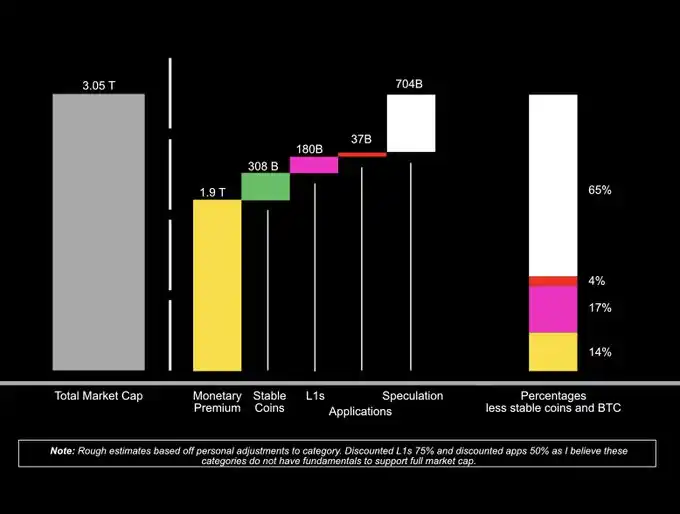
Two main adjustments were made:

  • Applied a 75% discount to the entire Layer 1 sector
  • Applied a 50% discount to the entire Application sector

This reflects the view that a significant portion of these two major asset classes lacks the fundamentals to justify their current valuations.

After adjustments, two points stand out:

1. The market size cannot support grand narratives

Despite the focus on the application layer, the actual market size remains very small. Last year's total on-chain fee revenue was about $10 billion, and not all of this revenue accrues to token holders. In a global context, this figure is negligible. One could even argue that the entire on-chain application ecosystem's total valuation, pre-adjustment, is less than that of a single food delivery company like DoorDash.

2. Even after declines, speculative premium still dominates altcoin valuations

Looking deeper:

Fundamentals

Fundamentals determine the price floor. For most tokens, this floor is far below the current price. Even at current valuation levels, the market cap of the vast majority of tokens is still driven by speculative premium – the value assigned because people expect to sell it to someone else at a higher price in the future. This premium is highly correlated with overall market volatility and naturally decays over time. The more mature the narrative, the smaller the room for speculation.

This situation is unlikely to change in the short term. Therefore, as speculative premium erodes, most existing altcoins will underperform Bitcoin. The faster the industry matures, the sooner this underperformance will arrive.

Layer 1

Layer 1 remains an important category, but the rules of the game have changed. The winner-take-most general-purpose blockchains are likely already identified. Marginal technical improvements are less important than the network effects already formed, such as liquidity, developer ecosystems, and distribution channels. New general-purpose blockchains will not receive the premium they did in past cycles. Application-specific chains will gradually be valued as "Application" class assets.

Revenue & Applications

The direction of "focusing on revenue" is correct, but it is often misunderstood in crypto. People often discuss revenue multiples, but there are very few crypto businesses with durable moats. Much of the revenue comes from incentives, and cash flows have historically been fragile. Even with strong businesses and stable cash flows, it's often unclear whether the token can effectively capture this value. A low valuation multiple does not automatically make it a good investment.

The application layer still holds the greatest long-term potential, but solving real problems takes time. From a liquidity investment perspective, there are huge opportunities here, but the timeline is likely longer than the market generally expects.

"We tend to overestimate the effect of a technology in the short run and underestimate the effect in the long run." – Amara's Law

The core conclusion remains: No matter how attractive the revenue narrative, no matter how much capital is betting on industry maturation, speculation remains the primary driver of market capitalization. It will take time for fundamentals to expand to a sufficient scale, and until then, valuations will be set by expectations, not cash flows.

Part 3: Trading Directions Worth Watching in 2026

In a single asset or market, speculative premium erodes over time. This is an old story in the crypto world – AI agents, early DeFi, NFTs have all gone through such cycles.
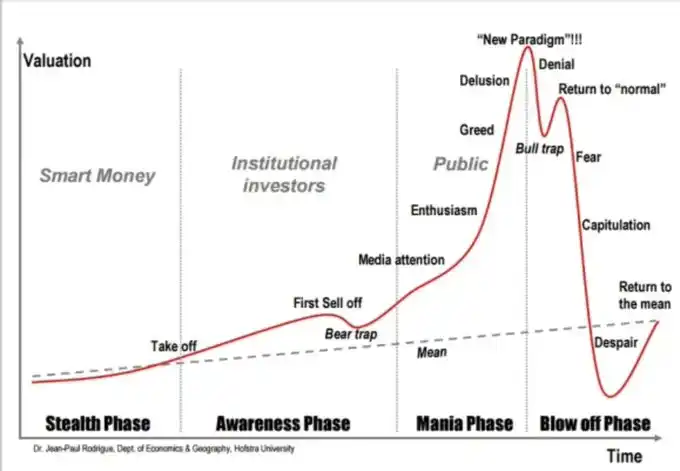
Speculation always flows towards areas where valuation is not yet defined, narratives are still forming, and market size is undefined (imagination space is infinite).

In one sentence: Bet on innovation.

The assets most likely to absorb speculative premium in 2026 typically have the following characteristics:

  • Can create entirely new assets or markets on-chain
  • Have a viable path to obtaining "monetary premium"
  • Are difficult to value due to novelty or unclear cash flow attribution (this is also why the monetary premium narrative is important)
  • Have some form of barrier: technical, cognitive, or access barrier (hard to arbitrage + better distribution)
  • Align with larger global trends – market size has no upper limit

These conditions delay the arrival of market efficiency, prolonging the window of mispricing, thus leaving room for speculation.

Specific Sectors and Projects to Watch

1. uPOW (Useful Proof-of-Work)

uPOW shifts mining output from pure inflation to output with practical utility, turning "mining for distribution" into "mining to add value to assets". This direction has been discussed for a long time, and the underlying technology is now nearing feasibility. uPOW projects are novel, difficult to value, represent a new class of productive assets, and have the potential to gain monetary premium. Currently focusing on two:

@nockchain: Early project, needs time to develop, fits the theme, and benefits from zero-knowledge proof and privacy narratives.

@ambient_xyz: In private pre-mining stage, expected to launch this year. Highly cyberpunk, using POW to provide compute for evergreen large language models.

2. Ownership Tokens

The era of "vibe coding" is here. Small teams developing short-cycle, niche MVPs will become the norm, and some will grow into real companies. Lightweight funding processes and the growth-enabling effects of tokens will continue to have value. The core issue for these tokens is the claim on business value, but various mechanisms are being explored to solve this. Opportunities lie both in the tokens themselves and in the launch platforms. Watching two:

  • @MetaDAOProject: Recommended multiple times, the clear leader in this space
  • @StreetFDN: Earlier stage, positioned to serve offline startups

3. Distributed Training & Compute Markets

Distributed training remains one of the most promising areas in AI x Crypto, with rollout slower than expected. Leading teams are beginning testing, hoping for full launch this year. Beyond the project tokens themselves, they are more likely to spawn secondary applications and token ecosystems built on top. The real liquidity opportunity might be there, although project tokens could also appreciate. Leading teams:

  • @NousResearch
  • @primeintellect
  • @pluralis

4. Social Metaverse

Digital social spaces continue to evolve. Product-market fit remains elusive, but experimentation continues. Expect continued trial and error in this area this year. The winner may not have emerged yet, currently watching:

  • @zora: Shows strong resilience, huge potential for synergy between creator and content tokens
  • @trendsdotfun: Solana ecosystem project, reaching Asia-Pacific markets, not yet widely noticed
  • @tryfumo: Included because it proves – execution itself is a moat
  • @ShagaLabs: Metaverse data direction – expect more projects like this

5. Solana: @solana ($SOL)

General-purpose blockchains have matured. As network effects strengthen, the importance of marginal technical improvements is less than existing liquidity, developer ecosystems, and distribution channels. The winners are likely already determined.

Solana has a strong core ecosystem, a rare long-term vision among builders and capital, and a reliable roadmap for continued scaling. The next wave of speculation will happen on existing infrastructure. Whatever the specific narrative, Solana is structurally positioned to capture a large amount of this activity.

Areas where I see less opportunity: Bots, Meme coins.

Summary

Nihilism is not insight; it is a lagging emotional reaction to price action, a symptom of the industry's problems, not a prophecy of the future.

When sentiment is low, capital retreats to "mature trades" and consensus narratives to avoid risk. But in crypto, as in other industries, playing it safe does not yield excess returns.

The industry is still structurally in a "pre-fundamental" stage, where price discovery is dominated by speculative capital, not cash flow. This shift will take longer than people think.

Speculative bubbles always follow innovation. Believe in innovation, try new applications, spend time with builders, bet on innovation.


Câu hỏi Liên quan

QWhat is the main reason behind the current 'risk-averse behavior' in the cryptocurrency market according to the article?

AThe main reason is a pervasive sense of nihilism stemming from the industry's problems, such as rampant scams, low-float high-FDV launches, exchange listing games, and KOL shilling. This leads participants to retreat to 'mature trades' and consensus narratives to avoid risk.

QWhat does the author argue is the primary driver of most altcoin valuations, even after price declines?

AThe author argues that speculative premium, not fundamentals, is the primary driver of most altcoin valuations. This premium is highly correlated with overall market volatility and decays over time.

QWhat type of assets are most likely to absorb speculative premium in 2026, as per the author's view?

AAssets that are most likely to absorb speculative premium are those that bet on innovation. They typically create new on-chain assets or markets, have a viable path to 'monetary premium,' are difficult to value, possess some form of barrier (technical, cognitive, or access), and align with larger global trends.

QName two specific project categories the author is bullish on for 2026 that involve creating productive assets with real utility.

AThe two categories are uPOW (useful Proof-of-Work), which turns mining into value-additive production (e.g., @nockchain, @ambient_xyz), and Ownership Tokens, which represent light-weight fundraising and growth enablement for small teams (e.g., @MetaDAOProject, @StreetFDN).

QWhy does the author single out Solana ($SOL) as a key infrastructure play, despite arguing that the era of new general-purpose L1s is over?

AThe author believes the winners for general-purpose L1s are likely already chosen. Solana is singled out because it has a strong core ecosystem, a rare long-term vision among builders and capital, and a reliable roadmap for continued scaling. It is structurally positioned to host a significant amount of the next wave of speculative activity, regardless of the specific narrative.

Nội dung Liên quan

Bitcoin: Liệu động thái của cá voi 130,5 triệu USD có làm trật bánh đà đưa BTC tiến tới 70.000 USD?

Một cá voi Bitcoin đã thực hiện giao dịch chuyển 2.000 BTC, trị giá 130,5 triệu USD, sau 6 năm tích lũy. Trong đó, 800 BTC được chuyển đến Cumberland để giao dịch OTC (cho thấy ý định bán tiềm năng), trong khi 1.200 BTC được chuyển sang địa chỉ mới, cho thấy có thể đây là động thái tái định vị danh mục hơn là thoát hoàn toàn. Mặc dù động thái của cá voi lớn thu hút sự chú ý, nhưng giá Bitcoin dường như không bị ảnh hưởng tiêu cực. BTC tiếp tục xu hướng tăng, đạt mức cao hàng tháng khoảng 66.314 USD, với các chỉ báo kỹ thuật như Stochastic Momentum Index và Squeeze Momentum Indicator cho thấy động lượng tăng vẫn còn mạnh, mở đường cho mục tiêu vượt 70.000 USD. Tuy nhiên, một số chỉ số on-chain lại cảnh báo áp lực bán có thể gia tăng trong ngắn hạn. Tỷ lệ Dòng chảy Quỹ (Fund Flow Ratio) và Chênh lệch dòng vào sàn (Exchange Netflow) đều tăng lên mức dương, báo hiệu nhiều BTC đang được chuyển vào các sàn giao dịch. Điều này thường làm tăng rủi ro bán tháo và có thể làm suy yếu động lượng, khiến giá có nguy cơ điều chỉnh về vùng 64.800 USD nếu áp lực bán gia tăng.

ambcrypto4 phút trước

Bitcoin: Liệu động thái của cá voi 130,5 triệu USD có làm trật bánh đà đưa BTC tiến tới 70.000 USD?

ambcrypto4 phút trước

Tích Hợp Axelar Vào XRP Ledger Mở Ra Một Lộ Trình DeFi Đa Chuỗi Mới

XRP Ledger đã tích hợp với Axelar, mở ra một tuyến đường mới cho XRP và các tài sản gốc của XRPL di chuyển vào các môi trường DeFi đa chuỗi rộng lớn hơn. Việc tích hợp này cho phép XRP kết nối với các ứng dụng trên các hệ sinh thái EVM và Cosmos thông qua công nghệ tương tác chuỗi chéo của Axelar. Điều này không biến XRPL thành một chuỗi EVM gốc, mà cung cấp một cây cầu rõ ràng hơn để tài sản XRPL vào các mạng và ứng dụng khác. Tính thanh khoản là lợi thế của XRP, nhưng trong DeFi, tài sản cần có khả năng di chuyển giữa các giao thức và chuỗi. Kết nối này giúp XRP tiếp cận nhiều ứng dụng DeFi hơn bên ngoài hệ sinh thái riêng của nó, tăng cường tính hữu dụng trong một thị trường đa chuỗi. Tuy nhiên, cần lưu ý rằng tích hợp này không làm cho XRPL chạy hợp đồng thông minh Ethereum một cách gốc. Người dùng có thể di chuyển tài sản nhưng sẽ đối mặt với rủi ro từ cầu nối. Thách thức thực sự nằm ở việc liệu người dùng và nhà phát triển có thực sự sử dụng tuyến đường mới này hay không, điều này phụ thuộc vào thanh khoản, sự tin cậy của cầu nối và các ứng dụng được xây dựng xung quanh nó. Trong bối cảnh thị trường tiền mã hóa đang hướng tới khả năng tương tác, việc kết nối này giúp XRP tham gia vào sự phát triển DeFi bên ngoài môi trường ban đầu của nó. Bài kiểm tra thực sự sẽ là khối lượng giao dịch và hoạt động bền vững thông qua các tuyến đường được kết nối bởi Axelar.

bitcoinist6 phút trước

Tích Hợp Axelar Vào XRP Ledger Mở Ra Một Lộ Trình DeFi Đa Chuỗi Mới

bitcoinist6 phút trước

Ripple Đạt Ủy Quyền MiCA Mở Rộng Làn Đường Thanh Toán Châu Âu

Ripple đã đạt được ủy quyền đầy đủ theo khung MiCA ở châu Âu, mở ra con đường pháp lý rõ ràng hơn để mở rộng các dịch vụ thanh toán bằng tiền mã hóa tại EU và EEA. Sự ủy quyền này áp dụng cho thực thể thanh toán doanh nghiệp của Ripple, cho phép hoạt động tuân thủ theo MiCA, chứ không phải là sự chấp thuận trực tiếp cho việc giao dịch XRP. Đây là một bước quan trọng cho hoạt động kinh doanh của công ty. MiCA tạo ra một khung quy định thống nhất, giúp các công ty như Ripple dễ dàng mở rộng quy mô tại châu Âu. Điều này có thể tăng cường khả năng hợp tác của Ripple với các ngân hàng, tổ chức tài chính và đối tác thể chế, nhờ vào sự rõ ràng về mặt pháp lý. Đối với XRP, sự phát triển này củng cố môi trường hoạt động cho doanh nghiệp thanh toán trọng tâm của Ripple, có khả năng hỗ trợ trường hợp sử dụng tiện ích lâu dài của token. Tuy nhiên, ủy quyền không đảm bảo nhu cầu đối với XRP; tác động thực tế sẽ phụ thuộc vào việc áp dụng sản phẩm, thanh khoản và khối lượng thanh toán thực tế. Việc Ripple được ủy quyền sớm theo MiCA có thể mang lại lợi thế cạnh tranh tại châu Âu - một thị trường đang trở thành điểm nóng về cấp phép tiền mã hóa. Thách thức thực sự bây giờ là chuyển giấy phép thành các đối tác, khối lượng và mức độ sử dụng thực tế trong thanh toán xuyên biên giới.

bitcoinist20 phút trước

Ripple Đạt Ủy Quyền MiCA Mở Rộng Làn Đường Thanh Toán Châu Âu

bitcoinist20 phút trước

Chainlink CCIP Tham Gia Các Chương Trình Thử Nghiệm Tài Sản Kỹ Thuật Số của Ngân Hàng Trung Ương

Chainlink CCIP đang được sử dụng trong các dự án thí nghiệm tiền tệ kỹ thuật số của ngân hàng trung ương (CBDC), đánh dấu một bước tiến trong việc áp dụng cơ sở hạ tầng blockchain bởi các tổ chức được quản lý. Các thử nghiệm liên quan đến sáng kiến Drex của Brazil, mạng lưới Ensemble của Hồng Kông và chương trình e-HKD+ với sự tham gia của A$DC từ ANZ Bank. Mặc dù đây chỉ là các thí nghiệm chứ không phải hệ thống thương mại đầy đủ, chúng có ý nghĩa quan trọng vì tập trung vào khả năng tương tác – yếu tố then chốt cho tương lai của các hệ thống thanh toán số hóa, tài sản mã hóa và giao dịch xuyên biên giới. CCIP được định vị như một giao thức nhắn tin và thanh toán xuyên chuỗi, đáp ứng các yêu cầu khắt khe về bảo mật và tuân thủ trong môi trường ngân hàng. Sự tham gia này củng cố định hướng của Chainlink trong việc phục vụ thị trường tổ chức, vượt ra ngoài chức năng oracle cơ bản. Tuy nhiên, cần lưu ý rằng thí nghiệm không đảm bảo việc áp dụng thương mại lâu dài. Thành công thực tế sẽ phụ thuộc vào hiệu quả kỹ thuật, phê duyệt quy định và tạo ra giá trị kinh tế rõ ràng. Dù vậy, sự hiện diện của CCIP trong các dự án này cho thấy token hóa và cơ sở hạ tầng tài chính có thể lập trình đang trở thành chủ đề nghiêm túc được các tổ chức lớn quan tâm.

bitcoinist36 phút trước

Chainlink CCIP Tham Gia Các Chương Trình Thử Nghiệm Tài Sản Kỹ Thuật Số của Ngân Hàng Trung Ương

bitcoinist36 phút trước

Các Bản Sửa Đổi XRP Ledger Tiến Gần Đến Hạn Chót Biểu Quyết của Validator

XRP Ledger (XRPL) đang bước vào giai đoạn quan trọng khi cửa sổ bỏ phiếu của các trình xác thực (validator) cho các sửa đổi giao thức được đề xuất sắp đóng lại. Quá trình này nhấn mạnh cách thức nâng cấp mạng lưới được thực hiện thông qua cơ chế quản trị. Các sửa đổi không tự động kích hoạt khi nhà phát triển phát hành mã. Thay vào đó, chúng cần nhận được sự ủng hộ của ít nhất 80% trình xác thực và duy trì mức ủng hộ này trong một khoảng thời gian nhất định trước khi chính thức có hiệu lực. Ngưỡng 80% này đảm bảo sự đồng thuận rộng rãi, thúc đẩy các bản nâng cấp ổn định và tránh những thay đổi vội vàng hoặc gây tranh cãi. Việc bỏ phiếu của trình xác thực là yếu tố then chốt, vì các quyết định của họ định hình các tính năng tương lai của mạng lưới, ảnh hưởng đến thanh toán, phát hành tài sản và chức năng sàn giao dịch phi tập trung (DEX). Tuy nhiên, việc đạt ngưỡng bỏ phiếu không đảm bảo kích hoạt ngay lập tức, và thị trường không nên đánh giá quá cao sự kiện này. Tiện ích lâu dài của XRP gắn liền với sự phát triển của XRPL. Các sửa đổi thành công có thể mở rộng khả năng cho nhà phát triển, nhưng tác động thực tế cuối cùng phụ thuộc vào việc áp dụng của nhà phát triển và nhu cầu của người dùng. Giai đoạn hiện tại là một cột mốc quản trị quan trọng, cho thấy liệu cộng đồng trình xác thực có sẵn sàng đưa các thay đổi giao thức tiếp theo vào hoạt động hay không.

bitcoinist50 phút trước

Các Bản Sửa Đổi XRP Ledger Tiến Gần Đến Hạn Chót Biểu Quyết của Validator

bitcoinist50 phút trước

Giao dịch

Giao ngay
活动图片