What Does Ethena's Trend Reveal About the Cryptocurrency Market?

marsbitXuất bản vào 2026-03-09Cập nhật gần nhất vào 2026-03-09

Tóm tắt

The article analyzes the perpetual futures market structure and risk sentiment in the cryptocurrency market using Ethena's transparency dashboard as a key indicator. It reveals that Ethena's deployed capital has dropped to $791 million, only 71% of its 2025 low and 12.9% of its peak, reflecting extremely low net long demand in the market. A key insight is that directional long positions are nearly equal to directional short positions—a rare and historically unsustainable balance in crypto. The analysis breaks down perpetual contract holders into four categories: directional longs, directional shorts (including hedgers), basis traders (like Ethena), and arbitrageurs. Ethena’s role as a basis trader provides a proxy for excess long demand. The sharp decline in its deployed capital—over 60% since February 2026—suggests either the unwinding of unprofitable basis trades, increased hedging activity from directional shorts, or weak leveraged long demand. Current negative funding rates and stable open interest indicate growing short or hedge demand, possibly from VC firms and crypto companies managing risk in a bearish market. This equilibrium between longs and shorts is unusual and may signal a market regime change, though it remains uncertain whether this balance can persist.

Article Author: Kyle Soska

Article Translation: Block unicorn

The cryptocurrency market has been in a risk-off state for several consecutive months, and I have been carefully studying various market data, looking for signs of a potential market turnaround. In this article, I will delve into the market structure of perpetual futures and, combined with data from the Ethena transparency dashboard, analyze market risk appetite.

In short: Ethena's deployed capital is at a multi-year low, only 71% of the 2025 low. This is not a criticism of Ethena, but rather a reflection of the current market conditions. Directional short positions are almost on par with directional long positions, an extremely rare and historically unsustainable balance in the cryptocurrency space.

The cryptocurrency market has long been characterized by the extreme volatility of its assets and the heavy use of leverage by traders. My previous research, "Understanding Cryptocurrency Derivatives: The BitMEX Case Study," explored the novel 100x perpetual contracts offered on BitMEX.

Since the BitMEX era, cryptocurrency futures have become the highest-volume product in the cryptocurrency market, with trading volumes 5 to 20 times that of the spot market. As a center for leveraged trading for retail investors, perpetual contracts can reflect the risk appetite of the cryptocurrency market and are therefore worthy of our attention.

Ethena provides us with an extremely unique perspective, allowing us to gain deep insights into the cryptocurrency derivatives market. As shown in the figure below, Ethena implements a cryptocurrency arbitrage trade. The strategy is simple: when cryptocurrency traders go long, Ethena acts as their counterparty and goes short. Ethena ensures it buys exactly the same amount of assets as the traders are shorting. In a sense, Ethena provides a leverage service. Traders want to profit from rising cryptocurrency prices but lack capital; while Ethena has capital but limited risk tolerance. Therefore, traders use perpetual contracts to borrow funds from Ethena at the basis plus the funding cost of the perpetual contract.
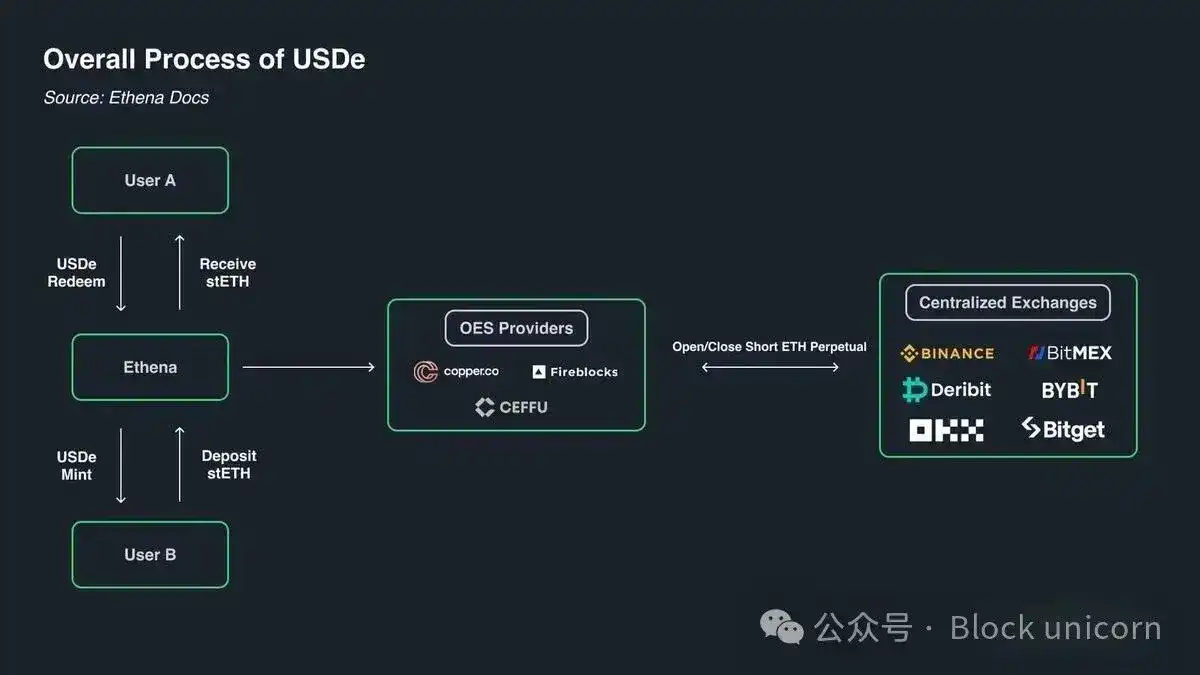
(Chart: Ethena Mechanism Illustration)

By construction, each long contract corresponds to a short contract in a 1:1 ratio. Each open interest in perpetual contracts represents a cash flow agreement between two parties. The exchange's role is to facilitate the matching of these contracts, ensuring that each contract always has a sufficiently funded long and short holder. The table below shows the four possible outcomes facilitated by the exchange.

Perpetual Contract Matching Matrix

Every trade has a buyer and a seller. When both the buyer and seller of a contract are long or both are short, the exchange merely transfers ownership of the contract from one party to the other. This transfer does not create or destroy any contracts. When the buyer is long and the seller is short, a new contract must be created, with the buyer taking the long position and the seller taking the short position, increasing the open interest by 1 contract. On the other hand, if the seller is long and the buyer is short, the exchange can directly unwind the contracts of the buyer and seller and delete the newly released contract, decreasing the open interest by 1 contract.

So, who are the actual holders of these contracts in a typical market? I believe contract holders can be broadly categorized into four types:

  • [Long] Directional Longs

  • [Short] Directional Shorts / Hedgers

    • a. Direct Asset Shorts / Hedges

    • b. Structured Product Hedges

  • [Short] Basis Traders (e.g., Ethena, etc.)

  • [Hybrid] Perpetual Arbitrageurs

Directional Longs seek exposure. They are risk-takers, and their demand for risk depends on their level of risk appetite.

Directional Shorts include both investors who wish to take on the downside risk of an asset and investors who wish to hedge their assets in a tax-efficient manner. Venture capital firms and company employees compensated with tokens often wish to hedge tokens that vest at current prices. For altcoins, many markets are too small for effective direct hedging, or may not even exist. In such cases, companies like Cumberland, Wintermute, FalconX, Flowdesk, and Amber can construct dynamically managed synthetic positions, using short sales of Bitcoin and Ethereum and other highly correlated assets to hedge exposure to less liquid markets (e.g., Monad). Projects like Neutrl also employ this strategy, offering such hedging as a yield strategy.

Basis Traders are opportunistic shorts. They are not interested in directional risk but actively fill the excess demand from directional longs when market supply and demand are imbalanced. Under most market mechanisms, long demand exceeds short demand, and the basis traders' role is to bridge the gap. Their position sizes are usually highly elastic.

Perpetual Arbitrageurs hold both long and short positions in perpetual contracts simultaneously. Their role is to connect different perpetual contracts and correct any minor price discrepancies, at a cost not exceeding transaction fees. Their long positions perfectly match their short positions at any given moment.

By construction, all perpetual contracts are in a 1:1 ratio, with long positions perfectly matched by short positions, so we know:

Directional Longs + Arbitrage Longs = Directional Shorts + Basis Shorts + Arbitrage Shorts

Furthermore, the structure of perpetual arbitrage tells us:

Arbitrage Longs = Arbitrage Shorts

Canceling this term from the first equation yields:

Directional Longs = Directional Shorts + Basis Shorts

Ethena provides us with a proxy for all basis shorts, which helps us gain insight into the difference between directional longs and shorts.

The chart below is Ethena's self-reported balance sheet, divided into cash and deployed capital, for the period from December 27, 2024, to March 7, 2026:
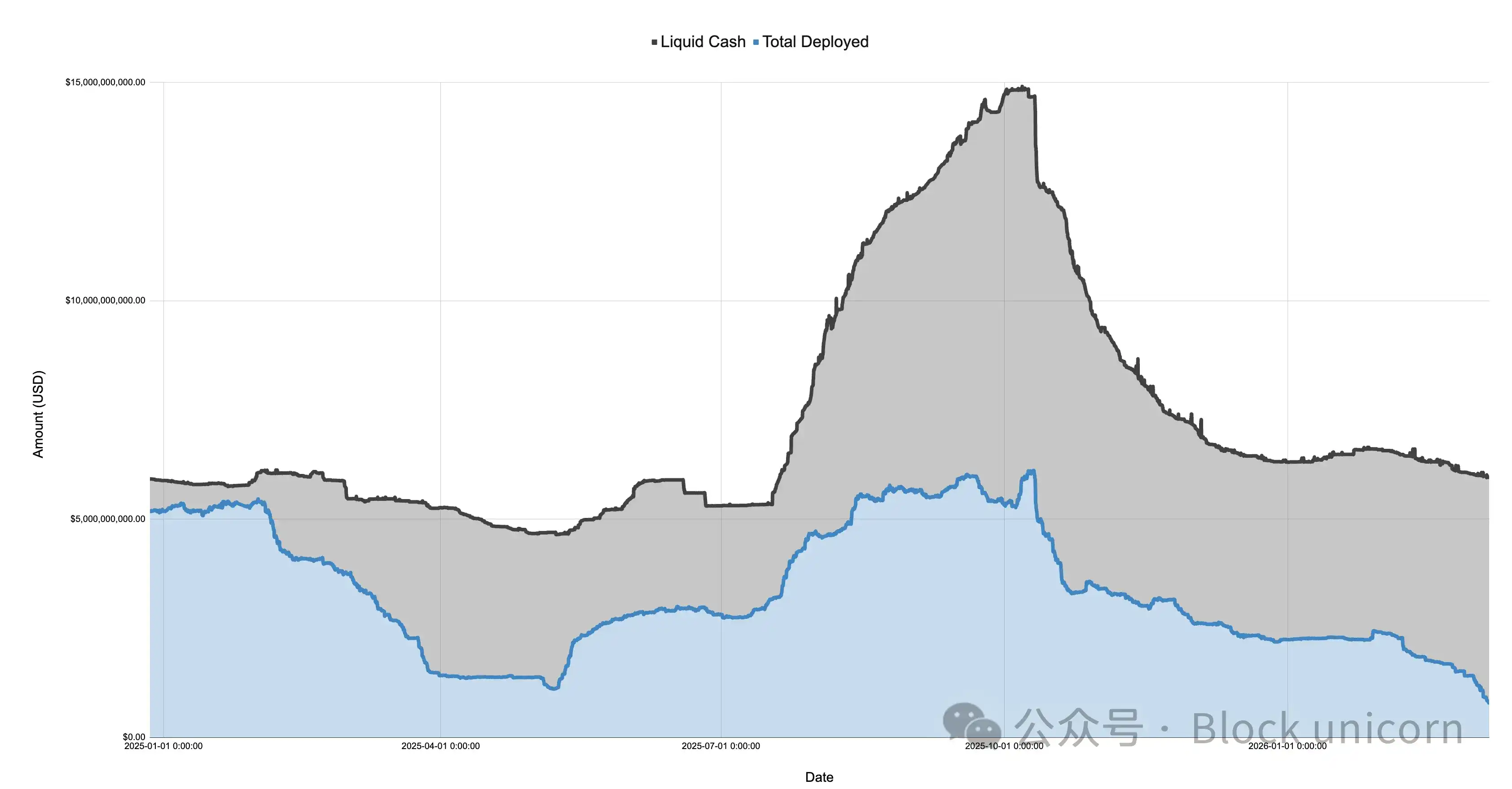
(Chart: Ethena Balance Sheet 2024-2026)

The market turned sharply risk-off in January 2025 after the launch of the $TRUMP token, followed by a continued decline during the initial tariff discussions and the "Liberation Day" in April. During this period, Ethena's deployed capital plummeted from over $5 billion to around $1.108 billion, a drop of more than 75%.

It is important to note that Ethena's deployed capital can serve as a reference for the degree of excess long demand in the market. Although Ethena is not the only institution conducting such trades, its size is substantial (sometimes around 25% of Binance and Bybit), and as long as it has ample cash, it will expand its positions to meet any unmet long demand. This suggests that while total long demand may not have fallen by 75% by April 2025, the excess demand not met by directional short covering did indeed fall by 75%.

The chart below shows the deployment of Ethena's balance sheet relative to its total size, the 2025 minimum, and maximum values.
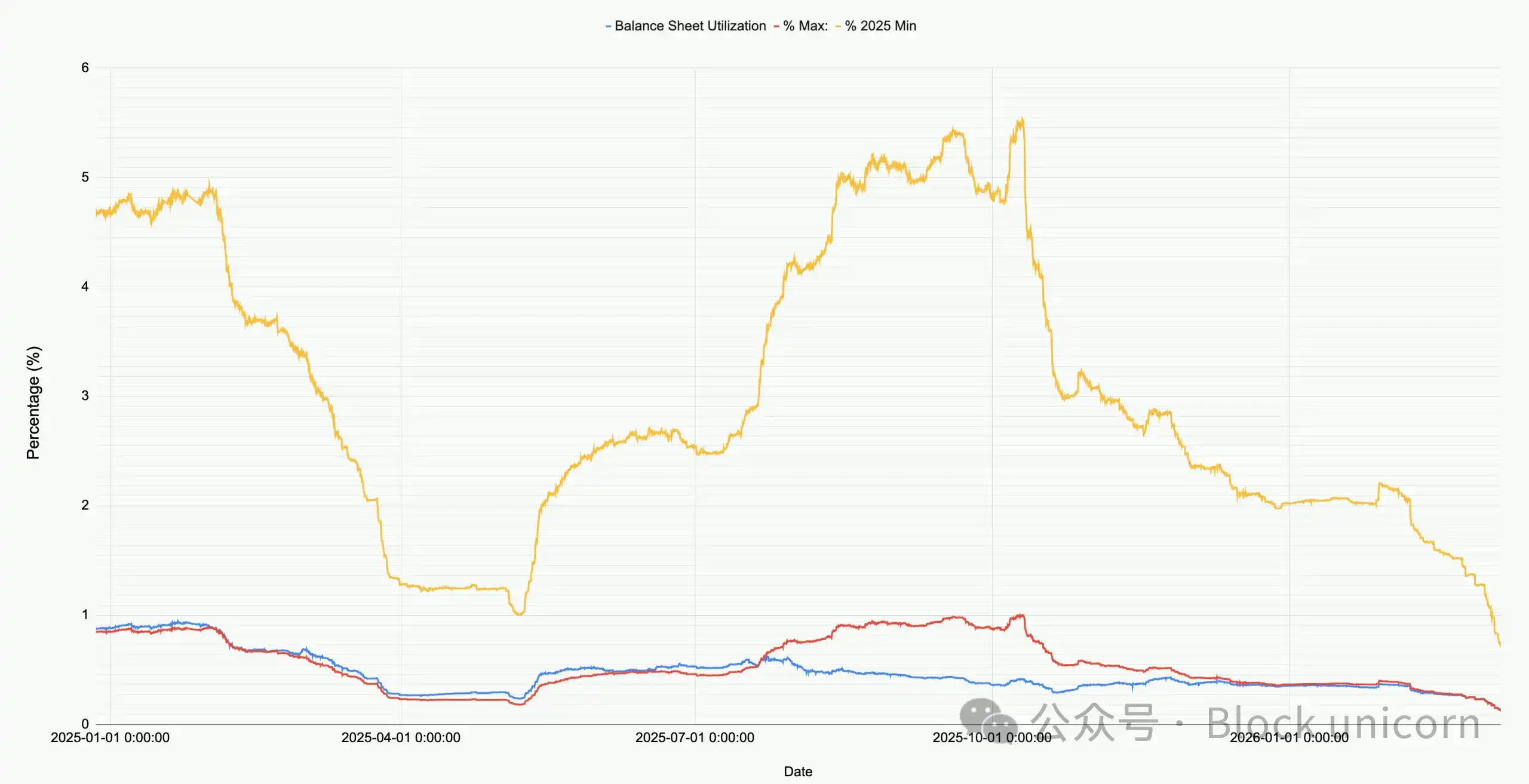
<极i data-index-in-node="0" data-path-to-node="29" style="font-size: inherit; font-family: PingFang SC,Helvetica Neue,Helvetica,Arial,Hiragino Sans GB,Heiti SC,Microsoft YaHei,WenQuanYi Micro Hei,sans-serif;">(Chart: Ethena Deployment Comparison)

Observing the current market, the total capital deployed by Ethena across all markets (BTC, ETH, SOL, BNB, XRP, HYPE) is only about $791 million. This is only 71% of the 2025 minimum and a mere 12.9% of the peak value before October 10th. This figure is not a criticism of Ethena but reflects the current market conditions: net long demand is at a historically low level.

It is particularly noteworthy that during the market crash where Bitcoin price plummeted to $60,000, Ethena deployed over $2 billion in capital. Since just a month ago, on February 8, 2026, Ethena's deployed capital has astonishingly decreased by 60%!

The chart below zooms in on Ethena's deployed capital and the price trend of Bitcoin since January this year.
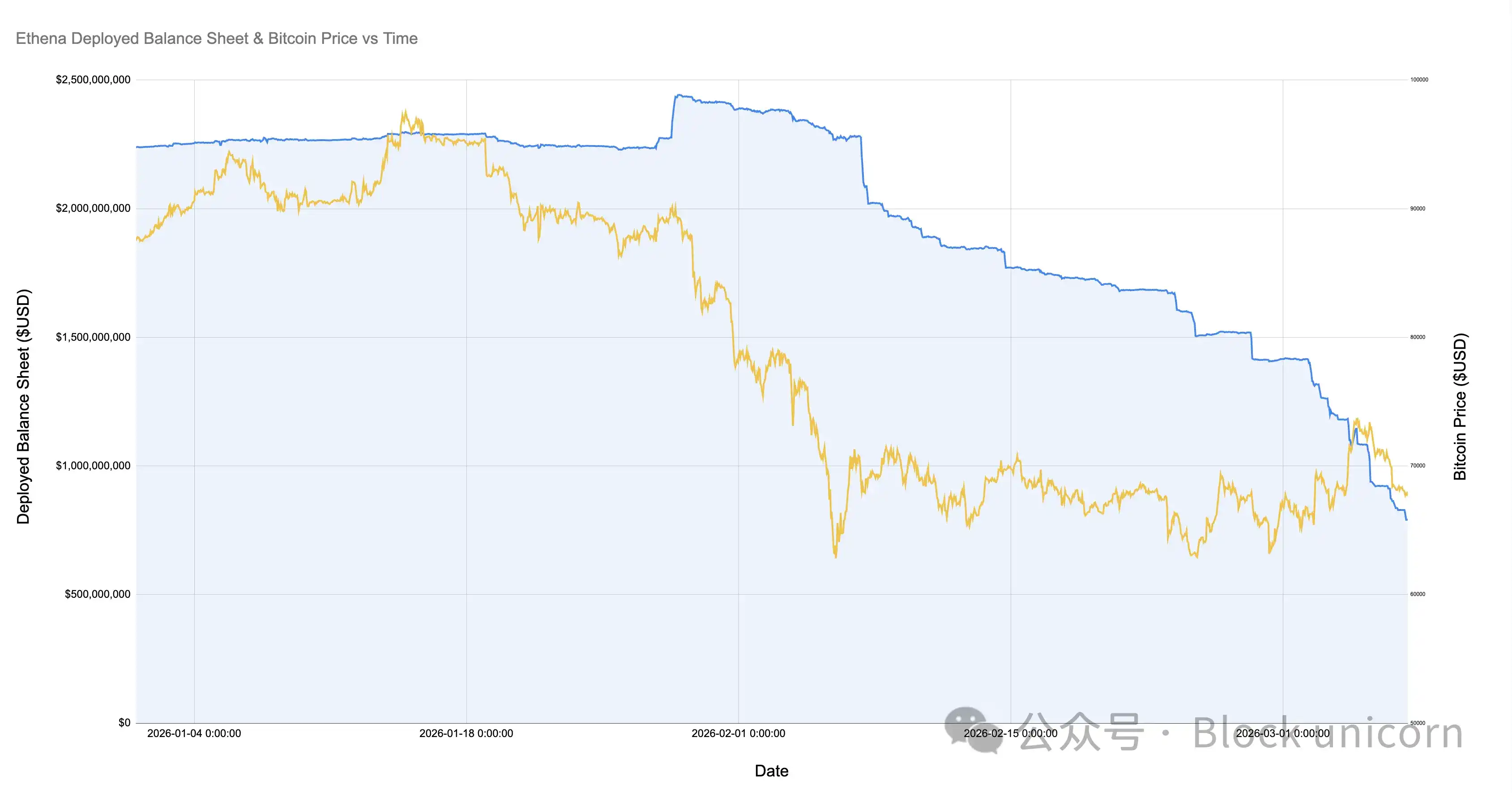
(Chart: Ethena Deployed Capital vs. Bitcoin Price Trend 2026)

Since the Bitcoin price fell to $60,000, Ethena's basis positions have shrunk by over 60%, from over $2 billion to less than $800 million. This change is puzzling because the market has been relatively stable during this period. The reasons for this are as follows:

  1. Profitable but unsustainable basis trades established after the February crash (the basis turned negative, but funding rates were also negative) are being gradually unwound.

  2. Increased hedging activity from directional shorts and price-insensitive participants is squeezing out opportunistic basis traders.

  3. Insufficient demand for leveraged exposure from longs.

(Chart: Open Interest vs. Funding Rate Trend)

In my opinion, the truth is primarily determined by a combination of factors 1 and 2, with factor 3 playing a minimal role. As shown in the chart above, during this period of gradual Ethereum project unwinding, the overall open interest for Bitcoin (and other major cryptocurrencies) has remained relatively stable. Meanwhile, funding rates have been negative for an extended period, with many cryptocurrencies (e.g., SOL) having cumulative negative funding rates across multiple exchanges. This indicates an increasing demand for shorting or hedging some form of risk exposure.

If I had to guess, I would say that small and medium-sized cryptocurrency companies and venture capital firms are both facing a crisis. Think of small-cap projects like Eigen, Grass, Monad, etc. There are hundreds of such cryptocurrencies, each representing dozens of venture capital firms and a company with capital and employees. Venture capital firms need to control losses and lock in profits to meet fund investment targets, and these companies need to ensure cash flow and headcount. This creates a situation where all participants want to squeeze the maximum benefit from the "stone," and the answer lies in relatively crowded trades through actively managed structured products that short a basket of correlated assets.

We saw the presence of these structured products during Ethereum's (ETH) explosive rally days, which also triggered short-covering rallies in numerous small and medium-sized cryptocurrencies. Another piece of evidence is the significant crowding out of opportunistic basis traders like Ethena.

Regardless of the specific reason, we can be sure that this is the first time in the history of the crypto market that directional longs and directional shorts have almost reached equilibrium. There is no充分 reason why this state cannot become the new normal, nor can it be proven that this market regime must change, but looking at other asset classes and markets, it is very unusual for such a trend to persist.

Câu hỏi Liên quan

QWhat does the significant decrease in Ethena's deployed capital indicate about the current cryptocurrency market?

AThe significant decrease in Ethena's deployed capital, which is at 71% of its 2025 low and only 12.9% of its peak, indicates that net long demand is at a historically low level. This reflects a prolonged risk-off sentiment in the market, where there is a lack of excess demand for leveraged long positions that is not being met by directional shorts.

QAccording to the article, what are the four main categories of perpetual contract holders in the crypto market?

AThe four main categories are: 1. Directional Longs (speculators seeking upside exposure), 2. Directional Shorts / Hedgers (those betting on downside or hedging existing assets), 3. Basis Traders (opportunistic shorts like Ethena that fill excess long demand), and 4. Perpetual Arbitrageurs (traders who hold both long and short positions to exploit price differences between contracts).

QHow does the article use the equation 'Directional Longs = Directional Shorts + Basis Shorts' to interpret market structure?

AThis equation, derived from the fact that all perpetual contracts are matched 1:1, shows that the amount of speculative long demand must be balanced by a combination of speculative short selling and the capital provided by basis traders. Ethena's deployed capital serves as a proxy for 'Basis Shorts,' allowing analysts to infer the relationship and imbalance between directional long and short interest.

QWhat are the proposed reasons for the 60% contraction in Ethena's positions since the February market crash, despite relatively stable prices?

AThe proposed reasons are: 1. The unwinding of profitable but unsustainable basis trades established after the February crash (where basis turned negative along with funding rates). 2. Increased hedging activity from directional shorts and price-insensitive participants, crowding out opportunistic basis traders. The article suggests reason 3 (insufficient leveraged long demand) plays a minimal role compared to the first two.

QWhat unique market condition does the current low level of Ethena's deployment reveal, and why is it considered unusual?

AIt reveals a market condition where directional long positions are nearly equal to directional short positions, achieving an extremely rare and historically unsustainable equilibrium. This is unusual because, in most asset classes and market regimes, there is typically a natural imbalance with a greater propensity for long speculation, making such a balance between bullish and bearish directional bets highly atypical.

Nội dung Liên quan

Sự phân bổ giá trị của stablecoin

Tác giả phân tích sự phân phối giá trị trong ngành stablecoin, chia thành 4 tầng: 1. **Lớp phát hành** (như Tether, Circle): Đúc stablecoin, nắm tài sản dự trữ, hưởng chênh lệch lãi suất. 2. **Lớp cơ sở hạ tầng** (như Bridge, BVNK): Kết nối stablecoin với hệ thống tài chính thực - xử lý nạp/rút tiền pháp định, đối ngân hàng, tuân thủ, quản lý tài sản. Đây là công việc phức tạp, tạo ra rào cản cạnh tranh. 3. **Lớp thu nhận/phân phối** (như Stripe, Coinbase): Tích hợp stablecoin vào hệ thống doanh nghiệp, quản lý thanh toán. 4. **Lớp ứng dụng**: Người dùng và doanh nghiệp cuối cùng. Lớp phát hành thu lợi nhuận lớn nhất. Tuy nhiên, tác giả nhấn mạnh tầm quan trọng tiềm năng của **lớp cơ sở hạ tầng**. Khó khăn thực sự không nằm ở chuyển tiền trên blockchain, mà ở việc kết nối nó với thế giới thực: đối ngân hàng, xử lý quy định, tích hợp vào quy trình nghiệp vụ doanh nghiệp. Các công ty như Stripe (mua lại Bridge) và Mastercard (mua lại BVNK) đang tranh giành để trở thành cổng kết nối mặc định này. Lớp cơ sở hạ tầng hiện ở giai đoạn đầu, vất vả, cần vốn, và bị kẹt giữa các tầng khác. Nhưng một khi stablecoin trở thành phương thức tài chính phổ biến, những công ty đã xây dựng được mạng lưới kết nối rộng khắp và sâu vào hệ thống doanh nghiệp sẽ có vị thế mạnh và quyền định giá.

marsbit6 giờ trước

Sự phân bổ giá trị của stablecoin

marsbit6 giờ trước

Tại sao NVIDIA không thiếu tiền nhưng vẫn muốn vay 200 tỷ USD?

Tóm tắt: Mặc dù có dòng tiền tự do mạnh mẽ (khoảng 486 tỷ USD trong quý gần nhất) và không thiếu tiền mặt, NVIDIA vẫn có kế hoạch phát hành ít nhất 20 tỷ USD trái phiếu (hối phiếu cao cấp) với kỳ hạn lên đến 30 năm. Động thái này không phải vì thiếu vốn, mà là một chiến lược quản lý vốn chủ động, tận dụng xếp hạng tín dụng AA vừa được nâng cấp để huy động vốn dài hạn với chi phí thấp. Mục đích của việc vay nợ bao gồm tái cấp vốn, đầu tư vào cơ sở hạ tầng và trung tâm dữ liệu AI, nghiên cứu & phát triển, thanh toán trước cho chuỗi cung ứng và các khoản đầu tư chiến lược. So với việc phát hành thêm cổ phiếu (làm loãng lợi ích của cổ đông hiện tại), việc phát hành trái phiếu được coi là có lợi hơn cho cổ đông khi NVIDIA có thể vừa duy trì các chương trình mua lại cổ phiếu và cổ tức lớn, vừa tài trợ cho sự mở rộng dài hạn. Hành động của NVIDIA phản ánh một xu hướng rộng hơn trong ngành công nghệ, nơi các gã khổng lồ như Alphabet, Meta và Amazon cũng đang sử dụng vốn vay để tài trợ cho chu kỳ chi tiêu vốn nặng về AI. Điều này cho thấy câu chuyện đầu tư AI đang chuyển sang một giai đoạn mới, đòi hỏi nguồn vốn dài hạn và quy mô lớn cho cơ sở hạ tầng. Thách thức chính trong tương lai là khả năng sinh lời từ các khoản đầu tư AI này phải đủ cao và đúng hạn để biện minh cho kỳ vọng và cấu trúc vốn mới.

marsbit7 giờ trước

Tại sao NVIDIA không thiếu tiền nhưng vẫn muốn vay 200 tỷ USD?

marsbit7 giờ trước

Liberland Sa Thải Bộ Trưởng Công Nghệ Sau Vụ Cố Gắng Chiếm Quyền Blockchain Và Trang Web

Theo một nghị quyết chính thức được công bố, Quốc hội Liberland - một dự án vi quốc gia - đã bỏ phiếu bãi nhiệm Bộ trưởng Công nghệ Dorian Stern Vukotić. Ông bị cáo buộc thực hiện một loạt hành động nhằm giành quyền kiểm soát cơ sở hạ tầng kỹ thuật của dự án, bao gồm việc gỡ bỏ bảo vệ đa chữ ký (multisig) trên tài khoản quản trị Sudo, cố gắng chiếm quyền điều khiển tên miền Liberland.org, chặn quyền bỏ phiếu của Tổng thống Vít Jedlička và phát hành token trái phép. Sự việc này nêu bật những rủi ro quản trị thực tế trong không gian crypto, vượt ra ngoài các lỗ hổng hợp đồng thông minh đơn thuần. Nó liên quan đến quyền kiểm soát các điểm then chốt ngoài chuỗi như tài khoản quản trị, tên miền website, quyền truy cập biểu quyết và thiết kế đa chữ ký. Tranh chấp tại Liberland trở thành một nghiên cứu điển hình về cách thức các dự án phụ thuộc vào sự pha trộn giữa quản trị on-chain và các cơ chế kiểm soát off-chain. Bài học chính cho người dùng crypto là những tuyên bố về phi tập trung cần được kiểm chứng với thực tế vận hành. Nếu chỉ một số ít người có thể kiểm soát các chức năng quản trị hoặc quyền truy cập then chốt, thì hệ thống quản trị vẫn có thể dễ bị tổn thương. Sự kiện này phản ánh xu hướng rộng hơn trong thị trường crypto, nơi cơ sở hạ tầng, bảo mật và quản trị ngày càng trở nên quan trọng ngang bằng với biến động giá.

bitcoinist7 giờ trước

Liberland Sa Thải Bộ Trưởng Công Nghệ Sau Vụ Cố Gắng Chiếm Quyền Blockchain Và Trang Web

bitcoinist7 giờ trước

Làm Thế Nào Để Nghiên Cứu Tốt: Rèn Luyện Những Khả Năng Thực Sự Có Thể 'Luyện Tập Chủ Động'

Chưa ai thực sự dạy bạn cách làm nghiên cứu. Hầu hết mọi người chỉ học cách "trông giống" một nhà nghiên cứu, trong khi năng lực thực sự là sự tích lũy các kỹ năng có thể rèn luyện có chủ ý. **Chọn vấn đề của riêng bạn:** Đừng chỉ tiếp nhận vấn đề từ người khác. Hãy bắt đầu từ một kết quả bạn thực sự muốn đạt được và suy ngược để thiết kế thí nghiệm. Điều này tạo ra tính độc đáo. "Khiếu thẩm mỹ" trong nghiên cứu giống như một cơ bắp, có thể phát triển thông qua việc dự đoán kết quả thí nghiệm và kiểm tra lại các dự đoán đó. **Nâng cấp đầu vào:** Đừng chỉ đọc các xu hướng mới nhất. Tài liệu cũ (như bài phát biểu của Claude Shannon năm 1952) và các lĩnh vực rộng (thần kinh học, thống kê, kiến ​​trúc máy tính) thường mang lại những hiểu biết sâu sắc có giá trị. Hãy đọc chính bài báo gốc, đặc biệt là phần phụ lục và hạn chế. **Viết mọi thứ xuống:** Viết lách là cơ chế phòng thủ rẻ nhất chống lại sự tự lừa dối. Nó phơi bày những lỗ hổng trong suy nghĩ. Giữ một cuốn nhật ký ghi lại giả thuyết, cài đặt, dự đoán, kết quả và bài học. Xem lại nó sẽ dạy bạn sự khiêm tốn. Tóm lại, nghiên cứu hiệu quả dựa trên việc chủ động chọn vấn đề, mở rộng nguồn tri thức và ghi chép trung thực để rèn giũa tư duy.

marsbit8 giờ trước

Làm Thế Nào Để Nghiên Cứu Tốt: Rèn Luyện Những Khả Năng Thực Sự Có Thể 'Luyện Tập Chủ Động'

marsbit8 giờ trước

Tăng Trưởng Vượt 150% Trong Nửa Tháng, Đằng Sau Sự Bùng Nổ Của Backpack

Backpack (BP), token của sàn giao dịch cùng tên, đã tăng hơn 150% trong nửa tháng, đạt mức cao 0,48 USD. Động lực chính đến từ việc ra mắt nền tảng Backpack Securities vào đầu tháng 6, cung cấp dịch vụ môi giới cổ phiếu Mỹ được quy định và hỗ trợ token hóa tài sản truyền thống. Sự kiện đáng chú ý là việc phát hành token SPCX, được neo 1:1 với cổ phiếu SpaceX thật, trên Solana vào ngày 12/6. Sản phẩm này cho phép giao dịch trên chuỗi 24/7 và có thể đổi ngược về tài khoản chứng khoán truyền thống, tạo cầu nối giữa thị trường vốn truyền thống và DeFi. BP có tổng cung 10 tỷ token với cơ chế phân phối độc đáo: 25% đầu tiên được airdrop cho cộng đồng, 37.5% tiếp theo sẽ mở khóa theo các cột mốc phát triển sản phẩm, và 37.5% cuối cùng sẽ được khóa cho đến sau IPO. Đội ngũ phát triển không nhận token ngay từ đầu. Người dùng có thể stake BP để nhận quyền chuyển đổi token thành cổ phần công ty khi công ty IPO, cùng các đặc quyền khác. Hiện khoảng 66% lượng token lưu hành đang được stake. Mặc dù từng có tranh cãi về cơ chế airdrop, sự chú ý của thị trường hiện đang dồn vào sự mở rộng thực tế của nền tảng và tiềm năng lâu dài của token BP trong hệ sinh thái mới kết hợp chứng khoán và tài sản token hóa.

marsbit8 giờ trước

Tăng Trưởng Vượt 150% Trong Nửa Tháng, Đằng Sau Sự Bùng Nổ Của Backpack

marsbit8 giờ trước

Giao dịch

Giao ngay
Hợp đồng Tương lai
活动图片